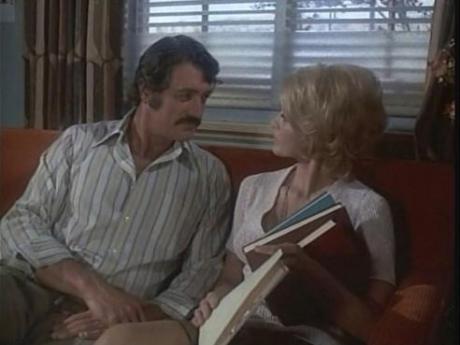
Retro Television Review: The Love Boat 1.1 “Captain & The Lady/Centerfold/One If By Land….”


Welcome to Retro Television Reviews, a feature where we review some of our favorite and least favorite shows of the past!  On Wednesdays, I will be reviewing the original Love Boat, which aired on ABC from 1977 to 1986!  The series can be streamed on Paramount Plus!

Welcome aboard, it’s love!

Produced by Aaron Spelling, The Love Boat is one of the signature shows of the 70s and the 80s.  Each week, the Pacific Princess would set off for a different location with a different group of guest stars.  Typically, each episode would feature three stories.  One story would be silly fun.  One story would be a dramedy.  And then one story would typically feature a member of the Love Boat crew either falling in love or worrying about losing their job.  It was a tremendously silly show but, from the episodes I’ve seen, it was also very likable.  If nothing else, the ship looked really nice.

While the passengers changed from week-to-week, the crew largely remained the same.  During the show’s first season, the crew was made up of:

Captain Merrill Stubing (Gavin MacLeod), who started out as a stern, no-nonsense captain but who became significantly nicer and a good deal goofier as the series progressed,

Adam “Doc” Bricker (Bernie Kopell), the ship’s doctor who hit on every woman who boarded the boat and who probably would have been an HR nightmare if the show actually took place in the real world,

Gopher (Fred Grandy), the ship’s purser who …. well, I’m not sure what a purser does but hopefully it wasn’t too important of a job because Gopher was always getting into weird situations,

Isaac (Ted Lange), the ship’s bartender who spent the entire cruise getting people drunk,

and Julie (Lauren Tewes), the cheerful cruise director.

And, of course, we can’t forget the true star of the show, the theme song!

Before the series, there were three made-for-television movies: The Love Boat (1976), The Love Boat II (1976), and finally The New Love Boat (1977).  These movies served as pilots for the show.  The first movie featured an entirely different cast playing the ship’s crew.  Kopell, Lange, and Grandy first played their roles in The Love Boat II.  MacLeod and Tewes came aboard in The New Love Boat.  Unfortunately, these pilots aren’t available on Paramount Plus but, fortunately, the rest of the series is.

So, let’s set sail on a course for adventure with the first episode of The Love Boat!

Episode 1.1 “Captain & The Lady/Centerfold/One If By Land….”

(Directed by Richard Kinon, Stuart Margolin, and Alan Rafkin, originally aired on September 24th, 1977)

The Pacific Princess is about to set sail but all is not right on the cruise ship that some call The Love Boat.

Ginny O’Brien (Brenda Sykes) just wants to get away from her longtime boyfriend, Ronald (Jimmie Walker).  Ginny wants to marry Ronald but Ronald just wants to have a good time.  When Ginny boards the cruise, Ronald decides to follow her.  The only problem is that the cruise is sold out and Ronald can’t break the law by stowing away.  (I was actually surprised that didn’t happen.  I can imagine The Love Boat writers room descending into chaos as the writers argued about whether or not it was too early to do a stowaway story.)  Ronald decides to follow the Love Boat from port to port, just so he can show Ginny that he is committed to something.  Ginny ends up spending her entire cruise wondering if Ronald is going to be make it to every port.  To me, it felt as if her cabinmate (Suzanne Somers) seemed to be kind of annoyed about getting sucked into all of Ginny’s personal drama but that could just be projection on my part.  I know that I would certainly get annoyed by it.

Meanwhile, Congressman Brad Brockway (Shelly Novack) has set sail with his fiancée, Sandy (Meredith Baxter-Birney).  When Sandy was younger, she posed for a sleazy photographer.  Now that she’s engaged to the Congressman, a tabloid has published those pictures.  Sandy spends the entire cruise trying to keep Brad from seeing any copies of the magazine.  The only problem is that the magazine is sold in ship’s gift shop!  (Did most cruise ships sell adult magazines in their gift shop?  I supposed it’s possible.  It was the 70s….)  Sandy manages to get almost every copy of the magazine but misses the copy that Doc keeps in his examination room.  Doc looks at the pictures and tells her that she has nothing to be ashamed of because the pictures look good.  That really wasn’t her main concern, Doc.  Anyway, it turns out that the Congressman doesn’t care.  Personally, I would have preferred that the story had ended with Sandy announcing that she was the one who didn’t care.
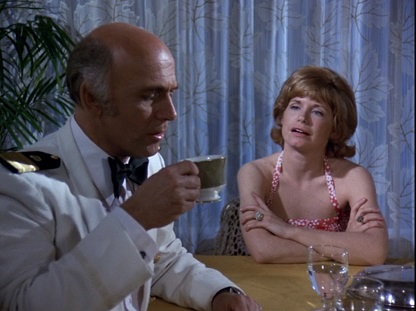
Finally, Captain Stubing is a nervous wreck because an executive of the cruise line named Aubrey Skogstad (Robert Symonds) is on the cruise and so is his wife, Stacy (Bonnie Franklin).  While Aubrey is quiet and polite, Stacy proceeds to tell every member of the crew that they are inadequate and that she will personally make it her duty to get them all fired.  It turns out that Stacy is hostile because she’s Captain Stubing’s ex-wife.  Since Captain Stubing is still new to the ship and has kept himself aloof from the rest of the crew, they wonder if he’ll ever stand up for them.  Eventually, the captain tells Stacy off and, in doing so, he finally wins the loyalty of his crew.  Yay!

Anyway, the first episode of The Love Boat was very, very 70s.  The only thing that could have made it more 70s would have been a disco ball on the lido deck.  Fortunately, as our long-time readers know, I’m a total history nerd so I enjoyed the show as a floating time capsule.  It’s one thing to watch a movie that’s set in the 70s and which features everyone going out of their way to bring to life every stereotype.  It’s another thing to actually view something that was specifically made during the time period.

Unfortunately, the stories and the passengers themselves were pretty forgettable.  The whole thing about the Stacy and the Congressman was slightly interesting just because, with the rise of social media, everyone’s got smutty pictures out there now.  For the most part, though, this first episode was about introducing Captain Stubing and the crew and the cast did display a good deal of chemistry together.  They were all likable.  Even Doc Bricker, with his stash of cruise porn, seemed to be well-intentioned.  They came across as people who most viewers would want to take a cruise with, which is exactly what the show required to be a success.

Next week …. more love, more 70s fashion, and more intrusive laugh tracks as we set sail on another voyage!
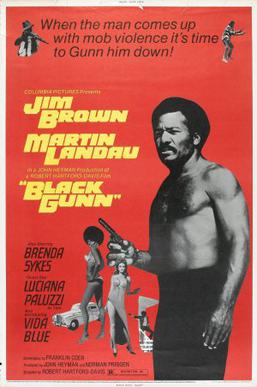
Black Gunn (1972, directed by Robert Hartford-Davis)


A war has broken out in Los Angeles.

The Black Action Group (B.A.G.) has robbed a Mafia bookmaking operation.  The Mafia, led by used car dealer Russ Capelli (Martin Landau, in his slumming it years), is less concerned with the money as they are with the fact that one of the militants, a Vietnam vet named Scott Gunn (Herbert Jefferson, Jr.), has also stolen a set of ledgers that could reveal every detail of their organization.  Capelli sends the psychotic Ray Kriley (Bruce Glover, father of Crispin) on a mission to track down Scott and kill him.

What the Mafia didn’t count on is that Scott’s older brother, Gunn (Jim Brown), is the owner of Los Angeles’s hottest nightclub.  When Scott approaches his brother, Gun tells him that he doesn’t care about the B.A.G. or any of their politics.  Still, Gunn allows Scott to stash the ledgers at his club and to hide out at his place.  When Scott still ends up getting murdered by Kriley, Gunn sets out to get revenge.

For the most part, Black Gunn is a standard blaxploitation movie with all of the usual elements, a cool nightclub, the mob, black militants,an anti-drug scene and a speech about why it’s important to not sell out to the man, and a hero played by an actor who may not have been able to show much emotion but who still radiated coolness.  Not surprisingly, Jim Brown is the main attraction here and he delivers everything that his fans have come to expect from him.  Blaxploitation regulars Bernie Case and Brenda Sykes also appear in the film.  Casey plays the head of B.A.G. while Sykes is wasted in a one-note role as Gunn’s girlfriend.  Among the villains, it’s fun to watch the glamorous Luciana Paluzzi plays a gangster’s niece and Bruce Glover is just weird enough to make Kriley interesting.  Though Martin Landau would end his career with a deserved reputation for being one of America’s greatest character actors, he spent most of the 70s sleepwalking through roles in low-budget action and horror films and his performance in Black Gunn is no different.  Having Capelli be both a car salesman and a gangster is a nice touch but otherwise, he’s just not that interesting of a character and Landau is only present to get a paycheck.

Black Gunn has some slow spots but the final shoot-out between the militants and the gangsters is exciting and so brutal that it will be probably take even the most jaded blaxploitation fan by surprise.  Black Gunn is hardly a classic but, like its hero, it gets the job done.

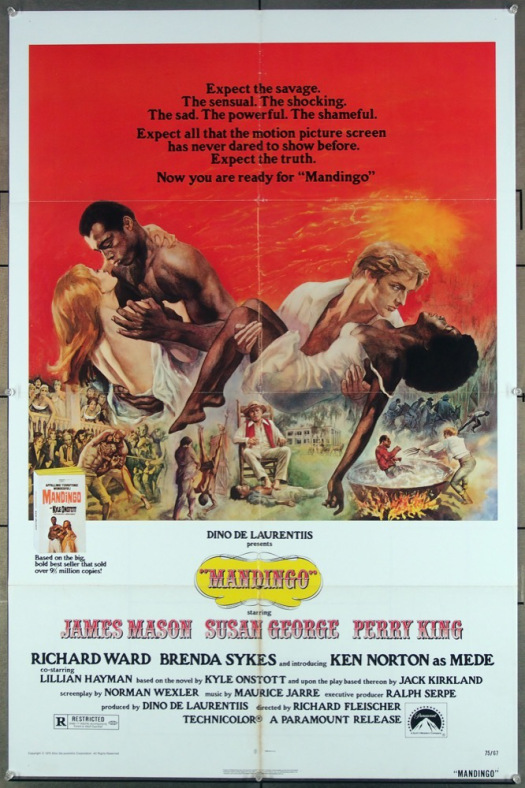
Gone With The Whaaat?: MANDINGO (Paramount 1975)


gary loggins's avatarcracked rear viewer

If you’ve never seen MANDINGO, be prepared for loads of gratuitous sex, violence, debauchery, depravity, racism, incest, nudity, and other such unsavory stuff! Some people today discuss the film in a scholarly manner, dissecting the sociological implications of pre-Civil War decadence in the deep South, the plight of the abused slaves, the overindulgent cruelty of the slave owners, and blah blah blah. I’m gonna talk about what the movie really is: pure, unadulterated Exploitation trash, in which some scenes will have your jaw dropping in shock, while others will leave you laughing at the exaggerated overacting and ludicrous dialog!

The movie centers around the Maxwell family and their plantation home, Falconhurst. It’s no Tara; Falconhurst is a run-down, gloomy, decrepit mansion that looks like it belongs in one of those “hillbilly horror” schlockfests of the 60’s or 70’s. Family patriarch Warren Maxwell wants a grandson to carry on the family…

View original post 771 more words

Embracing the Melodrama Part II #54: Mandingo (dir by Richard Fleischer)


Mandingo_movie_posterUp until last night, I was under the impression that James Mason never gave a single bad performance over the course of his long career.  Oh sure, I knew that Mason had probably appeared in his share of bad films.  But I figured he was one of those actors who was always better than his material.  Just watch Lolita, The Verdict, Julius Caesar, Odd Man Out, Bigger Than Life, or Murder By Decree and you’ll see that James Mason was a great actor.

But then, last night, I finally got around to watching the 1975 film, Mandingo.

I’ve actually owned Mandingo on DVD for a few years.  I bought it on a whim, the result of having seen it listed as one of the worst films of all time in several different reference guides.  But I have to admit that I did not have any great desire to actually sit through the film.  Instead, it was one of those films that you buy just so your very ownership of it can be a conversation piece.

(“Oh my God, Lisa, what’s this?”  “Oh, that little old thing?  That’s my copy of Mandingo…”)

However, when I decided to do Embracing the Melodrama, Part II, I realized that this would be the perfect time to actually watch and review Mandingo.

Mandingo deals with life on a sordid plantation in pre-Civil War Alabama.  Warren Maxwell (James Mason) owns the plantation and he spends most of his time sweating and complaining about his rheumatism.  When a Satanic slave trader named Brownlee (Paul Benedict) suggests that Warren can cure his rheumatism by always resting his feet on the backs of two little slave children, Warren proceeds to do just that.  Seriously, this is a 127 minute film and, nearly every time that Mason appears on screen, he’s got his feet propped up on the children.

Warren’s got a son named Hammond (Perry King).  Hammond walks with a limp, the result of a childhood pony accident.  Warren expects Hammond to sire an heir to Maxwell family legacy but Hammond is only comfortable having sex with slaves.  Finally, during a business trip with his decadent friend Charles (Ben Masters), Hammond meets and marries Blanche (Susan George).  Blanche assures Hammond that she’s a virgin and, on their wedding night, she asks Hammond how to have sex.  “We take off our clothes…” Hammond begins.

However, the morning after, Hammond is convinced that Blanche lied about being virgin because she enjoyed having sex.  Once they return to the plantation, Hammond refuses to touch Blanche and instead ends up falling in love with a slave named Ellen (Brenda Sykes).  When Ellen gets pregnant, Blanche beats her until she miscarries.

And meanwhile, James Mason keeps popping up with two little kids resting underneath his feet…

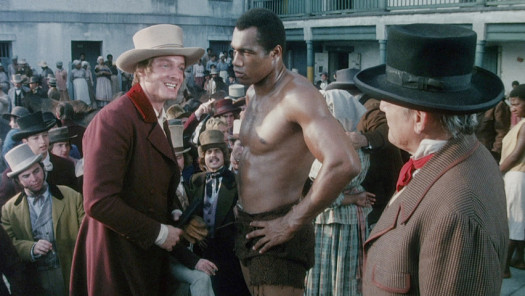
But that’s not all!  Hammond has purchased a slave named Mede (Ken Norton).  Mede is a boxer and wins Hammond a lot of money.  In order to “toughen up” his skin, Mede is also forced to bathe in a cauldron of very hot water.  “Shuck down those pants!” Hammond shouts before Mede gets in the cauldron.

Blanche, who is now an alcoholic, gets her revenge on Hammond by having sex with the the legendarily endowed Mede.  Soon, Blanche is pregnant and Hammond and Warren are both excited.  Then the baby is born and all Hell breaks loose.

And, meanwhile, James Mason rests his feet on the back of two little kids…

Mandingo is one of those films that you watch in wide-eyed amazement, shocked that not only was this movie made but it was also apparently made by a major film studio and directed by a professional director.  (Before he directed Mandingo, Richard Fleischer directed everything from 20,000 Leagues Under The Sea to Doctor Dolittle to Soylent Green.)  I know that some would argue that Mandingo used the conventions of exploitation cinema to expose the sickening inhumanity of American slavery but let’s be honest here.  Mandingo is not Django Unchained.  Instead, it’s a slow-moving soap opera that is occasionally redeemed by some over-the-top dialogue and histrionic performances.

And it’s also proof that James Mason was capable of giving a bad performance.  According to the imdb, James Mason described Mandingo as a film that he did solely for the paycheck.  From his terrible Southern accent to the way that he always seems to be trying to hide his face from the camera, Mason gives perhaps one of the worst performances ever given by a legitimately great actor.

But really, can you blame him?

Back to School #10: Pretty Maids All In A Row (dir by Roger Vadim)


Pretty Maids All In A Row, which — as should be pretty obvious from the trailer above — was originally released in 1971, is a bit of a historic film for me.  You see, I love movies.  And, as a part of that love, I usually don’t give up.  Regardless of how bad a movie may turn out to be, once I start watching, I stick with it.  I do not give up.  I keep watching because you never know.  The film could suddenly get better.  It could turn out that what originally seemed like a misfire was actually brilliant satire.  If you’re going to talk or write about movies, you have an obligation to watch the entire movie.  That was a rule that I had always lived by.

And then, one night, Pretty Maids All In A Row popped up on TCM.

Now, I have to admit that I already knew that Pretty Maids was going to be an extremely 70s film.  I knew that it was probably going to be more than a little sexist.  I knew all of this because the above trailer was included on one of my 42nd Street Forever DVDs.  But I still wanted to see Pretty Maids because the trailer hinted that there might be an interesting hiding underneath all of the cultural baggage.  If nothing else, it appeared that it would have some sort of worth as an artifact of its time.

(If you’re a regular reader of this site, you know how much I love my cinematic time capsules.)

So, the film started.  I logged onto twitter so that I could live tweet the film, using the hashtag #TCMParty.  And from the moment the film started, I knew it wasn’t very good.  It wasn’t just that the film’s camerawork and music were all extremely 70s.  After all, I like 70s music.  I don’t mind the occasional zoom lens.  And random psychedelic sequences?  WHO DOESN’T LOVE THOSE!?  No, my dislike of the film had nothing to do with the film’s style.  Instead, it had to do with the fact that there was absolutely nothing going on behind all of that style.  It wasn’t even style for the sake of style (which is something that I usually love).  Instead, it was style for the sake of being like every other “youth film” that came out in the 70s.

7770

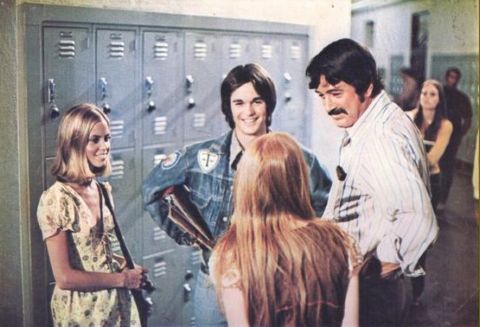
And then there was the film’s plot, which should have been interesting but wasn’t because director Roger Vadim (who specialized in stylish decadence) had no interest in it.  The film takes place at Oceanfront High School, where the only rule is that apparently nobody is allowed to wear a bra.  We meet one student, Ponce De Leon Harper (played by an amazingly unappealing actor named John David Carson), who is apparently on the verge of having a nervous breakdown because, at the height of the sexual revolution, he’s still a virgin.

(Because, of course, the whole point of the sexual revolution was for losers like Ponce to finally be able to get laid…)

Ponce is taken under the wing of high school guidance counselor Tiger McDrew (Rock Hudson, complete with porn star mustache).  Quickly figuring out exactly what Ponce needs, Tiger sets him up with a teacher played by Angie Dickinson.  However, Tiger has other concerns than just Ponce.  Tiger, it turns out, is a sex addict who is sleeping with nearly every female student at the school. But, American society is so oppressive and puts so much pressure on the American male that Tiger has no choice but to kill every girl that he sleeps with…

This is one of the only film I can think of that not only makes excuses for a serial killer but also presents him as being a heroic  character.  And, while it’s tempting to think that the film is being satirical in its portrayal of Tiger and his murders, it’s actually not.  Don’t get me wrong.  The film is a very broad comedy.  The high school’s principal (Roddy McDowall) is more concerned with the football team than with all of the girls turning up dead at the school.  The local sheriff (Keenan Wynn) is a buffoon.  The tough detective (Telly Savalas) who investigates the murders gets a few one liners.

But Tiger, most assuredly, is the film’s hero.  He’s the only character that the audience is expected to laugh with, as opposed to at.  He is the character who is meant to serve as a mouthpiece for screenwriter Gene Roddenberry’s view on America’s puritanical culture.  If only society was less hung up on sex, Tiger wouldn’t have to kill.  Of course, the film’s celebration of Tiger’s attitude towards sex is not extended towards the girls who sleep with him.  Without an exception, they are all presented as being empty-headed, demanding, shallow, and annoying, worthy only of being leered at by Vadim’s camera until Tiger finally has to do away with them.

(The film’s attitude towards women makes Getting Straight look positively enlightened.)

Rock and Angie

Rock and Angie

ANYWAY!  I spent about 40 minutes watching this movie before I gave up on it.  Actually, if you want to be technical about it, I gave up after 5 minutes.  But I stuck with it for another 35 minutes, waiting to see if the film was going to get any better.  It didn’t and finally, I had to ask myself, “Why am I actually sitting here and wasting my time with this misogynistic bullshit?”  So, I stopped watching and I did so with no regrets.

What I had forgotten is that I had set the DVR to record the film while I was watching it, just in case I later decided to review it.  So, last week, as I was preparing for this series of Back to School posts, I saw Pretty Maids All In A Row on my DVR.  I watched the final 51 minutes of the film, just to see if it ever got better.  It didn’t.

However, on the plus side, Rock Hudson does give a good performance in the role of Tiger, bringing a certain seedy desperation to the character.  (I’m guessing that this desperation was Hudson’s own contribution and not an element of Roddenberry’s screenplay, which more or less presents Tiger as being a Nietzschean superman.).  And beyond that, Pretty Maids serves as evidence as to just how desperate the Hollywood studios were to makes movies that would be weird enough to appeal to young people in the early 70s.

Watching the film, you can practically hear the voices of middle-aged studio executives.

“What the Hell are we trying to do with this movie!?” one of the voices says.

“Who cares!?” the other voice replies, “the kids will love it!”

A70-5583