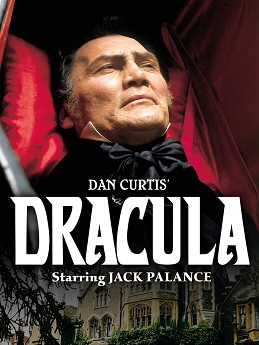
 1974’s Bram Stoker’s Dracula opens with a familiar sight.
British solicitor Jonathan Harker (Murray Brown) is in Transylvania, where he has an appointment with a mysterious man named Dracula. The local villagers are superstitious and seem to be frightened of Dracula’s very name. When Harker reaches Dracula’s castle, he discovers that Dracula (Jack Palance) is a courtly but enigmatic man. When Dracula sees a photograph of Jonathan’s fiancée, Mina, and her best friend, Lucy, something about it seems to capture his attention. Later, that night, Jonathan is attacked by several female vampires. After Dracula saves Jonathan’s life, he forced Jonathan to write a letter home, saying that he will be staying in Transylvania for month. Jonathan attempts to escape but is instead dragged off to the crypt, where Dracula’s brides await….
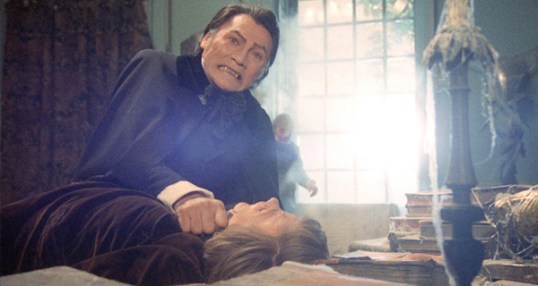
Soon, Dracula is in England. Lucy (Fiona Lewis), who looks exactly like Dracula’s long-dead wife, is taken mysteriously ill and dies. Dr. Abraham Van Helsing (Nigel Davenport), called in when Lucy was showed signs of being sick, suspects that there is a vampire at work. Lucky’s fiancé, Arthur Holmwood (Simon Ward), doesn’t believe it until he sees, with his own eyes, Lucy raised from the dead and calling for him to come and join her….
Not to be confused with the Francis Ford Coppola film, 1974’s Bram Stoker’s Dracula was directed by horror impresario Dan Curtis. It’s a rather loose adaptation of Bram Stoker’s novel. For one thing, Jonathan Harker does not return to England. Dracula is, from the start, more interested in Lucy than in Mina. Lucy’s other suitors — Quincy Morris, John Seward — are not present. And Dracula himself does not get younger as the result of drinking blood. In fact, it’s such a loose adaptation that it’s actually difficult to justify calling it Bram Stoker’s Dracula. (In fact, the film is also known as Dan Curtis’s Dracula, which is a far more appropriate title.)
That said, it’s still an entertaining vampire movie. Jack Palance, who previously worked with Dan Curtis in The Strange Case of Dr. Jekyll and Mr. Hyde, gives a properly intense performance as Dracula. He doesn’t try to adopt any sort of Eastern European accent or anything like that. Instead, he delivers his lines through clenched teeth (or, perhaps, fangs) and he fixes his victims with a powerful stare that hints at the animalistic urges behind his controlled demeanor. Palance plays Dracula as being arrogant and convinced that no mere mortal can defeat him. At the same time, there’s a vulnerability to Palance’s Dracula. Watch how his face briefly lights up when he sees Lucy’s picture and is reminded of his long-dead wife. Watch his fury when he discovers that Van Helsing and Arthur have gotten to Lucy before him. His love for his wife is the one shred of humanity that Dracula still has within him. When he loses her a second time (in the form of Lucy), he’s prepared to go to war.
Bram Stoker’s Dracula was originally meant to air in October of 1973 but the showing was pre-empted by the announcement that Vice President Spiro Agnew had resigned. As a result, this film — so clearly meant for Halloween — did not air until February of 1974. That doesn’t seem fair. Poor Dracula.



 Through the Shattered Lens