I’m not ashamed to admit it. I love reality TV. Survivor, Big Brother, Real World, The Amazing Race, Project Runway, the Bachelor(ette) – I could watch these shows forever. To me, Paradise Hotel (remember that one?) was one of the most brilliant television events in history. It’s traditional for culture snobs to hate reality television and to spend hours crying about how it represents the decline of civilization and blah blah blah.
Well, strangely enough, this year has seen the premiere of a reality show that has made me start to say “Blah blah blah.” What’s worse is that this show has become something of a populist hit, a show that has been embraced by the very people who should hate it. That show is Undercover Boss.
In Undercover Boss, a CEO goes undercover as an entry level worker in his own company. The experience is meant to humble him and bring him back down to Earth. Of course, what’s not mentioned is that each show basically works as a 60-minute commercial for whatever company is being featured on each episode. For that reason, we hear that the CEO of 7-11 knows that he needs to know how to improve his company’s image. However, at no point do we say anyone informing the CEO that he might end up getting shot if he works the late shift.
One of the reasons why Undercover Boss has become so popular is that every episode pretty much follows the exact same format. There’s never anything unexpected hiding in the shadows. This means that viewers can not only turn off the majority of their brain and still follow what’s going on but that they also get to pat themselves on the back for being able to predict what’s going to happen before it actually does. The show makes the audience feel smart by making them more stupid. George Orwell would be proud.
Each episode plays out as follows:
First, we get an overview of whatever company we’ll be investigating tonight. For the most part, these are companies that we’ve heard of but we rarely give much thought to. They are also companies that are successful enough that it really doesn’t matter whether the CEO goes undercover or not.
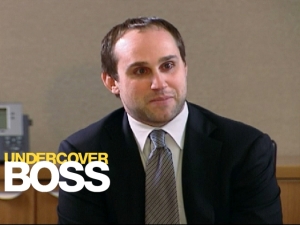
We then meet the CEO. If the 1st season is any indication, a CEO is a boring white guy who was either given his job by his father or else graduated from an Ivy League college. Apparently, this is one of those no-girls allowed type of jobs. I guess we’re just too emotional to handle the responsibility. We get to see our masculine CEO with his perfect family (which usually consists of a nameless wife and two or three kids just to make sure we know that our male CEO is a real man). The manly CEO will often make a point of telling us that he loves motorcycles or skydiving or something else that he thinks will make him less inherently boring than he actually is. The really pathetic CEOs are the ones who insist on being filmed while surfing. “See, I am too a normal guy! I own a surf board and wear a wet suit.”
However, the CEO tells us that he feels like he needs to go and get his hands dirty. He has to know what’s going on in his company.
The CEO then holds a meeting with his “corporate board.” His corporate board is usually a group of people who are somehow even more boring than the CEO. For the most part, this corporate board is equally male, white, and bald. Most of them could also seem to have that unfortunate thing where it’s impossible to tell where the chin ends and the neck begins. Strangely, a lot of these guys respond to this condition by trying to grow a beard which basically just makes them look a 100 times worse. Another thing I always notice about these corporate types is that they’re almost always wearing a suit but not a tie. Instead, they just leave their collar unbuttoned and show off a small fraction of their sweat-stained undershirt. I’m assuming they’re trying to say that they haven’t become corporate, that they’re still Jenny From The Block no matter how money they’re making. However, they just look like they forgot to finish getting dressed in the morning. Seriously, guys, fuck you.
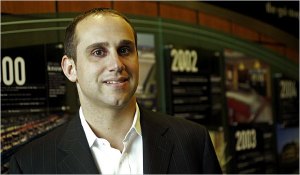
For the sake of diversity, there are usually one or two women on the board. For the most part, the women are white and their lipstick is bleeding into the wrinkles surrounding their mouth. There’s usually a black guy on the board too. Usually, he’s wearing a nametag that reads “Token.”
One odd thing about this show is that every CEO seems to have the same board of directors. I don’t just mean that all the boards are made up of bald white guys. I mean, that they seem to be made up by the exact same bald white guys. Honestly, I’m one of those bohemian artist girls. I don’t know much about Corporate America. Maybe there’s a traveling board of directors that goes from company to company. I’ll have to give the show the benefit of the doubt.
Anyway, the CEO says, “I’m going undercover. I’m going to pretend to be a very verbose blue collar worker with an Ivy League education. I’m going to lie to people to get them to tell me the truth. I’ll be in the trenches, working. Kinda sorta.”
What’s hilarious here is that, while he’s speaking, the camera will always find the one kissass board member who actually starts taking notes. I always want to know what they are actually writing down. Maybe something like: I am the Angel of Death. My time is now while the boss is out…
Another member of the board will then say, “Do you think you can hack it? I mean, those are silk boxers you’re wearing there.”
Everyone laughs nervously. The CEO glares and then says, “That’s what I’m going to find out, you smug asshole.”
The CEO goes undercover. This means that he either stops shaving or he does shave if he’s one of those insecure men who thinks a beard will somehow make him impressive. He takes off his tie. He puts on a baseball cap. BAM, suddenly he’s just your average articulate, well-spoken 57 year-old laid off construction worker. He tells us that if he’s going to undercover, he’s going to have to live like a poor person. This apparently means getting a room at some otherwise deserted motel where he promptly proceeds to snort a line of cocaine off the nightstand. Staring at the camera, he rubs his red nose and says, “Don’t film this, okay? God, my life is such a fucking lie!”
(I’m still waiting for one of the undercover CEOs to get stabbed to death in the shower…)
The Undercover CEO explains that he’ll be using a fake name. He also says that the camera crew will be explained away as a crew that’s making a TV show about entry level jobs. Oddly enough, apparently this story actually works. Nobody ever says, “Hey, articulate, educated, old white blue collar guy, why are there a bunch of TV cameras following you around?” Me, I have to wonder why anybody would want to watch a TV show about entry level jobs when they could be watching one about clueless undercover CEOs fucking up in their own companies.
Speaking of which –
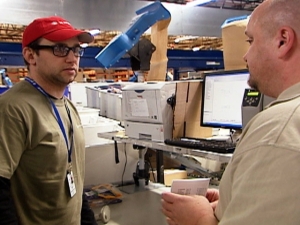
The first job that Undercover CEO takes almost always seems to involve a lot of physical activity and speed. He shows up for the job looking all unshaven and laid off-like. He meets his new supervisor. Undercover CEO grins like an idiot and goes, “I’m here to work.” The new supervisor says, “I give a fuck, kid.” Again, nobody mentions the camera crew.
Anyway, the supervisor assigns Undercover CEO to do the most demanding, difficult, and demeaning job possible. The Undercover CEO is assigned to work with either a jovial black man or a fat woman. The Undercover CEO is really, really impressed by his new co-workers. “Why they’re just the type of poor people I was hoping I’d meet!” he says.
They get to work. Undercover CEO does a terrible job. He can’t keep up. The Supervisor comes by and says, several times, “Jesus Christ, strangely soft-spoken blue collar worker, you sure do suck.” Undercover CEO tells the camera, “This is hard work!”
I think part of the CEO’s problem here is that he simply won’t shut up and do his job. Instead, he’s spending the whole time asking everyone around him questions like, “How long have you worked here?” and “Do you enjoy your job?” and “How do you work here and take care of your children?” His coworkers – who need their jobs much more than Undercover CEO – answer every single one of his questions. Does nobody find it weird that this stranger wants to know about everyone’s children?
Anyway, at the end of his first shift, Undercover CEO is told that he can’t cut it. “We don’t need you back,” the supervisor says. Dejected, Undercover CEO goes out, picks up a male prostitute, and goes back to his hotel where he allows his date for the night to tie him down to the bed and drip hot candle wax on his genitals. (Okay, maybe that was just Michael Rubin, who was probably the most clueless asshole of the 1st season’s CEOs.)
The next day, a properly sore and chastised Undercover CEO goes to work in the “service” part of his company. He’s either a short order cook or a cashier or something like that. Again, he’s assigned someone to train him. This time, the Undercover CEO does his job adequately despite the fact that he still won’t stop harassing his new co-workers with a bunch of inappropriate questions. He asks, “Do you like working here?” and “What do you think this company could do better?” Amazingly enough, people still answer him even though there’s a camera crew there filming them. Does it never occur to these people that there’s something weird about some stranger with a camera crew wanting to know every intimate detail of their lives within minutes of first meeting them?
Amazingly, Undercover CEOs always end up getting trained by the one person in the company who either needs an organ transplant or who has a child on dialysis. Undercover CEO is moved to tears. During his break, he tells the camera, “I wish all my employees were like her.” Which I guess means that he’s wishing all of his employees were terminally ill and unable to pay for adequate medical coverage.

Undercover CEO returns to his motel. He’s got a lot to think about now. He sighs. “Did you know,” he tells the camera, “that before I became a CEO, I was just another dirty little boy who liked to touch himself? Somehow, I have to get back in touch with that little boy. Hold me.”
Day 3, Undercover CEO is forced to deal with the dark underbelly of his corporation. This was the day that the CEO of 7-11 discovered that one of his stores did not have working lights. Shrimpy little Michael Rubin had to work with a rude woman in customer service on Day 3. (“I nearly went off on her,” Michael informs us. What-evuh, Michael. Go fuck yourself.) Most notoriously, the Hooters CEO met a manager who forced his waitresses to play “reindeer games.” Amazingly, these people engage in their bad behavior even though there’s a camera crew about two feet away from their face.
Undercover CEO’s mad now. “Yes,” Undercover CEO says, “my company may not be perfect but dammit, that’s just not the way we do things at Hooters! ” Undercover CEO sneaks outside. He yanks out his cell phone. He calls someone at the corporate office. He says, “This is your CEO speaking. We’ve got bad juju going down.” The person at corporate probably says, “I’ll get right on that, sir,” in a tone of contempt and seething hatred. Undercover CEO says, “Get on it, stat!” He hangs up his phone. He looks at the camera. “That’s not the way we do things!” he repeats as saliva forms at the edge of his mouth.
A few minutes later, a van pulls up in front of Hooters. Undercover CEO watches as Jack Bauer gets out of the van and runs into Hooters. For a few seconds, silence. Then a barrage of gunfire erupts. Bauer runs out of Hooters and jumps back in the van. As the van speeds off, the offending Hooters blows up. Undercover CEO looks at the camera and nods. “Sometimes,” he says, “it’s about doing what’s right.”

Back at the motel, Undercover CEO grins as he tells the cameraman, “That’s not the first time I’ve had to do that. What’s funny is that I’m not even the CEO of Hooters.” Undercover CEO starts to giggle. “I’ve been a baaaaad wittle boy, mommy,” he says.
Cut to commercial.
The next day, Undercover CEO has his final assignment. Inevitably, there’s someone at this last job who knows who Undercover CEO actually is. So Undercover CEO has to have a meeting where he goes, “Hey, I’m all undercover and stuff. You blow my cover and I’ll have your family killed and fed to a bunch of pigs.” Everyone agrees to keep Undercover CEO’s identity a secret. The audience sighs a sigh of relief because the audience is made up of a bunch of total dumgfugs.
Anyway, during the final assignment, Undercover CEO ends up working with an inspiring member of a minority who reaffirms the Undercover CEOs faith in humanity. Undercover CEO tells the camera, “That guy could be really valuable in this company, even though he’s black/Mexican/Indian/actually a woman.” Undercover CEO does his final job well. For some reason, everyone tells him every detail about their lives. Undercover CEO is moved.
However, Undercover CEO isn’t moved enough to actually give them any of his money. Instead, he just checks out of the Bates Motel and returns to his corporate office.
He has a meeting with his board of directors.
A member of the board goes, “I heard everyone hated you and you really suck.”
Undercover CEO says, “I’ve seen the light! We’re going to change how we do things at this company!”
The kissass board member continues to take notes.
Undercover CEO either starts to shave again or else grows his beard back. He puts on a suit. He says, “Thank God, I’m rich again. What are those fucking cameras still doing here? Oh yeah, I’ve got to let everyone know that I spent a whole day lying to them.”
Everyone that Undercover CEO has worked with is invited to the corporate office. They’re interviewed as they’re driven to the office. They say, “I’m scared. I hope I’m not getting fired.” None of them seem to connect the current TV cameras to the last group of TV cameras that they saw.
They meet the CEO. The CEO says, “You remember me? I actually run this company!”
“Bullshit!” the former co-worker replies.
“No, it’s true!”
“What-evuh, freak. Go fuck yourself.”
Most of this is edited out in post-production but you know it happens.
Undercover CEO tells everyone what a great job they’re doing. And he tells them that he’s going to reward them for being sick or not being able to take care of their children. (Never mind everyone else in his company who is in a similar situation.)
The co-worker smiles, probably hoping to hear that he’s getting a raise.
Undercover CEO says, “I was really touched by how your son is about to die if he doesn’t get a kidney transplant. So, I made a $1,000 dollar contribution to the Stop Global Warming fund.”
“Oh,” the co-worker says, “I guess that’s good. Considering that I had to do a lot of extra work to cover for your middle-aged ass…”
“Now, get the fuck out of my office and make sure you cut your overtime,” Undercover CEO says.
Finally, everyone who works for Undercover CEO gathers in a conference room where they watch clips of him fucking up. They all laugh and go, “See, I told you the boss is an idiot!”
Undercover CEO then addresses his employees. “See,” he says, “I am too a great guy.”
And life goes on.
That so many Americans have apparently been seduced by this obviously manufactured piece of mainstream propaganda is just sad.
The most common adjective that I hear to describe this show is “positive.” Supposedly, it celebrates the workers of America. It makes people feel better about their own largely pointless lives. And to all that, I say “Bullshit.” Yes, the CEO gets to be poor for a week but he does it secure in the knowledge that it’s only going to be for a week and that he’s not going to lose his job. The CEO is less an undercover investigator and more of a pampered tourist who looks at poverty all around him, says, “How awful,” and then promptly gets on the next plane home.


 Through the Shattered Lens