One of my all-time favorite comedies is the Zucker-Abrahams-Zucker 80’s classic, RUTHLESS PEOPLE! I’ll never forget watching it with my mom when I was a teenager. She laughed so hard, which made it loads of fun for me! I’ve been a fan of Danny DeVito ever since. As a matter of fact, DeVito is turning 81 today, which means he’s only a month older than my dad. Enjoy my friends!
Tag Archives: Bradley Crain
My happy place… a little story about me, my family, and an unexpected run-in with Hollywood!
My dad grew up in the Ouachita Mountains of central Arkansas. Some folks would surely call them hills, and they’d probably be right, because I come from a family of hillbillies. And there’s no place I like to go back to more often than those hills in Perry County, Arkansas. It’s probably been 35 years ago now that dad found a beautiful patch of land in the Ouachita National Forest that runs along the South Fourche River, just a few miles from where he spent his summers with his Grandpa and Grandma Crain, mostly working their farm, but also fishing and hunting anytime he could. This started a journey of patience when dad went to the county courthouse, found out who owned the property (an older lady who lived out of state), and wrote his first letter to see if she was interested in selling. She responded to that first letter and said that she was saving the property for her children to have as an inheritance. A few years later, dad wrote again. Still not interested, the lady kindly turned down dad’s offer and thanked him for his interest. Fast forward a few years later, about 8 years after dad’s first letter, and a man contacted my dad this time. It was the lady’s son, who had found my dad’s letters as he was going through his mother’s house after she had passed away. He wanted to sell, and dad made him an offer that he couldn’t refuse. Now owning the land of his dreams, dad and mom proceeded to build a cabin. When I say they built the cabin, I don’t mean that they hired someone else to build the cabin, I mean that they built the cabin from the ground up. For the longest time, the only power they had was the generator that he brought with him to the location. Now fast forward 25 years later, and it’s the place we have spent all of our holidays together for the last couple of decades. It’s truly my happy place, the place I go when I need to disconnect from the stresses of life and reconnect with my wife, my family, and nature itself. I took this picture a few feet off of the back deck a few moments ago.

My wife and I will spend this weekend sipping coffee off the back deck, listening to the sounds of the river rolling by, and then watching movies when the sun goes down. I’ll go see my brother this morning, who owns the local convenience store in the area, and I’ll work his cash register as he makes the best fried bologna sandwiches in central Arkansas. My brother bought the store five years ago, continuing a family tradition that started in 1940 when our great grandparents bought the store. It’s been in our family ever since. One of the coolest experiences in my life took place at the store a few months ago. The store has the perfect, old-timey, backwoods country store look, something even Hollywood noticed. In early August, the store was used as a filming location for a movie with major Hollywood talent. For a guy who’s been obsessed with movies since we got our first VCR in the 80’s, I asked my brother if my wife and I could come over and watch them film. I spent the day watching them film, visiting with a producer, visiting with the director, even taking a picture or two with the actors filming that day. It was truly one of the most awe-inspiring days of my life. My wife and I were able to get the picture below on that day. I can’t lie, the beauty of my wife is probably what allowed this to happen!
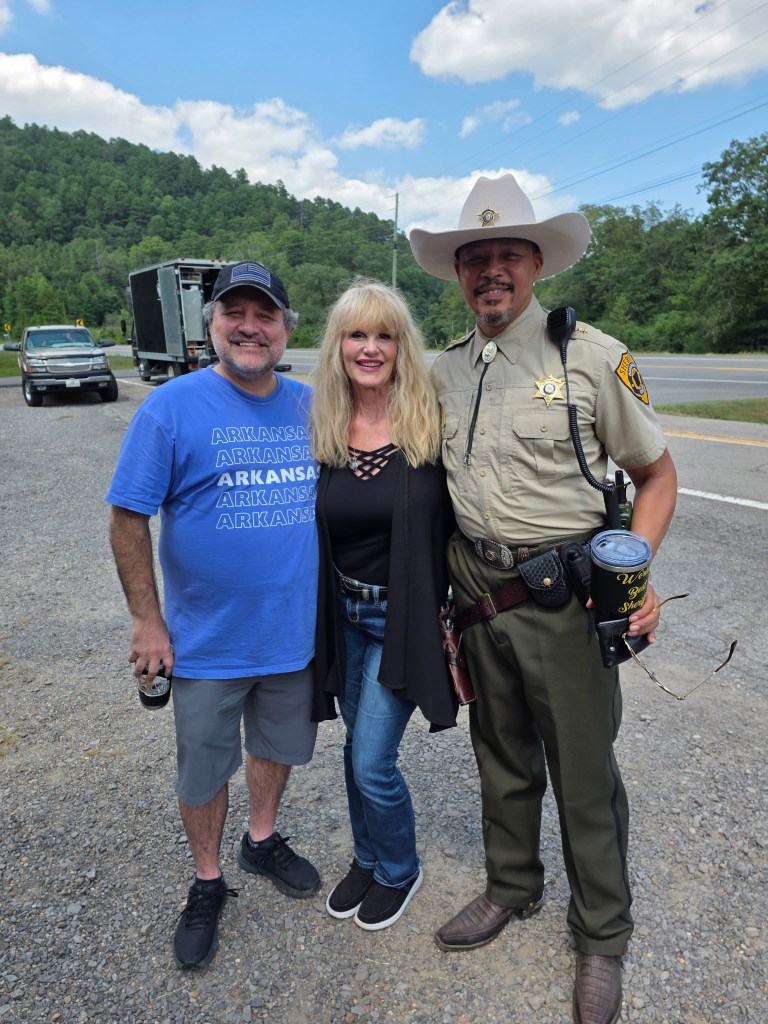
Have a wonderful weekend, my friends. I hope all of you get to spend part of it in your own happy place.
Brad reviews DOUBLE THREAT (1992), starring Sally Kirkland, Andrew Stevens and Sherrie Rose!

Sally Kirkland stars as Monica Martel, a sexy but aging Hollywood actress who’s in lust for, and obsessed with, her boy toy, Eric Cline (Andrew Stevens). When Monica is given a chance for a big comeback, she uses her pull to get Eric the leading man role. Still, the producer Crocker Scott (Anthony Franciosa) insists that the film contain a lot of sexy scenes and Monica isn’t exactly in her prime anymore. Needing this big break, director Stephen Ross (Chick Vennera) hires a model of visual perfection, the lovely Lisa Shane (Sherrie Rose), to serve as a body double for Monica on the production. Soon Eric and Lisa are having a hot affair while Monica is being left out in the cold. Not one to accept being the odd woman out, Monica hires a private investigator to track the oversexed young lovers. When Lisa’s car blows up, luckily for us viewers she isn’t in it at the time, you can’t help but wonder if Monica has decided nobody will make a fool of her again. Not so fast though when Detective Robert Fenich (Richard Lynch) shows up on the scene carrying a serious grudge against Eric… something to do with a murderous event that occurred in San Francisco a few years earlier. It’s not easy to determine who’s hateful and who’s just horny in this sizzler from Director David A. Prior.
This was my first viewing of the 1992 erotic thriller, DOUBLE THREAT, but I’ve seen plenty of movies like it before. I was a teenager when the erotic thriller became a staple at the video store. Actor Andrew Stevens, who had starred with my hero Charles Bronson in the films DEATH HUNT (1981) and TEN TO MIDNIGHT (1983) became a star of the genre with his roles in the NIGHT EYES and SCORNED series. I remember talking my mom into letting me rent NIGHT EYES (1990) because “the guy from 10 TO MIDNIGHT is in it.” Needless to say, she wasn’t happy when the “erotic” part of the erotic thriller started, and we never finished the film. To be completely honest, outside of the budget differences and the overall talent on display, a film like DOUBLE THREAT isn’t that much different than a movie like BASIC INSTINCT (1992), which I’m sure served as an inspiration when you consider that both films came out in 1992. There is a scene where Andrew Stevens walks into a club and sees Sherrie Rose dancing provocatively that reminded me of the corresponding scene in BASIC INSTINCT with Michael Douglas and Sharon Stone. And when it’s all said and done, the plots of these types of films are all pretty ridiculous. This one’s a real doozy, and looking back there are ample clues, but I somehow didn’t figure out the big twist at the end.
I must say that Sally Kirkland and Sherrie Rose, separated in age by 25 years, are both extremely appealing in DOUBLE THREAT as the actress on the comeback trail and her beautiful young body double. This is the first time I’ve watched one of these straight-to-video erotic thrillers in a long, long, time, so I may just need to revisit a few more just for old times’ sake! Besides the sexy ladies, this specific film intrigues me due to the presence of Andrew Stevens as the ladies’ man whose motives aren’t completely clear until later in the film. A consistent presence in Charles Bronson films of the early 80’s, Stevens has had quite the career as an actor, director, and producer, almost exclusively in low budget fare like this. He’s a good-looking guy and a pretty good actor, and I’m always glad to see him involved in a production. He’s recently written and directed a documentary about his mother called STELLA STEVENS: THE LAST STARLET (2025) that I have on my watch-list. Honestly, the full cast of DOUBLE THREAT is pretty stacked, with actors like Rychard Lynch (INVASION USA), Gary Swanson (VICE SQUAD), and Anthony Franciosa (TENEBRAE) all bringing some additional class to the proceedings in their various roles.
At the end of the day, you fall in one of three categories when it comes to a movie like DOUBLE THREAT: you’re the kind of person who wants to watch a low budget erotic thriller; you’re the kind of person who says that you don’t want to watch a low budget erotic thriller, but then you watch one anyway; or you’re the kind of person who truly doesn’t want to watch a low budget erotic thriller. In my case, there’s a certain nostalgia that I associate with these types of video store genre films that were a dime a dozen in my youth. As silly as it all is, I must admit that I enjoyed DOUBLE THREAT and proudly fall in the first category!
Rest in peace, Sally Kirkland.
Brad reviews SHOOT OUT (1971), starring Gregory Peck & Robert F. Lyons!
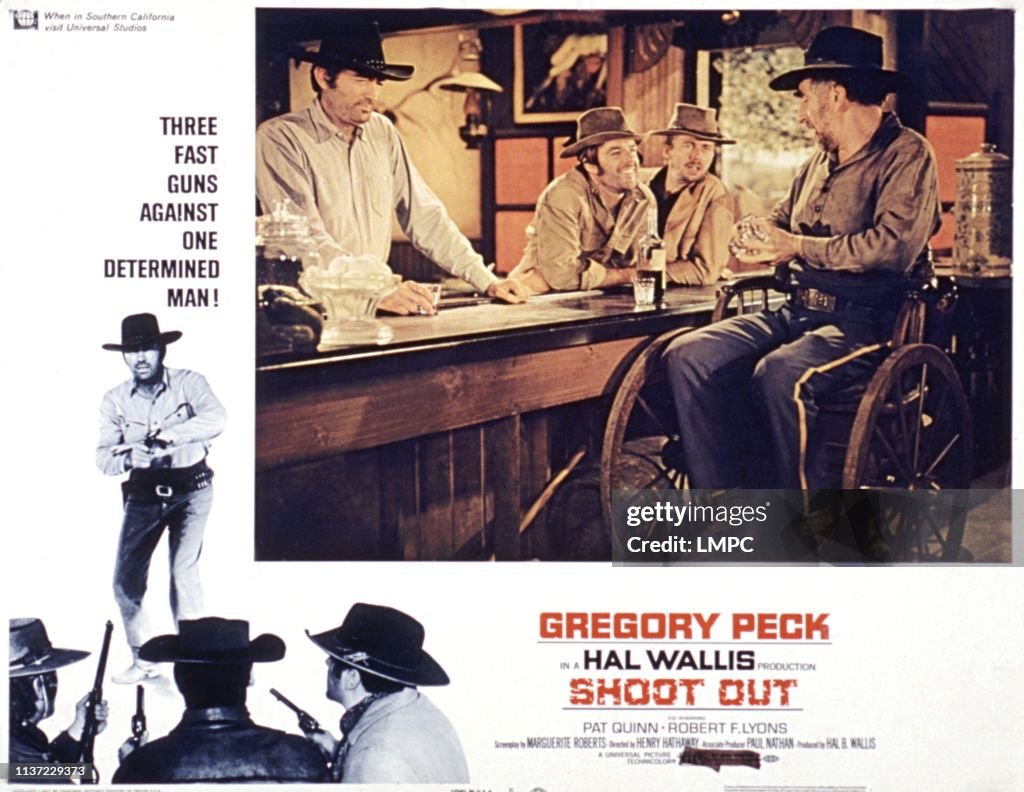
After serving a stretch at the Canon City penitentiary, Clay Lomax (Gregory Peck) gets out with only one thing on his mind… revenge on his former partner Sam Foley (James Gregory), who shot him in the back during a bank robbery, leaving him to take the rap. Foley isn’t a fool, though, so he’s hired a trio of young punks, Bobby Jay (Robert F. Lyons), Skeeter (John Davis Chandler), and Pepe (Pepe Serna) to surveil Lomax and let him know if he’s heading to his home in Gun Hill with payback on his mind. These guys are about as crazy as it gets, and they make two major mistakes. First, they kill Lomax’s friend Trooper (Jeff Corey) who lets him know where Foley is with his dying breath. Second, they kidnap the prostitute Alma (Susan Tyrell) just because they want to treat her like crap and have fun with her, which turns out to be a dumb move. Interrupting Lomax’s quest for revenge, he finds himself being forced to care for a young child named Decky (Dawn Lyn), who just may be his daughter with a lady back in Kansas City who used to be his “friend.” Looking after Decky, and then meeting and falling for the widow Juliana Farrell (Patricia Quinn), Lomax is soon facing off against his most dangerous foe, the crazed Bobby Joe, as he attempts to protect all these new people that he loves so he can move on with his life. But is it all too late?!!
I love westerns, but I must admit that I’m not the biggest fan of director Henry Hathaway’s SHOOT OUT. Hathaway has directed some of my favorite actors and movies, like Charles Bronson’s debut film with Gary Cooper, YOU’RE IN THE NAVY NOW (1951), along with the Jimmy Stewart film CALL NORTHSIDE 777 (1948) and John Wayne’s Oscar winning TRUE GRIT (1969). Unfortunately, it seems his best years are behind him, and he would only direct one more film after this, the less than excellent black action film HANGUP (1974). This isn’t exactly Gregory Peck’s best work either. Coming nine years after his Oscar winning performance in TO KILL A MOCKINGBIRD (1962), this is definitely not even close to that kind of level. Don’t get me wrong, I do enjoy his turn as Lomax when he’s the wronged outlaw looking for revenge, but I don’t really care at all for his part as the reluctant father figure trying to deal with the six-year-old Decky. I found Dawn Lyn to be more annoying than cute in the role, and this storyline distracted me from the revenge plot that I actually enjoyed. As a co-host of the “This Week in Charles Bronson Podcast,” we had the opportunity to interview Robert F. Lyons, who plays the bad guy, Bobby Jay Jones. I specifically asked him about this film and what it was like working with Gregory Peck. While he enjoyed working with Peck, his response about the film itself was telling…. “The work in there is not my work.” If you’ve watched much of the excellent actor’s work before, you can immediately understand what he means. Lyons goes so over-the-top as the spying outlaw Bobby Jay Jones, that his performance is inconsistent with the bulk of his career. Lyons told us that his performance was orchestrated by Hathaway in a way that he disagreed with, and he essentially disowns his work in the film. You can see a similar vibe with his “gang” that includes the actors John Davis Chandler and Pepe Serna.
While I’m not a huge fan of the overall direction of the storyline or the focus of some of the main performances in SHOOT OUT, I am appreciative of the genre and the classic western stars that Hathaway cast in supporting roles. I especially enjoy seeing Jeff Corey in the small but pivotal role as the wheelchair bound Trooper, Paul Fix as the train brakeman who delivers Decky and a stack of cash to Lomax, and Arthur Hunnicutt as the ranch owner who barters with Lomax over the price of a pony. Hunnicutt is a particular favorite of mine although his role here is very small. Nominated for an Oscar for his performance in Howard Hawks’ THE BIG SKY (1952), Hunnicutt is from the small town of Gravelly, Arkansas, which is not far from where my own family is from. He even attended the same college that I graduated from, the University of Central Arkansas, which was known as the Arkansas State Teachers College when he (and my dad) went there. And then there is the setup of the revenge scenario at the beginning and the final showdown at the end, classic staples of the western genre. These are enjoyable and satisfying moments as Lomax settles his scores and the bad guys get their comeuppance.
Overall, SHOOT OUT is best enjoyed by fans of old school westerns and star Gregory Peck. It veers aways from the best storylines of the genre and wastes a lot of time with uninteresting melodrama, but it does offer us another chance to see some of our great character actors doing what they do. That means something to me.
I’ve included our podcast episode with Robert F. Lyons below. He discusses SHOOT OUT at around the 1:00:30 mark.
RIP to the incredible Japanese actor Tatsuya Nakadai (1932 – 2025)
I’m a huge fan of samurai movies. As such, I love the Japanese actors Toshiro Mifune and Tatsuya Nakadai. I came for the samurai movies and soon learned that both actors are incredible in a wide variety of films. They are truly two of the best of all time, and I seldom think of one without thinking of the other. It made me quite sad when I read that Nakadai passed away a few days ago on November 8th at 92 years of age. Back in 1962, Nakadai starred in possibly the greatest samurai film of all time, Masaki Kobayashi’s HARAKIRI. It’s truly a masterpiece, with a powerful story and incredible action. In honor of Tatsuya Nakadai, I’m sharing the trailer for HARAKIRI below, and I recommend it to everyone!
Brad’s “Scene of the Day” – The incredible car chase in THE STONE KILLER (1973)!
I’ve been really busy the last few days preparing to record the next episode for the THIS WEEK IN CHARLES BRONSON Podcast. We’ll be covering THE STONE KILLER where Bronson plays a tough cop who stumbles upon a mafia revenge scheme decades in the making. It’s an interesting film that I can’t wait to cover in detail with a great group of Bronson enthusiasts. Did you know that THE STONE KILLER contains an incredibly underrated “car chases a motorcycle” sequence? The 70’s were so full of great stunts that some of the very best have almost been forgotten. Well that just doesn’t set well with me, so I’m sharing that chase with all of you. It’s a sequence that was filmed in 1973, the same year I was born, so it’s extra special to me. Enjoy my friends!
Brad’s TOP 5 favorite Charles Bronson Films – Happy Birthday, Charlie!! 🎉🎂
As possibly the biggest fan in the world of the legendary tough guy actor Charles Bronson, I’m often asked to name my favorite films that he has starred in. This is almost an impossible task, because I love his movies for many different reasons and oftentimes it doesn’t have a thing to do with what film critics think. Well, a few years ago, I decided I would try to rank all of the films where he has the lead role from my favorite to least favorite films. I threw out his supporting roles, which eliminates great films like THE GREAT ESCAPE and THE MAGNIFICENT SEVEN, and focused on films where he plays the main character. I also tried to choose the films I just enjoy watching the most. Since this is supposed to just be fun, and it’s also 100% subjective, I reserve the right to change the rules or my rankings at any time! In honor of Charles Bronson’s 104th birthday, here we go:
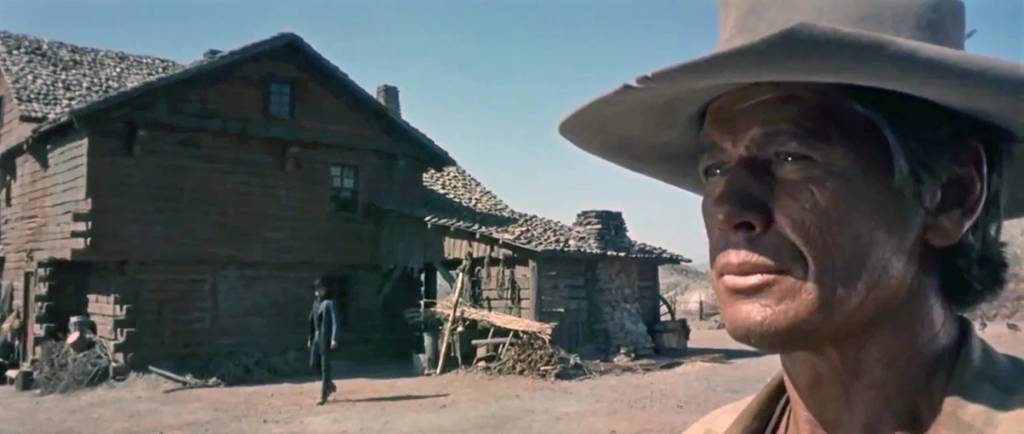
#5: ONCE UPON A TIME IN THE WEST (1968) – I’ve heard many people throw this classic spaghetti western into the “large ensemble cast” grouping of Charles Bronson films such as THE DIRTY DOZEN and THE GREAT ESCAPE. While I won’t argue that the cast is extremely impressive since it also stars Henry Fonda, Jason Robards and Claudia Cardinale, I don’t consider Bronson’s role in this film to be the same as those others. Here, the main storyline in the film concerns his character Harmonica’s quest to meet with the black-hatted Frank (Henry Fonda) to settle their business from the past, both beginning and ending with Harmonica in two of the most impressive scenes in movie history. I love this movie more than anything for the way Sergio Leone turns Bronson into an impossibly awesome instrument of justice. Every shot with Bronson makes him look like a badass, and every line that comes out of his mouth sounds incredibly cool. Leone had wanted Bronson for all three of the “Dollars trilogy” films, and once he finally got him, we can see why. His camera lingers on his face and eyes for a length of time that I guess was never done before or after. Henry Fonda is one of the all-time great Hollywood stars, Jason Robards is an acting legend, and Claudia Cardinale just may be the most beautiful woman who’s ever graced the face of Earth, but Charles Bronson is the star and centerpiece of ONCE UPON A TIME IN THE WEST. After this incredible performance Bronson would soon become the most popular star in the world, winning the Golden Globe award as “World Film Favorite” in 1972.
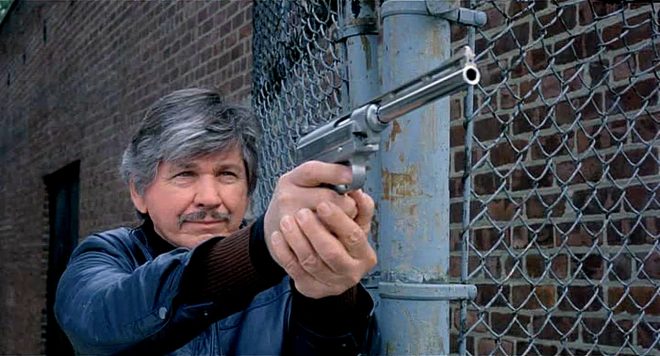
#4: DEATH WISH 3 (1985) – You are reading this right, in my list of my favorite Charles Bronson films, I rank DEATH WISH 3 above ONCE UPON A TIME IN THE WEST, and I’m not ashamed. My interest with Charles Bronson started with a late-night viewing with my dad of the original DEATH WISH, and it began to grow with some rentals of films like VIOLENT CITY and THE MECHANIC, but it reached its bloom as a full-blown obsession when I received DEATH WISH 3 as a Christmas present in 1986. It was the only Bronson film I owned on VHS (not counting a nearly unwatchable former rental tape of THE MECHANIC) and I watched it almost daily over the next sixth months or so. I still know every line of dialogue spoken in the film by heart. Granted, I recognize that new viewers may watch the film and wonder what the hell is wrong with me. To understand why I love DEATH WISH 3 so much, you have to be able to put yourself in the mind of a 13-year-old boy from Toad Suck, Arkansas, who is still new in discovering the world of R Rated cinema. This film had cussing, nudity and comic book level characters and kills from the opening scene to the last. And it had Bronson, the first tough guy actor I had ever really noticed. It would probably take an expert therapist to explain why I love Bronson and this film so much, but the fact is that it kicked off a lifelong interest that still continues almost 40 years later. If I can’t sleep at night, I just start streaming DEATH WISH 3 and lay my head down on my pillow and go to sleep to a nostalgic lifetime lullaby.
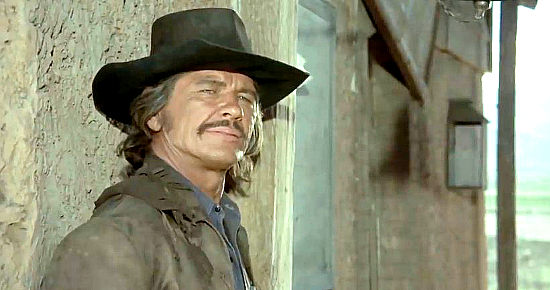
#3: RED SUN (1971) – While it does have its share of high-profile supporters, most famously Quentin Tarantino, RED SUN is another film that I hold in higher esteem than most. I remember seeing the huge VHS box at the local mom and pop movie rental store in Conway, Arkansas when I was a kid. I thought Bronson looked pretty darn cool with his cowboy hat, long hair and pointed gun. I rented the movie and liked it, but the quality of the VHS tape was horrendous, and I discovered in the years since that that particular version of the film was severely edited for content as well. The proud owner of a region-free DVD player, a couple of decades ago I bought a region 2 DVD of the film from Studio Canal. For the first time I was able to see the film, including Ursula Andress’ uninhibited performance, in its full glory. One of the things I love the most about RED SUN is Bronson’s engaging performance in the central role. He’s very much a rascal, he’s funny, he’s tough when he needs to be, and he even has a big heart, even if it takes a while to find it. The next thing I love about the film is the fact that he teams up with the incredible Japanese actor Toshiro Mifune. As Mifune himself is in my top 5 favorite actors of all time, the fact that he teamed up with Bronson in this fun western gives major bonus points to the entire production. They make an appealing pair as they head off after the evil Gauche, played by Alain Delon, another international favorite, whose LE SAMOURAI is an all-time classic in my book. With RED SUN, director Terence Young, who helmed the earliest James Bond films, took one of the great international casts ever assembled and delivered a fun and entertaining film that I revisit often!
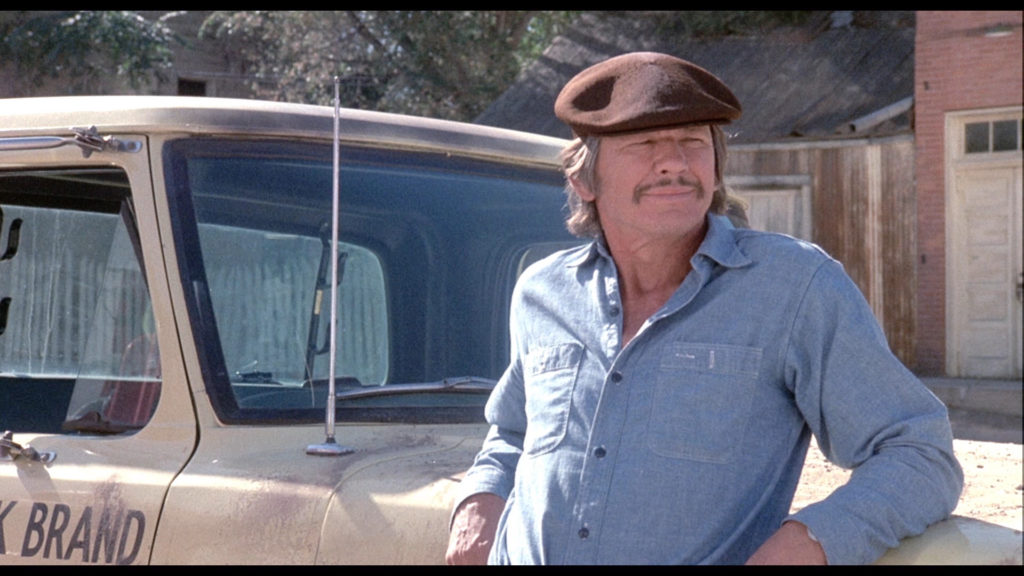
#2: MR. MAJESTYK (1974) – A simple story about a man in rural Colorado who just wants to be left alone so he can pick his melons, MR. MAJESTYK has been one of my favorite Charles Bronson films since the beginning. I remember Dad renting this one when I was a kid in my early Bronson discovery period, prior to the life-changing DEATH WISH 3 purchase. I loved the movie, but dad had to take it back to the video store after a couple of days, and I wouldn’t see it again for quite a while. Flash forward about 37 years and one of the great days of my life was spent in those same rural Colorado locations (Canon City, Manzanola, La Junta) where Vince Majestyk had righted wrongs a half a century before. My wife and I toured the various locations, and I felt like I was walking in the footsteps of the great Charles Bronson. It was an almost mystical experience, which I documented through tons of pictures and self-made videos. A few months later, as part of the THIS WEEK IN CHARLES BRONSON podcast, I was even blessed with the opportunity to co-host an interview with Jordan Rhodes, one of the two stars of the 1974 production that is still alive, the other being the beautiful Lee Purcell. It was the type of experience you assume you’ll never get in life, and then it happens! There are now so many personal reasons for MR. MAJESTYK to be special to me, but it’s also just a great 70’s action film with an interesting story, a badass hero, and a uniquely awesome set of villains. Elmore Leonard’s screenplay rocks and makes Bronson a working-class hero in a role that fits him like a glove. Throw in Al Lettieri as the biggest bully in the Bronson canon, and Paul Koslo as a creepy, local, wannabe ass-kicker, and the stage is set for action and audience satisfaction. My only warning is to stay away if the mutilation of fruit offends you. This movie contains the most horrid melon massacre in film history!
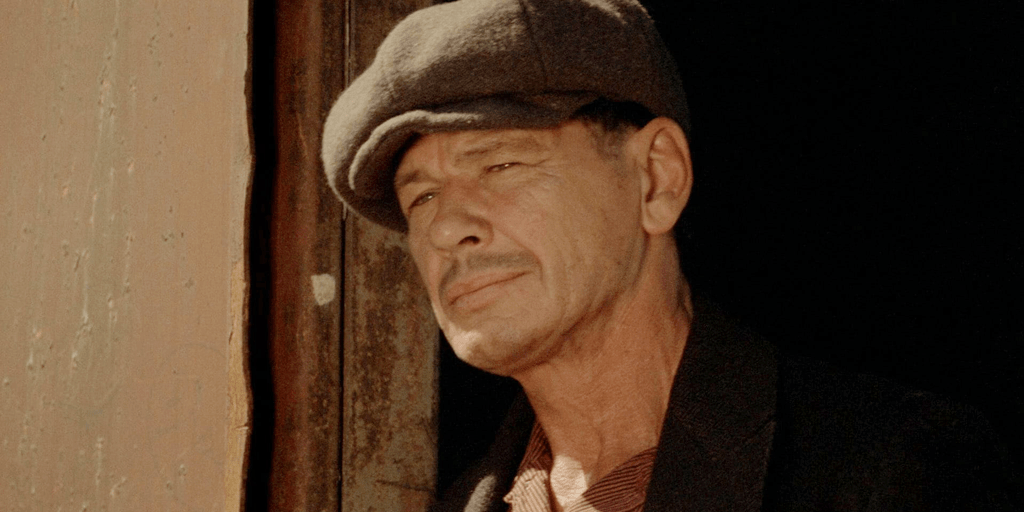
#1: HARD TIMES (1975) – The directorial debut of Walter Hill, HARD TIMES is the undisputed and still reigning number 1 champion of my favorite Charles Bronson films. When I published my first review in November of 2024 for The Shattered Lens, it was for HARD TIMES, where I declared that the movie is my personal favorite film. My thought was just to go ahead and truly introduce myself to the readers of the site, so they’ll know where I’m coming from as a cinema lover. I have a long history with this film that includes my own personal and working relationship with my dad. Dad was the kind of guy who worked all the time, and even harder on the weekends when he wasn’t doing his paid job as a high school basketball coach and teacher. Being his son, I was always right there with him, helping as we mowed our neighbors’ yards, hauled wood, built sheds… you name it, we did it. One day in appreciation for my help over the summer, dad took me to Wal-Mart and told me I could pick out a movie, and he would buy it for me. They had a nice, fresh stack of HARD TIMES VHS copies on their shelves and that’s what I selected. I had not seen the film before so when we got home, I wanted to watch it. What really surprised me is that Dad sat and watched the whole movie with me. What you have to understand is that my dad never sits still, and if he does, he usually falls asleep. That day he watched the movie, laughed at the right places, commented on the film at times, and seemed to really enjoy himself. I think all of us appreciate it when the special people in our lives will watch and enjoy a movie with us. That was one of those best movie moments ever when you consider it was with my dad. Not only do I have a fond memory of my first viewing, but HARD TIMES has also proven itself over the years to be one of Bronson’s best films and, in my opinion, an underrated 70’s classic. The polar opposite performances of Bronson as the quiet, powerful Chaney, and James Coburn as the fast-talking, hustler Speed, set the stage for high stakes drama in depression-era New Orleans. Somewhat like Harmonica from ONCE UPON A TIME IN THE WEST, Chaney is almost a mythic superhero as he rides into town on the train, impacts a lot of lives, and then gets back on the train and rides away. The audience satisfaction is off the charts as the mysterious drifter Chaney punches out smirking, younger opponents, hulking bald-headed opponents, shady managers who refuse to hand over the cash after a loss, and even a ringer who’s brought in all the way from Chicago. It’s a great film that was bought for me by a great dad, that’s filled with great actors who give great performances, all put together by a great director who would continue to make some of the greatest action movies of all time. How could this NOT be my favorite Charles Bronson film?!!
Brad’s Song of the Day – “Look at Me” from 10 TO MIDNIGHT (1983)! Happy Birthday, Charlie!!
10 TO MIDNIGHT is probably Charles Bronson’s best film from the infamous Cannon Films. It’s a solid police procedural with a slasher twist. It also has a good soundtrack from Robert O. Ragland. When we meet the creepy killer Warren Stacy (Gene Davis) at the beginning of the film, “Look at Me” plays on the soundtrack as he checks himself out in the mirror and goes through the crime in his mind. On Charles Bronson’s 104th birthday, I’ve chosen this as my song of the day!
Brad’s 2nd “Scene of the Day” – Harmonica arrives in ONCE UPON A TIME IN THE WEST (1968)! Happy Birthday, Charlie!!
On the precipice of becoming an international superstar, director Sergio Leone gave Charles Bronson one of the coolest introduction scenes in film history in ONCE UPON A TIME IN THE WEST. Enjoy my friends!
Brad’s “Scene of the Day” – Charles Bronson & Alan Ladd in DRUM BEAT (1954)! Happy Birthday, Charlie!!
Until 1954’s DRUM BEAT, Charles Bronson had been billed on screen as Charles Buchinsky. He then proceeded to steal the film right out from under star Alan Ladd. Bronson’s powerful performance as renegade Modoc indian Captain Jack is an early sign of Bronson’s immense talent and charisma.
Enjoy this action-packed clip from Delmer Davis’ excellent western, and happy 104th birthday, Charles Bronson!
 Through the Shattered Lens