Of all of the world’s real-life monsters, Jack the Ripper is one of the most iconic. Whether it’s because he was never actually caught or because he committed his savage crimes during an era that we associate with emotional and sexual repression or maybe just because he has a memorable name, Jack the RIpper continues to both fascinate artists of all genres and haunt the nightmares of viewers and readers like me.
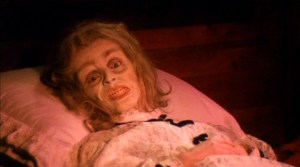
Tonight’s episode of televised horror on the Lens deals with Jack the Ripper. This episode of Thriller was originally broadcast on April 11, 1961 and is based on a short story by Robert Bloch. It was directed by actor Ray Milland.
Without further ado, here is Yours Truly, Jack the RIpper…
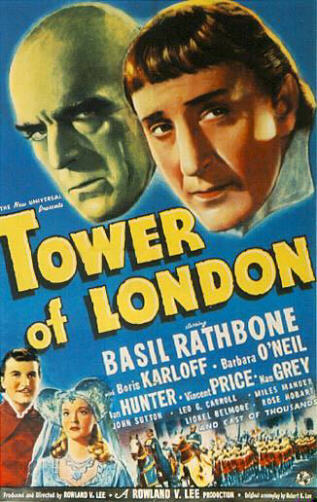
Today’s horror movie comes from 1939 and is presented in glorious black-and-white. Tower of London tells the famous (and historically controversial) story of King Richard III (Basil Rathbone). With the help of the club-footed executioner Mord (Boris Karloff), Richard murders his way to the throne of England.
Technically, The Tower of London is more of a historical film than a horror film but, in order to tell its story, it uses many of the techniques that had been previously perfected by the famous Universal monster movies. Rathbone turns Richard III into a chilling and plausible human monster while Karloff is obviously having a lot of fun in the role of the twisted Mord.
Also of historical interest is the fact that Vincent Price plays the Duke of Clarence, making Tower of London his first horror film and the first film in which he would appear alongside fellow horror icon, Boris Karloff.
Down here in Dallas, channel 47 is the local Me-TV affiliate. Me-TV specializes in showing old TV shows from the 50s, 60s, and 70s. The network sells itself as a nostalgic refuge for people who are several decades older than me, a place where they can go to escape from Seth McFarlane producing sitcoms and Maury Povich conducting DNA tests.
But you know what?
I like Me-TV and I’m glad that it exists. It probably has something to do with me being a history nerd at heart. I love the chance to see what the world was once like. Add to that, some very good shows were produced in the 50s and 60s. Just because a lot of us weren’t there to experience them firsthand doesn’t mean that we can’t appreciate them in rerun syndication.
Case in point: Thriller.
Thriller aired for two seasons in the early 60s. It was an anthology series, in the tradition of The Twilight Zone. Whereas The Twilight Zone was hosted by Rod Serling, Thriller was hosted by horror icon Boris Karloff, who always introduced the macabre material with a bemused gleam in his eyes.
Parasite Mansion was the 30th episode of Thriller and it originally aired on April 25th, 1961. In this episode, Marcia (Pippa Scott) crashes her car outside of a dilapidated Southern mansion. When she awakens, she finds herself in the position of being the unwilling guest of the eccentric family that lives inside the mansion. I like this episode, largely because I can never resist Southern gothic atmosphere.
Incidentally, the family’s matriarch is played Jeannette Nolan and, if she sounds familiar, that’s probably because she was one of the many actresses to voice Mrs. Bates in Psycho.
For my latest horror review, I will be reviewing another classic film from one of my favorite directors, Mario Bava. Following the suggestion of my twitter friend Tom, I spent last night watching Bava’s 1963 classic Black Sabbath.
Starring Boris Karloff, Black Sabbath is a compilation film that’s made up of three different horror-themed stories. Originally entitled Three Faces of Fear, Black Sabbath has been released in many different versions over the years. Depending on which version you seen, the stories may be in a different order than in the order that Bava intended. The version I watched was the original, uncut, Italian-language version that was released by Anchor Bay. For those of you who want to truly experience the genius of Mario Bava, this is the version to see.
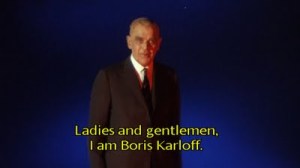
Black Sabbath begins with Boris Karloff playing himself, giving a deliberately over-the-top introduction and informing us that there could very well be vampires and werewolves sitting next to us in the theater. Yes, it’s silly and yes, it’s campy but it’s also a lot of fun. A lot of this is because these words are delivered by Karloff, an actor who could make even the silliest of dialogue sound important. The other part is that, as silly as the introduction may be, it’s beautiful to look at. Instead of going for the standard spooky narrator in a cobweb-filled library approach, Bava frames Karloff standing against a brilliant dark blue backdrop that establishes that this isn’t just your typical horror host … this is BORIS FREAKIN’ KARLOFF!
After Karloff’s introduction, we move on to the first of Black Sabbath’s three separate stories, The Telephone.
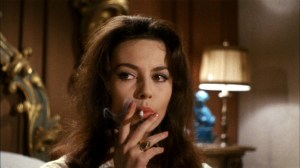
In The Telephone, Michele Mercier plays a Parisian prostitute who returns to her apartment after an evening out. As she tries to change for bed, her bright red telephone rings. Every time Mercier opens the phone, she hears a man’s voice taunting and threatening her. Finally, the caller claims to be Frank, Mercier’s former pimp who has just escaped from prison. The terrified Mercier calls her estranged lesbian lover (Lydia Alfonsi). Alfonsi comes over to the basement to comfort Mercier. However, what Mercier doesn’t realize is that it wasn’t Frank calling her. It was Alfonsi, pretending to be Frank. However, needless to say, there’s more twists to come before the night’s over.
Of the three segments, The Telephone is probably the least succesful if just because it has the most pedestrian plot. At the same time, this segment also show just how good Bava was at creating tension even with so-so material. Speaking as someone who has been stalked in the past, I can say that both Mercier and Bava perfectly captures the way that one seemingly simple intrusion on your privacy can leave you suddenly feeling very isolated and very alone. Finally, even after the segment’s over, it’s impossible to forget the sight of that vibrantly red phone sitting like a lurking monster in that artfully drab apartment.
The Telephone is followed by probably the film’s most famous segment, The Wurdalak.
Based on a short story by Tolstoy, The Wurdalak opens with a Russian nobleman (played Italian exploitation mainstay Mark Damon) on a long trip through the Russian wilderness. He comes across a headless corpse with a dagger plunged into its heart. Damon takes the dagger as a morbid souvenir of his trip.
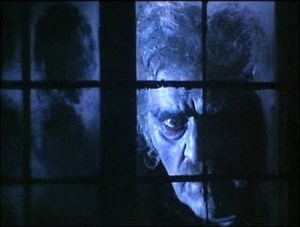
As night falls, Damon comes across a small cottage and asks the family inside for shelter. Inside the cottage, Damon discovers a wall that is covered with daggers similar to the one he found earlier. His hosts explain that the daggers belong to the family patriarch, Gorcha (Boris Karloff). Gorcha left five days earlier to kill a wurdolak (or vampire, by any other name). As the family waits for Gorcha to return, not knowing whether or not he himself is now a vampire, Damon finds himself falling in love with Gorcha’s daughter. When Gorcha finally does return, it’s obvious that he’s not the same man he was when he originally left.
Of the three segments, The Wurdolak is probably the most obviously Bavaesque and a whole lot of the same images and themes would later turn up in Bava’s masterwork, Kill, Baby, Kill. Everything, from the constantly howling wind to the sense of isolation to the well-meaning but ultimately impotent upper-class hero, is classic Bava. Special mention should also be made of Boris Karloff’s performance here. Because Karloff was best known for appearing in “monster” movies, he never gets enough recognition for being a pretty good actor. His performance here, which is full of malice and threat, is just as menacing as his earlier appearance in the introduction was fun and campy.
The final segment of the film is entitled The Drop of Water.
In many ways, The Drop of Water is the simplest segment of the film but for me, personally, it’s also the scariest. In London, a nurse (Jacqueline Pierreux) is called to a large house to prepare a medium for burial. While doing this. the nurse notices a large (and, quite frankly, kinda gaudy) ring on the medium’s finger. The nurse steals the ring and returns to her own apartment. As soon as she goes to her apartment, she finds herself haunted by increasingly ominous events: a buzzing fly refuses to leave her alone, the sound of water dripping echoes through the apartment, the lights go on and off, and — naturally — a mysterious figure suddenly appears in her bedroom.
Mixing the sense of growing paranoia that characterized The Telephone with Wurdolak’s sense of predestined, metaphysical doom, The Drop of Water is the perfect concluding chapter of Black Sabbath. It also happened to scare the Hell out of me. Along with Bava’s usual superb direction, this film was distinguished by some wonderfully creepy make-up work. Seriously, once that mysterious figure reveals itself, you’ll wish it hadn’t.
I usually don’t enjoy compilation films because, too often, it seems that you’re lucky if you get just one above average story surrounded by a bunch of forgettable filler. Far too often, the stories themselves don’t seem to go together. Instead, they just appear to have been tossed together randomly with the weakest of possible connection. Black Sabbath is an exception and that’s largely because of Mario Bava’s iconic direction. The stories aren’t linked together by plot as much as their linked together by motif and theme. Each story — from the emphasis on isolation to the creative use of color to suggest mood and menace — is linked by Bava’s style. Boris Karloff may have been the name emphasized in the credits but the true star of Black Sabbath is Mario Bava.
The genius of Bava wasn’t in the originality of the stories he told but instead, in the new ways that he found to tell familiar stories. Usually, I hate it when directors describe themselves as being about “style” as opposed to “substance.” Too often, it seems like that’s just an excuse to not come up with an interesting story. However, Bava is one of the few directors about whom the term “style over substance” can be used as a compliment. Bava knew how to make style into art and he certainly did that in Black Sabbath.
There’s literally been hundreds of film adaptations of Mary Shelley’s novel Frankenstein, or the Modern Prometheus. Everyone from James Whale to Terrence Fisher to Paul Morrissey to Kenneth Branagh to Marcus Nispel has taken a shot at interpreting the legend and the monster’s been played by everyone from Boris Karloff to Christopher Lee to Robert De Niro to Srdjan Zelenovic (who was pretty freaking hot and yummy for a creature stitched together out of random corpses in Flesh for Frankenstein).
However, the very first cinematic version of Frankenstein came out in 1910. Produced by Thomas Edison’s film company, this 10-minute, silent film starred an actor named Charles Ogle as the monster. Frankenstein, himself, was played by Augustus Phillips while his fiancée was played by Mary Fuller. The film was directed by a fellow known as J. Searle Dawley. Dawley reportedly directed over a hundred silent films and most of them are lost to history.
For about 6 decades, it was assumed that Dawley’s Frankenstein was lost as well. However, in the mid-70s, it turned out that one remaining print of the film still existed and was apparently sitting up in someone’s attic in Wisconsin. It also turned out that the film was still in viewable condition.
And now, thanks to a combination of YouTube and the fact that every movie made before 1922 is now in the public domain, I’ve had the opportunity to see this movie for free and even better, here’s your chance to see it for free. Understand that when I say better, I’m speaking from the point of view of someone who is fascinated by history in general and cinematic history in specific. In many ways, this film epitomizes everything that makes it difficult for modern audiences to appreciate the excitement once generated by silent film. The acting is overly theatrical and watching the film makes you appreciate the eventual development of the dolly shot and the zoom lens even more. Add to that, the music that was selected to accompany this video is way too obvious and heavy-handed. I would suggest, before watching, that you mute the video and put your own preferred music on instead.
Still, the film does have a lot of historic interest. I don’t think you can truly judge and appreciate the films of today unless you know something about the films of the past. Watching a movie like the 1910 Frankenstein not only makes you realize how far films have come as an art form but also how much of the medium’s inherent earnestness has been lost with each advance in technology.
Anyway, with all that said, here is the 1910 version of Frankenstein…
 Through the Shattered Lens