Book Review: The Scandalous History of the Roman Emperors by Anthony Blond and Laura Blond


Who were the scariest people in the Roman Empire?

According to this book, which was first published in 1994, it was the Emperors.  The Scandalous History of the Roman Emperors takes an enjoyably gossipy and occasionally disturbing look at the first six emperors of the Roman Empire, from Julius Caesar to Nero.  By analyzing the words of Roman historians and occasionally reading between the lines, Anthony Blond makes a good argument that the most powerful men in the ancient world were, for the most part, an incredibly petty group of neurotic people.  Julius Caesar emerges as a pompous blowhard who probably owed most of his reputation to the circumstances of his death.  Augustus is motivated less by strategic genius and more by his fear of never escaping his uncle’s shadow.  Tiberius starts out strong, just to end up a paranoid mess on the Isle of Capri.  Caligula is a spoiled brat.  Claudius emerges as a casually cruel man who used his infirmities as a way to keep his enemies off guard.  And finally, Nero is portrayed as a frustrated artist whose subsequent reputation for cruelty may have been overstated by biased historians.  The emperors are portrayed as being flawed humans who all, even Caligula, had potential to do good but who were ultimately corrupted by a society that treated them like Gods while also constantly plotting their downfall.

Laura Blond contributes chapters about life in ancient Rome. A chapter which examines a day in the life of a Roman citizen reveals not only the grandeur of Rome but also all the details that would have made me frightened to walk barefoot through the city.  If you think the erratic emperors were frightening, just try to get through the chapter about Roman eating habits!  Agck!

It makes for compulsive and occasionally gossipy reading.  I’m a history nerd and I’m fascinated by the Roman Empire so I loved it.

Book Review: The Confession by R.L. Stine


What would you do if your friend confessed to committing a murder?

That’s the dilemma that is at the heart of R.L. Stine’s 1996 YA horror novel, The Confession.

No one at Shadyside High likes Al.  He used to be kind of nice but, as of late, he’s been dressing in all black, drinking beer, and picking fights.  Plus, he’s got a really bad habit of blackmailing his friends.  Al is the type who will sell you the answers to a test and then threaten to tell everyone that you were cheating unless you keep him supplied with cash.  (Fortunately, my sister was a year ahead of me so I could just go through her old tests if I needed the answers in advance.)  Al is a real jerk and no one is that upset when he turns up dead and with a rollerblade stuffed in his mouth!

Who killed Al!?  Well, nerdy Sandy tells his friends that he did it.  At first, everyone’s okay with the idea of covering for Sandy because it’s not like Al was a nice guy and Sandy did promise not to kill anyone else.  But then Julie (who also discovered Al’s body) starts to have nightmares about Sandy and she finds it difficult to keep covering for him every time that she speaks to the police.  Julie also notices that Sandy has been acting a little bit differently since confessing to the murder.  Sandy seems to be a little bit more aggressive now, almost as if he might want to try to kill someone again….

AGCK!

Listen, if I was in Julie’s shoes …. well, I don’t know what I’d do.  On the one hand, I have always been against murder and violence in general.  On the other hand, Al was a real jerk and it was kind of obvious that he would have eventually ended up killing someone if someone hadn’t gotten to him first.  I would not want to be the person who sent a friend to death row.  So, in this case, R.L. Stine came up with a plot that actually made me think.  At the same time, he also added a last-minute twist that let almost all of the characters off the hook.  I guess that’s to be expected.  I mean, we’re talking R.L. Stine here, not Dostoevsky,  Still, I was a bit disappointed with the final few pages of the book.  Things worked out …. BUT AT WHAT COST?

Again, there was no cost.  This is R.L. Stine.  All the trauma in the world is worth it as long as you’re dating a cute guy and speaking in quips by the end of the book.  That, after all, is the appeal of Fear Street.

Book Review: Laid Cregar: A Hollywood Tragedy by Gregory William Mank


Ah, poor Laird Cregar.

Cregar was born in Philadelphia in 1913 and spent a good deal of his youth in England.  That was where he first appeared, as a child actor, with the Stratford-Upon-Avon theatrical troupe and it was also where he developed the English accent that would serve him well later in life.  Cregar once said that, from the age of eight, all he wanted to do was be on stage.

For most of the years that followed, Cregar never stopped performing.  Cregar went from acting on stage to eventually making his way to Hollywood.  He first appeared on the big screen in 1940 and he went on to appear in 16 films. He appeared in nearly every genre of film, from comedy to film noir to even a western.  As frequent viewers of TCM can tell you, he played a surprisingly charming devil in 1943’s Heaven Can Wait.  But he was probably best-known for playing a mysterious man who might be Jack the Ripper in 1944’s The Lodger and for his role as the possibly mad pianist, George Henry Bone, in Hangover Square, obsessively playing the piano while his room burned down around him.  Sadly, that will be his final role.

Cregar was an actor who had the talent to be a leading man but, because he weighed over 300 pounds, he found himself used as a supporting player in Hollywood.  He was a character actor who yearned to be a romantic star and who feared he would be forever typecast as a villain.  Perhaps because Cregar disliked playing villains, his villains often seemed to be conflicted about their actions.  (Indeed, there was a vulnerability to Cregar that made it difficult not to feel some sympathy for his characters.)  Determined to change his image, Cregar embarked on a crash diet that was aided by amphetamines.  He lost over a 100 pounds but he also put his health in jeopardy.  On December 9th, 1944, Cregar died after suffering a heart attack.  He was 31 years old.  His friend Vincent Price delivered the eulogy at Cregar’s story.  Cregar’s final film, Hangover Square, was released four months after he died.

Gregory William Mank’s biography, Laird Cregar: A Hollywood Tragedy, not only tells the story of Cregar’s short life but it also examines how Cregar took his frustrations and his insecurities and used them in his performances.  In Mank’s biography, Cregar comes across as being a kind and generous man who wanted so desperately to be a star that it destroyed him.  The book serves as not only an examination Cregar and his talent but an indictment of a studio system that set very rigid rules for who could and who couldn’t be a star.  The book also features details about Cregar’s extensive and successful stage career.  If you’re a history nerd like me, you’ll appreciate all of the detail that Mank goes into while discussing who co-starred with Cregar and their subsequent careers.  Mank explores Cregar’s childhood and his career.  The resulting biography pays tribute to a star who deserved better.

Book Review: The Face by R.L. Stine


In this 1996 R.L. Stine novel, Martha is a popular high school student with a problem.

Ever since she was involved in a mysterious accident, she has had amnesia!  Her friends have been told not to tell her too much about what happened because it’s important that she remember it all on her own.  Her friends agree to not tell her about what happened and, if you know anything about teenagers, you know how good they are not gossiping and keeping secrets.  Martha’s recovery is in good hands!

Martha keeps having flashes of memory, all of which involve some sort of drama that occurred at a cabin between her and her friends.  And whenever Martha tries to calm her nerves by drawing, her hands instinctively draw a picture of a boy who she doesn’t even know, a teenager with a scar over his eyebrow!  (OH MY GOD, A SCAR!  That’s always bad news in any book written by R.L. Stine.  Personally, I think scars are sexy and mysterious.  In Stine’s books, they’re almost always a sign of anti-social behavior.)  Sometimes, Martha discovers that she’s drawn the boy’s face without even realizing that she was drawing at the time.  That’s weird.  Like, how would you not realize that you were drawing?

Anyway, I was really hoping that it would turn out that Martha had been given a hand transplant and her new hands belonged to a murderer or something and now Martha was sleepwalking and strangling people with her new murder hands!  But, to be honest, that’s more of a Christopher Pike type of thing than an R.L. Stine thing.  Instead, this is another R.L. Stine book where the lead character starts to get menacing phone calls and then eventually, she discovers that it’s because all of her friends are keeping secrets and cheating on each other.  There is one surprisingly violent decapitation and some nonsense about hypnotism.  If there’s anything that I’ve learned from R.L. Stine, it’s that hypnotism is very easy to learn.  Despite a promising premise, this is pretty much a standard R.L. Stine rush job, one that efficiently hits all of the expected notes without digging too deep into the characters or the story.

Perhaps the most disappointing thing about this book is that the Face itself never comes to life.  From the cover, I figured that the drawing would actually start to move its lips and speak and totally freak Martha out.  I mean, the cover literally says, “He had something to tell her …. from beyond the grave.”  But once again, a talking picture is probably more of a Christopher Pike thing than an R.L. Stine thing.  I really should have read more Christopher Pike this October.  Oh well.  Live and learn!

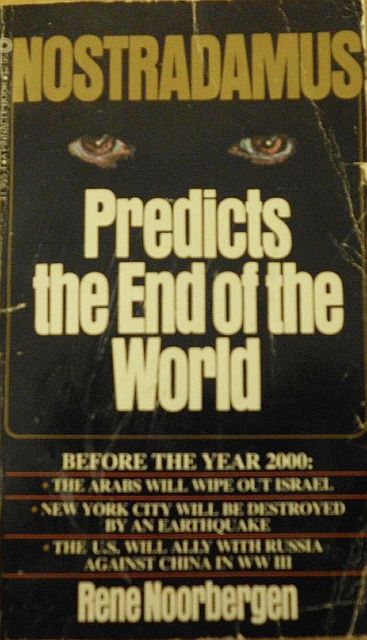
Book Review: Nostradamus Predicts The End Of The World by Renee Noorbergen


In the year 2010, I was at Half-Price Books when I came across an old paperback called Nostradamus Predicts The End Of The World.  The book was full of the cryptic prophecies of the French astrologer Nostradamus, along with interpretations of that what those predictions actually meant.  The book argued that, by using those interpretation, once could come up with a chronological narrative of the next great world war.  The book predicted that World War III was going to break out in the 90s, that New York was going to be destroyed in 1999, and that the world, as we knew it, would be over with around the year 2000.  Once I saw that the world has apparently ended ten years ago, my sense of humor demanded that I buy the book.

Since that time, a few people have told me that I shouldn’t laugh at stuff like this and that, just because the dates were wrong, that doesn’t mean that it’s not going to happen.  Some have pointed out that the passage in which Nostradamus predicted a nuclear bomb hitting New York in 1999 could have just as easily been a prediction of 9/11 and that perhaps Nostradamus either misinterpreted the date or maybe it was originally meant to happen in 1999 but got pushed back a few years or …. well, there’s always a reason, isn’t there?  My argument, of course, is that the only time that Nostradamus gives a date for any of his predictions, he was wrong.  It’s probably not coincidental that Nostradamus picked a date that was so far in the future, he wouldn’t have to worry having to explain himself.

The thing with Nostradamus though is that his “prophecies” were so vaguely written that they could pretty much be interpreted to mean anything.  Indeed, it seems like a compelling argument could be made that his prophecies were actually meant to keep him in favor with the wealthy and royal patrons who subsidized his life.  Much of what he wrote works as Rorschach test.  Readers are going to find what they’re looking for.

For instance, the author of Nostradamus Predicts The End of the World was apparently looking for a battle-by-battle history of the Third World War.  For the author, that was found in Nostradamus’s prophecies.  The book argues that conflict in the Middle East would lead to a World War between the U.S., Russia, and China and that apparently only Australia would be spared.  Towards the end of the book, the author fixates on a red-haired general who apparently referred to in several of Nostradamus’s prophecies.  One wonders why Nostradamus would specifically tell us the year that New York was going to be destroyed and why Nostradamus would, as some have claimed, warn about an evil German leader named “Hister” but while leaving vague the identity of the general who is going to be the key to saving the world.  Indeed, what even is the point of being able to see into the future if you’re going to be so deliberately vague in your reporting that no one is going to know what you’re talking about?

Interestingly enough, even though it’s been over 22 years since the date that Nostradamus the world would end, there are still people posting his prophecies online and saying that he predicted everything from Trump to COVID to AOC.  Never stop believing, I guess.

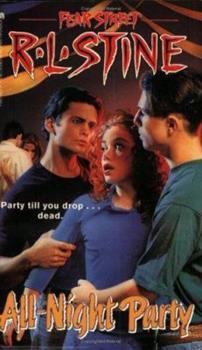
Book Review: All-Night Party by R.L. Stine


You may remember that, when I reviewed R.L. Stine’s The OvernightI commented that it seemed odd that Fear Lake would have an island sitting in the middle of it and I even wondered if this was a location that Stine used frequently or if it was just something that he randomly tossed into the book.

Well, 1997’s All-Night Party features yet another group of teens spending a long night on Fear Island so I guess that answers my question.  Fear Island is real!  And apparently, it’s a dangerous place.  This is the second book that I’ve read about an act of violence taking place on Fear Island.  Both books not only featured people getting attacked on the island but they also both featured people randomly falling down hills and stuff while walking around the island.  The island is not safe!  Maybe it’s time bulldoze the cabin and build a barrier around the island or something.  Of course, that’ll never happen because that would require too much commitment from the adults of Fear Street.  I’m not all that sure that the parents of Fear Street really care that much about any of their children.  I mean, someone gets murdered every week and yet, no one ever seem to move.  Instead, almost every book seems to start with a new family moving in!  The Shadyside High School yearbook has got to be 75% in remembrance ads.

As for All-Night Party, it’s perhaps the laziest R.L. Stine book that I’ve ever read, which is really saying something when you consider that R.L. Stine wasn’t exactly known for the great care that he put into coming up with his plots and characters.  This is a novel that, for all I know, could have been written by a computer program.

The plot involves a group of teens who decide to throw an all-night party at a cabin on Fear Island.  They’re celebrating Cindy’s birthday.  Cindy is kind of a bitch and after she assures everyone that she hates their presents, she’s murdered in the kitchen.  Who committed the murder?  Was it Patrick, the member of the group who has a big blood stain on his shirt and who keeps getting caught in obvious lies?  Or is the escaped lunatic that Patrick swears is on the island with them?  Or was it someone else in the party, like the seemingly creepy kid who is actually nice and nerdy or maybe the temperamental rebel who has long hair and drives a motorcycle.  This answer is so obvious that it will totally blow your mind when your realize how little effort was put into creating any sort of suspense.

The book feels a rushed and uninspired.  It was published in 1997 and it’s probably not a coincidence that it was one of the last of the original Fear Street books because it’s obvious that either Stine or his ghostwriter were just going through the motions at this point.  To be honest, the solution is so obvious and the plotting is so lazy that I nearly threw the book across the room after I finished with it.

Oh well.  What can you do?  It’s Fear Island.

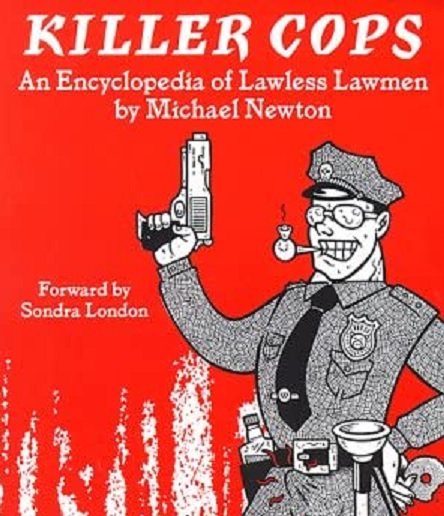
Non-Fiction Book Review: Killer Cops by Michael Newton


The late Michael Newton was quite a prolific author, publishing a total 357 books, which included 258 novels and 99 nonfiction books.  His novels were largely pulp paperbacks, the types with the covers that my sister often features here on the Shattered Lens.  His non-fiction was largely made up of encyclopedias concerning unsolved crimes, serial killers, conspiracies, and that sort of thing.  I own quite a few of this encyclopedias.  He was a good writer with a good knowledge of the macabre.

Killer Cops takes a look at men and women who took an oath to uphold the law but who then turned around and committed the worst crime of all.  Some of the people profiled in this book were serial killers who hid their crimes behind the badge.  Some were cops were just snapped one day.  Some were obviously crooked while others had spotless records.  Some of them were punished for their crimes.  Some of them are still revered for being justice to the frontier.  It makes for interesting and disturbing reading.  For the aspiring horror, thriller or crime fiction writer, Killer Cops is full of potential inspiration.   If there’s an overriding theme to the book, it’s that those in authority should be held to a higher standard and that certainly includes the police.  The killer cops portrayed in this book thought they could hide behind the badge and the uniform and, sadly, a few of them were right.  Newton warns against idealizing or blindly trusting anyone in authority, saying that it’s the individual’s action that matter more than the uniform they wear or the badge that they carry.

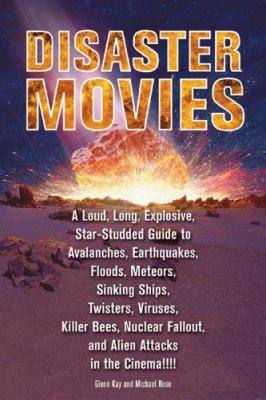
Non-Fiction Review: Disaster Movies by Michael Rose and Glenn Kay


What’s the only thing scarier than being trapped in a real-life disaster?

Being trapped in a disaster movie!

First published in 2006, the full name of this guide to the disaster genre is Disaster Movies: A Loud, Long, Explosive, Star-Studded Guide to Avalanches, Earthquakes, Floods, Meteors, Sinking Ships, Twisters, Viruses, Killer Bees, and Alien Attacks In The Cinema.  That title tells you pretty much everything you need to know about this affectionate but likably snarky look at all the movies that have been made about earthquakes, fires, torandoes, and …. well, basically all the stuff listed in the title.  

On a movie-by-movie basis, this guide reviews disaster movies that are both well-known and obscure.  All of the big ones — Airport, Towering Inferno, Titanic, Independence Day, Poseidon Adventure — are listed here but, even more importantly, so are the obscure ones.  In fact, the book features a lot of films that you might not have heard about but will probably want to track down after you’ve read about them.  The reviews are respectful to the conventions of the genre while also acknowledging the obvious, i.e., a lot of these are not good films.  But the authors understand that sometimes, a bad disaster film can be even more enjoyable than a good one.  The Poseidon Adventure is a classic of sorts but how about Beyond The Poseidon Adventure?  How about Flood!, a film so exciting that it even has an exclamation mark in the name?  How about Avalanche, the best of the snowy disaster films?  What about Meteor?  If love The Swarm but you can’t appreciate Meteor, I don’t know what to tell you.  

Disaster Movies is a well-written guide.  Most readers will discover the existence of at least one film that they previously knew nothing about.  And, hopefully, they’ll be inspired to watch a few of the film reviewed in this book.  In a disaster, it’s always helpful to be prepared.

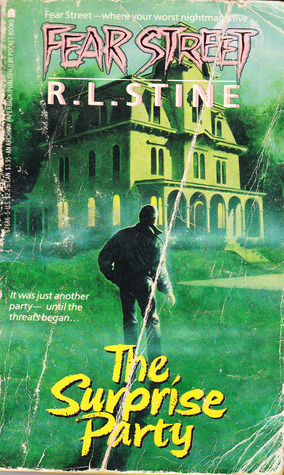
Book Review: The Surprise Party by R.L. Stine


Last summer, after her boyfriend Evan apparently shot himself in Fear Street Woods, Ellen moved away from Fear Street and her friends were left to attend Shadyside High without her.  However, a few months have passed and Ellen now feels safe about returning to Fear Street, if just for a visit.  Her friend, Meg, is super excited!  Meg wants to throw Ellen a surprise party!  Great idea, Meg!  Meg wants to throw it in Fear Street Woods, at pretty much the same location where the dead body of Ellen’s boyfriend was found.  Wait, what?

Meg is shocked when she starts to get phone calls from a mysterious stranger, telling her to cancel the party.  She’s even more upset when someone destroys the invitations that she spent so long working on.  Meg does exactly what I would do in those circumstances.  She makes a list of all the people who she thinks might be responsible.  A few people are put on the list for understandable reasons, i.e., being near the invitations before they were destroyed.  The rest are listed because Meg dislikes them personally.  One kid is listed because he’s way into playing Wizard and Dragons.  Meg’s extremely petty suspect list is probably the most realistic thing about The Surprise Party.  My suspects lists are always a combination of people who have blocked me on twitter and celebrities that I’m sick of hearing about.  My Congressman is usually on the list because he supports the ProAct.

Anyway, it does turn out that there is more to Evan’s death than anyone originally realized.  And yes, the truth comes out at the surprise party.  And yes, all of the twists don’t really make that much sense.  First published in 1989, this was the second of R.L. Stine’s Fear Street books and, to be honest, it’s a little bit disappointing.  There’s nothing supernatural about anything that happens.  Instead, it’s just one of those mysteries that can’t be solved because Stine doesn’t give us all the clues until the very last minute.  I spent the whole book thinking Meg was the culprit because throwing a surprise party in the woods where your friend committed suicide is just incredibly insensitive.  And, if this was a later Fear Street book, I have no doubt that Meg would have an evil twin or something.  But no, this is an early book and Meg’s just dumb.

Oh well.  That’s life on Fear Street!

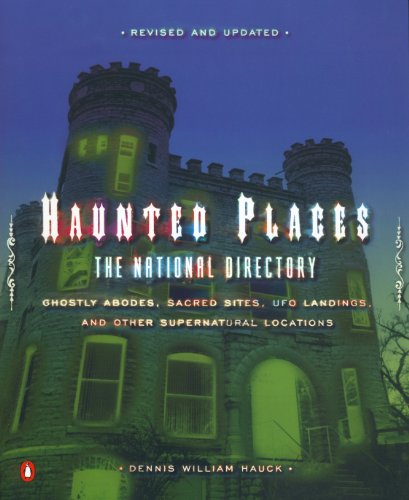
Book Review: Haunted Places: The National Directory by Dennis William Hauck


As I’ve said before, you don’t necessarily have to believe in ghosts to have fun searching for them.

Myself, I don’t believe in Ghosts, UFOs, conspiracy theories, or Bigfoot.  But I still enjoy reading about them and occasionally visiting the places where they’ve supposedly been spotted.  In fact, I would say that being a skeptic makes it even more enjoyable to visit a haunted house.  On the one hand, you would think that, because you don’t believe in ghosts, you wouldn’t be frightened about the possibility of running into one of them.  However, from my own personal experience, I’ve found the opposite to be true.  Haunted houses are even scarier when you don’t believe because you’ve always got that voice in the back of your head saying, “What if you’re wrong?”

Haunted Places: The National Directory is just what the title on the cover says it is.  It’s a listing of places across the country that some believe to be haunted.  Some of the places are said to be inhabited by ghosts.  Some of the places are better known for the UFOs that have supposedly visited.  Some places have been visited by Bigfoot.  There’s a few lakes that are rumored to be home to underwater monsters.  It makes for interesting reading and, like many paranormal directories, it’s a treasure trove of potential inspiration for the aspiring horror writer.  The latest edition of the book as published in 2002 so don’t expect to find information of recent hauntings and some of the locations may have been torn down in the past twenty year.  It happens.  That said, Jeff and I used this book to plan a road trip a few years ago and we had a great time, even if we didn’t see any ghosts.