Book Review: Shadow of Evil by Greye La Spina


Direct from my aunt’s paperback collection, it’s the story of Portia Differdale and her aunt Sophie!

The time is the 1920s.  Sophie has come to Brooklyn, in order to live with the recently widowed Portia.  Portia, unfortunately, is having some issues with her neighbors.  Portia’s late husband was an occultist and, now that he’s died (more or less a victim of his profession), she’s decided to continue on his work.  Needless to say, the local gossips aren’t particularly happy about that.  Personally, I would love to live next door to an occultist, just because I would always some place to send any spirits who showed up in my house.  “Really, you’re undead?” I would say, “Head on next door.”  Sadly, I guess that’s just not the ways things were done in Brooklyn back in the day.

Anyway, Portia is lucky enough to have a potential new suitor.  His name is Owen and Sophie thinks that he would be the perfect new husband for Portia!  Portia, for her part, agrees.  However, it turns out that someone else has her eyes on Owen, as well.  Princess Irma Andreyevna Tchernova is wealthy, beautiful, and charming.  The uninhibited and flirtatious Princess Tchernova soon appears to have all the men in the community under her spell, including Owen!  None of them seem to find it odd that the Princess has an oddly silent servant or that she owns several wolves.  Not even the fact that the Princess eats nothing but meat strikes anyone as odd….

Except, of course, for Portia.  It doesn’t take long for Portia to figure out that there’s something sinister about the Princess but will she be able to save Owen from her grasp?  Read the book to find out!

Greye La Spina was born in 1880 and stared writing horror fiction in the early 20th century, at a time when it was considered somewhat scandalous for a woman to even write fiction, much less horror.  Shadow of Evil was originally published over the course of three issues of Weird Tales in 1925.  It was then reprinted, in paperback form, in 1966.  The cover at the top of this post (and which my sister shared earlier this month) is from the 1966 edition.  Since that time, the book has been occasionally reprinted.

It’s a fun read.  La Spina was a lively and entertaining writer and she tells this tale with the right mix of melodrama and satire.  La Spina obviously loves her unconventional characters and the story is as much about their desire to be independent from the conventions of society as it is about any paranormal activity.  It’s got everything — intrigue, romance,humor, scares, thrills, and a wonderful atmosphere.  It’s an enjoyable story and, if you can track down a copy, one that’s worth reading.
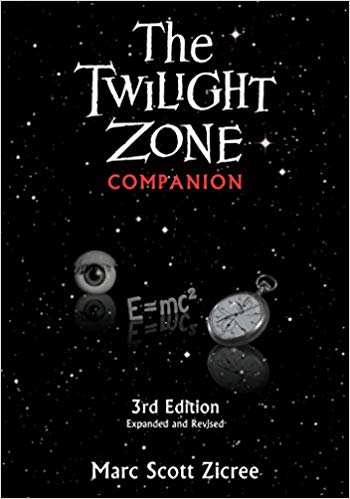
Halloween Book Review: The Twilight Zone Companion by Marc Scott Zicree


Up until a few years ago, every episode of the original Twilight Zone was available on YouTube.

That always made me really happy in October because, really, what better way to end each day of the Halloween month than by watching a classic episode of The Twilight Zone, right?  To Serve Man, The Monsters Are Due On Maple Street, It’s A Good Life, that episode with William Shatner freaking out on the plane and that other one with the guy entering his bedroom only to discover a lion waiting to eat him, these were all great episodes to watch in October!

Sadly, once Hulu started carrying Twilight Zone, all of the old episodes got yanked off of YouTube.  And now that the Twilight Zone is on Netflix, there’s no way the show will ever show up YouTube again.  We can still watch the episodes, of course.  Even if you don’t have Netflix for some reason, SyFy does regular marathons of the original show and, of course, there’s the Jordan Peele revival for those who watch old episodes of the Twilight Zone and say to themselves, “This is good but I just wish it was a little more heavy-handed.”

Well, I may not be able to embed any episodes this October but I can recommend that you order Marc Scott Zicree’s The Twilight Zone Companion, which is an indispensable guide to the original show.  Every episode is covered, with credits, plot synopsis, and anecdotes about the production.  Since a lot of important directors, actors, and writers did at least a little bit of work on Twilight Zone, the anecdotes are all very interesting and very much worth reading.  Even more importantly, Zicree takes a look at the life of Twilight Zone creator Rod Serling and also some of the key people involved behind the scenes.  The tragic story of Charles Beaumont will move you to tears.

So, if you’re a fan of the original show, you need this book!  Order it and enjoy!

Book Review: Lucio Fulci: Beyond The Gates: A Tribute To The Maestro by Chas Balun


Three years ago, I was really happy to discover that TCM was showing Lucio Fulci’s classic slasher, The House By The Cemetery.

Finally, I said, the maestro is getting some respect!

It’s the same feeling that I had when I recently came across both Zombi 2 and The Beyond playing on Showtime.  Sure, there’s a huge difference between one of your movies appearing on Showtime or Cinemax and being a respected filmmaker.   I mean, Uwe Boll’s movies are on all the time.  But still, just the fact that Fulci’s films were being shown meant that there was a chance that others would see them for the first time and maybe — just maybe — that person would get it.  That person would watch Fulci’s films and they would understand why horror fans like me continually describe him as being one of the best and most important filmmakers of all time.

Indeed, when it comes to Fulci, you either get it or you don’t.  When he died in 1996, Fulci was reportedly living in poverty and, despite all of his past cinematic successes, was struggling to find the financial support necessary to keep making films.  Sadly, he did not live to see his films rediscovered by horror fans like me.  Today, I’d say Fulci is still an underappreciated filmmaker but, slowly but surely, the Cult of Fulci is growing.  If nothing else, the current zombie movie boom would never happened without the efforts of both Lucio Fulci and George Romero.

Lucio Fulci: Beyond The Gates is a short, 79-page booklet that was published in 1996, immediately after Fulci’s death.  It’s really less a book than an extended essay written by a fan named Chas Balun.  The book, which covers Fulci’s filmography and pithily defends his work against his detractors, was really written mostly for Fulci fans.  It’s a booklet that we can read and laugh to ourselves as we say, “Can you believe those people who really don’t get it?”  As such, it’s probably not the book to give to someone who isn’t already a fan.  But, for those of us who already get it, it can be a fun read.  At the very least, it’s an important historical document as a tribute to the director that was written directly after Fulci’s death.  It’s the loving eulogy that Fulci deserved.

It’s also a bit of a collector’s item.  If you go on Amazon right now, you’ll find that copies in “new” condition are going for $100.  Used copies are going for $70.94.  I found my copy at Half-Price Books in Dallas and I paid $1.50 for it.

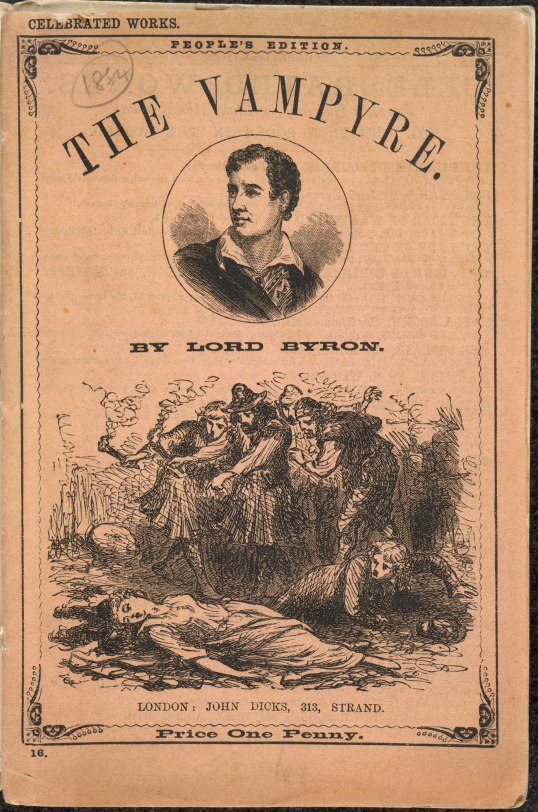
Book Review: The Vampyre by John William Polidori


Though The Vampyre was often erroneously attributed to Lord Byron, it was written by John William Polidori

First written way back in 1816, The Vampyre is a story about an amazingly naive young gentleman named Aubrey who becomes friends with the mysterious Lord Ruthven.

Everything about the enigmatic Lord Ruthven would seem to suggest that he’s a vampire but Aubrey never figures that out while he and the nobleman travel across Europe.  Even after an inkeeper’s daughter dies of a vampire attack shortly after telling Aubrey about vampires (and, also, immediately after the sudden arrival of Ruthven), it still doesn’t occur to Aubrey that there might be something strange about Lord Ruthven.  When Lord Ruthven is mortally wounded by bandits, he makes Aubrey swear an oath that he will not tell anyone about Ruthven’s death for a year and a day.  Aubrey promises to keep the oath.

Now, apparently, back in the 19th century, people took those oaths very seriously because, even after Lord Ruthven shows up alive once again and now claiming to be the Earl of Marsden, Aubrey can’t tell anyone that he saw Ruthven die.  Even after Ruthven starts to court Aubrey’s sister with the obvious intention of draining her blood, Aubrey still cannot bring himself to break his oath.  Is it because oaths were really that important or is it that Aubrey himself is as in thrall of Ruthven as his sister?

John William Polidori was a physician and a writer, as well as a contemporary and friend to Mary Shelley, Lord Byron, and Percy Shelley.  The Vampyre was conceived and written as a part of the same contest that saw Mary Shelley write Frankenstein.  Though Polidori’s story is understandably overshadowed by Mary Shelley’s (and, it must be said, Polidori was nowhere near as good a writer as his famous friends), it’s still historically significant as the first “romantic” vampire tale.  It’s the story from which so many others have sprung.

Many have also speculated that the story was based on Polidori’s friendship with Lord Byron, with Polidori represented by the unstable Aubrey while the self-centered but charismatic Lord Ruthven was perhaps meant to be a stand-in for Byron himself.  This may be true or it may not.  (When it comes to Byron, the Shelleys, and Polidori, it’s always perhaps a bit too tempting to read too much between the lines.)

The Vampyre is a historically important piece of work so, if you’re a fan of vampires, you have to read it.  Flaws and all, we owe much to Lord Ruthven and John William Polidori.


Book Review: David Warbeck: The Man and His Movies by Raymond J. Slater and Harvey Fenton


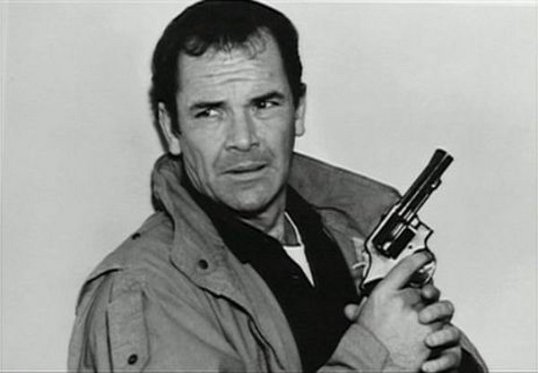
David Warbeck

Anyone who is a fan of Italian exploitation films will knows the name and the face of actor David Warbeck.  Warbeck was the handsome, rugged, and surprisingly likable New Zealand-born actor who went from studying at London’s Royal Academy of Dramatic Arts to appearing in films that were directed by everyone from Russ Meyer to Antonio Margheritti to Lucio Fulci.  He played a small but pivotal roles in Sergio Leone’s A Fistful of Dynamite and then went on to star in The Beyond, The Black Cat, The Last Hunter, Rat Man, and so many others.  While his films may never have been critical favorites at the time of their release (though several have been positively reevaluated), Warbeck’s movie did well enough at the box office that he was even considered for the role of James Bond,  Warbeck was one of those actors who was consistently good, regardless of the quality of the film in which he was appearing.

Sadly, Warbeck passed away in 1997, before many of his films were rediscovered.  It’s a shame because — as the commentary track that he and Catriona MacColl recorded for The Beyond shows — he was a charming raconteur who had a way with a story.  Fortunately, in 1996, Warbeck did sit down and gave a lengthy interview to Jason J. Slater, in which he discussed his career and shared many anecdotes about his life as an international exploitation superstar.  That interview is at the center of a short but interesting book called David Warbeck: The Man And His Movies.

The book not only features the interview with Warbeck but it also takes a detailed look at his filmography, reviewing some of his more interesting (and, in some cases, infamous) films.  The reviews are well-written by people who obviously love these often underappreciated films.

If you’re a fan of Italian exploitation, this book is simply a must-have.  Admittedly, it’s not an easy book to find.  I ordered a copy off of Amazon and it wasn’t cheap.  But it was worth it!

Horror Book Review: Monster by Christopher Pike


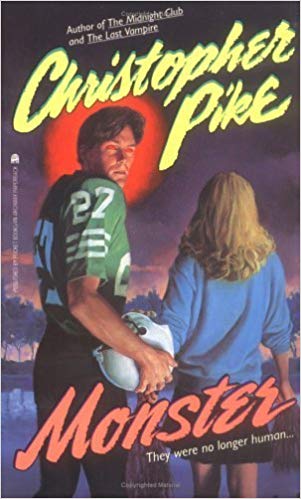
“They were no longer human…” the cover of 1992 first edition of Christopher Pike’s Monster announces and indeed, they’re not!  That cover, I should add, makes the book look a lot more light-hearted than it is.  It makes it look like it’s some sort of sci-fi comedy about a demonically possessed football player when there’s actually very little about this book that could be considered light-hearted.

This book is dark.  Like, seriously, dark.

It opens with popular high school student Mary Carlson walking into a party while carrying a shotgun.  She blows away a football player named Todd and then a cheerleader named Kathy and then she points the gun at her own boyfriend, Jim.  Fortunately, the new girl at school, Angela, manages to distract Kathy just long enough for Jim to take off running into the woods.  Mary goes chasing after him but she gets arrested before she guns him down as well.  It’s probably a good thing that Jim survived because, without him, how would the football team ever win another game?  After all, the team sucked just last season before all of the players and the cheerleaders suddenly got super strong!

Anyway, Mary says that she was shooting her friends because they were no longer human and, according to her, the three of them have been picking up people and killing them in a warehouse.  Police Lt. Nguyen doesn’t believe her but Angela feels a bit of an obligation to investigate Mary’s story.  And really, it’s the least she can do considering that she promptly starts flirting with Jim right after Mary’s arrested.

It quickly becomes obvious that something strange has happened to all of the school’s athletes and cheerleaders.  Maybe it has something to do with the mysterious crater from which the town gets its drinking water.  Angela notices that Jim tends to eat everything in sight, including a raw hamburger.  After she and Jim make out and she ends up getting some of his blood on her, she soon finds that she’s eating everything in sight.  Is it possible that some sort of monster has not only taken over Jim but is now taking over Angela as well!?

Yes, it is.  That’s bad news for Kevin, who is Angela’s BFF and who is totally in love with her even though she only views him as being a very good friend.  Oh, poor Kevin!  Kevin is one of the few wholly sympathetic characters in the book and he still ends up with a broken neck.  Like I said, this book is dark!

It all ends on an appropriately dark note and I guess that’s the important thing.  This book was written in 1992 and, at the time it was written, it was probably meant to be a metaphor about the dangers of having unsafe sex, as Angela is infected after fooling around with Jim.  Reading it today, though, it feels more like a commentary on just unsafe school has become over the past decade.  Mary Carlson, blowing away her friends because they’re “not human,” brings to mind so many recent gun-related tragedies.  It’s a bit difficult to read.

Anyway, Monster is a seriously dark book but still an effectively macabre story.  Nobody was as skilled at traumatizing young readers as Christopher Pike!

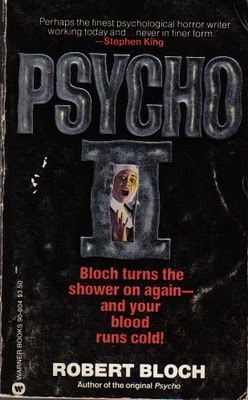
Horror Book Review: Psycho II by Robert Bloch


So, first things first.

This 1982 novel by Robert Bloch is indeed a sequel to the novel that inspired Alfred Hitchcock’s legendary horror film.  Yes, Norman Bates does return.  For that matter, so do Lila and Sam Loomis.  However, this novel should not be mistaken for Richard Franklin’s film, Psycho II, which came out a year later.  In fact, according to a later interview with Robert Bloch, Universal actually pressured him not to release this novel because they disliked the story Bloch had come up with and they also felt it would harm the financial prospects of their sequel.  Bloch, of course, did what he wanted to and was subsequently not invited to any screenings of Franklin’s film.

As for Bloch’s novel, it’s easy to see why Universal wasn’t enthusiastic about it.  It’s perhaps one of the most anti-Hollywood books ever written.  When Norman Bates escapes from a mental asylum and goes on another rampage, his doctor, Adam Claiborne, is convinced that Norman is heading to Hollywood to try to stop production of a movie called Crazy Lady, a movie that’s based on Norman’s crimes.  Even though everyone else is convinced that Norman’s been killed, Claiborne remains convinced that Norman faked his own death and is still out there.

Needless to say, the book’s Norman is considerably different from the vulnerable manchild that Anthony Perkins played in the films.  However, Norman is off-stage for the majority of Bloch’s sequel, the better to keep you wondering whether or not he actually is dead.  The majority of the book is dedicated to Claiborne getting to know the cast and crew of Crazy Lady, the majority of whom turn out to be sleazy Hollywood stereotypes.  Reading the book, it’s easy to see why Universal didn’t care much for it but, at times, Bloch occasionally comes across as if he think he’s the first person to ever be critical of Hollywood.

Another reason why Universal may have balked at adapting Bloch’s novel was because of a surreal chapter in which Paul Morgan, the actor who has been cast to play Norman, goes undercover at a brothel where all of the escorts look like then-Hollywood stars.  Since each escort is referred to by his star’s name, the entire chapter is basically Robert Redford, Clint Eastwood, and John Travolta making bitchy comments about Hollywood and religion.  It’s an odd chapter that doesn’t advance the story but, at the same time, it’s also Bloch at his most subversive.

Though the book’s take on Hollywood was hardly revolutionary, Bloch was a born storyteller and the story moves at a good pace.  It all ends with an effective twist, one that provides a proper ending to Bloch’s version of the Norman Bates story.  For Psycho and Bloch fans, it’s a must read.

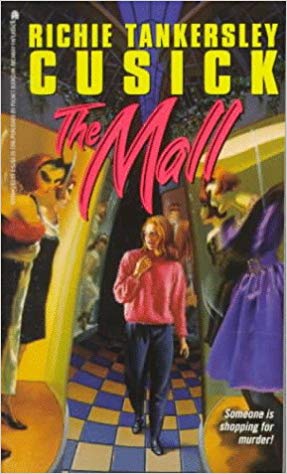
Horror Book Review: The Mall by Richie Tankersley Cusick


The Mall was first published in 1992 and really, it’s a story that could only have taken place in the early 90s.  Why is that?  Well, there’s a couple of reasons:

First off, it not only takes place in a mall but it also takes place during a time when everyone’s life revolved around the mall.  You can’t just order stuff online in this book.  Nope, you have to physically walk from store to store.  Sometimes, you even have to ride an elevator.  If you suggested to anyone in this book that they should just order something off of Amazon, they’d probably complain about having the pay the international shipping.

Secondly, this is a book in which characters regularly find themselves in situations where 1) there’s no escape and 2) there’s no one around to call for help.  Today, of course, anyone who gets stuck on an elevator can just call the cops on their phone.  By that some token, if you’ve got some weird stalker constantly calling you, you can just block him.  But, in the world of The Mall, there’s no way to block (or trace) a caller who uses a pay phone.  And, if you’re stuck on an elevator …. well, you’re just stuck there until your stalker decides to toss a dead body in there with you.

Anyway, this is one of those books that opens with a prologue in which a stalker stares at the object of his lust and spends a lot of time thinking about how she will eventually be his, though only when the circumstances are just right.  Apparently, because he’s obsessed with a teenage girl who works at the mall, the stalker spends a lot of time pretending to be a mannequin which …. agck!  I mean, c’mon, that is definitely a creepy image.

Trish Somerfeld works at the mall, with her best friend Nita.  Trish is employed at …. I kid you not, Muffin Madness.  Nita works at a clothing store called The Latest Trend (no seriously).  Nita is a little bit creeped out by the fact that another girl who worked at the mall recently disappeared.  The rumor is that the girl was murdered though it’s possible that she might just be out of town.  Trish, on the other hand, is disturbed by the fact that she keeps getting calls from someone who has a “womanish voice” and who says things like, “I’m eating your muffin right now.”  The stalker soon becomes known as the — *ahem* — Muffin Man.

Who is the Muffin Man?  Could he possibly be the cute guy who is always hanging out the mall and seems to be particularly interested in Trish?  (I mean, he winked at her!)  His name is Storm Reynolds and …. what?  THAT IS TOO HIS NAME!  DO YOU THINK I’D MAKE UP A NAME LIKE THAT!?

Where was I?  Oh yeah.  So anyway, Trish is totally being stalked and she knows it but, at the same time, she doesn’t really do much about it.  Even when she comes across a dead body with an ice pick in its head, she declines to let anyone know because she doesn’t want to get one of the mall security guards in trouble.  Anyway, Trish eventually is forced to deal with her stalker and the revelation of his identity is not really that much of a surprise.

It’s a dumb book but it’s also a fun book, largely because Richie Tankersley Cusick takes so much delight in describing life in the mall.  Because it’s a book that was written for 90s teenagers, the lead character can get away with doing a lot of dumb stuff and, as dense as Trish might be, at least she has two good friends, Nita and her twin sister, Imogene, who have always got her back.  Storm Reynolds is a bit of a jerk and you cringe when he’s set up as a love interest but, at the same time, his name is Storm so I always giggled whenever anyone talked about him.

Plus, how can you not enjoy a book where the main villain is known as the Muffin Man?  Seriously….

As far I know, Lifetime never did a film version of The Mall.  That’s a missed opportunity on their part, if you ask me.

Horror Book Review: Fevre Dream by George R. R. Martin


First published in 1982, George R. R. Martin’s Fevre Dream is a novel that centers on two men.  Captain Abner Marsh may be considered physically unattractive and lacking in certain social graces but he’s also known as one of the best steamboat captains in pre-Civil War Mississippi.  Joshua York may be wealthy and charming (if a bit pale and fond of a strange-tasting red liquor) but he knows little about how to actually run a steamboat.  That said, as York explains it to Marsh, he wants to build the fastest and most luxurious steamboat ever made.  Marsh may initially be weary of the seemingly eccentric York but he needs the money.

When the steamboat (which is christened the Fevre Dream) is eventually constructed, it turns out to be everything that York said it would be.  Soon, Marsh is sailing the boat up and down the Mississippi River.  The command of the boat and its passengers is largely left in Marsh’s hands.  York requests is that he and his friends be left alone in their cabins.  York doesn’t particularly enjoy coming out during the day….

Could York be a vampire?  Of course, he is!  But he’s not the type of vampire that everyone’s read about.  Instead, York is a visionary vampire.  His dream is to set his people free from their compulsive blood-drinking.  However, there’s another vampire moving up and down the river.  His name is Damon Julian and he has plans of his own for the Fevre Dream….

A vampire novel by George R. R. Martin!?  Indeed, it is!  Of course, since this is a Martin book, the vampires of Fevre Dream aren’t like the traditional vampires that we all know and love.  These vampires are a totally different species of being and one of the key points of the book is that humans cannot be transformed into vampires.  Indeed, the vampires view human as being mere “cattle,” being bred for their hunger.  York’s concern is that, if the vampires continue to feed on humans, the humans will eventually rise up and destroy them.  Damon, of course, is far less concerned about that.  Just as how the white slave owners arrogantly assume that their slaves have no desire to free, Damon and his followers arrogantly assume that the humans will always stay in their place.  Damon even has a human servant, Billy Tipton, who has been fooled into thinking that he might someday become a vampire as long as he does everything that Damon orders him to do.

It’s an interesting novel, one that does a good job of incorporating it’s paranormal story into an authentic, historical background.  If you’re really into vampires and steamboats, there’s a lot of both to be found in this book.  Unfortunately, I get the feeling that the people reading for the vampires will probably get bored with all pages devoted to steamboats while steamboat enthusiasts might not care much for the vampires.  Myself, I’m a history nerd and a lover of all things vampiric so there’s no way I wouldn’t appreciate a novel about vampires in 19th century Mississippi.

It may not be for everyone but Fevre Dream is a well-written and compulsively readable historical vampire epic.

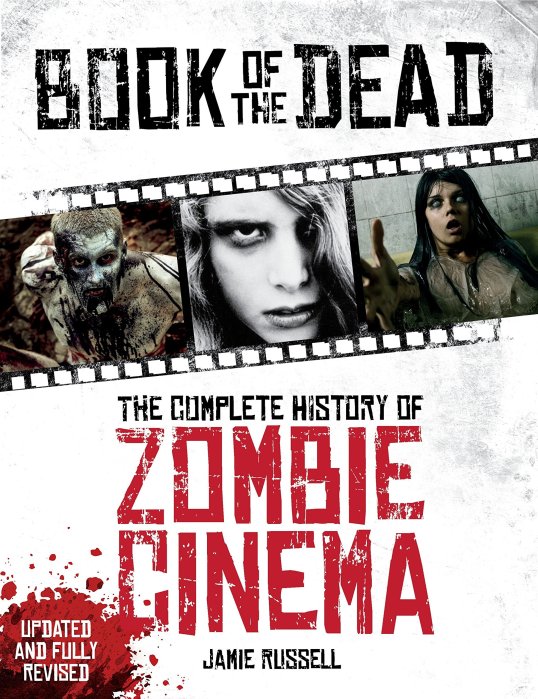
Horror Book Review: Book of the Dead by Jamie Russell


If you’re still making out your Halloween movie list, might I suggest that you pick up a copy of Jamie Russell’s Book of the Dead?  Because, seriously — what’s a Halloween movie night without a few zombies thrown into the mix?

Book of the Dead is comprehensive study of the history of zombie cinema, starting with a look at how the legend of the zombie first began and then progressing through White Zombie, the dead films of George Romero, the great Italian zombie films of Lucio Fulci, and finally moving all the way to the modern era.  Scary zombies, funny zombies, porno zombies, political zombies, underwater zombies, French zombies; they’re all here!  It’s a well-written book, one that was clearly written by somebody who not only loves the movies in general but zombie films in specific.  Russell seems to be having so much fun writing about these films that it’s impossible not to share his enthusiasm.

Even better, the book contains a comprehensive appendix that lists and reviews basically every zombie film ever made!  Seriously, there all here — from the obscure to famous.  When I first started to seriously study the history of horror cinema, Book of the Dead was one of the first resources that I purchased and I used to obsessively study that appendix.  It’s thanks to this book that I discovered films like I, Zombie: The Chronicles of Pain.  It was thanks to this book that I discovered that there was more to zombie cinema than just corpses eating brains.

This book was originally published in 2005 and, at that time, basically went up to the Resident Evil-era of zombie films.  Subsequent editions have been updated with even more zombie films and even more zombie reviews!  This is the perfect book for all of your undead needs!