Retro Television Review: The Only Way Out (dir by Rod Hardy)


Welcome to Retro Television Reviews, a feature where we review some of our favorite and least favorite shows of the past!  On Sundays, I will be reviewing the made-for-television movies that used to be a primetime mainstay.  Today’s film is 1993’s The Only Way Out!  It  can be viewed on YouTube.
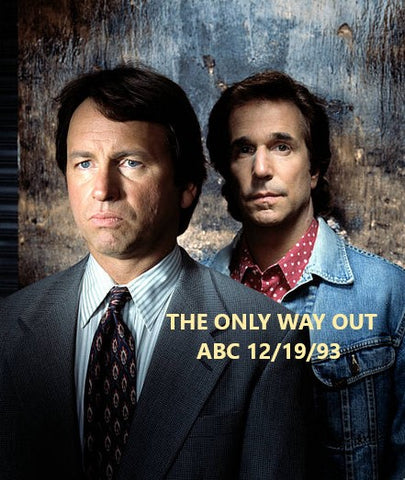
“I’ll kill you before I let you go,” Tony (Henry Winkler) says to his terrified girlfriend, Lynn (Stephanie Faracy).

Agck!  Those are frightening words and they are certainly not something that you would expect to hear from a character played by notorious Hollywood nice guy Henry Winkler.  And, indeed, it would probably shock most of the characters in the film if they knew how Tony talked to Lynn.  Tony is a grad student who has worked at any number of jobs.  While some people might say all of those jobs prove that Tony has a hard time sticking to anything, Tony has obviously learned how to convince people that he’s actually a just a determined man working his way through grad school and taking whatever job will help to pay the bills.  Tony is friendly and romantic and given to grand gestures.  He’s the type who shows up unexpectedly at Lynn’s place of employment with flowers.  He’s the type of guy that strangers applaud while those close to him look for any way to escape.

Lynn knows all about the other side of Tony.  Tony is controlling, obsessive, and abusive.  He hits her.  He barks orders at her kids.  When she tells him that she wants him out of her life, he refuses to go and blames her for all of their problems.  He’s someone who can quickly go from being everyone’s friend to being a monster.  He preys on insecurity and, whenever anyone stands up  to him, he plays the victim.  Tony is a classic abuser and the fact that he’s played by the likable Henry Winkler makes him all the more disturbing.  Like most abusers, Tony knows how to turn on the charm.  He knows the power of a smile and a few complimentary words.

Lynn is in the process of getting divorced from an architect named Jeremy (John Ritter).  It’s been a remarkably amicable divorce, with Jeremy and Lynn agreeing on joint custody and apparently not bearing any ill feelings towards one another.  The only problem is that Lynn cannot bring herself to actually sign the divorce papers.  Jeremy wants to marry Susannah (Julianne Phillips) and Susannah is not happy about the long wait.  She’s even less happy when Jeremy takes it upon himself to try to protect Lynn from Tony.  Soon, Tony is stalking Jeremy and Jeremy finds himself considering a particularly extreme solution to his problem.

It’s John Ritter vs Henry Winkler and the casting of two of Hollywood’s best-known nice guys as violent rivals works surprisingly well.  Winkler is memorably unhinged while Ritter plays a guy who is struggling to hold onto a life that, until Tony shows up, seemed to be perfect.  In the end, it’s not just Tony who catches us by surprise by just how far he’s willing to take things.  The film’s ending took me by genuine surprise.  Featuring excellent dramatic turns from two actors best known for their comedic skills, The Only Way Out is a superior melodrama.


Horror Movie Review: When A Stranger Calls Back (dir by Fred Walton)


The 1993 film, When A Stranger Calls Back, opens with the recreation of an urban legend.

A teenager babysitter named Julia Jenz (Jill Schoelen) arrives at a big suburban house for a routine baby-sitting gig.  The two children are already asleep in bed.  All Julia has to do is sent in the living room and do her homework until the parents return from their party.  Julia settles in.  She gets one mysterious phone call but hangs up.

Then, someone knocks on the door.

The man on the other side of the door explains that his car has broken down and he asks if he can come inside to call his auto club.  (This is one of those films that could have only worked in the age of landline phones.)  Julia doesn’t want to let the man into the house but the man is insistent that he needs Julia’s help.  Finally, Julia says that she’ll call the auto club for him but, when she goes to the phone, she finds that the line is dead.  Rather than tell the man the truth, Julia lies to him and says that she called the auto club.  The man thanks Julia and says that he’s returning to his car.

(What is an auto club?)

Eventually, the man returns, knocking on the door and asking if Julia really called the auto club.  Julia continues to lie, even as the man becomes increasingly belligerent.  What Julia doesn’t know but soon discovers is that the man is not outside talking to her but he’s actually inside of the house.  And he’s abducted the children!

The opening scene, which of course harkens back to the original When A Stranger Calls, is a genuinely well-done and suspenseful sequence.  Again, much like as if with the first film, the opening of When A Stranger Calls Back is so strong that the rest of the film can’t really keep up.

When A Stranger Calls Back is indeed a sequel to When A Stranger Calls, which means that, after Julia’s terrifying night of babysitting, the film jumps forward five years.  The children are never found and the man who knocked on the door is never identified.  Julia is now a college student but she’s still traumatized by the night and has a difficult time trusting anyone.  When she starts to suspect that someone has been in her apartment, she turns to Jill Johnson (Carol Kane), who is a counselor at the college and also the protagonist from When A Stranger Calls.  Jill helps Julie out, teaching her how to shoot a gun and also calling in the man who killed her stalker, John Clifford (Charles Durning).  Clifford figures out that Julia’s stalker is probably a ventriloquist.  Personally, I think the film made a huge mistake by making the stalker a ventriloquist instead of the ventriloquist’s dummy.

Despite strong performances from Carol Kane, Charles Durning, and Jill Schoelen, When A Stranger Calls Back suffers from the same problem as When A Stranger Calls.  After a scary and effective opening sequence, the rest of the film just feels like a letdown.  The killer in When A Stranger Calls Back is not quite as wimpy as the phlegmatic British guy from the first When A Stranger Calls but still, how intimidated can you be by a ventriloquist?  An even bigger problem is that When A Stranger Calls Back cheats at the end, suddenly revealing that a character who we had every reason to believe to be dead is actually alive.  It feels a bit as cop out on the part of the film, an attempt to slap an improbable happy ending on a film that would otherwise be pretty dark.

These films make me happy that I was never responsible enough to be a babysitter.