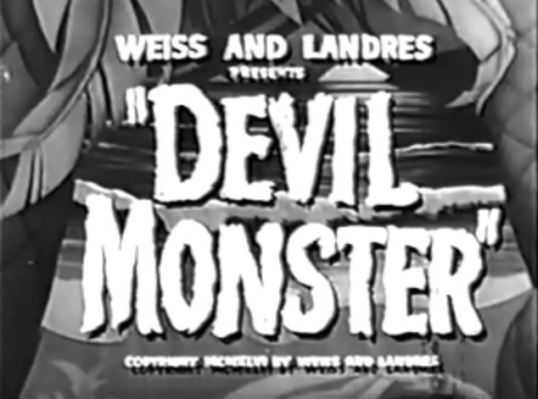
Oh my God, where to begin with this?
Okay, how about with a few confessions.
Number one, I came across the 1946 film Devil Monster in my 100 Horror Classic Movie Pack from Mill Creek. The main reason that I decided to watch and review it was because it only had a running time of 64 minutes. (On a good night, I have a 10-minute attention span.)
Number two, I guess it’s debatable whether or not Devil Monster really qualifies as horror movie. I mean, it is called Devil Monster. And there’s a big stingray that shows up during the final 10 minutes of the film and it rips off someone’s arm. I assume the stingray is meant to be the devil monster of the title. It’s not really scary but it’s supposed to be. What matters is that, from the title and some of the dialogue, it’s obvious that an attempt was made to sell this movie as being at least partially a horror film.
Finally, you may have noticed that I mentioned that Devil Monster was a 1946 film. Well, that’s actually debatable. Devil Monster was apparently released in 1946 but, according to Wikipedia and the imdb, it’s actually a re-edited version of a 1936 film called The Sea Fiend. Footage from The Sea Fiend was apparently mixed with stock footage and scenes lifted from other random films. (One scene, featuring a bunch of island natives dancing, was clearly lifted from a silent film.) The film was then dubbed over and a heavy-handed, nonstop narration was added in an attempt to link all of these random scenes together. So, even though Devil Monster was released in 1946, it was actually filmed, in pieces, much earlier.
And really, that’s the main thing that I liked about Devil Monster. It’s not that the film is in any way good or memorable. (Well, it is memorable but mostly in a WTF sort of way.) Instead, it’s a testament to the “never give up” attitude of the best B-filmmakers. The producers of Devil Monster took a bunch of random footage, crammed it all together, and created something that resembles a movie. Good for them.
As for the movie itself, it’s about a bunch of tuna fishermen who take the boat out and decide, in between searching for tuna, to stop by an island and pick up Jose (Jack Del Rio), who has been hiding out on the island ever since he was shipwrecked. The problem is that Jose doesn’t want to go home and, after he’s forcefully dragged onto the boat, he decided to sail the boat into a part of the ocean that is home to the Devil Monster. But then once the Devil Monster shows up, Jose changes his mind about killing everyone. He jumps overboard and gets into a fight with the Devil Monster and … well, you simply have to watch it to truly understand how ludicrous this fight truly is. Basically, footage of Jose throwing punches was superimposed over footage of a stingray in the ocean. As a result, the scene features Jose punching the stingray and the stingray not reacting at all. On top of all that, Jose is somewhat transparent. You can literally see the ocean through him. And, in the scenes where Jose is supposed to be swimming, you can see the hands of the crew holding him up in the air.
(Meanwhile, as we watch all this, we hear — but do not see — the tuna fishermen cheering Jose on. “Get that devil fish, Jose!” someone yells.)
Of course, before that exciting scene, we get to see a battle between an octopus and a moray eel. They are supposed to be at the bottom of the ocean but it’s obvious that they are actually in an aquarium. How obvious? Obvious enough that the studio lights are reflected in the glass and that the octopus tentacles gets stuck on the side of the aquarium in a few scenes.
And, before we watch the octopus/eel battle, the fisherman stop off at an island, where they meet a bunch of topless native girls. We don’t actually see the fisherman interact with the natives. Instead, we just hear the narrator tell us how much they enjoyed hanging out with the girls. The natives, of course, change ethnicity from scene-to-scene, depending on from which source the footage has been lifted.
One of my favorite parts of this film comes at the end. That’s where the boat captain’s son spots Jose and says, “There he is now.” We then see Jose walking, before cutting back to the exact same footage of the son saying, “There he is now,” followed by the exact same footage of Jose walking.
My other favorite part of the film comes about 40 minutes in. That’s when the screen goes black and we’re presented with a title card that reads, “One Moment Please, While We Change Reels.”
Of course, there’s also the scene where one of the fishermen suddenly yells, “TUNA! TUNA! TUNA!” He’s just sounds so excited.
Devil Monster is in the public domain and can be found on YouTube. Watch it at least once, just so you can say that you’ve seen it.
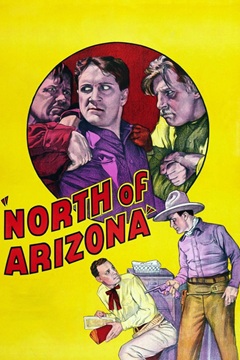 Newly hired ranch foreman Jack Loomis (Jack Perrin) comes to the aid of two Indians who were nearly swindled out of their land during a card game. The Indians inform Jack that his new boss, George Tully (Al Bridge), is actually a crook and the ranch is just a front for his criminal activities. When Jack says he doesn’t want to be a part of Tully’s schemes, Tully and his men frame Jack for a robbery.
 Through the Shattered Lens