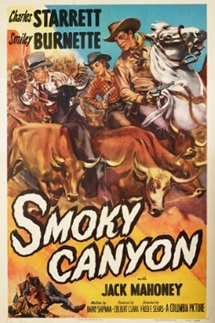
Smoky Canyon (1952, directed by Fred Sears)


There’s a $2500 dollar reward out for the masked bandit known as the Durango Kid but little do the residents of Timber Rock know that the Kid is actually Steve Brent (Charles Starrett), a Treasury agent who puts on a mask whenever he needs to go undercover and discover what the bad guys are doing.

A range war has broken out between the sheep farmers led by Jack Mahoney (Jock Mahoney) and the cattlemen led by Carl Buckley (Tristram Coffin).  To broker a peace and discover which side is the most to blame, Brent works for the cattlemen while the Durango Kid sides with the sheepmen.  It turns out that Buckley’s to blame here.  He’s using the war to thin out his cattle so that an Eastern beef syndicate can keep prices high.  When Mahoney gets too close to the truth, he is framed for the murder of Mr. Woodstock and it’s up to the Durango Kid to prove that Mahoney is innocent.  Meanwhile, Carl wants to blow up an entire mountain so that it will really thin out his cattle herd.

This is a typical Durango Kid movie, entertaining if you like B-westerns and probably boring if they’re not your thing.  It has all the usual gunfights, horse chases, and dynamite explosions that are promised by every Durango Kid film.  Starrett was always one of the most convincing cowboys on screen, even if his use of the Durango Kid alter ego didn’t always make sense.  All the usual members of the Durango stock company show up, all playing different characters than they did in the previous Durango Kid film.  Mahoney gets to play one of the good guys for once and his spirited girlfriend is played by the lovely Dani Sue Nolan.  Smiley Burnett shows up to provide comic relief.  This time, he’s a singing tour guide.  He sings a song called It’s Got To Get Better.  Let’s hope so.

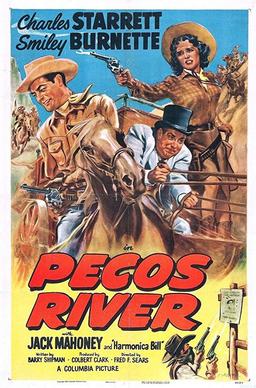
Pecos River (1951, directed by Fred F. Sears)


College student Jack Mahoney (Jock Mahoney) returns to his hometown on the frontier to pay a surprise visit to his father, Old Henry (Edgar Dearing).  Old Henry owns a local stagecoach line and is being targeted by outlaws.  When Jack reaches his father’s house, he discovers that someone has shot Henry in the back.  With the help of Steve Baldwin (Charles Starrett) and Betty Coulter (Anne James), two of Henry’s employees, Jack Mahoney tries to bring his father’s killers to justice.

Also helping is the masked Durango Kid, who tells Jack that Henry was an old friend of his.  Durango, who is never present at the same time as Steve for some reason, teaches Jack how to handle a gun.  When Steve is framed for murder, Durango works even harder to help bring the outlaws to justice.

This late Durango Kid entry has more of an edge that some of the other Durango films.  Both Durango and Jack are out for vengeance and their grim determination sets this one apart from some of Durango’s other, more jokey adventures.

Even with Durango in a serious mood, Smiley Burnette is around to provide some humor.  This time, Smiley is a traveling “specs specialist” who goes from town to town and sells people glasses.  (He also sings two songs while accompanied by Harmonica Bill.)  At the end of the movie, Smiley breaks the fourth wall, puts on a pair of glasses that he says allow him to see the future, and he lets us know whether or not Durango, Jack, and Betty are going to be safe.  Smiley says that he can see himself singing but he can’t hear the song because he only has the glasses.  “Looks like a good song, too.”

One final note: this movie actually features Jock Mahoney in two roles.  Not only does he play college student Jack Mahoney but he was also Charles Starrett’s stunt double in the movie’s action scenes.

Roaring Rangers (1946, directed by Ray Nazarro)


Another frontier town is in trouble.

Sherriff Jeff Conner (Jack Rockwell) is having trouble ridding his town of outlaws so his son, Larry, (Mickey Kuhn) writes a letter to his hero to ask for help.  He addresses the letter to “Durango Kid, Texas.”  That’s all it takes for Steve Randall (Charles Starrett) and his sidekick, Smiley Burnette, to show up in town.

Steve and Smiley apply to be deputies but Sheriff Conner explains that someone is circulating a petition to get him fired.  Steve dresses up as the Durango Kid and pressures the citizens to give the Sheriff another chance.  Realizing that the Durango Kid is making them look bad, the outlaws decide to dress up one of their own as Durango and make the Kid look bad.  With the town turning on Durango, will Durango and Smiley be able to save Sheriff Conner from an assassination attempt?

This Durango Kid film is different from the rest of the series in that, for once, Steve is hired to be a deputy instead of a sheriff.  This really is Sheriff Conner’s story, as he tries to win the respect of the town and keep its citizens safe, even while his own brother (Ed Cassidy) is working with the outlaws.  There are all the usual horse chase and shootouts but this time, Durango and Smiley are mostly around to provide support to a man who is trying to do the right thing.  B-western fans will enjoy it.

Smiley sings a few songs, as always.  This time, musical accompaniment is provided by Merle Travis and his Bronco Busters.

Landrush (1946, directed by Vernon Keays)


Steve Harmon (Charles Starrett) rides again!  This time, he’s investigating the murder of a Pony Express rider.  The murderer is outlaw leader Claw Hawkins (Bud Geary), who is working with rancher Kirby Garvey (Steve Barclay) to cheat the local homesteaders out of their land.

When local newspaper editor Jake Parker (Emmett Lynn) is attacked for trying to expose Claw Hawkins, Steve puts on a mask and dark clothing and, as the Durango Kid, he moves Jake to the carpentry shop owned by Durango’s old friend, Smiley Burnette.  While Jake continues to spread the word to the homesteaders, Durango works to prevent Claw and Kirby from taking all of the land for themselves.

This is a typical Durango Kid film.  This is not the first time that I’ve seen the Durango Kid protect the rights of homesteaders and, as usual, the main villain is not the outlaw that everyone fears but the respectable citizen who is controlling him.  Along with the usual gunfights and horse chases, Landrush has an exciting sequence where Durango and the homesteaders have to deal with a series of fires that have been set by Claw to keep the homesteaders from reaching their land.  Charles Starrett is as authentic a cowboy as ever.  Unfortunately, Bud Geary and Steve Barclay aren’t very interesting as the villains.  People who have watched several Durango Kid films will regret that series regulars Frank Fenton and Jock Mahoney weren’t cast in the roles.

As usual, Smiley Burnette provides comedy relief and sings two songs.  This time, he’s accompanied by Ozie Waters and His Colorado Rangers.

Gunning For Vengeance (1946, directed by Ray Nazarro)


Steve Landry (Charles Starrett) rides into another town and is once again named the new sheriff.  Luckily, Steve’s old friend Smiley Burnette is working as the town’s blacksmith.  Steve makes Smiley his deputy and then sets about trying to break up a gang of cattle rustlers.  When Steve learns that his jurisdiction does not extend beyond the city limits, he dons the disguise of his alter ego, The Durango Kid, to go after the outlaws.

Has Steve met his match in Belle (Phyllis Adair), the saloon owner who is the secret leader of the outlaws?  She notices that The Durango Kid’s boot tracks are the same as Steve’s boot tracks.  I’m surprised that no one has ever noticed that before.  Steve went through a lot of trouble to disguise himself as Durango but he never bothered to change his boots.

This entry in the Durango Kid series features a lot of Smiley Burnette so your enjoyment on the film will depend on how much tolerance you have for Smiley’s songs and his style of humor.  Each film featured Smiley being followed around by a different group of musicians.  In this one, Smiley is accompanied by The Trailsman.  When Smiley accidentally locks himself in a jail cell, the Trailsman stand on the other side of the bars and sing a song about how Smiley can’t get out of the cell.  Smiley does eventually get out but, later on, he’s knocked out cold during an attempted jail break.  Smiley’s not much of a help in this one.

This has all of the typical Durango Kid elements, including the stock footage of the stampeding cattle that appeared in nearly all of his films.  There’s another saloon fight and a gunfight towards the end.  Durango rides out of town alone, leaving Smiley behind, but we know they’ll soon be reunited in another adventure.

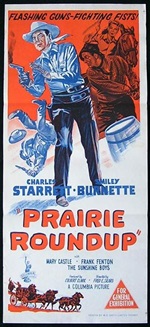
Prairie Roundup (1951, directed by Fred F. Sears)


Steve Carson (Charles Starrett) is wanted for murdering the Durango Kid!

I know that sounds confusing because Steve Carson is the Durango Kid.  The bandit that Carson shot was just disguised as the Durango Kid but actually, he was just a dim-witted outlaw who was set up by Buck Prescott (Frank Fenton), a rustler who was run out of Texas by Steve and who was trying to find a way to stop Steve from investigating his new scheme to cheat a bunch of ranchers in Santa Fe.

Steve is taken to jail but luckily, Smiley Burnette is around to help him break out.  Smiley and Steve head to Santa Fe, where they get jobs working as cowhands at the Eaton Ranch and work to expose Prescott and his gang as being responsible for a series of stampedes.  Smiley sings some songs and Steve resurrects the Durango Kid from the dead.

This was one of the later Durango Kid films.  The range war plot is one that showed up in many Durango Kid films but Prairie Roundup adds something new to the formula but having Steve framed for murdering himself.  Steve could prove his innocence by revealing that he’s actually the Durango Kid but Steve is determined to maintain his secret identity.  I’ve seen several Durango Kid films and I still don’t really understand why Steve felt he needed a secret identity in the first place.  But Prairie Roundup shows the extent to which he’ll go to keep it.

There’s plenty of fight and horse chases, more than enough to keep western fans happy.  Smiley Burnette gets to throw some punches along with singing all of his usual songs.  It’s also nice to see the lovely Mary Castle in the role of Toni Eaton, the daughter of one of the ranchers who has been targeted by Prescott.  Featuring less stock footage than usual, Prairie Roundup is a worthy entry in the Durango Kid series.

The Lone Hand Texan (1947, directed by Ray Nazarro)


Oil’s been discovered on the Texas frontier and Sam Jason (Fred Sears) has got the rights to several wells.  Someone in town keeps sabotaging his operations and blowing up his oil wells.  Sam sends a telegram to his old friend, Steve Driscoll (Charles Starrett).  Steve shows up in town to help Sam set up his business.  Meanwhile, Steve’s alter ego, the masked Durango Kid, works to discover who has been targeting Sam.

This is actually more of a Smiley Burnette movie than a Durango Kid film.  As always, Smiley is the Kid’s sidekick in the movie.  Smiley owns a general store and he’s the towns postmaster.  Everywhere Smiley goes, he is followed by two musicians, Mustard and Gravy.  Smiley sings even more songs than usual in this movie and he even has a brief romance with the local widow (Mary Newton), who unfortunately is also behind the efforts to drive Sam out of business.  Smiley may be the sidekick but he gets more screentime than the Durango Kid in The Lone Hand Texan and he does a mighty fine job with it.

One of the curious things about The Lone Hand Texan is that one of the bad guys also decides to wear a mask and claim to be The Durango Kid.  I wish the movie has done more with that because I have never really understood why Steve feels like he has to pretend to be Durango in the first place.  It’s not as if it’s difficult to recognize Steve, even when he’s wearing a mask.  I have never understood why no one in his movies ever notices that you never see Steve and the Durango Kid in the same place at the same time.  Even Lois Lane should have been able to figure out Durango’s secret identity.

The Lone Hand Texas is a standard Durango Kid outing, albeit not as dependent on stock footage as some of Durango’s other films.  Smiley gets to do more than usual, which is the only thing that really sets it apart.  As with most of the Durango Kid films, it will be best appreciated by those who are already fans.