Late Night Retro Television Review: CHiPs 3.12 “Destruction Derby”


Welcome to Late Night Retro Television Reviews, a feature where we review some of our favorite and least favorite shows of the past!  On Mondays, I will be reviewing CHiPs, which ran on NBC from 1977 to 1983.  The entire show is currently streaming on Prime!
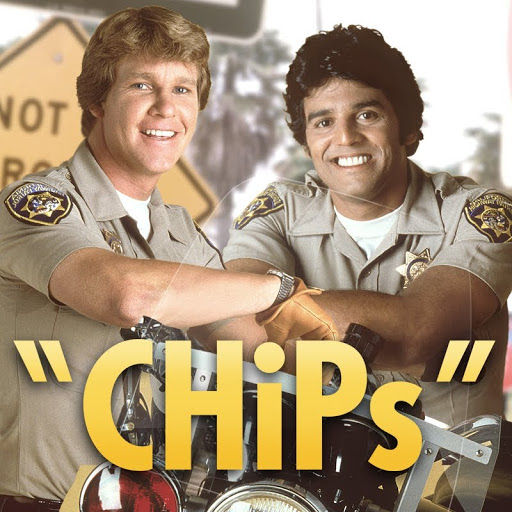
Baker and Ponch — but mostly Ponch — get a chance to shine this episode.

Episode 3.12 “Destruction Derby”

(Dir by Gordon Hessler, originally aired on November 24th, 1979)

Ponch and Baker are working undercover!

That’s …. odd.  Aren’t they just members of the Highway Patrol?  I mean, don’t get me wrong.  I know that being a member of the Highway Patrol isn’t easy and I don’t mean to imply that they’re not doing an important job.  But it just seems like undercover work would be something that you would give to a detective.  It seems like you would need some sort of special training to do that. For a show that, in the past, has pretty much taken a day-in-the-life approach to its stories, a sudden undercover episode just feels weird.

Ponch and Baker are working at the local demolition derby, trying to uncover a drug ring that…. I don’t know.  I guess people who sell drugs enjoy demolition derbys.  To be honest, I get the feeling that someone in production said, “Let’s shoot a bunch of demolition derby footage and then we’ll just make up something stupid to justify it.”  When it comes to the derby, Baker is working as a member of the pit crew and, of course, Ponch is the one driving the car.  And, of course, Ponch turns out to be a natural because there’s nothing that Ponch can’t master.  Ponch also falls for the only driver who can beat him, the mysterious Billy Wakefield (Angel Tompkins).  This episode is from the 70s so, of course, there’s a scene where she takes off her helmet, her long blonde hair falls across her back, and I guess everyone at home is supposed to go, “A woman race car driver!?  What is this madness!?”

Baker is not totally wasted in this episode.  He gets to save Ponch’s life when the bad guys attempt to booby trap Ponch’s car.  He also gets to play tennis with Getraer and Grossman.  This episode may feature Ponch and Baker going undercover but it seems like the real plot is just Baker and Ponch doing fun California things.  This episode basically is a commercial for the state.  Look! the episode says, Tennis!  Handball!  Demolition Derbies!  Erik Estrada!  We’ve got it all!

Erik Estrada can be seen wearing a wrist brace in this episode, which I assume is a lingering result of the accident that he’s spent the last few episodes recovering from.  I make a lot of jokes about Estrada but, from watching the last few accidents, it is obvious that he was pretty seriously injured in that stunt-gone-wrong.  That, while recovering, he appeared on camera at all seems worthy of respect.  A major theme of this episode seems to be that Ponch is back and Baker, after having the lead role for a few episodes, in once again back to being a supporting player.  Thank you for your service, Larry Wilcox.

Anyway, this episode featured a lot of fast cars and a lot of crashes so I liked it.
Welcome Home, Soldier Boys (1971, directed by Richard Compton)


Talk about embarrassing!  When Lisa told me that today was Joe Don Baker’s birthday, I decided that I would review Speedtrap, as 1977 car theft movie that Lisa and I watched last week.  But, when I took a look at the imdb to double check the name of the character that Baker played in Speedtrap, I discovered that I had already reviewed it!

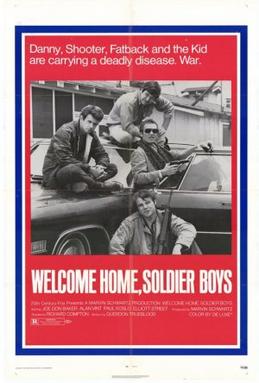
Instead of talking about Speedtrap a second time, I’m going to recommend one of Joe Don Baker’s early films.  In Welcome Home, Soldier Boys, Baker stars as Danny, the leader of a group of Green Berets who have just returned from Vietnam and can no longer find a place in society.  Danny, Kid (Alan Vint), Shooter (Paul Koslo), and Fatback (Elliott Street) go on a cross-country road trip.  After they kill a prostitute (Jennifer Billingsley) who demanded more money than they were willing to pay, they visit many sites from their youth.  They go to a high school basketball team.  They spend some time in a sleazy motel.  (Geoffrey Lewis plays the desk clerk.)  They get into a fight with a mechanic (Timothy Scott) over the price of some auto repairs.  After being cheated by one too many people and realizing that no one cares about the sacrifices that they made for their country, they put on their uniforms and violently take over a small town, leading the National Guard to show up to take them all out.

Welcome Home, Soldier Boys is a pretty ham-fisted anti-war allegory and the plot sometimes meanders too much for its own good.  With its road trip violence, its a dry run for director Richard Compton’s far more cohesive Macon County Line.  The movie still packs a punch, due to the efforts of the cast and the violent ending.  The movie is full of familiar characters actors, who are all convincing in their roles but it really is dominated by Joe Don Baker’s hulking intensity.  Danny is the dark side of the amiable country boys that Joe Don Baker would play in so many other movies.  Danny is angry but, as a stranger in a strange land, he’s sometimes sympathetic.  Ultimately, Danny wants the respect that was given to the returning soldiers of the previous generation.  Instead, he comes back to country that doesn’t want much to do with him or his friends.  Returning from serving overseas and still trying to deal with the things that he saw in overseas, Danny feels lost in and rejected by his home country.  It’s one of Baker’s best performances.

18 Days of Paranoia #14: The Organization (dir by Don Medford)


Sidney Poitier played Detective Virgil Tibbs for the third and final time in the 1970 film, The Organization.

This time, Virgil is investigating a murder at an office building in San Francisco.  It’s a very odd murder, in that an executive was shot, a security guard was bludgeoned, and even though it looks like there was a robbery taking place, nothing appears to have actually been stolen.  Since neither the company nor the executive were believed to be involved in anything shady, Virgil finds himself perplexed as to why any of this has happened at all.

Fortunately, the local urban revolutionaries are here to help!  They contact Virgil and Virgil reluctantly agrees to meet with the group, which is made up of the usual collection of angry 1970s activists — i.e., a dissident preacher, a reformed drug dealer, a guy who won’t stop yelling, and a woman who is obviously going to be killed before the movie is over.  The revolutionaries explain that they were the ones who broke into the office but they also say that they didn’t kill anyone.  Instead, they broke into the office because they wanted the police to investigate the break-in and discover that the company was a front for a bunch of drug dealers.  “The Organization” is flooding poor and minority neighborhoods with heroin and the revolutionaries want to stop them.  In fact, the revolutionaries have stolen four million dollars worth of heroin.  Now, they want Virgil to help them.

Even though Virgil is sympathetic to the revolutionaries, he’s still a cop and he can’t get directly involved with illegal activities.  Instead, he agrees to not arrest the revolutionaries and to continue his investigation, in the hope of bringing down the Organization.  It’s not going to be easy, of course.  There’s evidence that the Organization may even have agents inside the San Francisco police department.

As far as the Virgil Tibbs movies are concerned, The Organization is slightly better than They Call Me Mister Tibbs! but it’s nowhere near as good as the one that started it all, In The Heat of the Night.  Probably the biggest flaw with The Organization is that Virgil has to share the spotlight with the revolutionaries.  With the exception of Raul Julia (who plays a former drug dealer named Juan), none of the revolutionaries are particularly memorable characters and their plan for taking down The Organization is so unnecessarily convoluted that it’s hard to believe that Virgil would go along with it.

On the plus side, The Organization works fairly well as a conspiracy thriller.  It does manage to create a consistent atmosphere of unease and mistrust.  This is one of those films where people are constantly getting shot by unseen gunmen mere minutes after getting arrested and the fact that even cool and in-control Virgil Tibbs can’t save them does a lot towards creating a nice sense of paranoia.  The films end on perhaps the most downbeat note of all of the Virgil Tibbs movies, suggesting that, in the end, everything we’ve just watched was for nothing.


Other Entries In The 18 Days Of Paranoia:

  1. The Flight That Disappeared
  2. The Humanity Bureau
  3. The Private Files of J. Edgar Hoover
  4. The Falcon and the Snowman
  5. New World Order
  6. Scandal Sheet
  7. Cuban Rebel Girls
  8. The French Connection II
  9. Blunt: The Fourth Man 
  10. The Quiller Memorandum
  11. Betrayed
  12. Best Seller
  13. They Call Me Mister Tibbs


Tom Horn (1980, directed by William Wiard)


Today would have been Steve McQueen’s 90th birthday.

Sadly, McQueen died in 1980 at the absurdly young age of 50.  In life, McQueen never got as much respect as he deserved as an actor but in death, he’s been rediscovered as not just an icon of cool but also as an underrated actor who, much like Clint Eastwood, could say a lot without uttering a word.  (Be sure to read Marshall Terrill’s biography of McQueen.)  When Steve McQueen (as played by Damian Lewis) showed up in Once Upon A Time In Hollywood, it seemed appropriate.  McQueen and Tarantino both seem made for each other, even if McQueen died long before Tarantino even wrote his first screenplay.

McQueen made two films shortly before he died, The Hunter and Tom Horn. Unfortunately, neither one of them was a hit with audiences or critics.  The Hunter, which was McQueen’s last film, is a forgettable movie that features McQueen as a bounty hunter who can’t drive.  Tom Horn, however, was an underrated western that features one of McQueen’s best performances.

In Tom Horn, McQueen plays the title character, a legendary frontier scout who is known for the role he played in the capture of Geronimo.  When the film opens, Tom Horn has seen better days.  With the frontier changing and the old west being replaced by the modern age, Horn has been reduced to being almost a vagrant, wandering from town to town in search of work.  When the film begins, Horn has found employment as a “stock detective.”  He’s employed by the local cattlemen to keep rustlers from stealing their stock.  Horn uses the same violent methods that he’s always used, gunning down rustlers and often doing so in public.  What Horn doesn’t realize is that times have changed and the methods that previously made him a legend are now making him a pariah.  When the cattlemen realize that the townspeople are turning against them because of Horn’s activities, they conspire to take out Horn themselves.

Tom Horn is based on a true story.  In 1903, Tom Horn was hung for shooting a 15 year-old boy.  While it is agreed that Horn killed many men over the course of his life, he was undoubtedly framed for the murder for which he was executed.  While sitting in his jail cell, waiting to be executed, Horn wrote the autobiography upon which this movie is based.  The movie makes the argument that Horn was executed because he was a reminder of what the West used to be like.  In order to prove that they were now ready to be members of civilized society, the cattleman had to sacrifice Horn in the most public way possible.

The film does a good job of capturing the final days of the old west and Steve McQueen does an even better job of playing a man who doesn’t realize that his time has come to a close.  Horn often seems to be the only man who doesn’t understand that the time of outlaws and the gunslingers is coming to a close and that leaves him defenseless when he’s put on trial.  Even after found guilty, Horn remains confident that he will somehow escape the hangman’s noose.  Tragically, it’s not until time is up that Horn truly comes to understand that the world has changed and civilization no longer has place for men like him.  The same people who used to depend on men like Tom Horn now just want to forget that he ever existed.  McQueen took a long break between making The Towering Inferno and Tom Horn and dropped out of the public eye.  The only film he made during that period was a barely released version of Enemy of the People.  When McQueen made Tom Horn, he was also a man out of time and he brings a sense of resignation and loss to the role that he might not have been capable of doing earlier in his career.

Sadly, it was while filming Tom Horn that McQueen first started to show symptoms of the cancer that would eventually kill him.  Tom Horn was released in 1980 and never got the attention that it deserved.  It’s a minor western classic and features Steve McQueen at his best.


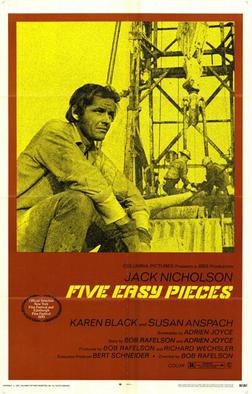
Lisa Reviews An Oscar Nominee: Five Easy Pieces (dir by Bob Rafelson)


First released in 1970, Five Easy Pieces tells the story of a lost man named Bobby Dupea (Jack Nicholson).

When we first meet Bobby, he’s working at a California oil field.  He likes to go bowling.  He has a girlfriend named Rayette (Karen Black), who is a country music-obsessed waitress.  His best friend is Elton (Billy “Green” Bush), a friendly redneck with a memorable laugh.  Bobby may have a girlfriend and Elton may be married but that doesn’t stop either one of them from going out at night, getting drunk, and trying to pick up women.

Bobby seems to be just another blue-collar guy with a grudge against the bosses but it doesn’t take long to realize that there’s something different about him.  Bobby may be friends with Elton but it’s obvious that the two of them come from very different background.  No matter how much he tries to hide it, Bobby is smarter than everyone else around him.  When he and Elton get stuck in a traffic jam, Bobby spots a piano sitting on the back of a pickup truck.  Getting out of his car, Bobby yells at everyone who is honking and then climbs up to the piano.  He sits down, he puts his fingers to the keys and he starts to play.  Knowing Bobby, you’re expecting him to just bang the keys and make noise.  Instead, he plays beautiful music.

Later, Bobby steps into a recording studio.  Paritia (Lois Smith), a neurotic woman, is playing the piano.  The recording engineers joke about her lack of talent.  Bobby glares at them, annoyed.  It quickly becomes apparent why Bobby is so protective.  Paritia is Bobby’s sister.

Bobby, it turns out, comes from a wealthy family of musicians.  Everyone in the family has dealt with the pressure to succeed differently.  Paritia continues to play, despite not having much talent.  Bobby’s older brother, the buffoonish Carl (Ralph Waite), plays violin and has staid home with their father (William Challee).  Bobby, on the other hand, ran away from home.  He’s spent his entire life trying to escape from both his talent and his family.  However, when Paritia explains that their father has suffered from two strokes and might not live much longer, Bobby reluctantly decides to return home and try to make some sort of peace with his father.

It’s not as easy a journey as Bobby would have liked.  For one thing, Rayette demands to go with him.  On the drive up to Washington, they pick up two hitchhikers (Helena Kallionetes and Toni Basil), one of whom is obsessed with filth.  In the film’s most famous scene, an attempt to get a simple lunch order modified leads to Bobby losing control.

See, that’s the thing with Bobby.  In many ways, he’s a jerk.  He treats Rayette terribly.  While his family is hardly perfect, the film doesn’t hide from the fact that Bobby isn’t always the easiest person to deal with.  And yet, you can’t help but sympathize with Bobby.  If he seems permanently annoyed with the world … well, that’s because the world’s annoying.  And, to Bobby’s credit, he’s a bit more self-aware than the typical rebel without a cause.  When one of the hitchhikers praises his temper tantrum at the diner, Bobby points out that, after all of that, he still didn’t get the order that he wanted.

In Washington, Bobby tells Rayette to stay at a motel and then goes to see his family.  Bobby seems as out-of-place among his wealthy family as he did hanging out in the oil fields with Elton.  He ends up cheating on Rayette with Carl’s fiancee, a pianist named Catherine van Oost (Susan Anspach).

And then Rayette shows up for dinner…

Five Easy Pieces is a sometimes funny and often poignant character study of a man who seems to be destined to always feel lost in the world.  Bobby spends the whole movie trying to find a place where he can find happiness and every time, reality interferes with his plans.  Nicholson gives a brilliant performance, playing Bobby as a talented guy who doesn’t really like himself that much.  Bobby’s search for happiness leads to a rather haunting ending, one that suggests that some people are just meant to spend their entire life wandering.

Five Easy Pieces was nominated for Best Picture but lost to Patton.