Released in 2000, Boiler Room tells the story of Seth Davis (Giovanni Ribisi).
Seth is only 19 years old. He’s the son of a federal judge and he’s also a college dropout. Seth is making a pretty good living for himself, running a casino out of a house near the campus. One night, a handsome 20something named Greg Weinstein (Nicky Katt) stops by and tells Seth that he could be making an even better living for himself as a broker at J.T. Marlin.
Located somewhere in Long Island, J.T. Marlin is a brokerage firm that is dominated by loud and young men. Overseen by the ruthless Jim Young (Ben Affleck, doing the glorified cameo thing), J.T. Marlin is a place where everyone owns an expensive car, an expensive watch, and where everyone brags about how much money they’ve made. The insults and slurs fly from desk to desk, as they tend to do whenever a bunch of wealthy, highly competitive guys get together. J.T. is seduced by the atmosphere, even as he watches some broker breaks down due to the pressure. He becomes friends with Chris Varick (Vin Diesel) and falls for receptionist Abbie Halpert (Nia Long), who just happens to be Greg’s ex-girlfriend. Eventually, Seth gets good at his job. Unfortunately, it turns out that his job is centered around tricking people into investing in a pyramid scheme and eventually, one of Seth’s clients, Harry (Taylor Nichols), ends up broke and without his family. The guilt-stricken Seth realizes that he has a conscience.
Like a lot of these type of movies, Boiler Room is at its best when it starts, when it’s all about tough talk, rude jokes, and obsessive competition amongst a bunch of well-dressed good-looking guys. Nicky Katt and Vin Diesel are so much fun to listen to that it’s hard not to regret that the entire film wasn’t just about them. Things become significantly less interesting once the FBI shows up and Seth decides to become a snitch. For the most part, no one like a snitch, even if they’re motivated by the purest of intentions. To make a snitch likable, he has to be a truly compelling character, like Henry Hill in Goodfellas. For the most part, audiences prefer anti-heroes who go down with the ship as opposed to the rats who jump into the first lifeboat they see. In The Wolf of Wall Street, Jordan Belfort agrees to wear a wire but then slips his business partner a note, warning him. That’s one of the reasons why The Wolf of Wall Street is still a classic while Boiler Room has been largely forgotten. As a character, Seth just isn’t compelling enough to pull off the snitch act. Nor does he really seem clever enough to pull off what he does at the end of the film.
That said, I do enjoy Boiler Room. It’s largely due to the cast. Nicky Katt, Vin Diesel, Scott Caan, Giovanni Ribisi, they were all young, energetic, and eager to show off what they could do. While their characters competed to see who could make the most money, the actors competed to see who could steal the most scenes. The film is ultimately only so-so but that cast is unforgettable.
The official date of death is February 22nd, 1987. The 58 year-old artist died in his sleep of a cardiac arrhythmia. He was at Manhattan’s New York Hospital, recovering from gallbladder surgery. The surgery itself had been a minor procedure and, in the days before his death, Warhol was reported to be making a good recovery. Warhol himself was scared of doctors and had continually put off having the procedure done.
Others, however, argue that Warhol might as well have died on June 3rd, 1968. That was the day that the world-famous pop artist was shot, at point blank range, by a woman named Valerie Solanas. Warhol barely survived the attack, spending five hours in surgery and carrying both the mental and physical scars with him for the rest of his life. It’s debatable whether Warhol ever physically recovered from being shot. It’s been theorized that the reoccurring gallbladder problems that led to Warhol entering the hospital were directly the result of being shot. If that’s the case, then Solanas murdered Andy Warhol.
But even beyond the lingering physical injuries, the shooting left Warhol mentally shaken. The artist who, in the 60s, was famous for hosting a never-ending party at The Factory became far more reclusive and paranoid. No longer could anyone from anywhere show up in New York and, if they were interesting enough, become a member of Warhol’s entourage. No longer would Warhol direct films that challenged the assumption of what film had to be. Warhol spent most of the 70s doing portrait commissions and finding new ways to make money. (As he wrote in 1975, “Making money is art, and working is art and good business is the best art.”)
It can be argued that, with the pull of a trigger, Valerie Solanas changed the course of history and yet, she has always remained an obscure figure. (Many would argue that she deserves to remain an obscure figure.) After the shooting, when Solanas turned herself in, she said that she had no choice but to shoot Andy because “he had too much control over my life.” Others theorize that Solanas was upset because Andy hadn’t helped her get her book, The SCUM Manifesto, published. Solanas was diagnosed with paranoid schizophrenia and, for nearly a killing an artist, she spent three years in prison. While she was in prison, The SCUM Manifesto was finally published. Ironically, she died in poverty and obscurity, just a few months after Warhol, as forgotten as Andy as was celebrated.
So, who was Valerie Solanas? That’s the question that 1996’s I Shot Andy Warhol attempts to answer. Lili Taylor portrays Valerie, giving a performance that is both frightening in its intensity and empathetic in its portrayal of Valerie’s desperation to be heard as a human being and respected as an artist. Wherever Valerie goes, she’s an outsider. As a lesbian, she’s been rejected by conventional society. When she appears on a local talk show, the audience boos her and the host has her thrown off the set. As a writer, she is rejected by publishers and readers who view her work as being, as one person puts it, “too sick even for us.” When, like many aspiring artists and lost souls, she arrives at the Factory, the members of Warhol’s entourage reject her because she’s neither beautiful nor glamorous. Valerie is stuck in a winless situation. It’s her intensity that makes her a memorable writer but it’s the same intensity that guarantees that almost no one will be willing to read what she writes.
Valerie has written The SCUM Manifesto. (SCUM stands for Society of Cutting Up Men.) Throughout the film, we see black-and-white scenes of Valerie reading from the opening of her book:
“Life” in this “society” being, at best, an utter bore and no aspect of “society” being at all relevant to women, there remains to civic-minded, responsible, thrill-seeking females only to overthrow the government, eliminate the money system, institute complete automation and eliminate the male sex.”
Today, of course, Valerie could just start a tumblr or maybe get a job teaching at Evergreen State. In the 1960s, though, Valerie believes that the only way she’ll ever be heard is by getting her work to Andy Warhol. When she first meets Andy (Jared Harris), he seems to be receptive to her but we soon see that this film’s version of Andy is receptive to almost anyone. I Shot Andy Warhol portrays Andy as being an emotionally detached voyeur, a master of passive aggressive behavior. Instead of personally rejecting Valerie, he lets the more bitchy members of his entourage do it for him. In fact, at times it seems as if the reason that Warhol surrounds himself with such angry people is so he’ll never have to get angry himself. It’s actually a rather interesting interpretation of Warhol and the Factory, though it does rely a bit too much on the clichéd image of Andy Warhol as a passive voyeur. Whenever Jared Harris is onscreen, you never forget that you’re watching someone imitate Andy Warhol as opposed to feeling like you’re watching Warhol yourself.
(When Andy Warhol died, he was worth 220 million dollars. That alone should be enough to debunk the image of Andy Warhol being a passive voyeur of his own life.)
I Shot Andy Warhol is a frequently fascinating film, one that is sympathetic to both Solanas’s artistic ambitions and her desperate need to be acknowledged as a writer, while also not shying away from the fact that she was a very sick and dangerous person. At the same time, the film does leave out one very important detail of Solanas’s later life. After she was released from prison, she still continued to stalk Andy and other members of the New York art world. That’s an important detail that should have, at the very least, been acknowledged.
Finally, after Andy Warhol’s death, Lou Reed wrote a song called “I believe.” The song dealt with his feelings towards Valerie Solanas and it’s reasonable to assume that Reed spoke for many of Warhol’s associates. Here are just a few of the lyrics: ” “I believe life’s serious enough for retribution… I believe being sick is no excuse. And I believe I would’ve pulled the switch on her myself.”
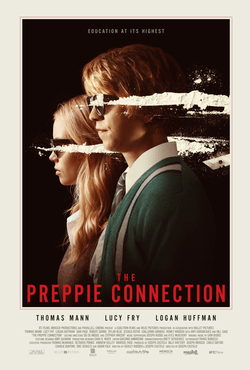
The Preppie Connection, which is currently playing On Demand and in limited release, has got a 0% rating at Rotten Tomatoes. That seems a little bit harsh to me. I mean, The Preppie Connection isn’t exactly a good movie but it’s still not a disaster. It’s main sin is that it’s generic and forgettable and squanders a potentially interesting story. That’s definitely not a good thing but still, The Preppie Connection is still better than some of the other films that currently have a zero score on Rotten Tomatoes.The Preppie Connection may not be great but it’s still better than Bucky Larson: Born To Be A Star andA Thousand Words.
0%?
Not hardly.
More like 25%.
Anyway, The Preppie Connection is apparently based on a true story. Tobias Hammel (Thomas Mann) is a poor kid who wins a scholarship to an exclusive private school. At first, Tobias struggles to fit in. He doesn’t know how to relate to his wealthy classmates and he’s embarrassed when his friends from the old neighborhood show up on campus. When he is instructed to sign a 200 year-old book, he accidentally knocks the book to the floor. As a result, the other students beat him up.
Fortunately, for Tobias, everyone assumes that — since he’s poor — he’ll be able to get them drugs. At first, everyone is satisfied with weed but, since this movie is taking place in the 80s, everyone soon starts to pressure Tobias to get them cocaine. Fortunately (and conveniently), Tobias has befriended the son of the Colombian ambassador. Soon, Tobias is making regular trips to Colombia and returning with bags of cocaine hidden away in his travel bag.
Usually, I love films about wealthy drug addicts. There’s usually a few good scenes of drug-fueled decadence and, since they’re rich, everyone’s usually dressed nicely. But no… sorry. The Preppie Connection just doesn’t work. Visually, the film is flat and, even worse, it appears that the budget was too low to be able to afford the rights to any period music. I was hoping to hear at least a few classic 80s songs but instead, the film only offered some generic synthesizer-fueled music.
Speaking of generic, Thomas Mann narrates nearly the entire film and it’s some of the most vapid narration that I’ve ever heard. I mean, I understand that everyone loves Goodfellas and Casino but that doesn’t mean that every period gangster film has to feature nonstop narration.
Ultimately, The Preppie Connection is such an incredibly forgettable film that I really can’t even come up with more than 400 words to type about it. That said, Logan Huffman and Lucy Fry both give good performances as two of Tobias’s customers and they’re good enough to bump the film up to at least a score of 25 out of 100.

 Through the Shattered Lens