Welcome to Retro Television Reviews, a feature where we review some of our favorite and least favorite shows of the past! On Saturdays, Lisa will be reviewing The American Short Story, which ran semi-regularly on PBS in 1974 to 1981. The entire show can be purchased on Prime and found on YouTube and Tubi.
This week, we have an adaptation of a 1963 short story.
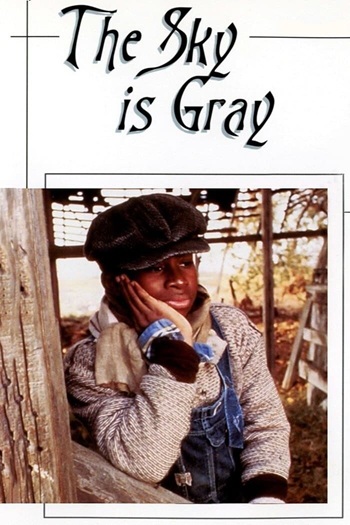
Episode #15: The Sky Is Gray
(Dir by Stan Lathan, originally aired in 1980)
This adaptation of an Ernest Gaines short story takes place in Louisiana during the 1940s. James (James Bond III) is a young black child who lives on a farm. His father is overseas, serving in the Army during World War II. His mother (Olivia Cole) is a stern but loving woman who is trying to raise the sensitive James in a world where one often has to depend on their inner strength to survive. When James comes down with a toothache, he and his mother travel to a nearby town so he can see the dentist. From having to stand in the back of the bus to listening to a debate between a priest and a militant in the dentist’s office, it’s an eye-opening journey for James. When the white receptionist at the dentist’s office arbitrarily cancels James’s appointment and tells him and his mother to come back tomorrow, the two of them seek shelter. James discovers how strong his mother is when they’re harassed by a pimp (Reuben Collins). He also learns that there is unexpected kindness in the world when a white store owner invites him and his mother inside to give them shelter from the cold and windy day. During one trip to the dentist, James learns that the world is far more complicated than he originally knew.
This was an okay adaptation of Gaines’s acclaimed short story. Young James Bond III gave a good performance as James and the episode was full of scenes that visually captured the feel of being an outsider. That said, as was often the case with this series, the adaptation was so straight-forward that it didn’t really capture the nuance of Gaines’s writing. In the short story, Gaines put the reader right into James’s head. The adaptation doesn’t really do that. A heavy-handed musical score doesn’t help matters but, with all that in mind, this was still an effective coming-of-age tale.
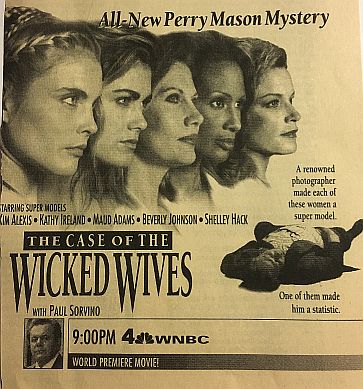
Famed fashion photographer David Morrison (Eric Braeden) has fallen on hard times but things are looking up. The American Museum of Art wants to do a retrospective of his work. He just has to get the permission of his current wife, Dee (Kathy Ireland), and his four ex-wives (Shelley Hack, Kim Alexis, Maud Adams, and Beverly Johnson). All of them are super models who owe their careers to David but four of them hate his guts and Dee isn’t happy when she sees evidence that he has been cheating on her. When David turns up dead, Dee is arrested. She claims that she’s innocent but the prosecution is sure that they have an airtight case.
This sounds like a case for Perry Mason!
However, Perry’s out of town so it falls to Perry’s never previously mentioned best friend, Tony Caruso (Paul Sorvino), to solve The Case of the Wicked Wives! With the help of Perry’s tireless associates, Della Street (Barbara Hale) and Ken Malansky (William R. Moses), Caruso works to solve the case and prove the Dee is innocent. He also prepares many pasta dinners and frequently sings.
So, where was Perry? As everyone knows, Raymond Burr played Perry Mason for 9 seasons in the 50s and the 60s. 20 years after the show aired its final episode, Burr returned to the role in a series of highly rated, made for television movies. Unfortunately, Burr died in 1993 with several movies left to be filmed. In his will, Burr specifically requested that production on the remaining films continue so that the cast and crew wouldn’t lose their jobs. Since the role of Mason obviously could not be recast that soon after Burrs’s death, it was decided that the remaining movies would feature guest lawyers. Enter Paul Sorvino.
The Case of the Wicked Wives was the first Perry Mason film to be made after Burr’s death. As his replacement, Tony Caruso has much in common with Mason, including the ability to make the guilty confess in open court. Unlike Mason, Caruso is also obsessed with cooking elaborate spaghetti dinners and singing operatic arias. This movie came out just a year after Sorvino left Law & Order to specifically pursue his opera career. Sorvino sings a lot in The Case of the Wicked Wives, sometimes in court. Unfortunately, a love of singing and pasta are the only two personality traits that are really given to Caruso. Through no fault of Paul Sorvino’s, Caruso is never as compelling a character as the coolly calculating Mason. Mason could trick anyone into confessing through perfectly asked questions. Caruso is more into courtroom stunts that would get most lawyer disbarred.
Because the mystery itself is a dud, the main reason to watch The Case of the Wicked Wives is for the wives. Who wouldn’t want to keep Kathy Ireland from being wrongly convicted? All of the wives get at least one big moment to shine and tear up the scenery. You’ll guess who the murderer is long before anyone else in court.
Last year, I started a new blog called Lisa Marie’s Song of the Day. It’s nothing big. It’s just a place where, on a daily basis, I share music that I happen to like. Ever since I started the site, certain people have been giving me a hard time over the fact that they have discovered that I am a total Britney Spears fangirl.
Well, I’m not ashamed to admit it. I love Britney Spears. I always have. Even when I was going through my whole “wearing black and writing dark poetry” phase, I still loved Britney. Her songs are great to dance to and they’re even more fun to sing off-key and at the top of your lungs when you’re taking a shower or driving to or from work. Even better is when you have a family member in the car and she has no choice but to listen as you sing Work Bitch in your thickest rural accent.
(Whenever I sing, I unleash my inner country girl.)
Of course, it’s never just been Britney’s music to which I’ve paid attention. I was jealous of her when she dated Justin Timberlake. I was worried for her when she married Kevin Federline. I was scared for her when she went through her period of public instability. When she shaved her head, lost custody of her children, and was placed under the conservatorship of her father and attorney, it angered me to watch as the media treated her pain as entertainment. When she was diagnosed as being bipolar, I related to her because I knew exactly what she was going through. I even still use the #FreeBritney hashtag on twitter.
So, in short, I’m definitely a fan. But I have to admit that I prefer Later Britney, the one who uses bitch as a term of empowerment, to Early Britney, the one who used to lie about being a virgin.
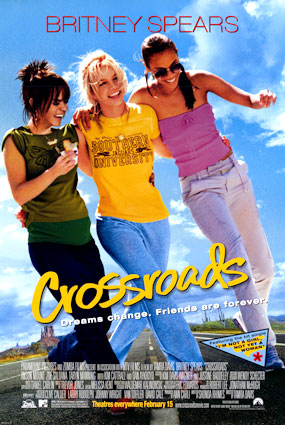
The 2002 film Crossroads is definitely all about Early Britney.
Crossroads was Britney’s feature film debut and it was also pretty much her exit. The film did well at the box office (and I’ll admit that I paid money to see it … well, actually, I got someone else to pay for me to see it but you get the point…) but the critics absolutely hated it and it still regularly appears on lists of the worst films ever made. For the record, I do not think that Crossroads is one of the worst films ever made. Don’t get me wrong. It’s not exactly a good film but it’s definitely something of a guilty pleasure. Whenever I watch it, I go on a nostalgia trip and that’s always a little bit fun.
In Crossroads, Britney plays Lucy. Lucy has just graduated from high school. Lucy is supersmart and, the film is quick to tell us, a super virgin as well. (There’s something rather icky about how much media emphasis was put on Britney’s claimed virginity. Especially since even her biggest fans suspected there was no way she was still a virgin if she was dating Justin Timerblake…) Lucy was her school’s valedictorian and now her father is looking forward to Lucy going to medical school and becoming a doctor. Lucy’s father is played by Dan Aykroyd. Though Aykroyd is playing a Georgia auto mechanic, he makes no attempt to hide his thick Canadian accent. Good for you, Dan!
Anyway, Lucy is preparing to do what her father wants but then she gets an opportunity to drive across the country with two childhood friends and a complete stranger. In high school, Lucy had little to do with snobby Kit (Zoe Saldana) and pregnant Mimi (Taryn Manning) but, when they were all 10 years-old, they were all BFFs. In fact, they were so close that they even buried a time capsule. Digging up the capsule inspires these three frenemies to hop into a car with Ben (Anson Mount) and hit the road!
Ben, it turns out, has just gotten out of prison but he’s hot and he’s musically talented. The girls are a little bit scared because they think Ben might have been in prison for murder but seriously, Ben is way too cute to be a murderer. Plus, when he reads Lucy’s poetry, he sets it to music.
AND SERIOUSLY, HOW CAN YOU NOT LOVE THAT!? I mean, c’mon — every girl who has ever written a poem has, at some point, fantasized about a boy who would put that poem to music and tell her that her words were almost as beautiful as she was.
I mean, there’s a lot of negative things that could be said about Crossroads. I’m not a fan of the way Mimi was portrayed and, towards the end of the film, it almost feels as if the movie is suggesting that she’s being karmically punished for getting pregnant without being married. The film’s emphasis on Lucy’s (and, by implication, Britney’s) chastity feels dangerously reactionary. And, while Britney doesn’t really give a bad performance, she’s still not quite believable as someone who was so busy studying that she didn’t even go to one single party during high school.
But ultimately, this will always be the film where a hot guy took a girl’s poem and spontaneously set it to music.
“A guy named Steve Rubell had a dream: To throw the best damned party the world had ever seen and to make it last forever. He built a world where fantasy was put up as reality and where an 80-year-old disco queen could dance till dawn. Where models mingled with mechanics, plumbers danced with princes. It was a place where all labels were left behind. A place where there were no rules.”
— Shane O’Shea (Ryan Phillippe) in 54 (1998)
So, did you actually read that quote at the beginning of the review? I don’t blame if you didn’t because not only is it ludicrous overwritten but it just goes on and on. It’s one of those quotes that you read in a script and you think to yourself, “They better get absolutely the best actor in the world to deliver these lines,” and then you realize Ryan Phillippe has been cast in the role.
Except, of course, I doubt that any of those lines were found in the original script for 54. 54 is one of those films where, as you watch it, you can literally imagine the chaos that must have been going on during the editing process. Subplots are raised and then dropped and the mysteriously pop up again. Characters change both their personalities and their motives in between scenes. Huge dramatic moment happen almost at random but don’t seem to actually have anything to do with anything else happening in the film.
In short, 54 is a mess but it’s a mess that’s held together by incredibly clunky narration. Shane O’Shea, who spent the waning days of the 1970s working at Studio 54, narrates the film. And, despite the fact that Shane is presented as being kinda dumb (think of Saturday Night Fever‘s Tony Manero, without the sexy dance moves), his narration is extremely verbose and reflective. It’s almost as if the narration was written at the last-minute by someone desperately trying to save a collapsing film.
I watched 54 on cable because I saw that it was about the 70s and I figured it would feature a lot of outrageous costumes, danceable music, and cocaine-fueled melodrama. And it turns out that I was right about the cocaine-fueled melodrama but still, 54 is no Boogie Nights. It’s not even Bright Lights, Big City.
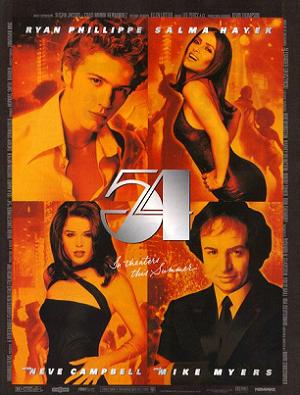
54 does have an interesting cast, which makes it all the more unfortunate that nobody really gets to do anything interesting. Poor Ryan Phillippe looks totally lost and, in the film’s worst scene, he actually has to stand in the middle of a dance floor and, after the death of elderly Disco Dottie (that’s the character’s name!), yell at all the decadent club goers. Breckin Meyer is cute as Phillippe’s co-worker and Salma Hayek gets to sing. Neve Campbell plays a soap opera actress who Phillippe has a crush on and…oh, who cares? Seriously, writing about this film is almost as annoying as watching it.
Mike Myers — yes, that Mike Myers — plays the owner of the club, Steve Rubell. The role means that Myers gets to snort cocaine, hit on Breckin Meyer, and vomit on the silk sheets of his bed. I think that Myers gives a good performance but I’m not really sure. It could have just been the shock of seeing Mike Myers snorting cocaine, hitting on Breckin Meyer, and vomiting on the silk sheets of his bed.
If you want to enjoy some 70s decadence, avoid 54 and rewatch either Boogie Nights or American Hustle.
 Through the Shattered Lens