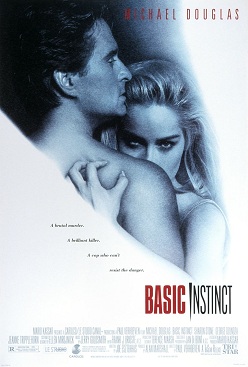
 Nick Curran (Michael Douglas) is a San Francisco police detective who, along with his jolly partner Gus (George Dzundza), finds himself investigating the ice pick-stabbing of a rock star. The main suspect is glamorous writer Catherine Trammel (Sharon Stone), who is obviously guilty but manages to outsmart all of the men investigating her by not wearing panties during her interrogation. Nick finds himself drawn to Catherine, despite his own relationship with with psychologist Elizabeth Garner (Jeanne Tripplehorn). The more Nick digs into Catherine’s past, the more he becomes obsessed with her but also the more he suspects that she may be a serial killer. This is mostly because Catherine obviously is a serial killer and anyone should have been able to figure that out. Instead, Nick, an experienced homicide detective, just gets turned on.
It’s strange to remember how seriously people took Basic Instinct when it was released in 1992. People debated whether it was a throwback to Hitchcock or just a dirty movie. Feminists debated whether it was empowering or exploitive. For several years afterwards, every show from The Simpsons to Seinfeld parodied the interrogation scene. (In Seinfeld’s case, it helped that Wayne Knight appeared in the film as the district attorney who kept shifting in his seat to get a better view.) Sharon Stone was described as being the new Grace Kelly and, for a period of years, was the subject of fawning profiles in which she was asked about the future of sex in movies. For a while, she was inescapable.
Sharon Stone, to be fair, did make the role of Catherine her own. It’s impossible to imagine some of the other actresses considered — Michelle Pfeiffer, Geena Davis, Mariel Hemingway, or Meg Ryan — in the role. After a decade of not getting anywhere with her film career, Stone was hungry to be a star and was also willing to do things on camera that other name actresses would have refused. Sharon Stone was not the next Grace Kelly and Catherine Trammel was ultimately more of a sexual fantasy than an actual character but Stone still deserves a lot of credit for her uninhibited performance in the role. Though Stone later said that she didn’t realize what was actually being filmed during the interrogation scene, it’s her confidence and her unapologetic sensuality that makes the scene compelling. Her performance has the energy that the sleepwalking Michael Douglas lacks.
Today, Basic Instinct is best-viewed as a satire. Director Paul Verhoeven sends up both the cop film and the erotic thriller with a movie that turned everything to eleven. The film’s sensibility is established by the fact that Michael Douglas’s “hero” is nicknamed Shooter because he killed two innocent people while high on cocaine. The film’s main joke is an obvious one. Everyone is too busy staring at Sharon Stone to notice that she’s about to stab them in the back with an icepick. Joe Eszterhas’s script was vulgar to the point of parody and, fortunately, director Paul Verhoeven understood that even more than Eszterhas did.
Basic Instinct has been imitated countless times but it’s never been equaled. To that, the credit is owed to Sharon Stone and Paul Verhoeven.
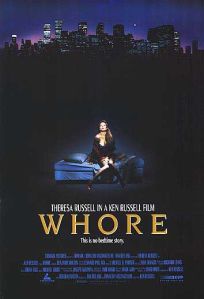 Liz (Theresa Russell) is a prostitute trying to survive on the mean streets of Los Angeles. With the help of a homeless performance named Rasta (Antonio Fargas), Liz tries to escape from her abusive pimp, Blake (Benjamin Mouton).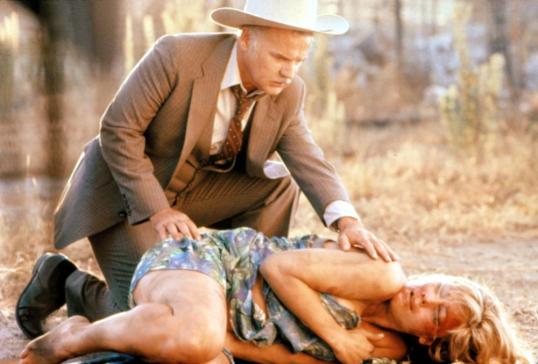
 Through the Shattered Lens