Doctor Who — Invasion of the Dinosaurs (1974, directed by Paddy Russell)


Fresh from defeating an attempt by a Sontaran to disrupt British history, the Third Doctor (Jon Pertwee) and his newest companion, reporter Sarah Jane Smith (Elisabeth Sladen), return to present-day London and discover that it has been transformed into a ghost town.  Dinosaurs are roaming the streets.  The Doctor teams up with UNIT to try to figure out who has been monkeying with time but what he doesn’t know is that the trusted Captain Yates (Richard Franklin) is working with the people responsible for the dinosaur invasion.

Invasion of the Dinosaurs was the second serial of the 11th season.  Like The Sea Devils, this was another case where I read the novelization long before I got a chance to see the actual serial.  Well-written by Malcolm Hulke, the novelization really got me excited to watch Invasion of the Dinosaurs.  It did not prepare me for how fake the dinosaurs would look.

It was to be expected, though.  Classic Doctor Who was never known for its wonderful special effects.  Instead, it was known for rubber monsters, torn costumes, and alien landscapes that were often made out of cardboard.  For many of us, that was a part of its charm.  The dinosaurs in this serial look like toys that have been unleashed on a still photo of London.  I’ve read that the serial was criticized for its bad dinosaur effects when it originally aired 1974 and that was long before Jurassic Park made everyone take the idea of seeing a realistic dinosaur for granted.


Despite the very fake dinosaurs, Invasion of the Dinosaurs still has one of the better scripts of the Pertwee era.  The villains aren’t the typical evildoers who usually showed up on Doctor Who.  Instead, they are people who have convinced themselves that the only way to save humanity is to dial back time to what they consider to be the “Golden Age,” before technology and industry blighted what they believe to be the ideal landscape.  Of course, they plan to take only the very best among the population to their golden age with them.  The villains are elitist environmentalists, convinced that they and only they know what is best.  This may be the first episode of Doctor Who where the main antagonist, Sir Charles Grover (Noel Johnson), is a member of Parliament.

Captain Yates’s betrayal of UNIT and the Doctor adds some emotional depth to this story.  While Yates was never as important a character as the Brigadier or Sgt. Benton, he was still present for almost all of the Third Doctor’s adventures and the small scenes where he would flirt with Jo Grant were some of the most awkward moments of the Pertwee era.  Captain Yates was a loyal member of the Third Doctor’s entourage and his betrayal was motivated not by greed or resentment but instead by a desire to make the world a better place.  The novelization made it clear that it was actually the terrible things that Yates saw as a member of UNIT that convinced him that time needed to be turned back.

This was the final Jon Pertwee story to be set entirely on Earth and, though Yates and the Brigadier would return for Pertwee’s final serial, it was the last true UNIT story of the Pertwee years.  Jon Pertwee had already decided that the 11th season would be his last.  The 12 season would feature a new Doctor.  And while the BBC considered actors like Graham Crowden, Bernard Cribbins, and Jim Dale for the role, the Fourth Doctor was ultimately be played by Tom Baker, an actor who was working as a construction worker when Invasion of the Dinosaurs first aired.

Doctor Who would never the same.

Music Film Review: Tommy (dir by Ken Russell)


“Tommy, can you hear me?”

That’s a question that’s asked frequently in the 1975 film, Tommy.  An adaptation of the famous rock opera by the Who (though Pete Townshend apparently felt that the film’s vision was more director Ken Russell’s than anything that he had meant to say), Tommy tells the story of a “deaf, dumb, and blind kid” who grows up to play a mean pinball and then become a cult leader.  Why pinball?  Who knows?  Townshend’s the one who wrote Pinball Wizard but Ken Russell is the one who decided to have Elton John sing it while wearing giant platform shoes.

Tommy opens, like so many British films of the 70s, with the blitz.  With London in ruins, Captain Walker (the almost beatifically handsome Robert Powell) leaves his wife behind as he fights for his country.  When Walker is believed to be dead, Nora (Ann-Margaret) takes Tommy to a holiday camp run by Frank (Oliver Reed).  Oliver Reed might not be the first person you would expect to see in a musical and it is true that he wasn’t much of a singer.  However, it’s also true that he was Oliver Reed and, as such, he was impossible to look away from.  Even his tuneless warbling is somehow charmingly dangerous.  Nora falls for Frank but — uh oh! — Captain Walker’s not dead.  When the scarred captain surprises Frank in bed with Nora, Frank hits him over the head and kills him.  Young Tommy witnesses the crime and is told that he didn’t see anything and he didn’t hear anything and that he’s not going to say anything.

And so, as played by Roger Daltrey, Tommy grows up to be “deaf, dumb, and blind.”  Various cures — from drugs to religion to therapy — are pursued to no avail.  As the Acid Queen, Tina Turner sings and dances as if she’s stealing Tommy’s soul.  As the Therapist, Jack Nicholson is all smarmy charm as he gently croons to Ann-Margaret.  Eric Clapton performs in front of a statue of Marilyn Monroe.  Ann-Margaret dances in a pool of beans and chocolate and rides a phallic shaped pillow. As for Tommy, he eventually becomes the Pinball Wizard and also a new age messiah.  But it turns out that his new followers are just as destructive as the people who exploited him when he was younger.   It’s very much a Ken Russell film, full of imagery that is shocking and occasionally campy but always memorable.

I love Tommy.  It’s just so over-the-top and absurd that there’s no way you can ignore it.  Ann-Margaret sings and dances as if the fate of the world depends upon it while Oliver Reed drinks and glowers with the type of dangerous charisma that makes it clear why he was apparently seriously considered as Sean Connery’s replacement in the roles of James Bond.  As every scene is surreal and every line of dialogue is sung, it’s probably easy to read too much into the film.  It could very well be Ken Russell’s commentary on the New Age movement and the dangers of false messiahs.  It could also just be that Ken Russell enjoyed confusing people and 1975 was a year when directors could still get away with doing that.  With each subsequent viewing of Tommy, I become more convinced that some of the film’s most enigmatic moments are just Russell having a bit of fun.  The scenes of Tommy running underwater are so crudely put together that you can’t help but feel that Russell was having a laugh at the expense of people looking for some sort of deeper meaning in Tommy’s journey.  In the end, Tommy is a true masterpiece of pop art, an explosion of style and mystery.

Tommy may seem like a strange film for me to review in October.  It’s not a horror film, though it does contain elements of the genre, from the scarred face of the returned to Captain Walker to the Acid Queen sequence to a memorable side story that features a singer who looks like a junior Frankenstein.  To me, though, Tommy is a great Halloween film.  Halloween is about costumes and Tommy is ultimately about the costumes that people wear and the personas that they assume as they go through their lives.  Oliver Reed goes from wearing the polo shirt of a holiday camp owner to the monocle of a tycoon to the drab jumpsuits of a communist cult leader.  Ann-Margaret’s wardrobe is literally a character of its own.  Everyone in the film is looking for meaning and identity and the ultimate message (if there is one) appears to be that the search never ends.


Back to School #7: if… (dir by Lindsay Anderson)


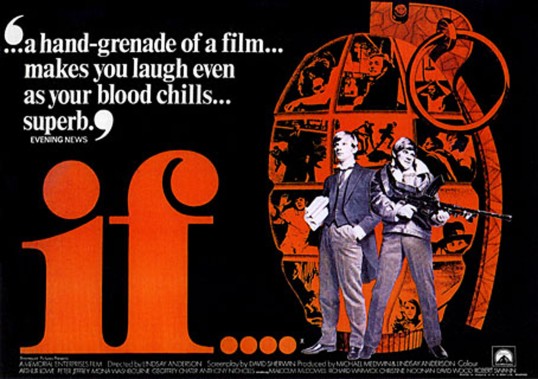
For today’s final entry in our series of Back to School reviews, let’s close out the 60s by taking a look at a 1968 British film.  Directed by Lindsay Anderson, if… not only won the Grand Prix du Festival International du Film (now known as the Palme d’Or) at the 1969 Cannes Film Festival but it also featured the film debut of future icon Malcolm McDowell.

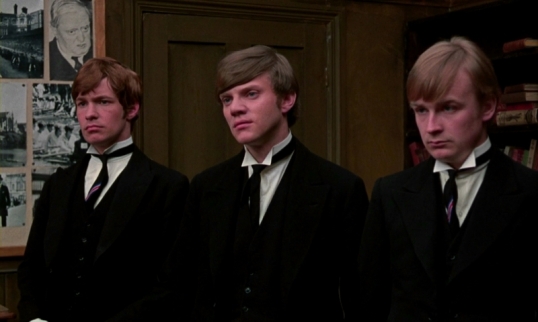
if… takes place at a British public school (or, as we would call it here in the States, a private school) that is mired in a long tradition of conformity and oppression.  For roughly the first half of the film, we see how the school works.  The teachers are stern and out-of-touch.  The headmaster (Peter Jeffrey) considers himself to be something of a reformer and is clueless as to just how little respect the students have for him.  Discipline is maintained by the Whips,sadistic upperclassmen who revel in their power and who spend most of their time speculating about which one of them will claim 13 year-old Bobby Phillips (Rupert Webster) as his own.  Three students — Mick Travis (Malcolm McDowell), Johnny (David Wood), and Wallace (Richard Warwick) — are considered to be nonconformists and soon find themselves being targeted by both the school’s faculty and the Whips.  During this first half, the film plays out as harsh but relatively realistic.

And then something happens.

If2

About 45 minutes into the film, if… starts to grow increasingly more and more surreal.  In a scene that plays out in languid, sensual slow motion, the otherwise dim-witted Wallace gracefully exercises on a high bar while an entranced Bobby Phillips watches.  When Rowntree and his fellow whips decide to punish Mick, Johnny, and Wallace with a particularly brutal caning, the disturbing sound of it echoes throughout the entire school.  During a war game, Mick fires an automatic rifle full of blanks at the chaplain and is subsequently forced to apologize while the chaplain sits up in a drawer kept in the headmaster’s office.  Mrs. Kemp, the wife of the housemaster, wanders naked through the dormitory.  Perhaps most famously, the film goes from randomly being in color to black-and-white and then back again, all adding to the movie’s dreamlike feel.

Perhaps most importantly, Johnny and Mick manage to sneak off campus and spend a day roaming around the city.  After they steal a motorcycle from a showroom, they stop at a cafe where they are served coffee by a character known only as the Girl (Christine Noonan).  The Girl tells Mick that sometimes she’s a tiger and soon, they are wrestling naked on the floor while Johnny sits in a corner booth and drinks his coffee.  Later, when Mick returns to the school, he looks through a telescope and sees the Girl staring back at him and waving.

Johnny, the Girl, and Mick

And finally, the Girl shows up while Mick, Johnny, Wallace, and Bobby are cleaning out a storeroom as a part of their punishment for scaring the chaplain.  Among the dusty shelves, they find not only a jar containing a fetus but a cache of weapons as well.  This leads to the film’s famous conclusion, a shocking act of violence that, in the 60s, was probably viewed as a show of solidarity with rebellious youth everywhere but, when seen in this time and age, draws disturbing parallels with the American tradition of school shootings.

Seen today, if… remains a surprisingly potent celebration of rebellion and a harsh condemnation of conformist society.  Occasionally pretentious in that wonderful way that only a British film made in 1968 could be, if… is also a surprisingly stinging satire that doesn’t leave anyone — even the film’s heroes — untouched.  Perhaps best of all, if… is also the film debut of Malcolm McDowell and he gives a strong performance here.  It’s easy to understand why, after seeing if…, Stanley Kubrick cast McDowell in A Clockwork Orange.  Interestingly enough, despite if’s apocalyptic ending, McDowell would play Mick Travis twice more, in Anderson’s O Lucky Man, a film that is even more surreal than if…, and in Britannia Hospital.

Tomorrow, we’ll continue our journey back to school by taking a trip to the 70s!

If