Which Way Forward For The “Batman” Movie Franchise? Take Ten : Flashbacks And Origins


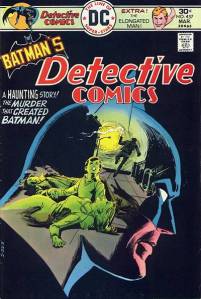
If you’ll recall, when we left things yesterday, the basic plot background for our hypothetical Batman I  was pretty well underway, and Bruce Wayne was hopping onto the back of a boxcar to make his way westward in preparation for catching a flight there that would mark his “official” return to Gotham City. Which probably, and quite naturally, makes you wonder why I would choose to kick this post off with the cover to the classic 1970s Batman origin story “There Is No Hope In Crime Alley!” by Denny O’Neil and Dick Giordano (who was in full Neal Adams rip-off mode at the time, like a lot of the comics industry).

Well, friends, that’s because I figure that this type of scene would give us the best opportunity to give this flick the closest thing I really want it to have to an “origin of the Batman” sequence, which would consist largely of flashbacks running across Bruce’s bat-brain as he takes in scenic views of the vast American landscape. Ideally, I wouldn’t think this montage would need to last more than four or five minutes, but it should hit on all the following key points:

It should start with the by-now-ubiquitous murder of young Bruce Wayne’s parents, followed by a scene of him dropping out of a prestigious prep school, followed by several scenes of intense martial arts and physical stamina training in a wilderness environment where he’s seen side-by-side with numerous other black-clad “ninja-type” guys (spoiler alert! This will be revealed to be Ra’s Al Ghul and his “League Of Shadows” outfit in the second film of our imaginary series), finally wrapping up with some scenes showing the Batman’s earliest exploits rounding up the Gotham crime lords as we laid out in our last little installment here.

I was giving some serious thought as to whether this flashback montage should be in black and white or color, and finally decided on the simple answer of : frankly, it doesn’t really matter. I’m sure a skilled director can pull it off either way and maybe making the whole thing B&W would be a little bit too obvious. In any case, that’s about as “deep” into the origins as we really need this story to go for our purposes. As the scene concludes, we can show Bruce jumping off the train into the quiet, just-post-dawn West Coast morning, and when we next join him, it will be an in entirely different, complete-media-circus-type atmosphere.

I suppose, short and sweet as it is, that’s probably as good a spot as any to leave things for today, since slow, steady, and methodical is our MO here with this series, I’ll just “tease” tomorrow’s installment by saying this — we’ll be leaving Bruce Wayne for a short while and meeting our other principal players, namely Jim Gordon, Harvey Dent, and Selina Kyle before we get back to the star of the show, so their various methods of introduction will be what we take a look at a short 24 hours (or less) from now.

Until then, as always, I welcome any thoughts, criticisms, concerns, critiques, etc. that you, dear reader, may have about today’s (admittedly rather brief) addition to this little ongoing blogging opus-of-sorts I’m in the midst of here.
Which Way Forward For The “Batman” Movie Franchise? Take Nine : The Story Takes Shape


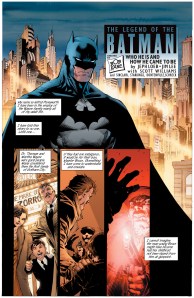
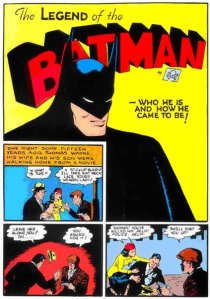
The above image, in case you hadn’t figured it out, is an updating of the classic Batman “quick-version” origin story, “The Legend Of The Batman – Who He Is And How He Came To Be” by Bill Finger and Bob Kane that I included with the last post. This modernized version was done for the Jeph Loeb/Jim Lee Batman storyline “Hush,” which is considered something of a modern “classic” even though, for my money, it pretty much sucks. I’ve never been a fan of Lee’s art, and the story here is essentially another drawn-out murder mystery by Loeb a la his “Long Halloween” storyline, and in point of fact he even employs the exact same plot conceit to disguise the identity of the true killer that he used in that previous series! All of which has precisely zero to do, specifically, with the hypothetical storyline of our hypothetical Bat-trilogy, save for one thing — folks who have read the “Hush” story should know that the Batman/Catwoman relationship depicted therein will have a big influence on how I see their relationship developing in this series. In an ideal world, I suppose, we’d just be able with this new series to come right out and admit a couple less-than-well-kept secrets about the Batman — namely that he’s gay and that he has a taste for a bit of, as the British would so politely put it, “rough trade,” but I think the world is, sadly, about 20 years years away from being ready and able to accept an openly gay Batman, so in this trilogy we’re going to keep up the pretense, paper-thin as it’s getting to be at this point, that the Caped Crusader is, indeed, heterosexual.

But we’re a good few posts away from really getting into the “meat” of how I see the whole Batman/Catwoman relationship evolving, being that we just wrapped up our pre-credit “teaser” sequence, the credits themselves have just rolled, and the there’s already a bit of a conundrum brewing in the audience’s mind as to whether or not this really is the Batman we’ve always known — as in, Bruce Wayne — at all.

Our first scene after the credits roll would be to see Bruce Wayne examining a large computer screen in the nearly-completed Batcave, and as the ever-reliable Alfred Pennyworth enters, they’ll exchange some dialogue about how two years of intense legwork are nearly complete — the cave itself, where Wayne has essentially been living and training, is all set, the “Bat vigilante” is firmly fixed in the public mind as a force that seems to be on their side, and their super-computer has been able to pin all the crime lords in town barring Vincent Lucchesi with plenty of criminal charges. Now is the time for the next phase in Bruce Wayne’s master plan to begin — he’ll “return” to Gotham officially, stake his claim to Wayne Enterprises through a surrogate, take the reins of the Thomas And Martha Wayne Foundation himself as his “day job,” and at night he’ll concentrate on nailing Lucchesi in his “Bat-vigilante” persona.

For that, though, he’ll need some help — and he’s zeroed in on two people on the “inside” that he’s made a calculated determination he can trust — new police commissioner Jim Gordon and new DA Harvey Dent. His period of working alone is over, and now that he’s delivered every other big crime lord in town to them, he’s earned a level of trust and respect from both these men. Lucchesi’s going to be a tougher nut to crack, though, because unlike the other guys, who could all be tied to the drug trade eventually through various phony business set-ups, bank accounts, etc., Gotham’s last “crime lord” doesn’t actually seem to be involved in the drug trade at all — the strangest thing Bruce Wayne/Batman has been able to come across in regards to Lucchesi is his well-concealed , even more well-concealed than the other guys were in regards to their involvement with the drug trade, orchestration of the shipment of large amounts of a perfectly legal, albeit quite dangerous, form of liquefied fertilizer into town, which naturally has Batman thinking that he’s working on a massive bomb of some sort.

Now, hopefully a competent screenwriter quite weave all this into a naturally-enough-sounding conversation that wasn’t too heavy on the info-dump and that would end with Alfred saying something along the lines of “well, all these questions will have to wait, sir, because Bruce Wayne is due in on a flight from San Francisco at noon on Friday.”

“And so I do, Alfred, and so I do.”

“And how, pray tell, do you intend to get to San Francisco undetected, sir?”

“You know, Alfred, I’m feeling a bit nostalgic — I thought I’d hop the rails for old times’ sake.”

I think I’ll leave it at that for now, since the next scene, with a clearly disguised-to-give-him-a-disheveled appearance Bruce Wayne playing hobo and riding in the back of a boxcar is the next crucial stage in the overall setup of the film’s first act and probably deserves a post of its own, so we’ll focus in on that tomorrow.

What say you to our little setup so far, then? Thumbs up? Thumbs down? Still too early to tell? As always, any and all comments are welcome, whether positive, negative, or aggressively neutral!


Which Way Forward For The “Batman” Movie Franchise? Take Eight : Finally, The Story Begins!


So here we are, after seven posts setting up background, detail, etc., and we’re finally ready to begin exploring the (admittedly skeletal) plot structure I have in place for our new Detroit-filmed, more-emphasis-on-the-detective-and-heroic-aspects-of-the-character Bat-trilogy, which we’re (tentatively, at any rate) simply titling, in succession, Batman IBatman II, and Batman III.

But first a word about that classic “Legend Of The Batman” panel “by” Bob Kane reproduced above. Like all the classic early Bat-stories, it was drawn by Kane, but the story and all the concepts behind it are the work of comics writer Bill Finger, who Kane conspired with DC management with to completely screw out of his co-creator’s claim to the Batman character. If you want to know how complete and thorough-going was finger’s contribution to the Caped Crusader, consider not only that by most reputable accounts he created Gotham City, The Joker, and Robin, but that when Kane first approached Finger with his idea for a new comics character, he called him — I shit you not — “Birdman,” and wanted him to dress as, no surprise, a bird of some sort. That whole bat idea? It was all Finger’s. And for all his troubles he died dead broke, buried in an unmarked grave, while Kane went on to make millions, and DC billions, off his ideas. So it’s to the immortal, yet criminally unsung, memory of Bill Finger that I dedicate my own admittedly completely unsolicited and sure-to-be-unread-by-anyone-who-could-ever-do-anything-about-them ideas here. Unlike Warners, DC, and Bob Kane himself, at least I have the decency to admit from the outset that none of the work I’m doing here would be possible without the truly mighty imaginings of the late, great Bill Finger. He is the giant the rest of us stand on the shoulders of.

All that aside, fear not, as we’ve already established we’re still talking about a “soft” reboot here that doesn’t concentrate itself terribly heavily on Batman’s origins, although the story does take place early in his career. I just thought for a visual accompaniment to the text here we may as well begin at the character’s beginnings — but fear not, the overall “plan,” such as it is, to “play down” the origin aspects of the story remains in place. And so, without any further ado, here’s how I think I’d begin the initial pre-credits sequence of our hypothetical Batman I 

We’re on the set of a daytime news/chat-type show called “Gotham City Today” or somesuch, with two presenters, one male and one female. The female presenter launches into the top news stories from overnight, the first being that the so-called “Bat vigilante” has stuck again, this time delivering the sixth of seven of Gotham’s most notorious reputed “crime lords” into police custody, along with incriminating computer files that should , in theory, give new district attorney Harvey dent more than enough ammunition to prosecute the guy. Speculation is rampant as to the identity of the “Bat-vigilante,” with most wondering whether or not he’s either a surce within the police department itself or a member of some computer-hacking collective a la “Anonymous,” so complete and thorough are the dossiers he’s been handing over along with the crooks themselves.

The anchorwoman’s male counterpart then cuts in with something along the lines of “but one menace he’s been unable to deliver over to the law is the notorious cat-burglar who’s been prowling Gotham’s rooftops at night, cleaning out the safes of one penthouse apartment after another. She apparently struck again last evening, looting the residence of our own station owner of well over one million dollars in cash, jewelry, and other valuables, leaving only her trademark claw-scratch on one of the paintings in his home.”

Back to the female anchor who assures audiences that both the bat-vigilante and the cat-burglar are priorities two and three of new police commissioner Jim Gordon and the aforementioned DA Harvey Dent, right behind the city’s sole remaining crime kingpin, one Vincent Lucchesi (apologies to any and all Italian readers for making the head mobster in town of Italain origin, I’m just not creative enough to come up with anything better, I honestly mean no offense), before segueing into something along the lines of ” — and on a lighter note, all of Gotham is abuzz with the imminent return home on Friday of our city’s most fortunate son, and certain to be most eligible bachelor, Bruce Wane, after twelve years spent abroad. Where all has he been and what’s he been doing? Why is he coming home now? And what are his plans for the future? We’re pleased to say that all that and more will be discussed when yours truly sits down with Mr. Wayne for an exclusive interview here on Gotham City Today next Monday morning.”

And with that little “teaser” in place, we roll our opening credits —

Hopefully that should whet your appetites to keep reading every bit as much as it will whet the audience’s to find out exactly what’s going on here, so I’ll leave it at that for now, but rest assured, I’ll be back tomorrow with more, and all should hopefully become apparent!

Which Way Forward For The “Batman” Movie Franchise? Take Seven : What’s In A Name?


That right there, friends, is my personal favorite Batman logo.

I know, I know — it’s far too campy and cartoonish to fly in today’s movie market, but the hypothetical Bat-trilogy we’re cooking up in this series of posts is, as we’ve established, probably going to have a lot more emphasis on the heroic and detective aspects of the character than it is on the “Dark Knight” aspects. and as such, I like to think having this new trilogy go out under an “old school” logo like that would be a pretty cool thing. And while this particular logo may not be the exact logo from the old Adam West Batman TV show per se, it’s still pretty close, at least thematically, so any way you slice it, I’m sure it’s a no-go.

That being said, there is a somewhat “retro” logo that I think would form a rather apropos visual backbone for this new trilogy, namely this one from the late-80s/early-90s  DC Bat-books —

Sure, it’s still not quite the perfect look, but it’s pretty cool , evokes just the right touch of the past, yet still wouldn’t be totally off-putting to a contemporary audience. It would, of course, inevitably be tinkered and toyed with, but that’s more than okay, since my point isn’t so much that it’s a perfect logo, by any means, merely that its design would form a nice visual basis for whatever sort of logo the series would, inevitably, end up with.

But you know what? It’s not logos I’m here, specifically, to talk about. That’s just a side issue, although one that fits in with what I am actually here to talk about which is — plot details, right? Well, that was the plan. And it’s still the plan. But it’s going to have to wait until Monday because I’m still cooking up a few minor details and tomorrow my free time is limited and I’m firmly committed to reviewing the latest Before Watchmen book for my own website, http://trashfilmguru.wordpress.com. So plot stuff is coming, I promise — on Monday.

What’s the whole subject here today, then? Apart from logos, that is? Well, titles. Because is strikes me that what we’re gonna call these flicks is actually, you know, kind of important. And as good as I thought Batman Begins was as a film, I still think it’s kind of a stupid title. With the whole “Dark Knight” concept being one this series is sort of moving away from, or at least toning down, starting things off with a flick called something like The Dark Knight Returns is out, too — and would just cause confusion with the Frank Miller book of the same name, anyway.

The basic title of Batman is probably a no-go, too, since it’s been used twice already, in both the 1960s and 1980s, but I do, ideally, want this series to have more a Batman feel than a Dark Knight feel, so what does that leave us with? I have to admit it was something I was kind of struggling with in my mind, until I realized that sometimes the most basic names are the best, and sometimes the most workable solutions to problems are hiding in plain sight, to wit —

How about we just call these things Batman IBatman II, and Batman III? Sure, it’s basic, maybe even (okay, definitely) unimaginative, but what the heck? Most of the folks out there would just say they want a ticket for “Batman,” whichever “Batman” it is, when they get to the box office anyway, so it’s definitely functional, at any rate. And yes, the idea of putting a I in the title of the first flick might be a bit presumptuous, but having “Episode I” in the title for The Phantom Menace didn’t hurt its performance at the gate any (nor did uniformly horrible reviews), and for a more current example of the same concept working out okay take a look at Atlas Shrugged, Part I, which has a sequel on the way even though the first movie lost tens of millions of dollars and was laughed off even by many of the same members of the “Cult Of Rand” at which it was squarely — and, frankly, solely — aimed. So maybe openly stating one’s intent to make more films in a series in the title of the first film is one way to guarantee that said successive films will happen?

Nah. I think that that theory’s a pretty dubious one at best, too, and I know full well that Atlas Shrugged, Part II  is only happening because a couple of Rand-fans with very deep pockets agreed to finance a trilogy from the outset, but still — I think Batman III, and III works (or rather would  work, mustn’t get ahead of myself) just fine, even if it doesn’t exactly reek of brilliance and/or originality.

I’ll be back Monday with — I swear! — the first plot details, but until then you’ve got 48 hours to tell me why this idea is brilliant, stupid, or somewhere in the middle —

Which Way Forward For The “Batman” Movie Franchise? Take Six : Should It Stay Or Should It Go? Part Two


I’ll be honest — I’ve never played the apparently-insanely-popular Batman : Arkham City video game — or any Batman-related video game, for that matter  As far as I understand it, though, the idea behind it is that there’s been a jailbreak of some sort at Arkham Asylum and all the “lunatic” criminals — uhhhmmmm — “housed” there are now loose on the streets of Gotham.

Neat idea, and it seems to be catching, as there’s an Arkham City comic book mini-series being published by DC as we speak. Wonder where they got it the concept from in the first place? Oh yeah — it was the central plot conceit in the third act of Christopher Nolan’s Batman Begins, although the video game, apparently, ups the ante quite considerably.

All of which leads us, in an admittedly rather roundabout way, to the subject of today’s “What I’d Do Next With The Who ‘Batman’ Movie Franchise” thing, namely — which specific plot points and/or characters from Nolan’s trilogy would I keep in the franchise’s inevitable relaunch (which, if you’ll recall, is going to be of the “soft” variety)? Well, let’s take a look at precisely that —

As preamble, let me state that I need, once again, to beg your indulgence, dear reader, for a day or so here because all I’m going to do here today is give you a laundry list of the specific items I’d keep, but not go so far as to explain why. Fear not, though, the why is coming — and in detail! — over the next several days as I lay out in detail the specific plotline I have in mind for the new hypothetical trilogy we’re planning here (we did, in fact, decide it was going to be another trilogy a few weeks back, remember? I wouldn’t blame you if you didn’t). So here’s what I’d keep, and tomorrow I’ll start in on why I’m keeping this stuff — or rather, my plot outline should, if its communicated even semi-coherently (always a gamble with me) demonstrate on its face this “why” factor I’m harping on about.

Needless to say, the “Arkham jailbreak” idea makes the cut. I have no desire to have it be on as grand a scale as the video game probably depicts, or even as grand as Nolan’s original iteration of the event, but it’s gonna be in there, as is the guy who was behind it in the movie, Dr. Jonathan Crane, aka The Scarecrow, although in somewhat reduced form. I like The Scarecrow. I like the whole “fear gas” thing. I think it worked, and can work again, albeit with a different spin, I think, on things. And speaking of villains —

My hypothetical new trilogy will, indeed, feature many of the same principal baddies as Nolan’s films. I’m thinking, specifically, that in addition to The Scarecrow, we’ll be looking at Harve “Two-Face” Dent again, in a dramatically expanded role, Ra’s Al Ghul in a somewhat reduced role (and not until the second film), The Joker is an essentially similar role (lead villain in the second film), and Catwoman in, like Two-Face, a very much expanded role. In fact, as I’m looking at things right now, but Harvey Dent and Selina Kyle will feature prominently in all three imaginary (sigh) films of our imaginary (sigh again) trilogy.

As for what else I’d keep from the Nolan flicks, I’m thinking the idea of a somewhat younger Bruce Wayne (at least to start with) is a keeper, as are supporting cast members Lucius Fox, corrupt cop Lieutenant Flass, and, of course, Alfred Pennyworth and Jim Gordon. There will be differences in how they’re depicted, though, that range from the subtle to the radically different.

I guess that’s what we call a bit of a “teaser” for the next installment in this series of posts, isn’t it? Well, rest assured, friends, I’m on a definite roll here (even if it’s only in my own mind), and part seven of this ever-evolving thang will go up at some point tomorrow, barring unforeseen calamity of some sort, knock wood.I hope to see you back here then as I begin to take these pieces, add in some others (naturally), and then show you just how I think this whole unwieldy jigsaw should be put together.

Which Way Forward For The “Batman” Movie Franchise ? Take Five : Should It Stay Or Should It Go? Part One


It’s funny how life works, isn’t it? Three weeks ago I said I’d be back here in a week to continue this series on how I think the Batman film franchise should be relaunched, and that week off became two, became three — anyway, I apologize, but I’m back. I could bore you with the usual litany of excuses as to why my absence was longer than expected, all of which are, in this case, true — busy at work, lots of shit going on outside of work, etc., but I’ll spare you all that (whoops!, guess I sort of subjected you to them in an off-handed manner already), and simply say for those of you who actually look forward to these little rants of mine, I sincerely apologize for the delay.

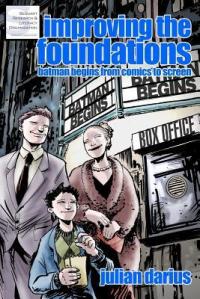
That being said, not all my time between posts has been wasted. For example, I had the good fortune to purchase, and subsequently read, an excellent little book by one Dr. Julian Darius, published under the auspices of his own imprint, Sequart Literacy & Research Organization, called Improving The Foundations : Batman Begins From Comics To Screen that’s set me to thinking about all this shit in a far more serious and cohesive manner than I had before.

Darius’ little tome essentially tracks back all the various threads that went into Christopher Nolan’s Batman Begins and while the whole book makes for some pretty fascinating reading, I have to admit that the stuff I found most interesting was in the section that covered the various version of Batman that didn’t make it to the big (and small) screens in the period between Joel Schumacher’s Batman & Robin debacle and Nolan’s first flick. I won’t rehash any of it here because I honestly want folks who are interested to read Darius’ book, as well as to support Sequart because they’re a fine bunch of folks, but I will say this much — reading through all that has given me a much better understanding of what won’t work when the time comes to relaunch Batman on celluloid and, more importantly perhaps, why it won’t work.

All of which brings me, rather neatly, full-circle in terms of where I’d been intending to take this series of posts anyway. I promised this next segment would deal with the elements I’d keep from the Nolan series, but before I delve into the nitty-gritty of the details, which I’ll do tomorrow, let me just state for the record the one overarching philosophical approach practiced by Nolan and screenwriter David S. Goyer that I would most definitely stick with : a “scattershot,” pick-n’-choose approach to adapting/borrowing material from the comics and reformulating all these disparate elements into a version that works best for cinema.

While a more literalist approach to translating the Dark Knight’s origins to the silver screen would have been to say “let’s just do a pretty faithful adaptation of Frank Miller and David Mazzuchelli’s Batman : Year One” — an approach the studio even tried by bringing in Miller himself to write a treatment based on his comic — the Nolan/Goyer tandem was happy to borrow some of the best, or at least best-suited-for-cinematic-adaptation, elements not only from Year One, but from the old 1970s Batman stories by Denny O’Neil and Neal Adams, from the previously-discussed-in-these-parts Batman : The Long Halloween by Jeph Loeb and Tim Sale, and even from Miller’s legendary, though-in-no-way-an-origin-story Batman : The Dark Knight Returns. And as the Nolan bat-series wore on, they continued this approach of borrowing liberally from disparate periods of the Caped Crusader’s history and adapting the stuff they were grabbing to better suit their overall vision (Bane certainly didn’t start out as a vigilante for the 99% crowd, for instance — he was just a typical 1990s ripped-on-‘roids villain in a wrestling mask).

So even more than any particular plot details, I think the most valuable lesson whoever Warners hires to helm the next chapter in the Caped Crusader’s cinematic exploits can take from Nolan is this overall “take what you want and put it all together in whatever way suits you best” approach. Details matter, to be sure, and we’ll delve into those a bit more tomorrow, but for the time being, since I promised to be almost painstakingly focused/ incremental here, I just wanted to set the stage beforehand by saying that approach is one that I think by and large served the last Bat-trilogy well, at least in terms of overall concept if not always in its execution, and that I can think of no coherent reason to chuck it overboard and go for a more “this must be just like the comics” approach that’s only going to make die-hard, long-time readers of Batman’s adventures on the printed page happy while alienating pretty much anyone and everyone else. And on that note, I’ll save the rest for tomorrow’s (I promise!) installment.

VGM Entry 39: End of the NES era (part 1)


VGM Entry 39: End of the NES era (part 1)
(Thanks to Tish at FFShrine for the banner)

Games would continue to be made for the NES long after the release of the Super Nintendo, but its glory days had come and gone. Already by 1990, the system was starting to sound a little stale, and even the most impressive compositions faced an enormous burden in keeping pace with video game music at large on a hopelessly outdated system.

Koichi Sugiyama certainly didn’t produce much of interest. The improved rendition of the main theme aside, Dragon Quest IV (Enix, 1990) was not a particularly memorable soundtrack. It has no faults per se. It certainly had nothing approaching the annoyance of the original Dragon Quest‘s combat theme. But no amount of listening to the tracks beyond the main theme here has revealed the slightest hint of anything special. It’s a soundtrack secure in its simplicity. The music is wholly appropriate for an RPG, never clashing with the style of gameplay, but it also adds nothing to the experience save pleasant background music. I’ve heard plenty worse by RPG composers with much more diverse sound systems to work with, but it definitely feels to me as though this one stands out more for the fact that “Dragon Quest” and “Koichi Sugiyama” are attached to it than for its own worth.

Final Fantasy III (Square, 1990) was a somewhat different situation. It’s got a lot more emotion to it, and frankly it might constitute Nobuo Uematsu’s finest compositions on the NES, but in the context of its place in time it can be pretty hard to appreciate. Here’s a track list for the video:

(0:00) Prelude
(0:56) Crystal Cave
(1:54) Jinn the Fire
(2:43) Chocobo Theme
(3:20) The Invincible
(4:11) Battle
(5:06) Last Battle
(5:59) The Boundless Ocean
(6:59) Fanfare

Nobuo Uematsu definitely climaxed as a specifically NES composer on Final Fantasy III. “Battle” and “Last Battle” express a full appreciation for the NES as an instrument, and the rapid-fire accompaniments in both, but especially the latter, are some of the most powerful on the system. The SID-like sound on “Crystal Cave” and “Last Battle” adds a new dimension to the songs which would have been unthinkable for Uematsu a mere three years prior, while “The Invincible” is a practically perfect arrangement. If Final Fantasy might best be defined as lovely compositions poorly arranged, Final Fantasy III was definitely the full package.

The problem, and the reason it took me setting the game aside and coming back to it weeks later to be able to really appreciate it, is that this was 1990. Amidst the Sega Genesis/Mega Drive, the Commodore Amiga 500, and the NEC PC Engine/TurboGrafx-16, the NES just sounded terrible; it was no longer novel and it was way behind the times. Nintendo’s lengthy development paid off, as things turned out, but a lot of early 1990 releases better suited for the SNES suffered from the delay.

Resting somewhere between these two in quality was Castlevania III: Dracula’s Curse (Konami, 1989). I have seen no less than five musicians credited with the composition. Hashing out who all among Hidenori Maezawa, Kenichi Matsubara (Castlevania II), Yoshinori Sasaki, Jun Funahashi, and Yukie Morimoto were really responsible for the music might be a fun task, but I only have the time for so many such projects. For whatever it’s worth, Hidenori Maezawa, Jun Funahashi and Yukie Morimoto are the three most frequently credited names. Consisting of a long list of virtual unknowns, this is one of those scores for which “Konami Kukeiha Club” might be the most appropriate accreditation.

One thing that strikes me as interesting here is how the drums and bass feel like they’ve borrowed from Batman (Sunsoft, 1989) by Nobuyuki Hara and Naoki Kodaka, especially considering I felt Hara an Kodaka themselves might have been inspired in part by the Castlevania series before I ever heard Castlevania III specifically. This connection, or at least the possibility of Batman‘s drum and bass influencing Castlevania III, is virtually impossible. As it turns out both games were actually released on the exact same day: December 22, 1989. (I had originally thought Castlevania III was released in 1990, hence my placing it in this post, but it’s close enough.)

The game has some pretty impressive original tracks, especially “Beginning” (0:00) and “Mad Forest” (1:10), not to mention a new rendition of “Vampire Killer” (5:49). The overall sound is a lot less classical and a lot more peppy than previous Castlevania titles, though I think that can be forgiven in light of the good, consistent job they did with it. Again, the soundtrack only took a while to grow on me due to its historical context. It was most certainly technologically behind the times, but there wasn’t much the Konami sound team could do about that.

VGM Entry 36: Mother, Batman, Goemon


VGM Entry 36: Mother, Batman, Goemon
(Thanks to Tish at FFShrine for the banner)

A lot of solid Nintendo soundtracks were released in 1989, and I can’t touch on all of them, but here are a few other noteworthies I can’t justify passing over.

Ganbare Goemon 2 (Konami, 1989) added a lot to the sound of the original 1986 Goemon titles (Legend of the Mystical Ninja series in the west), maintaining the same style but adding a percussion track and much more complimentary and varied tone selections. I’ve not managed to find a satisfactory answer as to who composed it though. Tomoya Tomita, Koji Murata, and Michiru Yamane have all been credited here an there without any explanation as to their different rolls, and I’m pretty sure at least the latter two were definitely involved in some capacity, but I can’t be sure.

Konami has a long history of botching the names of their video games, and the Goemon series is no exception. For instance, I have seen sites unattentively list authorship credits as: “Goemon: Satoko Miyawaki. Goemon 2: Michiru Yamane”. But not only was there no game in the Goemon series actually titled Goemon or Ganbare Goemon, there were two games titled Ganbare Goemon 2. Different sub-titles sort this out, but I don’t trust the creators of massive composer compilation lists to have attentively adhered to this.

In so far as the original Mr. Goemon was released on arcade and the third Ganbare Goemon title was an MSX port of the first NES game (I’m not sure why it’s listed separately), calling the 1989 instalment Ganbare Goemon 2 was a fair move. The confusion in this instance did not arise until Konami decided to release Ganbare Goemon 2: Kiteretsu Shogun Magginesu in 1993. (If you add them all up, the second “Goemon 2” was the tenth Goemon video game.)

At any rate, you’re hearing Ganbare Goemon 2, no subtitle, and it was released in 1989. Enjoy.

Nobuyuki Hara and Naoki Kodaka composed Batman (Sunsoft, 1989) in the wake of Mega Man 2, when the bar for NES action game soundtracks was through the roof. I certainly don’t think it’s as good as Takashi Tateishi’s historic work, but it demands an honorable mention. Its most famous track, first in this compilation, feels straight out of a Castlevania game, whereas the second song here kicks off with more of a Mega Man vibe. All the while it is consistently driven by a forceful bass which really best defines the soundtrack. It is in large part the consequence of Hara and Kodaka landing on highly complimentary bass and drum tones which seem to mutually emphasize each other. The bass track is also much more complex in a lot of these songs than was typical for Nintendo music, and the dark, punchy vibe is perfectly suited for a Batman-themed action game.

Similarly, the frequent employment of Castlevania-style melodies is less a ripoff than a completely appropriate sound for the game. I mean, it could be a total coincidence that they sound alike at all. What is our hero here supposed to be again? Oh yeah, a bat.

Or it could be the case that Hara and Kodaka were avid fans of contemporary video game musicians and incorporated the best of every world with conscious intent. A lot of amazing works have derived from calculated stylistic fusions, and I would not rule out either possibility.

And then there is Mother (Nintendo, 1989). If you ever played Earthbound on the SNES, its music is etched into your memory whether you like it or not. Earthbound was the sequel, and Mother has still yet to be released outside of Japan today. I was a cool little middle school computer nerd who managed to get his hands on a fan-translated ROM, but having succeeded in acquiring it, I promptly lost all interest in actually playing it. It’s a shame, because now I am completely perplexed as to how these two games overlapped. The gameplay is literally identical to the SNES sequel, and I’m not wholly convinced that the plot is not as well. Likewise, quite a number of the songs of Earthbound first appear in Mother, including a lot of the battle themes. Keiichi Suzuki and Hirokazu Tanaka remained partners for both titles, and there is hardly any break where one lets off and the other begins. The original was certainly one of the most unique compositions on the Nintendo, but the same can be said for its sequel on the SNES despite the music really not changing much.

This compilation is really one of garudoh’s weaker efforts, and I can’t easily provide you with many alternatives, so I may leave most of the Mother discussion for Earthbound when I get to it.

But on a final note, here is one of the revisited battle themes in its original form, just to give you an idea of how effective Keiichi Suzuki and Hirokazu Tanaka’s drum and bass emphasis was even on a system as limited as the NES.

Which Way Forward For The “Batman” Movie Franchise? Take Four : The Power Of Three


There are those who insist that good things come in multiples of three and there are those who will tell you that bad things tend to come in threes — both camps have a Star Wars trilogy they can point to as evidence for their pet theory, and while neither are strictly correct, on a purely rational level, neither side is technically wrong, either.

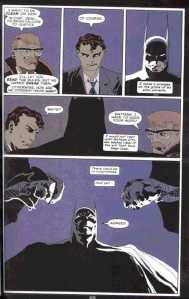
So let’s just face facts here and admit there are some good movie trilogies and some bad ones, that within the good ones some better than others, and that within the bad ones some are better than others. All of which brings us back to that rooftop scene we started this “Rebooting Batman'” series with, from Jeph Loeb and Tim Sale’s The Long Halloween miniseries, the second page of which is reproduced above (and I apologize for its crookedness, it’s the only scan of this particular page I could find online).

Quite clearly, the latest cinematic iteration of the Dark Knight Detective, as helmed by Christopher Nolan, was a trilogy, and flaws aside, I think that by and large structuring the whole thing this way, whether by accident or design, by and large worked, story-wise. We got a beginning, middle, and end to Batman’s career, and a forth installment probably would have been pushing things a bit much (okay, fair enough, folks who didn’t like the Nolan films probably feel like three was too many, but that’s another matter for another time). I guess I’m in the minority on this, but I would have liked to see Tim Burton get a third crack at the bat-franchise, as well. It certainly would have been better than Batman Forever.

And this is the point at which attentive readers will tell me to back the fuck up for just a minute and pick up on that “all of which brings us back to the rooftop scene” bit. Your wish is my command. Quite clearly, the Harvey Dent/Commissioner Gordon/Batman triumvirate that forms the thematic core of The Long Halloween is what I’d like to see at the center of the entirely-hypothetical next Bat-trilogy I’m building in my head, even if I’d take pretty much no other cues from this particular book whatsoever. I mentioned last time around that giving Bruce Wayne and/or Batman a real life that included some actual friends apart from Alfred would be an idea that I. and a lot of fans out there, would be receptive to. And of course, we all know that the story of Harvey Dent is, ultimately, a tragic one that could translate well into a central theme spread out over three flicks. I’m still working out all the details as to how to do it in my head — like I said in a previous post, I’m very much making this up as I go along — but how about this for starters? In our new Bat-trilogy, Dent, Gordon, and Batman start as uneasy allies, and are pretty firm, honest-to-goodness friends by the end of the first flick. Perhaps even to the point where Batman decides to clue them in on his secret identity (although that’s not, strictly speaking, necessary — just something to keep in mind).

If Warner Brothers were to decide to give this hypothetical “soft reboot”‘s director a three-picture guarantee, absolutely not unheard of in the movie business, then that would seem a natural enough relationship to build a trilogy around, and we can get into Harvey’s inevitable turn for the worse as we move into discussions of (the again completely hypothetical) parts two and three. If the first flick were to be a complete and utter flop, then hey, they can always fire everybody, go back to the drawing board, and us fanboys and fangirls can endlessly debate the “great Batman trilogy that never was,” which is always a pretty fun little time-waster in and of itself, as well.

So, to recap, here’s where we are right now — the next Bat-flicks are going to have a shift in tone toward the more heroic, old-school, brains-over-bran interpretation of the character that will result in a bit less “dark” an overall tone; we’ve established Detroit at the central filming location for Gotham City; we’re going the “soft reboot” route by going back to an earlier point in Batman’s career but not obsessing over the details of his origin too explicitly; and we’re planning for a trilogy of films from the outset, one with a genuine story of friendship between Batman, DA Harvey Dent, and Police Commissioner Jim Gordon at its core.

Sound good? Sound bad? Now’s the time to chime in, and I do appreciate all your comments, both good and bad, so far. On a minor “housekeeping” note, I’ll probably be stepping away from this series for the next week or so as I attend to some business on my “main” site (trashfilmguru.wordpress.com, in case you didn’t know), but will be checking, and responding to, comments on here just the same. A guy’s only got so many hours in a day to write, and I’ve been running a series of comic reviews over there that I really want to wrap up in the next few days before showing the love of my life (yes, that would be my wife) a terrific time for her upcoming 30th birthday. Once that’s all taken care of, I’ll be back to the task at hand here with the next entry in our series, which will focus on which details I’d keep, and which I’d scrap, from the Nolan series of Bat-films. Then we can finally get into the plot of the films themselves proper, followed by arguably the most fun part of all, ideal casting choices for all the characters!

Oh, and maybe we should start bandying about some names as to who we’d like to see directing these flicks in an ideal world, as well? But I did say one thing at a time was going to be the order of the day here, didn’t I? Must try to stick with that — if at all humanly possible!

Which Way Forward For The “Batman” Movie Franchise? Take Three : Setting The Tone


They just don’t draw Batman like that anymore, do they? These days, he’s a “ripped” steroid freak in a high-tech suit of armor who’s usually either thrashing someone to within an inch of their life or brooding silently. Ever since Frank Miller’s legendary Dark Knight Returns story — which, I’ll grant you, is still probably the single-best Batman story ever — he’s been getting increasingly somber, morose, and violent. Miller himself even portrayed him, essentially, as a child-abusing psychopath in All-Star Batman & Robin, The Boy Wonder. The films,  Joel Schumacher aberrations aside, have been getting increasingly darker over time, as well. People thought Tim Burton’s Batman flicks were a little too dark, so Warner went to Schumacher for a “course correction” that fell flat on its face, and then Christopher Nolan came along with the most popular, and darkest, cinematic version of Batman yet.

Then came the midnight premier of The Dark Knight Rises in Aurora, Colorado.

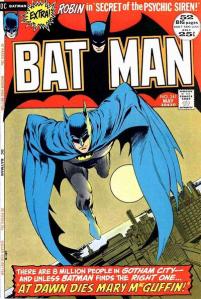
I would argue that even before that tragedy, this whole “increasingly dark” thing had run its course, but now I think a change in tone is positively essential. Which is not to say that Batman should ever go back to the light-hearted goofiness of the 1960s TV series. Modern audiences like a Dark Knight who is — well, dark. But I think the right tone was struck in books like the one pictured above, by the legendary 1970s Batman creative team of writer Denny O’Neil and artist extraordinaire Neal Adams. Their Batman was a serious, determined, perhaps even obsessive guy, but he was as much a man of intellect as of action, and at the end of the day he was a hero first and foremost, and could always be counted on to do the right thing. I think modern audiences are ready for that again after seeing Bruce Wayne essentially degenerate into basket-case status by the beginning of Nolan’s third flick, only to heroically redeem himself at the end. Let’s pick any new series up from that point — not storywise, mind you, but tonally.

To be a bit more specific about what I have in mind — think maybe a little more Michael Keaton and a little less Christian Bale. I liked Keaton’s take on the character — you felt like he was a decent guy at heart who just had this fundamental inability to resolve a gaping hole left in his life by his parent’s murder and had enough money and free time to channel that pain in a really — well — weird  direction, but would give all that up for a normal life in a heartbeat if he could just, ya know, figure out how to. Keaton;s cracking of the Joker’s poison code in Batman was also one of the few instances in any of the 1989-and-onwards Bat-films where we actually saw the Caped Crusader putting to use something that his name has always been, and always should be, synonymous with, namely his detective skills. I think it would be a great step in the right direction to see the next version on Batman on the big screen be just as at home in the Batcave’s crime lab or poring over information on its super-computer as he is kicking ass in a rainy alleyway.

I don’t think there’s any need for Schumacher camp, much less 60s-style uber-camp, but by all means, you can lighten things up a bit and still give us an essentially dark and mysterious character. 1970s Batman was pretty much all about that. And any Batman that’s going to “work and play well with others” in the inevitable Justice League movie DC’s cooking up will have to be at least a little more of a “joiner” than Bale and Nolan’s take on the character was.

To that end, I propose giving Bruce Wayne some actual friends apart from Alfred, a love interest who doesn’t get murdered, and an actual social life that’s not an OTT front from his crime-fighting activities and nothing more. But I promised to stay focused, and will get a bit more into the details of that tomorrow, as I examine the relationship that I think should be at the core of the next bat-series, and how it ties back into the rooftop scene from The Long Halloween that I started this whole thing with. I’ll also be getting into why I think a trilogy should be the plan for the next series from the outset — I know, I know, I said one thing at a time, but trust me, the “two” topics really are one and the same. In the meantime, of course, if you think I’m barking up the wrong tree with those whole “tone down the darkness a notch” stuff, now’s the time to say so!