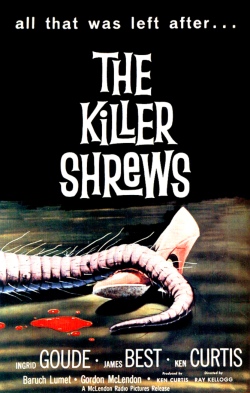
The TSL’s Horror Grindhouse: The Killer Shrews (dir by Ray Kellogg)


Genetic modification.  Sure, it sounds like a good idea.  But are the results ever worth it?

Dr. Marlowe Cragus (Baruch Lumet) thought it was a good idea.  That why he and his daughter, Anne (Ingrid Goude), and Anne’s boyfriend, Jerry (Ken Curtis), all moved to an isolated island.  Dr. Cragis though he could perform some experiments on some shrews and that he would unlock the secret of how to …. well, who knows what Dr. Cragis thought he was actually doing.  (I mean, to be honest, who is really sure what a shrew really is?)  Cragis claims that he was trying to end world hunger but that sounds like a convenient excuse.  To be honest, it seems like Dr. Cragis was just experimenting for the sake of experimenting.

Unfortunately, Cragis’s experiments somehow led to the shrews turning into giant and carnivorous beasts.  At first, the doctor kept them locked up.  But then Anne broke up with Jerry and Jerry got drunk and he let all the shrews go free.  Yep, it’s a mess.  Now, the shrews are running around the island and the doctor and everyone else is trapped in the lab.  Boat captain Thorne Sherman (James Best) has arrived to take everyone back to the mainland but, unfortunately, there’s a hurricane approaching.  The humans will have to survive one more night on the island of …. THE KILLER SHREWS!

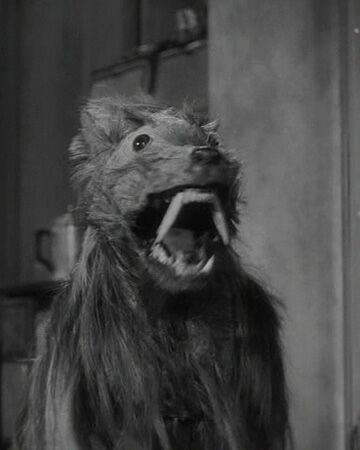
Directed by Ray Kellogg, The Killer Shrews was filmed in 1959.  It was a regional production, filmed just outside of my hometown of Dallas and released to local drive-ins.  It did well enough to get national distribution and it continues to be popular among aficionados of bad cinema.  The main problem with The Killer Shrews is that the shrews themselves are obviously just dogs that are wearing shrew masks.  For the most part, the dogs seem to be happy to be there.  I’m pretty sure that I saw a few of them wagging their tails shortly before launching their attack on the humans.  We’re told that the shrews are killers but they don’t look like they’ve ever killed anything.  Instead, they look like very good boys.  One gets the feeling that they were a lot of fun to play with between filming.

That said, The Killer Shrews is entertaining if you’re looking for a short movie that will inspire a good laugh or two.  James Best and Ken Curtis play romantic rivals and the fact that they both attempt to give serious performances only serves to highlight the absurdity of a group of people being held prisoner by a pack of shrews.  Baruch Lumet, the father of director Sidney Lumet, acts up a storm in the role of Dr. Cragis, yelling all of his dialogue like the stage veteran that he was.  And, of course, the dogs playing the shrews appear to be having the time of their lives. Hopefully, someone tossed around a tennis ball with them after they finished their scenes because they definitely earned the reward.

The Killer Shrews is not exactly a killer movie but at least the dogs are cute!
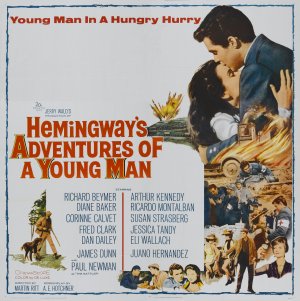
Lisa Cleans Out Her DVR: Hemingway’s Adventures Of A Young Man (dir by Martin Ritt)


(Lisa is currently in the process of cleaning out her DVR!  It’s going to take a while.  She recorded this 1962 literary adaptation off of FXM on January 30th!)

Hemingway’s Adventures Of A Young Man is one of those films that you just know was made specifically to win Oscars.  It’s a big prestige production, complete with a historical setting, an epic scope and big, all-star cast.  That most of those stars appear in relatively small roles was undoubtedly meant to evidence of the film’s importance.

“Look!” the film seems to shout at times, “This is such an important film that even Paul Newman was willing to stop by for a day’s work!”

The film is based on ten short stories by Ernest Hemingway and, loosely, A Farewell to Arms.  The stories all dealt with the early life of Nick Adams, who was a literary stand-in for Hemingway.  Since the Nick Adams stories were autobiographical (and, for that matter, so was A Farewell to Arms), the film can also be viewed as biopic.  Richard Beymer (who, a year earlier, had starred in West Side Story and who is currently playing Ben Horne on Twin Peaks) may be playing Nick Adams but the film leaves little doubt that he was actually meant to be playing Ernest Hemingway.

The film opens with Nick hunting with his father, Dr. Harold Adams (Arthur Kennedy).  He is present when his father travels to an Indian camp and helps to deliver a baby.  He respects his father but Nick wants to see the world and the film follows him as he explores America, working odd jobs and meeting colorful characters along the way.  Paul Newman shows up as a punch-drunk boxer and proceeds to overact to such an extent that he reminded me of Eric Roberts appearing in a Lifetime film.  Nick meets rich men, poor men, and everything in between.  He works as a journalist.  He works as a porter.  Eventually, when World War I breaks out, Nick enlists in the Italian army and the film turns into the 100th adaptation of A Farewell to Arms.

And really, I think it would have been an enjoyable film if it had been directed by someone like Otto Preminger, George Stevens, or maybe even Elia Kazan.  These are directors who would have embraced both the pulpy potential of the Nick Adams stories and the soapy melodrama of the war scenes.  A showman like Preminger would have had no fear of going totally and completely over the top and that’s the approach that this material needed.  Instead, Hemingway’s Adventures Of A Young Man was directed, in a painfully earnest style, by Martin Ritt.  Ritt tries to imitate Hemingway’s famously understated style with his understated direction but, cinematically, it’s just not very interesting.  Ritt portrays everything very seriously and very literally and, in the end, his direction is more than a little dull.

Sadly, the same can be said for Richard Beymer’s performance in the lead role.  Beymer comes across as being the nice guy who everyone says you should marry because he’ll be able to get a good and stable job and he’ll probably never go to jail.  Two months ago, when I watched and reviewed Twin Peaks, I really loved Beymer’s performance as Ben Horne.  He just seemed to be having so much fun being bad.  Unfortunately, in Hemingway’s Adventures Of A Young Man, he never seemed to be having any fun at all.  No wonder he temporarily put his film career on hold so that he could fully devote himself to working as a civil rights activist.

In the end, this is a movie that’s a lot more fun to look at than to actually watch.  Visually, the film is frequently quite pretty in an early 1960s prestige movie so sort of way.  And there are some good performances.  Eli Wallach, Ricardo Montalban, Susan Strasberg, Arthur Kennedy — there’s a whole host of performers doing memorable supporting work.  Unfortunately, even with all that in mind, this well-intentioned film largely falls flat.