Horror Film Review: The Call of Cthulhu (dir by Andrew Leman)


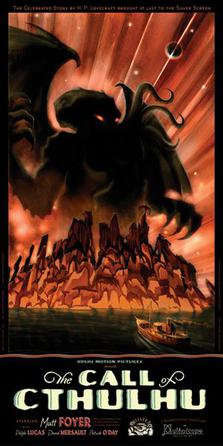
2005’s The Call of Cthulhu is several stories in one.

In a mental hospital, an apparent madman (Matt Foyer) talks to his psychiatrist (John Bolen) about the death of his uncle, a professor who had similarly gone made during his final days.  The man’s uncle was obsessed with evidence of a worldwide cult who worshipped an ancient being, perhaps named Cthulhu and perhaps sleeping somewhere in the ocean.  When his uncle died, the man received all of his research.  The files detailed the discovery of a cult in Louisiana, with the added caveat that the man who discovered the cult himself died under mysterious circumstances.  Later a boat is found floating at sea and the records within suggest that the boat’s crew met a fearsome creature on a dark and stormy night.  As soon becomes clear, the price for investigating Cthulhu is losing one’s own sanity.  Once a researcher realizes that Cthulhu and the Old Ones are real and that the universe really is beyond understanding or human control, insanity inevitably follows.

H.P. Lovecraft’s The Call of Cthulhu was originally published in 1928 and it remains Lovecraft’s best-known work.  It’s often cited as the start of the Cthulhu mythos, though Lovecraft had hinted at Cthulhu’s existence in previous stories.  Lovecraft was a prolific correspondent who kept in contact with other pulp writers and who allowed them to add to the Cthulhu mythos.  As a result, it seems as if writing a Cthulhu story has become a rite of passage for many aspiring horror writers.  (Even Stephen King has written a few.)  H.P. Lovecraft may have not been a household name when he died but Cthulhu ensured his immortality.

Why has Cthulhu had the impact that it has?  I think the answer is right there in the story.  As the characters come to realize, Cthulhu is beyond understanding and, because it cannot be understood, it cannot be defeated.  Cthulhu and the other Great Old Ones are beyond humanity’s traditional concepts of good and evil.  Whereas other monsters can be defined and often defeated by what they want, Cthulhu is beyond such concerns.  Not even the members of his cult really seem to be sure just what exactly it is that they’re going to gain from their worship.

Cthulhu represents powerlessness of humanity in the face of a cold and uncaring universe.  Cthulhu represents chaos.  There is no way to fight Cthulhu but, because Cthulhu is such an enigma, intellectually curious humans (and Lovecraft’s protagonists often were academics) find themselves drawn to him.  But the minute one starts to research Cthulhu, they are inevitably drawn to their destruction.  The same is probably true of people who specifically read short stories and watch movies about Cthulhu.  We’re all doomed.  I hope this hasn’t ruined your Wednesday.

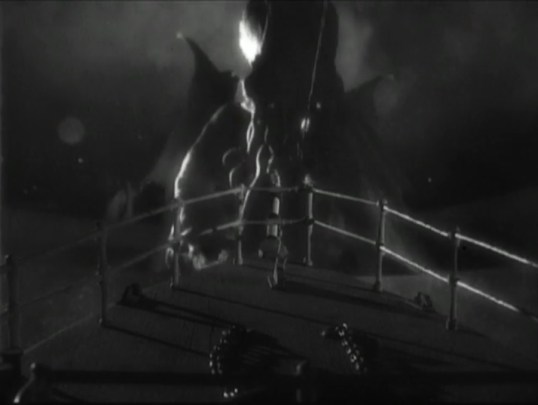
The Call of Cthulhu was long-considered to be unfilmable but, in 2005, director Andrew Leman proved the skeptics worng.  Realizing that The Call of Cthulhu was the epitome of 1920s horror, Leman made the clever decision to adopt the story in the style of a 20s-silent film.  The black-and-white cinematography is gorgeous, the title cards perfectly capture the melodramatic tone of 20s cinema (and they also help with the fact that Lovecraft’s dialogue doesn’t always sound natural when spoken aloud), and the largely practical effects capture the haunting horror of Lovecraft’s vision.  The moment when the boat’s crew meets Cthulhu at sea is especially well done, with the stop-motion effects proving themselves to be far more effective than any CGI could be.  The end result is a film pays tribute to Lovecraft while also bringing to life the mystery of Cthulhu.
The Call of Cthulhu (2005, directed by Andrew Leman)

Retro Television Review: Miami Vice 4.13 “Vote of Confidence”


Welcome to Retro Television Reviews, a feature where we review some of our favorite and least favorite shows of the past!  On Mondays, I will be reviewing Miami Vice, which ran on NBC from 1984 to 1989.  The entire show can be purchased on Prime!

This week, Crockett and Tubbs are not looking for bull semen.

Episode 4.13 “Vote of Confidence”

(Dir by Randy Roberts, originally aired on February 12th, 1988)

After spending last week trying to retrieve a cannister of bull semen, this episode finds Crockett, Tubbs, and Switek actually doing Vice work for once.  At the start of this episode, they stop a train that doubles as a rolling bordello.  They arrest a man named Tom Pierce (Larry Pine), a congressman who just happens to be running for governor!

(Tubbs thinks that Pierce has some good ideas.  Crockett doesn’t believe in voting.  Try to get away with that on a television show in today’s hyperpartisan climate.)

Tubbs and Crockett are frustrated when the district attorney declines to prosecute Pierce.  The D.A. says that they can’t prove that Pierce was actually on the train to hook up with a prostitute.  He could have just been passing out campaign literature.  Crockett and Tubbs are outraged, wondering why the prostitutes should be arrested but not the people who keep them in business.  Crockett and Tubbs see it as another example of the rich and powerful being let off the hook and they’re probably right about that.

Still, Pierce’s campaign is rocked by the news of his arrest and, when he withdraws from the election, Internal Affairs investigates to make sure that Crockett and Tubbs didn’t set him up.  While Crockett and Tubbs are definitely innocent, they still suspect that someone may have indeed set Pierce up.  When Pierce disappears, they wonder if maybe he’s been abducted or murdered.  Their investigation leads them to a notorious political prankster (Barry Lynch) and a shady press operative (Jonathan Hadary).

This episode was apparently based on the same scandal that, decades later, would inspire The Front Runner.  It was an improvement on last week’s but then again, anything would have been an improvement on last week’s episode.  Just the fact that Crockett and Tubbs were actually doing police work as opposed to stifling laughs every time someone mentioned “bull semen” guaranteed that this episode would shine compared to last week’s episode.  On the plus side, this episode features a return of the cynical Crockett and Tubbs that we all know and love.  On the negative side, the story itself is so bland that it fades from the memory as soon as the episode ends.  This episode was competently done but bland.  That’s the problem with episodes that are meant to be “ripped from the headlines.”  Headlines eventually fade.

Late Night Retro Television Review: Pacific Blue 1.7 “Heatwave”


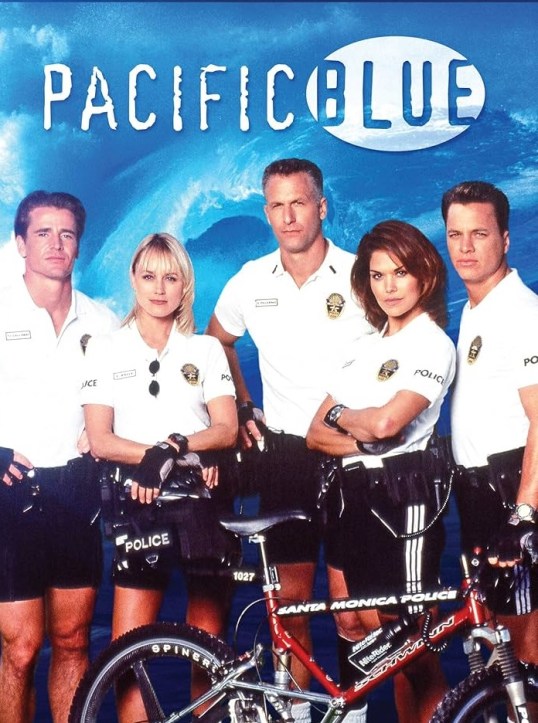
Welcome to Late Night Retro Television Reviews, a feature where we review some of our favorite and least favorite shows of the past! On Tuesdays, I will be reviewing Pacific Blue, a cop show that aired from 1996 to 2000 on the USA Network!  It’s currently streaming everywhere, though I’m watching it on Tubi.

This week, there’s a heatwave on the beach!

Episode 1.7 “Heatwave”

(Dir by Lyndon Chubbuck, originally aired on April 13th, 1996)

A heatwave has hit Santa Monica!  Everyone is sweltering and the cameras of Pacific Blue are there to record every drop of sweat.  The AC at Chris’s apartment is not working so, while she waits for it to get repaired, she moves in with TC.  What will TC’s girlfriend think of that?  Actually, she won’t think anything about that because her character disappeared after the pilot.

As I watched this episode, it occurred to me that the show’s writers really seemed to have no idea who the characters actually were.  Instead of coming across like actual human beings, every character has one personality trait that the writers insist on hammering into every scene.  Chris is always complaining about something.  Even after TC offers to let her stay at his apartment, Chris complains.  Chris complains so much that it actually becomes a bit whiny on her part.  But it’s not really Chris’s fault.  It’s the fault of the writers who obviously assumed that writing a “strong woman” meant making her act like a bitch no matter what the situation.  TC’s character trait is that he has a permanent chip on his shoulder even though every episode so far has essentially been a TC love fest.  He’s second-in-command of the bike cops.  He’s never held responsible for his mistakes.  He comes from a rich family.  Lt. Palermo praises him nonstop.  And yet TC always seems like he’s bitter about something.  And, as with Chris’s permanent bad mood, it’s just because the show’s writers didn’t bother to give him a personality beyond always acting like he has something to prove.  The episodes hints at an attraction between Chris and TC but they would really be a terrible couple.

This episode finds a radio sex therapist (Maura Peters) being stalked by Jordan Crane (Denis Forest, playing the same type of creepy psycho that he played on multiple episodes of Friday the 13th), a listener who is obsessed with her and who murders anyone who he thinks is getting too close to her.  TC has a crush on the sex therapist.  Chris dislikes the sex therapist and thinks TC is dumb because of course she does.  Chris and TC run afoul the homicide detective, Bart Browning (Barry Lynch), who is investigating the case.  Browning doesn’t have much respect for cops who ride bicycles.  Palermo, Chris, and TC go out of their way to change his mind.

So, yes, this is yet another episode where Pacific Blue tries to convince us that cops on bikes aren’t as dorky and useless as they look.  Every time Browning makes fun of them, we get a shot of the bike cops chasing a thief or investigating a lead.  The problem is that Browning does have a point.  The cops do look really silly on their bikes.  The fact that they often have to pick up and carry their bikes doesn’t help.  And listen, this is not an anti-bicycle thing.  I have a bike,  I occasionally ride it in the park.  (What I don’t do is ride it in the middle of the street.)  When you’ve got asthma like me, cycling is a good way to keep your lungs healthy.  But if I need the police, I want to see a squad car and I don’t want to have to deal with anyone wearing shorts.

While this is going on, Victor and Cory investigate a thief who hires strippers to perform in stores and bars.  While everyone is distracted, the thief robs the place.  This storyline actually did make me laugh a little.  All of the male witnesses could perfectly describe the strippers but none of them even saw the man sneaking behind the counter with a gun.  In the end, the thief is captured in an elaborate undercover sting.  Cory and Chris pretend to be the dancers while Palermo pretends to be the bartender and the thief soon discovers everyone else in the bar is a cop as well.  At least in this storyline, Chris’s bad mood had to do with being annoyed with the objectification of women as opposed to being mad because someone offered her a place to stay so she wouldn’t die of heatstroke.

Finally, Elvis discovers a lot of holes on the beach and thinks that the aliens are coming.  It turns out that a local golf course was just stealing the sand for their sand traps.  I’m glad that worked out!

As much as I’ve complained, this episode of Pacific Blue was a slight improvement over the previous few episodes, if just because the the subplots were vaguely interesting and/or amusing.  Chris and TC continue to be the weakest part of the show.  Hopefully, they’ll get some new personality traits soon.

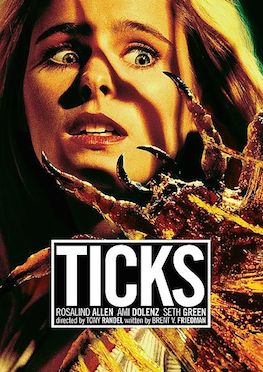
Stay Out Of The Woods: Ticks (1993, directed by Tony Randel)


Don’t go in the wood alone, kids!  There are giant ticks out there that can attach themselves to you, lay their eggs under your skin, and then cause your face to explode when the eggs hatch!  It’s all because of the steroids that local farmer Jarvis Tanner (Clint Howard) has been using to enhance his marijuana crop.  The end result may be good weed but you will  be dead from a tick bite before you get to enjoy it.  That’s bad news for Jarvis, who keeps stepping in bear traps and who, at one point, has a dozen tick eggs drop on him.  It’s even worse news for the group of juvenile delinquents who have been sentenced to spend a weekend camping in the woods.

Mostly because the film featured the beautiful Ami Dolenz as one of the delinquents, Ticks used to be a mainstay on late night HBO.  It combines the basic features of a 50s monster movie with the gore-filled style of a 90s splatter film.  What Ticks may have lacked in originality, it made up for in scenes of people’s faces exploding.  Make no mistake about it.  This one is for splatter fans.

Ticks has an interesting cast.  If you have ever wanted to see Alfonso “Carlton” Ribiero play a gangbanger, this is the movie for you.  The nerdiest juvenile delinquent is played by Seth Green while TV regular Peter Scolari plays an idealistic social worker and Rance Howard (father of Ron and Clint) plays the local sheriff who loses his legs.  And finally, there’s Clint Howard, giving it his all in yet another straight-to-video horror film.  Clint suffers even more indignities than usual in Ticks but he never gives up hope.  Clint’s scenes were directed by the film’s executive producer, Brian Yuzna, and added after the first cut of the film was judged to be missing something.  That was a good decision on Yuzna’s part because Clint Howard is easily the best part of the film.

Today, the appeal of Ticks is mostly one of nostalgia.  This is the type of mind-warping stuff that we used to watch when we were growing up.  This is what we used to rent at Blockbuster while our parents were looking for the latest Oscar nominees.  This is what late night cable used to be all about.