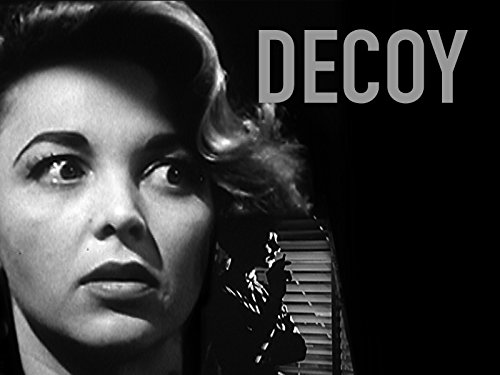
Welcome to Retro Television Reviews, a feature where we review some of our favorite and least favorite shows of the past! On Thursdays, I will be reviewing Decoy, which aired in Syndication in 1957 and 1958. The show can be viewed on Tubi!
Episode 1.13 “My Brother’s Killer”
(Dir by Stuart Rosenberg, originally aired on January 6th, 1958)
Anne (Barbara Barrie) goes to the police because her boyfriend, Victor Bernard (Bernard Kates), has been acting strangely and refuses to let her into his apartment. At first, the police point out that there’s nothing they can do about this but then Casey, in what can only be described as a miraculous feat of deductive reasoning, guesses that Victor Bernard’s last name might have originally been Bernardino and he might be the brother of wanted robber, Frank Bernardino.
A look at a picture of Victor reveals that he does look a lot like Frank. However, as Casey discovers when she goes over to Victor’s apartment, Frank is dead. But his partner, Hal Bishop (Sy Travers), is still alive. Hal promptly takes Casey and Victor hostage and heads for the Canadian border.
Once you accept that Casey’s miracle hunch (and, seriously, it takes some effort), this is an intense episode. I’m not really a fan of shows in which people are held hostage — the confined narrative tends to get tedious pretty quickly — but this episode featured a typically good performance from Beverly Garland and an absolutely terrifying one from Sy Travers. It also features what seems like a surprising amount of violence for a 1950s television show. Imagine gathering the family in front of the television in 1958 and being immediately confronted by Sy Travers as Hal Bishop pointing a gun at an innocent man’s head and pulling the trigger. A lot of people get shot over the course of this episode, including Hal Bishop himself. Casey survives but there are no smiles or celebrations. There’s just the weary look of someone who has been confronted with the worst that humanity has to offer.
Welcome to Retro Television Reviews, a feature where we review some of our favorite and least favorite shows of the past! On Thursdays, I will be reviewing Decoy, which aired in Syndication in 1957 and 1958. The show can be viewed on Tubi!
This episode, Casey searches for a man who has abandoned his daughter so he can pursue a career as a painter of clowns.
Episode 1.2 “The Red Clown”
(Dir by Teddy Sills, originally aired on October 21, 1957)
Mike Foley (John McLiam) has quit has job and left his New York home. His wife (Barbara Barrie) suspects that Mike has returned to Greenwich Village so that he can pursue his dream of being a painter. Normally, this wouldn’t be a police manner but Mike has also left behind his daughter, Bobby (Barbara Myers), and is facing charges of child abandonment unless he starts paying child support. Policewoman Casey Jones (Beverly Garland) works undercover, pretending to be a bourgeois art collector who wants to buy one of Mike’s horrid clown paintings.
This episode featured some wonderful on-location footage of New York City in the 1950s. The history nerd side of me loved that. I have to admit, though, that I found myself wondering whether or not Casey is actually that good at her job. Bobby managed to follow Casey all the way to Greenwich Village without Casey noticing. When Casey did notice, she did the whole thing where she went to a phone booth and told Bobby, “Stay here while I make a call.” Well, of course, Bobby didn’t stay there. Bobby went running off to look for her father.
(Was Bobby’s mother not concerned that her daughter was basically wandering around the city?)
Of course, if Bobby hadn’t followed Casey to Greenwich Village, they never would have found Mike. Mike, it turned out, was living in a shabby building and spending all of his time painting. He was pursuing his dream. When Bobby asked him to come home, Mike replied that he had no interest in his old life and that he didn’t want anything to do with his family. Mike’s harsh words left Bobby in tears. The episode ended with Bobby playing in a playground a few wees later, with Casey watching her and telling us, “I think she’ll be okay.” Yeah, I don’t think so, Casey.
The episode was depressing! But I have to give the show a lot of credit for not having Mike have a sudden change of heart. The truth of the matter is that he left his family because he was self-centered. He didn’t become any less self-centered when he was confronted by his daughter. After listening to Mike’s self-serving crap, Bobby dropped the clown doll that she carried with her as she searched for Mike, saying that she didn’t like clowns anymore. It’s a painful lesson and a sad one but at least Bobby now knows that truth about her father. Other than that playground coda, this episode had the guts not to give into false hope.
Next week: Casey deals with an obscene phone caller!
Our regularly scheduled review of Welcome Back Kotter will not be posted this week so that we may bring you this special presentation….
From 1982 and filmed for HBO, it’s a stage production of Barefoot In The Park! I’ve always loved the Robert Redford/Jane Fonda film version but I also enjoy this recording of one of the play’s periodic Broadway revivals. Richard Thomas and Bess Armstrong play the newlyweds and they really bring Neil Simon’s dialogue to life.
Without further ado, here is Barefoot In The Park!
Due to a chemical spill that is spreading through the ocean, life on Earth is going to end in five years unless something is done. A group of friendly alien offer to give Earth either the “Good Package” or the “Big Gun.” The Good Package can clean up the ocean. The Big Gun is a big gun. They both sound good to me! The aliens only want a glass of water in return and they want that glass to be delivered by CIA Agent Pillbox.
Unfortunately, Pillbox has been killed in the field so the government tracks down a meek office worker named Bob Wilson (John Ritter) who looks just like Pillbox. Tough and streetwise Nick Pirandello (Jim Belushi) is sent to recruit Bob and take him to the aliens. Trying to stop Nick and Bob are a group of rogue CIA agents who would rather get the Big Gun than the Good Package. Nick teaches Bob how to be a “real man” and Bob teaches Nick how to be a real friend. They also beat up clowns.
A box office failure that did even worse with the critics, Real Men is a movie that was saved by cable. When I was a kid, Real Men used to show up on HBO all the time. Whatever flaws the film may have had, the mix of John Ritter’s physical comedy, Jim Belushi’s wiseguy attitude, and the action scenes made it the type of movie that was ideal for home viewing, especially if you had just gotten out of school and wanted to watch something before your parents came home and asked if you had done your homework. Real Men was fun enough to hold up to repeat viewings but it was also slight enough that it wasn’t a huge tragedy if the channel got changed before the movie ended.
When I rewatched Real Men, I thought the film’s storytelling could have been tighter but it still turned out to be better than I was expecting. There were a lot of classic buddy movies released in the 80s and while Real Men may not be the equivalent of a 48 Hours or a Midnight Run, John Ritter and Jim Belushi are still an entertainingly mismatched team. Ritter again shows that he was a master at physical comedy while Belushi provides sarcastic commentary from the side. A lot of the odd couple-style banter is predictable (Bob doesn’t smoke but Nick does) but Ritter and Belushi deliver their lines with enough conviction to still make it work. Nick teaches Bob to believe in himself and Bob is able to both save the world and tell off the neighborhood bullies. The film’s mix of action, science fiction, and broad comedy confounded critics in 1987 but it holds up today.
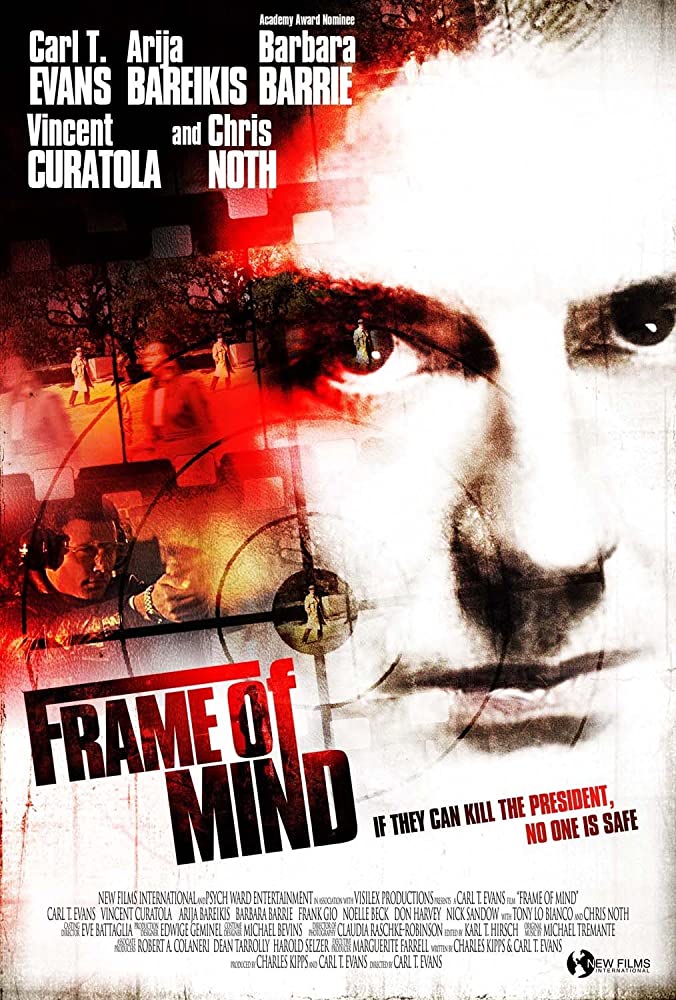
David Secca (Carl T. Evans, who also directed) is a New York cop who has just transferred to a town in New Jersey. His wife, Jennifer (Arija Bareikis) has a new job as a teacher. One day, while they’re out antiquing, they purchase a box that contains a roll of film. Looking at the film reveals pictures of a dangerous looking man who has a gun and who appears to be standing on the infamous grassy knoll in Dallas, Texas.
Convinced that he’s uncovered new evidence in the assassination of John F. Kennedy, Secca carries out his own investigation of the film. He tracks down the woman (Barbara Barrie) who actually shot the film and discovers that she is now 85 and confined to a nursing home. He talks to a skeptical conspiracy theorist (Chris Noth). As Secca investigates, his progress is monitored by people who, after all these years, still don’t want the truth about the Kennedy assassination to get out. As Secca discovers, these people are still willing to kill to protect the conspiracy.
Frame of Mind is an attempt to make a conspiracy thriller that, unfortunately, is done in by its own low budget. It’s difficult to make a conspiracy seem convincing when you don’t really have the money to hire more than a few extras. Probably the most interesting thing about the film is that, despite the low budget, there are a few established actors in the cast. Along with Barrie and Noth, Tony Lo Bianco, Don Harvey, Vincent Curatola, and even KISS’s Peter Criss all have small roles. The strangest cameo of all goes to former New York Mayor David Dinkins, who plays a senator. Being mayor of New York may be a dead end politically (just ask John Lindsay, Rudy Guiliani, Michael Bloomberg, and Bill De Blasio) but it can still serve as a launching pad for a career in the entertainment industry.
Frame of Mind might hold some interest for JFK assassination hobbyists, though it doesn’t really bring anything new to the able. It’s mostly interesting just to see who shows up in the cast.
The 1964 film, One Potato, Two Potato, is the story of two people who fall in love.
Julie Cullen (Barbara Barrie) was previously married to Joe (Richard Mulligan). She’s divorced now and raising her daughter, Ellen (Marti Mericka), on her own. Ellen was barely a year old when Joe abandoned his family and she’s never known her father. Perhaps that’s for the best because, as we later see firsthand, Joe was an immature and abusive man.
Frank Hamilton (Bernie Hamilton) is quiet, responsible, and mild-mannered. For the majority of the movie, the only time that we see Frank show any emotion is when he’s playing football with coworkers. However, he’s obviously a sensitive and intelligent man. He and Julie begin a relationship, tentatively at first. But soon, they’re very much in love and planning to get married.
And really, there’s nothing unusual about either one of them. They’re two genuinely nice people who met and fell in love. The only thing that sets their romance apart from so many other romances is that Julie’s white and Frank’s black. For that reason, Frank and Julie get harassed by the police when they try to enjoy a romantic stroll at night. For that reason, Frank’s parents (played by Robert Earl Jones and Vinette Carroll) object to their relationship, saying that all the love in the world can’t overcome prejudice. For that reason, when Frank and Julie do get married, hardly anyone comes to the wedding and the one bridesmaid glares at them throughout the ceremony. Frank and Julie end up living on a farm with Frank’s parents, in love but practically isolated from the world. (Tellingly, the “friend” who first introduced them doesn’t want to visit them after they marry.) When Joe suddenly shows up and discovers that Julie has not only remarried but that her new husband is black, he goes to court and demands custody of his daughter.
It’s interesting think that, in 2019, it’s very easy to take interracial relationships (not to mention interracial marriages) for granted. And yet, it wasn’t until 1967 (three years after the release of One Potato, Two Potato), that the U.S. Supreme Court officially ruled that laws against interracial marriage were unconstitutional. One Potato, Two Potato was an early independent film, precisely because none of the major studios were willing to deal with an issue as controversial as interracial marriage. (When the studios finally did deal with it, the end result was Guess Who’s Coming To Dinner, a film that was as safe and mild as One Potato, Two Potato was brave and angry.) Barbara Barrie did win the best actress award at Cannes and the film itself received an Oscar nomination for Best Original Screenplay but otherwise, it’s a sadly neglected piece of film history. If I hadn’t recorded it off of TCM, I probably never would have seen or even heard of this film.
And that would have been a shame because, along with being a valuable historical document, One Potato, Two Potato is a compelling and heartbreaking drama. The film approaches its subject matter with a maturity and an honesty that probably stunned audiences back in 1964. This film refuses to give into any of the well-intentioned clichés that often dominated films about racism in the 60s and 70s. There are no sympathetic whites (à la Gregory Peck in To Kill A Mockingbird) willing to argue for Frank and Julie’s right to raise Ellen. (In fact, the lawyer that they hire gets angry when Frank first approaches him and advises them to leave the state.) It does Frank no good to be dignified and patient. The racism in One Potato, Two Potato does not come from a handful of ignorant souls. Instead, it’s built into the very system to which Frank and Julie are now having to appeal.
One Potato, Two Potato is also a rarity in that it’s a film that allows a black man to get angry about the way he’s being treated, even if it means making whites in the audience uncomfortable. One need only compare the hopeful ending of Guess Who’s Coming To Dinner with the heart-breaking conclusion of One Potato, Two Potato. Whereas Guess Who’s Coming To Dinner highlighted Sidney Poitier saying, in his dignified manner, that he has no interest in fighting the battles of the past, One Potato, Two Potato finds a distraught Bernie Hamilton watching a western and finally breaking down as he yells, “Kill that white bastard!”
One Potato, Two Potato ends with a title card that informs us that the story that we’ve seen is fictional but that the laws and the issues discussed in the film are real. 55 years after it was released, One Potato, Two Potato remains a compelling drama and an important historical document.
I ask because I just watched Breaking Away, a 1979 nominee for best picture. Breaking Away was shot on location in Bloomington, Indiana and on the campus of Indiana University. And though the film doesn’t go out of its way to idealize either the state, the town, or the university –in fact, the title refers to the desire of several characters to break away from their life in Bloomington — it still manages to make Indiana look like the nicest place on Earth. Add to that, Indiana University is home to the Eskenazi Museum of Art, which I will someday visit.
Breaking Away is actually a film about a lot of things: it’s a comedy, it’s a quasi-love story, it’s bittersweet coming-of-age story, it’s a sports film, and it’s a sweet, good-natured film that made me cry. At the heart of the film is Dave Stoller (Dennis Christopher), who has just graduated from high school and whose cheerful and eccentric exterior hides the fact that he appears to have no real future. Dave is obsessed with bicycle racing and idolizes that the Italian cycling team. In fact, he idolizes them so much that he decides to be Italian. He rides around Bloomington, greeting people with a merry “Ciao!” At home, he listens to opera and renames the family cat “Fellini.” While his mother (Barbara Barrie) is understanding, his father (Paul Dooley) cannot understand what’s happening to his son. Of course, Dave doesn’t truly believe that he’s Italian. He just desperately wants to be something other than who he is.
And who is Dave? He’s a citizen of Bloomington, a town that is divided between the upper class students at Indiana University and the blue-collar townies. The students call Dave and his friends “cutters,” because the only real industry in town is working in the quarry, cutting stone. The students look down on the cutters and the cutters resent the students.
Dave has three close friends, all of whom were big in high school and who are now facing an uncertain future of anonymity. Cyril (Daniel Stern) is the funny and quirky one, the former basketball player who talks about how he would like to be a cartoon character. Moocher (Jackie Earle Haley) is usually easy-going but loses his temper whenever anyone mentions that he’s short. (At one point, Moocher’s boss orders him to, “Punch the time clock, Shortie!” Moocher literally does just that.) And finally, there’s Mike (Dennis Quaid). Mike is their leader, a former high school quarterback who idolizes the Marlboro Man and who knows that he’s destined to spend the rest of his life in Bloomington, going from “20 year-old Mike” to “mean old man Mike.”
When Dave meets a student named Katherine (Robyn Douglass), he pretends to be an Italian exchange student and, soon, he’s serenading her on the lawn of her sorority house. That doesn’t make Katherine’s boyfriend, Rod (Hart Bochner), happy. Rod and his friends beat up Cyril, which leads to another fight at a bowling alley. (Cyril, for his part, gets his finger stuck in a bowling ball.) Seeking to broker some sort of peace and understanding between the students and the town, the university president (played by John Ryan, who was the real-life President of Indiana University at the time) announces that the cutters will be invited to take part in the annual Little 500 bicycle race at Indiana University.
And you can probably guess how the race turns out. It’s a feel-good sports film so you already know who is going to win and that he’s going to have to win after initially falling behind and sacrificing a big lead. You know all that but it doesn’t matter. Breaking Away is such a sweet and well-acted movie that it still brought tears to my eyes even if the ending didn’t surprise me.
And really, the film does have a few surprises. For one thing, Rod turns out to be not as bad a guy as you initially think he’s going to be. Over the course of the film, he gets two small reaction shots, both of which hint that he’s not as much of a jerk as he often appears to be. It’s a minor detail and it’s easy to miss but what’s important that it’s there and it’s one of the many small details that makes Breaking Away feel alive. After watching the movie, I feel like I could go to Bloomington and still find all these character hanging out at the quarry.
There’s another scene that I want to mention. This is the scene that made me cry. Dave and his father walk around the university and his dad talks about how he and the fathers of all of Dave’s friends helped to cut the stone that was used to build campus. His dad admits that, even though he helped to build it, he’s never felt comfortable on the campus and then tells his son that he doesn’t have to be a cutter. And it’s such a heartfelt scene and so beautifully performed by Paul Dooley and Dennis Christopher that I started to cry. Perfectly acted, perfectly directed, and perfectly written, what a great scene! Fantastico!, as Dave might say.
Whenever I go to Half-Price Books, I always seem to end up spending most of my time browsing the “nostalgia” section. This is where they keep all of the old paperbacks that were published long before I was born. This is where you can find old romance novels, “for adults only” novels, detective novels, and occasionally you’ll even find mainstream novels that were apparently considered to be quite daring when they were originally released. These novels usually carry cover blurbs that brag about how controversial they are and how they deal with the “real issues of today.”
Usually, these novels are pretty silly and over-the-top which is why I always seem to end up buying a lot of them. About a year ago, I bought a novel from 1959. It was by Dariel Telfer and it was called The Caretakers. The cover features a naked woman standing in front of several nurses and doctors. The cover blurb announces that The Caretakers is “A shattering novel about nurses, doctors, and patients in a state hospital where emotions readily explode!” The back cover features a pull quote from Time: “Will shock as well as arouse compassion.”
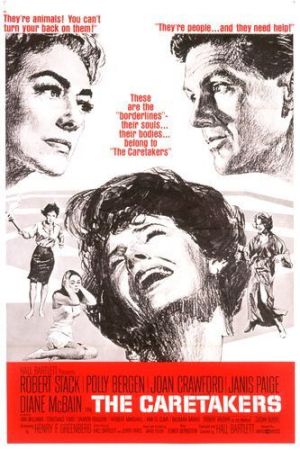
Now, I have to admit that I have yet to get around to actually reading The Caretakers. However, thanks to TCM, I recently saw the 1963 film version and it’s a film that definitely embraces the melodrama.
How melodramatic is The Caretakers? It’s melodramatic enough that it opens with Lorna Medford (Polly Bergen) stumbling into a movie theater and having a nervous breakdown. Since this film was made in 1963, her mental breakdown is represented by spinning the camera around and getting hyperactive with the zoom lens, all while Bergen shrieks and tears at her hair.
Lorna is sent to a mental hospital, where she meets several other patients and is treated by Dr. MacLeod (Robert Stack), who is a rebel. We know that he’s a rebel because everyone else at the hospital keeps telling him that he’s a rebel and complaining about his use of radical use of group therapy. Under Dr. MacLeod’s guidance, Lorna reveals that she hasn’t gotten over the tragic death of her child.
As the film progresses, Lorna gets to know the rest of the patients. They’re a mixed bunch, all played by actresses who clearly saw this as their chance to pick up an Oscar for Best Supporting Actress and were determined to make as big an impression as possible. For instance, Barbara Barrie plays Edna, who never speaks but who does enjoy setting fires and who, whenever she’s feeling persecuted, poses as if she’s hanging from a cross. And then there’s grandmotherly Irene (Ellen Corby), who is supposed to be the nice one but always looks like she’s on the verge of very sweetly shoving a pair of knitting needles into someone’s eyes.
However, my favorite patient was the cynical Marion (Janis Paige), precisely because she was so cynical and, as a result, she got all the best lines. Marion is a former prostitute who now hates all men and Paige has a lot of fun playing the role. Whenever Paige is giving one of her long, angry monologues, she practically grabs the film and refuses to let it go.
And then, of course, there’s Joan Crawford. Crawford doesn’t play a patient. Instead, she’s the head nurse and she doesn’t approve of Dr. MacLeod’s methods. Crawford announces early on that she’s been attacked by a patient in the past and her main concern is protecting her staff. She teaches a self-defense class. If you’ve ever wanted to see a middle-aged Joan Crawford flip someone over, The Caretakers is a film to watch.
And that’s The Caretakers for you. It’s one of those films that takes itself so seriously that it becomes humorous despite itself. As a result, the film is a lot of unintentional fun.
And who knows?
Maybe someday, I’ll get around to reading the book!



 Through the Shattered Lens