October True Crime: Getting Gotti (dir by Roger Young)


In this 1994 made-in-Canada movie, Anthony Denison plays John Gotti.  We watch as he goes from being a street boss to Paul Castellano to assassinating Castellano so that he can take over the Gambino crime family.  Gotti thinks that he’s the king of New York and he’s convinced that no one will ever bring him down.  U.S. Attorney Diana Giacalone (Lorraine Bracco) is determined to prove him wrong.  She becomes the first of many prosecutors to try to get Gotti and Gotti reacts by having his attorney launch a series of outrageously misogynistic attacks against her.  Gotti doesn’t just want to defeat Diana.  He also wants to humiliate her.  Diane may have the evidence but Gotti’s got the money.  Who will get Gotti?

Now, I guess I could argue here that the horror aspect of this film comes from the crimes that Gotti commits.  And it is true that we see Gotti kill a number of people.  He’s a sadistic killer, the type who will shoot someone twenty more times than he needs to.  As the last of the truly flamboyant gangsters, Gotti would go on to become something of a pop cultural institution.  But one should not overlook the fact that, for all of his charisma and bravado, John Gotti was not a nice guy.  Of course, I should also point out that none of that charisma is really present in Anthony Denison’s performance as Gotti.  As played by Denison, John Gotti — the so-called Teflon Don whose greatest strength was his shamelessness — comes across as being a little boring.

Actually, the scariest thing about this film is Lorraine Bracco’s performance as Diana Giacalone.  Bracco does a lot of yelling as Giacalone.  Sometimes, it’s understandable.  Giacalone is portrayed as being someone who grew up on the same tough streets as Gotti and who resents people like Gotti and the Mafia giving a bad name to Italians in general.  The problem is that Bracco yells her lines even when there’s no reason to be yelling.  At one point, she discovers that someone screwed up her lunch order and she screams about it as if the world is ending.  Visiting her mother (Ellen Burstyn) for the holidays, Giacalone yells at her family.  When the verdict comes in, Giacalone yells some more.  The yelling is pretty much nonstop and, as a result, one starts to feel that the other U.S. attorneys might have a point when they say that Giacalone is a loose cannon.  The film tries to present her as being a strong, no-bullshit woman who is going up against an army of misogynists but there’s more to being strong than just yelling.  It would be such a big deal if the film had given her a personality beyond yelling but it doesn’t.  I blame the script more than I blame Lorraine Bracco, who can be a very good actress when cast in the right role.

Getting Gotti pretty much hits every Mafia cliche.  Whenever anyone drives around the old neighborhood, Italian string music plays.  There’s a moment where Giacalone yells that her goal is to make sure that people understand that the Mafia isn’t “Al Pacino looking soulful” in The Godfather.  I had to wonder if Giacalone had ever actually watched The Godfather.  Seriously, an Italian attacking The Godfather?  Who does she think she is, Joe Columbo?

Gotti remains the Gotti film to watch.
Brad reviews DEATH HUNT (1981), starring Charles Bronson, Lee Marvin, Carl Weathers, and Andrew Stevens! 


Today is actor Andrew Stevens’ 70th birthday. I grew up watching Stevens in the Charles Bronson films 10 TO MIDNIGHT (1983) and DEATH HUNT (1981), the movie I’m reviewing today. I also enjoyed watching him in Brian De Palma’s THE FURY (1978). Later in his career he stepped behind the camera where he produces and directs mostly low budget films. As of this writing, he’s still going strong, and he’s built quite a nice career. And for me, my appreciation all started because he worked with Charles Bronson when he was in his twenties!

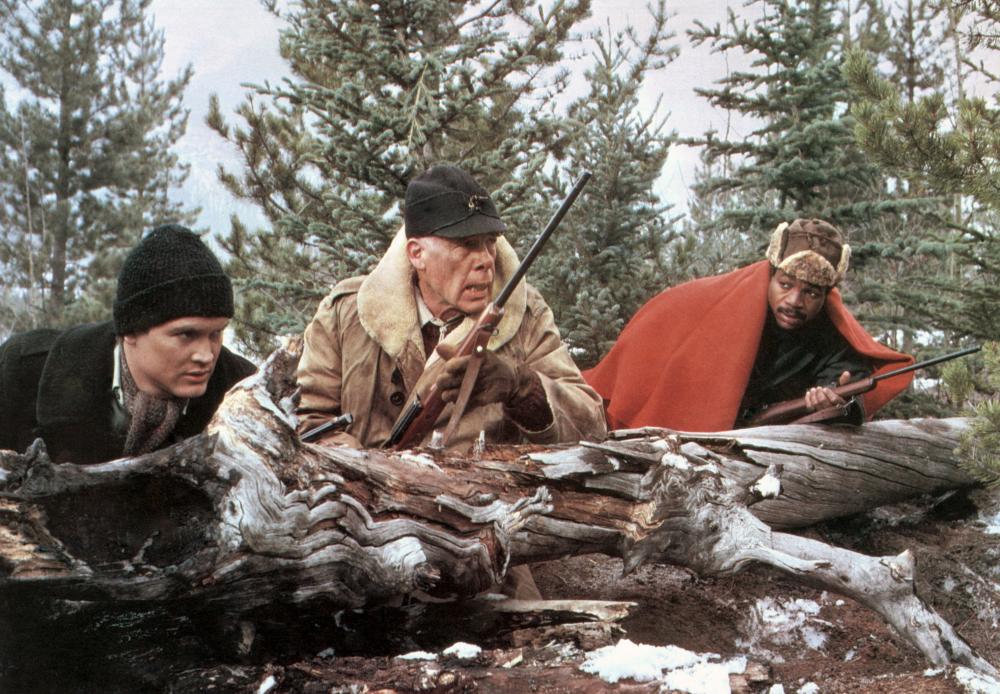
In the “based on a true story” DEATH HUNT, Charles Bronson plays trapper Albert Johnson, who lives in the Yukon Territory in the year of 1931 and just wants to be left alone. Early in the film, Johnson comes across a vicious dogfight and rescues one of the participants who’s almost dead. The problem is that the dog belongs to a piece of shit named Hazel (Ed Lauter), and even though Johnson pays him for the dog, Hazel heads to town and tells Sergeant Edgar Millen (Lee Marvin), of the Royal Canadian Mountain Police, that Johnson stole his dog. Millen doesn’t have time for Hazel’s B.S., so he tells him to go on. Millen would rather drink whiskey and hang out with his friends and co-workers in town. These people include the experienced tracker Sundog, aka George Washington Lincoln Brown (Carl Weathers), a young fresh-faced constable with the RCMP named Alvin Adams (Andrew Stevens), his latest lover Vanessa McBride (Angie Dickinson), and everyone’s favorite sidepiece, the Buffalo woman (Amy Marie George). Not willing to let things slide, Hazel and his men go up to Johnson’s cabin and start some more trouble, and one of his buddies gets his scalp shot off by the more than capable Johnson. Even though the entire mess has been started by Hazel and his crew of goons, who include character actors William Sanderson and Maury Chaykin, Millen is forced to try to bring Johnson in, so they can straighten everything out. When it seems Johnson may be about to go in with Millen, one of Hazel’s dumbass men opens fire, and all hell breaks loose. In the aftermath, Johnson escapes, kicking off a massive manhunt across the mountains and wilderness of the Yukon Territory! 

DEATH HUNT is an awesome film, primarily because it pairs Charles Bronson, as the tough mountain man, against Lee Marvin, as the seasoned lawman who probably has only one chase left in him. This is a match made in heaven, and even though the two stars share little screen time, the icons dominate each frame of the film. Their characters respect each other and you get the feeling the two men, who couldn’t be more different in real life, probably felt the same way about each other. The remainder of the cast is filled with so many recognizable names and faces. I’d say the the best performances outside of Bronson and Marvin come from Carl Weathers, Andrew Stevens and Ed Lauter. I like the camaraderie that Weathers shares with Marvin, and of course he’s a lot of help when the action starts. Initially, Stevens seems like he’s going to be another “new kid” who’s too inexperienced to be of much help, but he proves to be more than capable by the end of the film. And good grief is Lauter good at playing a piece of crap! Everything about Hazel is cruel, sadistic, and ignorant, and he plays the part perfectly. A scene where a bullying Hazel gets his comeuppance at the hands of the young Adams (Stevens), is a highlight of the film. Sadly, Angie Dickinson, one of the most beautiful women in the history of cinema, is somewhat wasted in her small, unimportant role. I still like seeing her though, even if the part is beneath her. 

Aside from the phenomenal cast that Director Peter R. Hunt (DR. NO and THUNDERBALL) was able to assemble, there are other good reasons to watch DEATH HUNT. I love movies that are filmed outside of the city, and you can’t get much further out of the city than the Canadian Rocky Mountains. This setting provides plenty of beauty, but its frozen landscape and bitter conditions also allow for a sense of loneliness, isolation and desperation to seep in for the various characters as the manhunt stretches out over time. There is also some rugged and violent action spread out through the film. I was caught off guard the first time I watched the film by some of the more graphic violence in the action scenes. I’ve already mentioned Bronson’s character basically blowing a guy’s head off, and there’s another scene involving William Sanderson getting his arm caught in a trap. These scenes make my toes curl up just thinking about them. The action highlight occurs when the men think they have killed Johnson in an explosion, to only have him emerge from the smoke and flames of his decimated cabin with slow motion shotgun blasting. It’s an incredibly badass moment in the movie and in Bronson’s overall filmography. Finally, the story is interested in contrasting the old ways of doing things, as exemplified by Bronson and Marvin, versus the new ways of doing things, as exemplified by the young Stevens and a hotshot pilot (Scott Hylands) who is called in to help with the search. Edgar Millen is somewhat of a dinosaur who isn’t ready to truly move into the 20th century. He wants to catch Johnson through old-fashioned, out maneuvering him in the wilderness, while Stevens’ character brings in a radio and the expertise to use it, and Hylands tries to locate him and gun him down from high in the sky. These two schools of thought clash and play out to varying degrees of success and failure as the chase rushes toward its conclusion.

DEATH HUNT is not a perfect film by any stretch of the imagination, but it’s been one of my favorite Bronson films since I first saw it the mid to later 80’s. Just seeing Bronson and Marvin together on screen, in a rugged, violent, badass story, goes a long way with me. It’s as simple as that! See the trailer below:

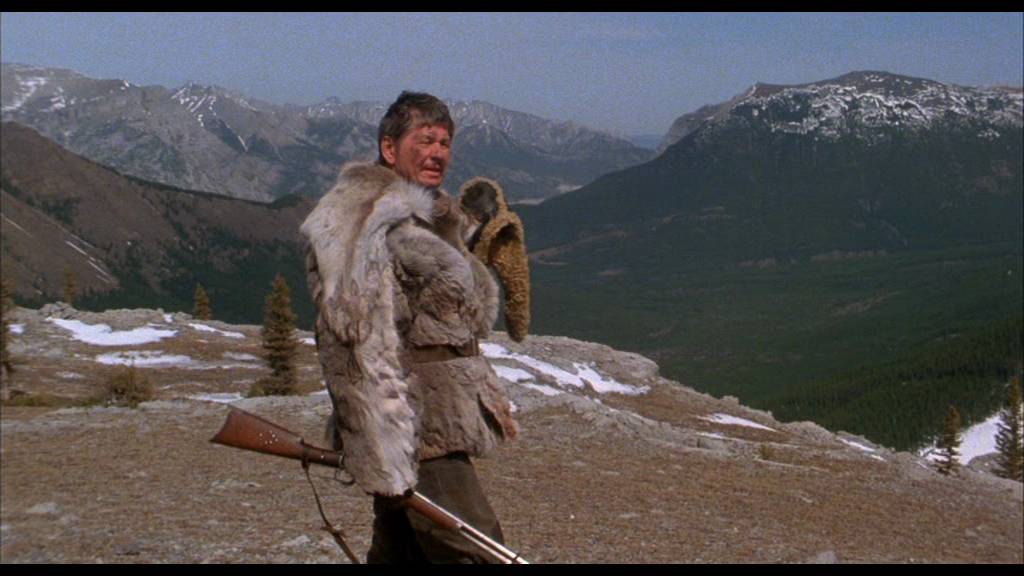
Charles Bronson in DEATH HUNT (1981) – Keep warm my friends!


If you’re in Texas or Arkansas today, I hope you’re keeping as bundled up as Charles Bronson in DEATH HUNT. It’s cold out there people! Keep safe and stay home if at all possible! We don’t know how to drive in this weather!

Enjoy DEATH HUNT’s trailer below! Charles Bronson and Lee Marvin are as tough as it gets!

Late Night Retro Television Reviews: Friday the 13th 1.6 “The Great Montarro”


Welcome to Late Night Retro Television Reviews, a new feature where we review some of our favorite and least favorite shows of the past! On Fridays, I will be reviewing Friday the 13th, a show which ran in syndication from 1987 to 1990. The show can be found on YouTube!

This week’s episode of Friday the 13th is all about magic, blood, and costumes!

Episode 1.6 “The Great Montarro”

(Dir by Richard Friedman, originally aired on November 2nd, 1987)

This week’s episode opens with a magician named Fahteem (August Schellenberg) performing his signature trick.  He steps into the Cabinet of Doom and, once he’s sealed inside, several sword blades are driven through the cabinet.  Somehow, Fahteem always survives without a scratch and the audience is always amazed.  What the audience doesn’t know is that the Cabinet is a cursed antique.  Before each performance, Fahteem drugs a woman and locks her in another cabinet.  The blades kills whoever is in that cabinet while leaving Fahteem untouched.  Of course, if no one is in the other cabinet than the blades will kill whoever is in the Cabinet of Doom.  That is something that Fahteem discovers when an unknown perpetrator decides to take the cabinet away from him.

After Fahteem is murdered, Jack, a former musician who was an unfriendly acquaintance of Fahteem, discovers that the Cabinet of Doom was actually purchased from the antique store.  Jack decides to return to the world of magic and magicians so that he can track down the cabinet.  Helping him, and getting to wear a cute assistant’s uniform, is Micki.  Ryan also helps but he doesn’t get anything cute to wear.

It turns out that the cabinet is now in the possession of the Great Montarro (Graeme Campbell) and his wife, Lylah (Lesleh Donaldson).  Realizing that Jack is trying to take away the cabinet, Montarro and Lylah are soon targeting him and trying to make his signature trick into a fatal one.  Seeing as how that trick involves Jack being tied up in a sack that is then set on fire, that might be an easier task than it sounds.

This is the bloodiest episode of the show yet, with the camera focusing on the gory results of every failed trick.  Blood drips from cabinets.  Blood spreads across stages.  Watching the show, you really do find yourself watching why there’s so many spikes and blades just lying around.  Apparently, audiences for magic shows are not satisfied unless there’s a chance that they might see someone die in a terrible fashion.  In the role of Jack, Chris Wiggins appears to be having a ball performing magic tricks and, as a result, both Micki and Ryan spend most of the show standing off to the side.  Fortunately, Wiggins is a lot of fun to watch in this episode.  The joy that he takes from pulling off the perfect trick is contagious.  The overall episode is a bit too slowly paced but at least almost everyone gets to wear a nice costume.

Next week, Jack, Ryan, and Micki try to recover a cursed scalpel!

Boobs, Music, and Sci-Fi: Heavy Metal (1981, directed by Gerald Potterton)


Heavy MetalI think I was twelve when I first saw Heavy Metal.  It came on HBO one night and I loved it.  So did all of my friends.  Can you blame us?  It had everything that a twelve year-old boy (especially a 12 year-old boy who was more than a little on the nerdy side) could want out of a movie: boobs, loud music, and sci-fi violence.  It was a tour of our secret fantasies.  The fact that it was animated made it all the better.  Animated films were not supposed to feature stuff like this.  When my friends and I watched Heavy Metal, we felt like we were getting away with something.
Based on stories from the adults-only Heavy Metal Magazine, Heavy Metal was divided into 8 separate segments:

Soft Landing (directed by Jimmy T. Murakami and John Bruno, written by Dan O’Bannon)

Heavy Metal opens brilliantly with a Corvette being released from a space shuttle and then flying down to Earth, surviving reentry without a scratch.  Who, after watching this, has not wanted a Space Corvette of his very own?

http://www.youtube.com/watch?v=DWMPe3wF9jQ

Grimaldi (directed by Harold Whitaker)

On Earth, a terrified young girl listens a glowing green meteorite called the Loc-Nar tells her that it is the source of all evil in the universe.  This sets up the rest of the film, which is made up of stories that the Loc-Nar tells about its influence.  The Loc-Nar is the film’s MacGuffin and, seen today, one of Heavy Metal’s biggest problems is that it has to find a way to force the Loc-Nar into every story, even if it meant sacrificing any sort of consistency about what the Loc-Nar was capable of doing.  Even when I was twelve, I realized that the Loc-Nar was not really that important.

Harry Canyon (directed by Pino Van Lamsweerde, written by Daniel Goldberg)

In this neo-noir tale, futuristic cabby Harry Canyon (voiced by Richard Romanus) is enlisted to help an unnamed girl (voiced by Susan Roman) to find the Loc-Nar.  Slow and predictable, Harry Canyon does feature the voice of John Candy as a police sergeant who attempts to charge Harry for police work.

den_1268427864Den (directed by Jack Stokes, written by Richard Corben)
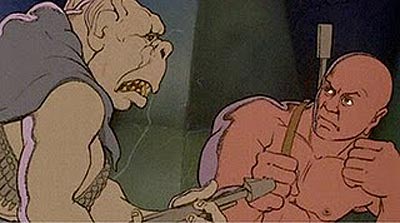
Nerdy teenager David (voiced by John Candy) finds a piece of the Loc-Nar and is transported to the world of Neverwhere, where he is transformed into Den, a muscular, bald warrior.  As Den, David gets to live out the fantasies of Heavy Metal‘s target audience.  On his new planet, Den rescues an Earth woman from being sacrificed, overthrows an evil queen and a sorcerer, and gets laid.  A lot.  Den is the best segment in Heavy Metal, largely because of the endearing contrast between the action onscreen and John Candy’s enthusiastic narration.

Captain Sternn (directed by Paul Sebella and Julian Harris, written by Bernie Wrightson)

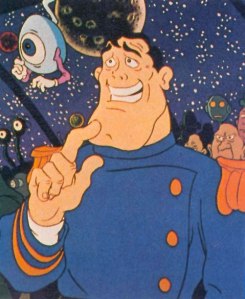
heavy-metal_captain-sternOn a space station orbiting the Earth, Captain Lincoln F. Sternn is on trail for a countless number of offenses.  Though guilty, Captain Sternn expects to be acquitted because he has bribed the prosecution’s star witness, Hanover Fiste.  However, Hanover is holding the Loc-Nar in his hand and it causes him to tell the truth about Captain Sternn and eventually turn into a bloodthirsty giant. Captain Sternn saves the day by tricking Hanover into getting sucked out of an air lock.
Captain Sternn was a reoccurring character in Heavy Metal Magazine and his segment is one of the best.  Eugene Levy voices Captain Sternn while Joe Flaherty voices his lawyer and Dean Wormer himself, John Vernon, is the prosecutor.  Even National Lampoon co-founder Douglas Kenney provided a voice.

 B-17 (directed by Barrie Nelson, written by Dan O’Bannon)

After the Loc-Nar enters Earth’s atmosphere, it crashes into a bullet-riddled World War II bomber, causing the dead crewmen within to reanimate as zombies.  Scored to Don Felder’s Heavy Metal (Takin’ a Ride), B-17 is one of the shorter segments and its dark and moody animation holds up extremely well.

http://www.youtube.com/watch?v=ELUP-oZQKM4

So Beautiful and So Dangerous (directed by John Halas, written by Angus McKie)

Nubile Pentagon secretary Gloria is beamed aboard a spaceship that looks like a giant smiley face.  While she has sex with the ship’s robot captain, the two crew members (voiced by Harold Ramis and Eugene Levy) pour out a long line of cocaine and shout “Nosedive!” before snorting up every flake.  So Beautiful and So Dangerous is so juvenile and so ridiculous that it is actually all kinds of awesome.

Taarna

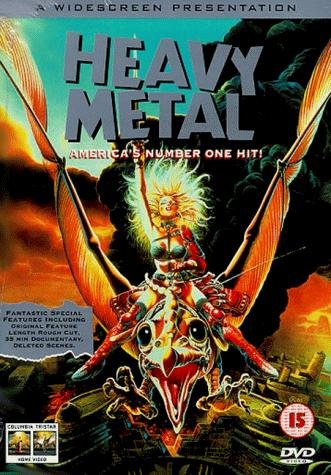
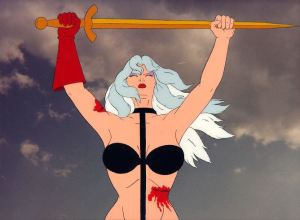
SacrificedIn the film’s final and most famous segment, Taarna, the blond warrior was featured on Heavy Metal‘s poster, rides a pterodactyl across a volcanic planet, killing barbarians, and finally confronting the Loc-Nar.  She sacrifices herself to defeat the Loc-Nar but no worries!  We return to Earth where, for some reason, the Loc-Nar explodes and the girl from the beginning of the film is revealed to be Taarna reborn.  She even gets to fly away on her pterodactyl.  Taarna was really great when I was twelve but today, it is impossible to watch it without flashing back to the Major Boobage episode of South Park.
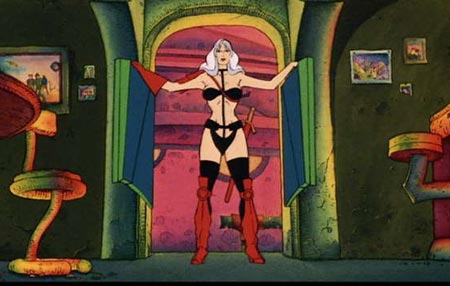
Much like Taarna, Heavy Metal seems pretty silly when I watch it today.  But when I was twelve, it was the greatest thing ever.

Taarna_Heavy_Metal