At the height of the Civil War, the small town of Border City, Missouri has declared itself to be neutral ground. Mayor Delilah Courtney (Nina Varela) announces that anyone who enters her town looking to recruit for either the Union or the Confederacy will be arrested and will face the possibility of being hung from the noose in the middle of Main Street.
That doesn’t stop Charles Quantrill (Brian Donlevy) from coming to town. Quantrill is a former Confederate officer who now terrorizes the Arkansas/Missouri border with his gang of thieves. Accompanying Quantrill is his wife, Kate (Audrey Totter), who once lived in Border City and who still enjoys singing a song at the saloon.
Another new arrival is Sally Maris (Joan Leslie), who comes down from Michigan to help her no-account account, Bitterroot Bill (Reed Hadley), run his saloon. Sally attempts to bring some order to the rowdy saloon, which makes an enemy out of Kate. When Bill is killed in a gunfight, Sally takes over the saloon and soon, she is being challenged first to a fight and then to an actual duel by Kate. With the disapproving Mayor Courtney watching all of the action from her office, it is obvious that one of the women is eventually going to be taken to the noose in the middle of the street but which one?
This is one of the best of the many B-westerns that Allan Dwan directed in the 1950s. Though much of the emphasis is on the usual western action — Quantrill wants to take over a mine, there’s a Confederate spy in town, and both Frank and Jesse James appear as supporting characters — the film is really about the rivalry and eventual partnership between a group of strong-willed woman who aren’t going to let anyone tell them how to live their lives. As tough as Kate is, Sally proves to be stronger than she looks and, in the end, they realize that they are stronger working together for a common goal than trying to tear each other down. Audrey Totter and Joan Leslie both give sexy and tough performances as Kate and Sally. They’re equally believable hanging out in a saloon, flirting with a cowboy, or drawing guns on each other in the middle of the street.
Along with taking a strong stand against vigilante justice, Woman They Almost Lynched features an exciting stage coach robbery, an intriguing story, and two very interesting lead characters. It’s a western that deserves to be better known.
At the height of the Korean War, American scientist Dean Olmstead (Joseph Hamilton) is flying being enemy lines when he’s shot down over North Korea. Because Olmstead had just created a new type of radar technology and he didn’t bother to leave behind any notes to explain to anyone else how the technology works, it’s imperative that he be rescued from a North Korean POW camp before the Russians brainwash him and take the technology for themselves.
Captain Tom Arnett (John Agar!), Lt. Bill Claiborn (Gregory Walcott, star of Plan 9 From Outer Space!!), and unconvincing beatnik Chick Lane (Nicky Balir) parachute behind enemy lines. They meet up with both the local rebels and Tanya Nikova (Audrey Totter), a Russian nurse who is secretly a double agent and an anticommunist. She’s also Arnett’s former lover and helped him escape the last time that he was being held prisoner by the communists. (Arnett was also in charge of the flying escort that was supposed to keep Olmstead from getting shot down so, given his past history of failing and getting captured, Arnett may not be very good at his job.) Working with Tanya and Capt. Chon (Victor Sen Young), Arnett ad Claiborn set out to rescue Olmstead from the KGB’s Col. Kuban (Robert Carricart).
Jet Attack is a z-grade war film that features a ton stock footage that you’ll probably recognize from other 50s war films. As a result, the look of the jets often change from shot to shot and one North Korean airplane has “California Air National Guard” prominently written on its tail. I know that some right-wingers like to refer to California as being “Commiefornia” but accusing the state of siding with the enemy during the Korean War is taking things too far. The only thing that looks cheaper than the stock footage is the footage that was actually shot for the movie. (The stock footage at least includes some pretty cool explosions.)
John Agar started his career co-starring with John Wayne and marrying Shirley Temple but, by the time Jet Attack was made, his star had dimmed considerably. Whether he was appearing in a major production or a cheap film like Jet Attack, Agar was always reliably dull. Here, he’s regularly outshined by co-star Gregory Walcott who, despite being best-known for appearing in films like Plan 9 From Outer Space, could actually act and show a hint of emotion on screen. Probably the best thing about this film is Audrey Totter, who, despite an unfortunately attempt at a Russian accent, plays her role with more conviction than the script really deserves. As Chick Lane, Nicky Blair also deserves some credit for telling the North Koreans that their attempts to torture him are “squaresville.”
The most surprising thing about Jet Attack is that it wasn’t produced by Howard Hughes. With its emphasis on planes and evil commies, it feels like a Hughes film. It’s a dull and workmanlike film but bad movie buffs will want to see it just to witness John Agar getting acted off the screen by Gregory Walcott and Audrey Totter.
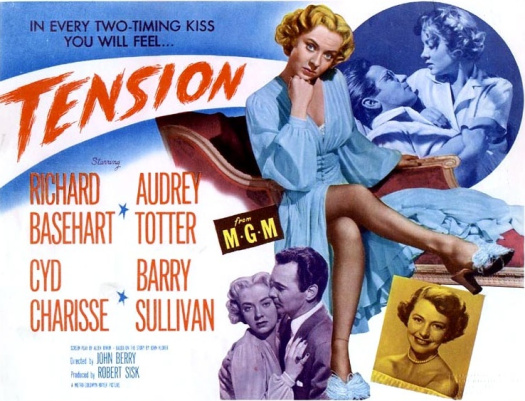
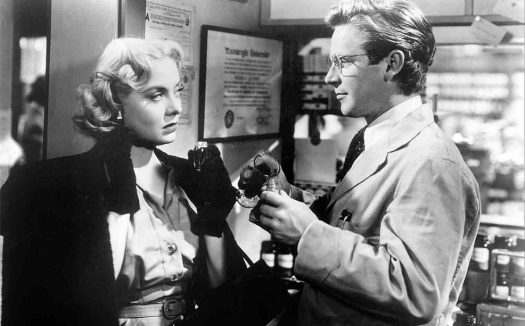
The best films noir deal with post-WWII disillusionment, and that’s exactly what drives Richard Basehart’s sad sack Warren Quimby in TENSION. This cynical, downbeat, and downright sordid little tale of infidelity and murder is boosted by first-rate performances from Basehart and scorchingly hot Audrey Totter as his manipulative bimbo of a wife, with a taut screenplay by Allen Rivkin and solid direction by John Berry. It may not make anyone’s top ten list (or even top thirty), but it’s one of those ‘B’ films that really works, provided you’re willing to suspend disbelief for an hour and a half.
Mild mannered pharmacist Quimby met and married Claire while stationed in San Diego during the war. He, like many others, hopes to someday live the American Dream: house, kids, the whole nine yards. Trampy Claire doesn’t give a crap about that; she prefers excitement, the high life. Claire is messing around…
As a classic film blogger, I’m contractually obligated to cover film noir during the month of “Noirvember”, so every Tuesday this month I’ll be shining the spotlight on movies of this dark genre!
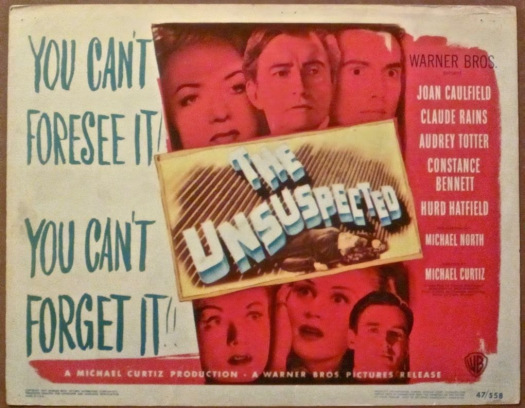
Claude Rains received second billing in 1947’s THE UNSUSPECTED, but there’s no doubt who’s the star of this show. Nobody could steal a picture like Rains, as I’ve stated several times before – his sheer talent commands your attention! Here, he gives a chilling portrayal of a cold, calculating murderer in a Michael Curtiz noir based on a novel by Edgar Award-winning mystery writer Charlotte Armstrong, and runs away with the film. Joan Caulfield gets top billing, but let’s be honest – it’s Claude’s movie all the way!
The film begins with a frightening scene played mostly in shadow, as a figure creeps into the office of Victor Grandison (Rains) and murders his secretary Robyn Wright while…
The worlds of supernatural horror and film noir collided to great effect in ALIAS NICK BEAL, John Farrow’s 1949 updated take on the Faust legend. The film wasn’t seen for decades due to legal complications, but last August the good folks at TCM broadcast it for the first time. I have been wanting to see this one for years, and I wasn’t disappointed! It’s loaded with dark atmosphere, a taut screenplay by hardboiled writer/noir vet Jonathan Latimer , and a cast of pros led by a ‘devilish’ turn from Ray Milland as Nick Beal.
The Faust character this time around is Joseph Foster, played by veteran Thomas Mitchell . Foster is an honest, crusading DA with political ambitions. When he says aloud he’d “give my soul” to convict racketeer Hanson, Foster receives a message to meet a man who claims he can help. Summoned to a seedy tavern on…
(Lisa is once again in the process of cleaning out her DVR! She recorded the 1947 film noir Lady In The Lake off of TCM on June 17th!)
You are Raymond Chandler’s world-famous private detective, Phillip Marlowe!
Well, no. Actually, you aren’t. Lady in the Lake is best-known for being one of the first (if not the first) film to be shot from the viewpoint of the main character but actually, the film goes out of its way to remind you that you’re seeing the story through Marlowe’s eyes but you’re not Marlowe yourself. There are three scenes in which Marlowe (played by Robert Montgomery, who also directed the film) is seen sitting behind a desk and directly addressing the audience. He shows up to fill in a few plot details and to assure the audience that, while the film they’re watching may be experimental, it’s not too experimental. For his part, Montgomery looks and sounds absolutely miserable whenever he has to speak directly to the audience. One gets the feeling that these scenes were forced on him by nervous studio execs, who were probably worried that the film would be too weird for mainstream audiences.
However, the rest of the film is seen totally through Marlowe’s eyes. When Marlowe gets punched, we see the fist flying at him. When Marlowe smokes a cigarette, we see the smoke float away from him. When Marlowe leers at every single woman that he meets, the camera leers as well. When Marlowe looks at himself in a mirror, we see his reflection. When Marlowe passes out after a beating or a car accident, the image grows blurry before fading to black. There’s even a rather clever scene when Marlowe leans in for a kiss, just to suddenly change his mind and pull back.
Today, of course, the film’s technique doesn’t seem quite as revolutionary. We’re used to point of view shots and moving cameras. Last year, Hardcore Henry told its entire stupid story through a point of view shot and the shaky cam effect actually made me physically ill. In Lady in the Lake, there is no shaky, hand-held camera work and I was happy about that. Marlowe may turn his head left and right and he may walk forward but he apparently has nerves of steel because the image stays steady and only shakes when Marlowe’s getting beat up.
As for the film’s plot, it opens with Marlowe explaining that, since he’s not making enough money as a P.I., he’s decided to try his hand at writing for a pulp magazine. While his stories are not accepted, publishing executive Adrienne Fromsett (Audrey Totter) does hire him to track down the missing wife of her boss, Derace Kingbury (Leon Ames). As Marlowe quickly figures out, nobody’s motives are exactly pure. Adrienne wants to marry her boss and get her hands on his money. The wife’s lover (Richard Simmons) claims that he hasn’t seen her in weeks but still lets slip that she may no longer be alive. The police (represented by Lloyd Nolan and Tom Tully) are corrupt, rather rude, and may know more than they are letting on. Even a seemingly innocent landlady (Jayne Meadows) might have a secret or two.
And, of course, there’s the dead woman who is discovered in a nearby lake. Her identity holds the key to many mysteries…
It’s an intriguing puzzle and it actually helps to see everything through Marlowe’s eyes. If nothing else, it cuts down on the red herrings. If Marlowe stops to stare at something, you know exactly what he’s staring at and you can be sure that it will prove to be important at some point in the story.
By the way, did I mention that Lady In The Lake is not just an experimental film noir but a Christmas movie? Seriously, it opens with holiday music playing in the background and the opening credits are printed on cheery Christmas cards. It’s only after the credits are over that we see that there’s a gun underneath the cards. As a director, Montgomery does a great job juxtaposing the cheeriness of Christmas with the sordidness of the people who Marlowe has to associate with on a daily basis. He may be dealing with a bunch of murderers and greedy con artists but almost everyone has a Christmas tree in their apartment.
In fact, it’s so easy to get so wrapped up in the film’s technique that the viewer runs the risk of not noticing just how dark and cynical Lady in The Lake truly is. Everyone that Marlowe meets is sleazy. Marlowe, himself, does not come across as being particularly likable. Every room that Marlowe enters is underlit. Interestingly, with the exception of the opening credits and a driving montage, there’s not much music to be heard in the film, a reminder that we’re only hearing what Marlowe hears. And, in Marlowe’s world, there’s no music playing in the background to provide relief from the tension. There’s just a mix of lies and threats.
Lady in the Lake is an intriguing film and it shows up on TCM fairly frequently. Keep an eye out for it.
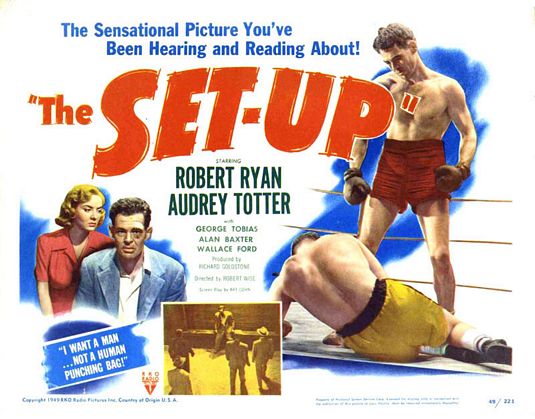
The seedy worlds of professional boxing and film noir were made for each other. Both are filled with corruption, crime, and desperate characters trapped in situations beyond their control. Movies like CHAMPION, BODY AND SOUL, and THE HARDER THEY FALL expose the dark underbelly of pugilism. One of the best of this sub-genre is THE SET-UP, Robert Wise’s last film for RKO studios. He doesn’t fail to deliver the goods, directing a noir that packs a wallop!
THE SET-UP follows one night in the life of aging, washed up fighter Stoker Thompson ( Robert Ryan ). Stoker’s 35 now, ancient in boxing terms, but still has delusions of making the big time. Wife Julie (Audrey Totter ) is tired of going from one tank town to the next, and fears for Stoker’s safety. She refuses to go to tonight’s fight, a matchup with up and coming young contender Tiger…
The 1960s was apparently a bad time for talented old school Hollywood filmmakers getting sucked into making big budget, excessively lengthy films. Joseph L. Mankiewicz spent most of his career making movies like All About Eve and then, in 1963, he ended up directing Cleopatra. Elia Kazan went from A Face In The Crowd to The Arrangement. John Huston went from Treasure of the Sierra Madre and The African Queen to directing not only The Bible but Reflections in a Golden Eye as well.
And then there’s Edward Dmytryk. Dmytryk may not be as highly regarded by modern critics as Mankiewicz and Huston but he still directed some of the best film noirs of the 1940s. His 1947 film Crossfire was nominated for best picture and probably should have won. In 1952, he directed one of the first true crime procedural films, The Sniper. His 1954 best picture nominee, The Caine Mutiny, featured one of Humphrey Bogart’s best and most unusual performances.
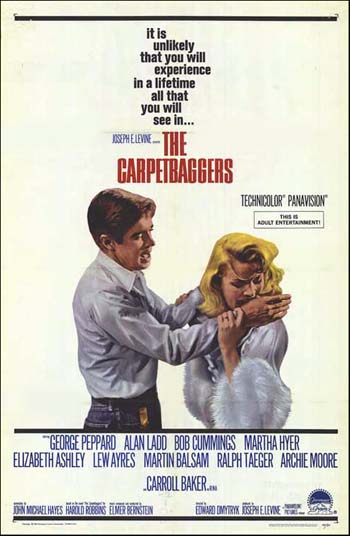
And yet, in 1964, he somehow found himself directing The Carpetbaggers.
The Carpetbaggers tells the story of Jonas Cord (George Peppard). Jonas is the son of the fabulously wealthy Jonas Cord, Sr. (Leif Erickson). At the start of the film, father and son do not get along. Senior resents that Junior is more interested in piloting airplanes than in learning the family business. Junior is angry that Senior has married Jonas’s ex-girlfriend, actress Rina Marlowe (Carroll Baker). In fact, as far as Jonas, Jr. is concerned, Nevada Smith (Alan Ladd) is more of a father to him than his actual father.
Nevada Smith is Jonas, Sr.’s best friend and occasional business partner. He’s a former cowboy who, we are told in a lengthy bit of exposition, is legendary for tracking down and killing the three men who killed his parents. (As we listen to Jonas, Jr. tell the entire lengthy story, we find ourselves thinking, “Okay, so why not make a movie out of that story?” Well, they did. Two years after the release of The Carpetbaggers, Steve McQueen starred in Nevada Smith.) Nevada’s also a film star whose career is in deep decline.
Speaking of deep decline, Jonas, Sr. ends up having a heart attack and dramatically dropping dead before he can get a chance to disinherit his son. Jonas, Jr. inherits the Cord fortune and the Cord business and proceed to spend the next two and a half hours abusing everyone who gets close to him. He even mistreats his loving and neurotic wife, Monica (Elizabeth Ashley, giving the only really memorable performance in the entire film).
Yes, there’s really no reason to have any sympathy at all for Jonas Cord, Jr. but the film insists that we should because he’s the main character and he’s played by the top-billed star. We’re also told that he’s a brilliant aviation engineer and I guess we’re supposed to admire him for being good at what does. We also discover that Jonas believes that his mother was insane and that she passed down her insanity to him. He fears that he’ll pass the crazy gene to any of children that he might have so that’s why he pushes everyone away. Just in case we don’t understand how big a deal this is to him, the camera zooms in for a closeup whenever Jonas is reminded of his mother.
(In the 60s, all mental instability was represented via zoom lens.)
However, Jonas isn’t just into airplanes! He also buys a movie studio, specifically because Rina Marlowe is under contract. Soon, Jonas is directing movies his way. Jonas also finds himself falling in love with another actress (Martha Hyer) so, of course, he starts treating her badly in an effort to push her away.
What can be done to save the tortured soul of Jonas Cord? Maybe he just need to get beaten up by Nevada Smith…
The Carpetbaggers was based on a novel by Harold Robbins. The novel was apparently quite a scandal when it was originally published. People read it and they wondered, “Who was based on who?” Well, if you’ve ever seen The Aviator, it’s not that difficult to figure out. Jonas Cord, eccentric movie mogul and obsessive pilot, was obviously meant to be Howard Hughes. Rina Marlowe was meant to be Jean Harlow, a fact that can be guessed just by looking at the last names. And I’m guessing that Nevada Smith was probably based on former President Warren G. Harding because … well, why not?
I suppose that, by the standards of 1964, the film version of The Carpetbaggers would have been considered risqué. For a modern audience, the main appeal of something like The Carpetbaggers is to see what was once considered to be shocking. The film is overlong, George Peppard doesn’t exactly figure out how to make Jonas into the compelling rogue that he needs to be, the clothes and the sets are a lot more interesting than any of the dialogue (but not interesting enough to carry a nearly 3 hour movie), and the film’s pacing is so off that some scenes seem to go on forever while others are way too short. But, as a cultural and historical artifact, The Carpetbaggers does hold some interest.
The Carpetbaggers was made at a time when Hollywood felt it was under attack from both television and European cinema. With a film like The Carpetbaggers, the studios were saying, “See!? Television will never be able to make a film this long and big! And those Europeans aren’t the only ones who can make a movie about sex!” Of course, as so often happened during this time, the studios failed to take into account that size and length don’t always equal quality (and ain’t that the truth?). As for the sex — well, we hear a lot more than we actually see. The Carpetbaggers is one of those films where everyone talks about sex, largely because showing sex wasn’t really an option. (And it should be noted that most of the sex talk is delivered in the language of euphemism.) As a result, The Carpetbaggers feels incredibly tame by today’s standards. As a result, your main reaction to The Carpetbaggers will probably be to marvel at what was considered daring and shocking 50 years ago.
(And before we get too cocky and quick to dismiss those who came before us, let’s consider how our current films will look to movie audiences five decades from now…)
As far as biopics of Howard Hughes are concerned, The Carpetbaggers in no Aviator. However, it is an occasionally interesting historical artifact.
 At the height of the Civil War, the small town of Border City, Missouri has declared itself to be neutral ground. Mayor Delilah Courtney (Nina Varela) announces that anyone who enters her town looking to recruit for either the Union or the Confederacy will be arrested and will face the possibility of being hung from the noose in the middle of Main Street.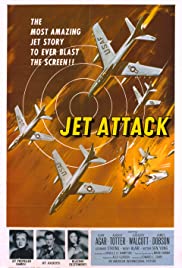



 Through the Shattered Lens