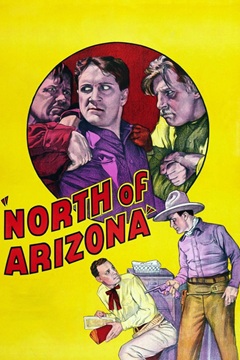
North of Arizona (1935, directed by Harry S. Webb)


Newly hired ranch foreman Jack Loomis (Jack Perrin) comes to the aid of two Indians who were nearly swindled out of their land during a card game.  The Indians inform Jack that his new boss, George Tully (Al Bridge), is actually a crook and the ranch is just a front for his criminal activities.  When Jack says he doesn’t want to be a part of Tully’s schemes, Tully and his men frame Jack for a robbery.

After you watch enough of these Poverty Row westerns, you start to get the feeling that anyone in the 30s could walk into a studio and star in a B-western.  Jack Perrin was a World War I veteran who had the right look to be the star of several silent films but once the sound era came along, his deficiencies as an actor became very apparent.  He could ride a horse and throw a punch without looking too foolish but his flat line delivery made him one of the least interesting of the B-western stars.  That’s the case here, where Perrin is a boring hero and the entire plot hinges on the villain making one really big and really stupid mistake.  John Wayne could have pulled this movie off but Jack Perrin was lost.

Jack Perrin’s career as a star ended just a few years after this film but not because he was a bad actor.  Instead, Perrin filed a lawsuit after a studio failed to pay him for starring in one of their films.  From 1937 until he retirement in 1960, Perrin was reduced to playing minor roles for which he often went uncredited.  Hollywood could handle a bad actor but not an actor who expected to be paid for his work.

The Nevada Buckaroo (1931, directed by John P. McCarthy)


When the population of a small frontier town all sign a petition asking that the governor name their town the new county seat, the petition is stolen by outlaw Cherokee (George “Gabby” Hayes).  Cherokee substitutes a different petition requesting a pardon for a member of his gang, The Nevada Kid (Bob Steele).

The Nevada Kid gets his pardon, is released from prison, and returns to the town.  No one is happy to see him, even though he says that he has changed his ways.  Even if the pardon was gotten through illicit means (which the Nevada Kid himself knew nothing about), the Kid still says that he’s going to take advantage of his second chance.  When Chereokee and the gang start to demand that the Nevada Kid once again work with them, Nevada gets his chance to show whether or not he’s really left being an outlaw behind.

I never expect much from these Poverty Row westerns but The Nevada Buckaroo, despite having not a great title, is actually pretty good.  A very young-looking Bob Steele gives a good performance as the Nevada Kid and George Hayes show that, before he became everyone’s favorite sidekick, he was capable of being a very intimidating actor.  The movie actually has something to say about trust, community, and second chances.

I don’t know much about director John P. McCarthy and I think this is the first of his films that I’ve seen.  He and cinematographer Faxon M. Dean put together a film that looks infinitely better than the average B-western.  That was obvious with even the grainy print that I watched.  The final shot, of the Nevada Kid riding into the sunset, is a perfect western image.

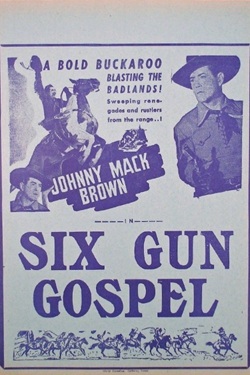
Six Gun Gospel (1943, directed by Lambert Hillyer)


Marshals Nevada Jack McKenzie (Johnny Mack Brown) and Sandy Hopkins (Raymond Hatton) are sent to the frontier mining community of Goldville to determine who is responsible for hijacking all of the gold that should be coming out of the town.  Not surprisingly, it’s all the work of another dastardly saloon owner (Kenneth MacDonald) who is planning on stealing all the gold, chasing off all the settlers, and then selling their land to the railroad company.  While Sandy goes undercover as the town’s new preacher, Jack agrees to ride shotgun on a gold shipment, along with with Dan Baxter (Eddie Drew).  Dan is in love with Jane Simms (Inna Gest), the daughter of honest miner Bill Simms (Kernan Cripps).

Johnny Mack Brown made a countless number of westerns for several different production companies but it seems like they always featured a crooked saloon owner and a plan to sell the land to a railroad company.  Luckily, nobody watches these movies for the plots and that was probably true even when they were first released.  People watch these movies for the nostalgia value of watching a movie where it’s good vs evil and good always triumphs without leaving any sort of lingering doubt about whether or not the heroes did the right thing.  Johnny Mack Brown is as authentic on a horse and carrying a gun as he ever was and there’s a scene where he manages to get a gun despite being tied up that’s pretty cool.  The appeal of Johnny Mack Brown was that he always seemed like he could do the things that he did in the movies in real life as well.  Raymond Hatton provides comic relief, pretending to know the hymns being sung by his congregation and providing some songs of his own.  There’s enough gun fights and horse chases to provide nostalgic happiness for fans of the genre and that’s the important thing.