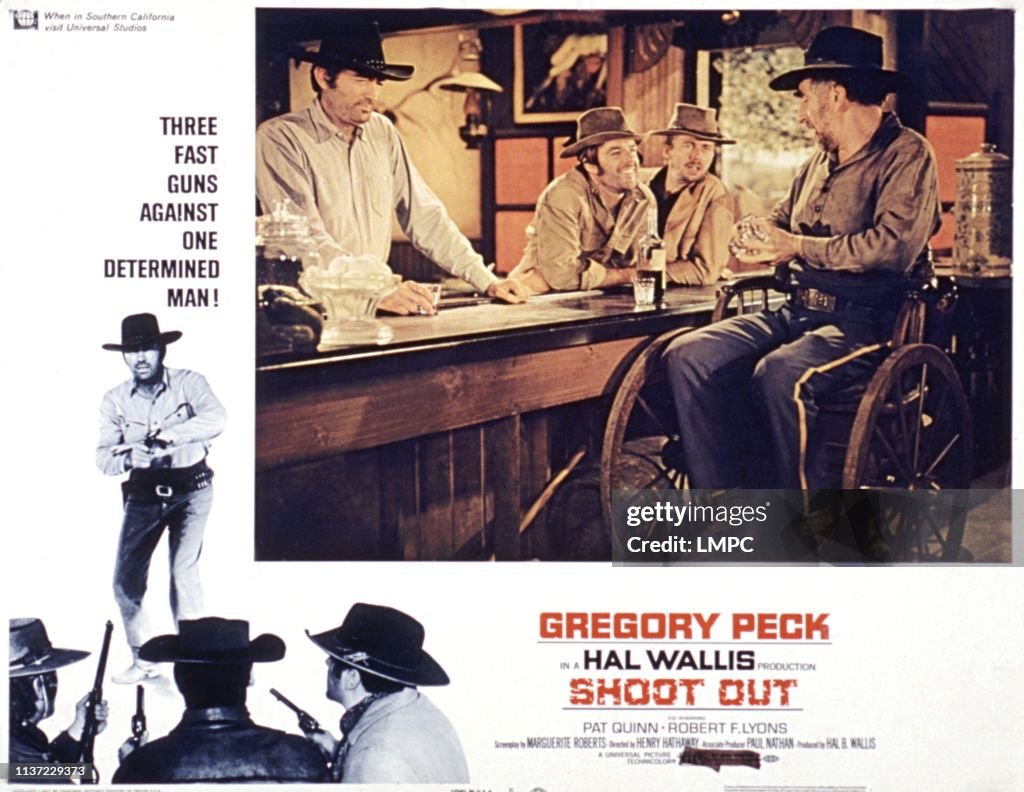
Brad reviews SHOOT OUT (1971), starring Gregory Peck & Robert F. Lyons! 


After serving a stretch at the Canon City penitentiary, Clay Lomax (Gregory Peck) gets out with only one thing on his mind… revenge on his former partner Sam Foley (James Gregory), who shot him in the back during a bank robbery, leaving him to take the rap. Foley isn’t a fool, though, so he’s hired a trio of young punks, Bobby Jay (Robert F. Lyons), Skeeter (John Davis Chandler), and Pepe (Pepe Serna) to surveil Lomax and let him know if he’s heading to his home in Gun Hill with payback on his mind. These guys are about as crazy as it gets, and they make two major mistakes. First, they kill Lomax’s friend Trooper (Jeff Corey) who lets him know where Foley is with his dying breath. Second, they kidnap the prostitute Alma (Susan Tyrell) just because they want to treat her like crap and have fun with her, which turns out to be a dumb move. Interrupting Lomax’s quest for revenge, he finds himself being forced to care for a young child named Decky (Dawn Lyn), who just may be his daughter with a lady back in Kansas City who used to be his “friend.” Looking after Decky, and then meeting and falling for the widow Juliana Farrell (Patricia Quinn), Lomax is soon facing off against his most dangerous foe, the crazed Bobby Joe, as he attempts to protect all these new people that he loves so he can move on with his life. But is it all too late?!!

I love westerns, but I must admit that I’m not the biggest fan of director Henry Hathaway’s SHOOT OUT. Hathaway has directed some of my favorite actors and movies, like Charles Bronson’s debut film with Gary Cooper, YOU’RE IN THE NAVY NOW (1951), along with the Jimmy Stewart film CALL NORTHSIDE 777 (1948) and John Wayne’s Oscar winning TRUE GRIT (1969). Unfortunately, it seems his best years are behind him, and he would only direct one more film after this, the less than excellent black action film HANGUP (1974). This isn’t exactly Gregory Peck’s best work either. Coming nine years after his Oscar winning performance in TO KILL A MOCKINGBIRD (1962), this is definitely not even close to that kind of level. Don’t get me wrong, I do enjoy his turn as Lomax when he’s the wronged outlaw looking for revenge, but I don’t really care at all for his part as the reluctant father figure trying to deal with the six-year-old Decky. I found Dawn Lyn to be more annoying than cute in the role, and this storyline distracted me from the revenge plot that I actually enjoyed. As a co-host of the “This Week in Charles Bronson Podcast,” we had the opportunity to interview Robert F. Lyons, who plays the bad guy, Bobby Jay Jones. I specifically asked him about this film and what it was like working with Gregory Peck. While he enjoyed working with Peck, his response about the film itself was telling…. “The work in there is not my work.” If you’ve watched much of the excellent actor’s work before, you can immediately understand what he means. Lyons goes so over-the-top as the spying outlaw Bobby Jay Jones, that his performance is inconsistent with the bulk of his career. Lyons told us that his performance was orchestrated by Hathaway in a way that he disagreed with, and he essentially disowns his work in the film. You can see a similar vibe with his “gang” that includes the actors John Davis Chandler and Pepe Serna. 

While I’m not a huge fan of the overall direction of the storyline or the focus of some of the main performances in SHOOT OUT, I am appreciative of the genre and the classic western stars that Hathaway cast in supporting roles. I especially enjoy seeing Jeff Corey in the small but pivotal role as the wheelchair bound Trooper, Paul Fix as the train brakeman who delivers Decky and a stack of cash to Lomax, and Arthur Hunnicutt as the ranch owner who barters with Lomax over the price of a pony. Hunnicutt is a particular favorite of mine although his role here is very small. Nominated for an Oscar for his performance in Howard Hawks’ THE BIG SKY (1952), Hunnicutt is from the small town of Gravelly, Arkansas, which is not far from where my own family is from. He even attended the same college that I graduated from, the University of Central Arkansas, which was known as the Arkansas State Teachers College when he (and my dad) went there. And then there is the setup of the revenge scenario at the beginning and the final showdown at the end, classic staples of the western genre. These are enjoyable and satisfying moments as Lomax settles his scores and the bad guys get their comeuppance.

Overall, SHOOT OUT is best enjoyed by fans of old school westerns and star Gregory Peck. It veers aways from the best storylines of the genre and wastes a lot of time with uninteresting melodrama, but it does offer us another chance to see some of our great character actors doing what they do. That means something to me. 

I’ve included our podcast episode with Robert F. Lyons below. He discusses SHOOT OUT at around the 1:00:30 mark.
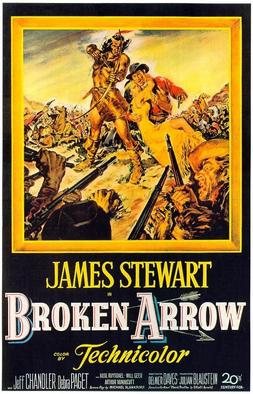
Film Review: Broken Arrow (dir by Delmer Daves)


The 1950 film, Broken Arrow, takes place in the years following the Civil War.

Having survived the war, frontier scout Tom Jeffords (James Stewart) just wants to get away from his fellow countrymen for a while.  During the Civil War, Jeffords saw the worst that humanity had to offer and the experience has left him cynical about the idea of bringing civilization to the American frontier.  Tom just wants to be left alone.  Still, when he comes across a 14 year-old Apache who has been shot in the back, Tom stops to help.  Though wounded, the Apache still tries to attack him.  He’s learned not to trust the white man.  Broken Arrow is a film that suggests that he has good reason not to.  Indeed, Broken Arrow was one of the first major Hollywood productions to attempt to treat the American Indians with sympathy and fairness.

Tom saves the Apache’s life and reunites him with his tribe.  When the Apaches attack and kill a group of nearby gold prospectors, they allow Tom to live but they warn him to stay out of their territory.  However, circumstances make it impossible for Tom to do that.  When Tom arrives in Tucson, the citizens are incredulous that he allowed the Apache child to live.  When Tom learns the Apache language and customs and marries an Apache woman named Sonseeahry (Debra Paget), it causes the other whites to distrust him even more.  However, it is Tom’s eventual friendship with the Apache chief Cochise (Jeff Chandler) that eventually lands Tom in the middle of the conflict between the Apaches who want to preserve their way of life and the white men who want their land.

Broken Arrow is a well-intentioned film, in the way that mildly liberal films from the 50s tended to be.  The U.S. government and its citizens are criticized for breaking their promises and their treaties to the Apache but the film’s ultimate message is one of compromise and understanding.  The bigoted whites may be the villains but then again, so is Geronimo (Jay Silverheels) for refusing to accept Cochise’s desire for peace.  Cochise is the film’s hero specifically because he calls for setting aside differences and living in peace with the white man, despite his own distrust of their leaders.  The majority of the extras were Apache, though Neither Jeff Chandler nor Debra Paget were of Native descent.  Both of them give good performances that largely avoid the stereotypes of the time.  Chandler received his only Oscar nomination, for Best Supporting Actor, for his performance in this film.

That said, the unnominated Jimmy Stewart dominates the film and that’s not really surprising.  (It should be noted that, while Stewart was not nominated for this film, he was nominated for his performance in Harvey, that same year.)  Stewart may have first found fame as the happy and go-lucky face of Middle America but his experiences in World War II left a definite mark on him.  He returned from the war a much more serious figure and every character that he played (even the lovable Elwood in Harvey) had more than a hint of melancholy to him.  Stewart plays Tom as being a troubled soul, someone who is still struggling to come to terms with the destruction and cruelty that he saw during the Civil War.  There’s an authenticity to Stewart’s performance, leaving little doubt that he understood exactly what Tom was going through.  Broken Arrow ends on a note of compromise and racial harmony but it’s a sad film because we know what waits in the future for Cochise and his people.  Tom Jeffords fights to bring peace to the frontier but it’s a peace that won’t last.  And, as played by Stewart, Tom seems to understand that better than anyone.

Film Review: The Cardinal (dir by Otto Preminger)


The 1963 film, The Cardinal, opens with an Irish-American priest named Stephen Fermoyle (Tom Tyron) being instituted as a cardinal.

In a series of flashbacks, we see everything that led to this moment.  Stephen starts out as an overly ambitious and somewhat didactic priest who, over the years, is taught to be humble by a series of tragedies and mentors.  It’s a sprawling story, one that encompasses the first half of the 20th Century and, as he did with both Exodus and Advice and Consent, Preminger tells his story through the presence of several familiar faces.  Director John Huston plays the cardinal who takes an early interest in Stephen’s career.  Burgess Meredith plays a priest with MS who teaches Stephen about the importance of remaining humble and thankful.  When Stephen is in Europe, Romy Schneider plays the woman for whom he momentarily considers abandoning his vows.  When Stephen is assigned to the American South, Ossie Davis plays the priest and civil rights activist who teaches Stephen about the importance of standing up for those being oppressed.  In the days leading up to World War II, Stephen is sent to Austria to try to keep the local clergy from allying with the invading Nazis.  Stephen also deals with his own family drama, as his sister (Carol Lynley) runs away from home after Stephen counsels her not to marry a good Jewish man named Benny (John Saxon) unless Benny can be convinced the convert to Catholicism.  Later, when his sister becomes pregnant and Stephen is told that she’ll die unless she has an abortion, Stephen is forced to choose between his own feelings and teachings of the Church.  Along the way, performers like Dorothy Gish, Cecil Kellaway, Chill Wills, Raf Vallone, Jill Haworth, Maggie McNamara, Arthur Hunnicut, and Robert Morse all make appearances.

All of the familiar faces in the cast are used to support Tom Tryon and Tryon needs all the support that he can get.  Despite Otto Preminger’s attempts to make Tom Tyron into a star, Tryon eventually retired from acting and found far more success as a writer of the type of fiction that Stephen Fermoyle probably would have condemned as blasphemous.  Tryon gives a stiff and unconvincing performance in The Cardinal.  The entire film depends on Tryon’s ability to get us to like Stephen, even when he’s being self-righteous or when he’s full of self-pity and, unfortunately, Tryon’s stiff performance makes him into the epitome of the type of priest that everyone dreads having to deal with.  Tryon gives such a boring performance that he’s overshadowed by the rest of the cast.  I spent the movie wishing that it would have spent more time with John Saxon and Burgess Meredith, both of whom give interesting and lively performances.

The Cardinal is a long and rather self-important film.  The same can be said of many of Preminger’s films in the 60s but Exodus benefitted from the movie star glamour of Paul Newman and Eva Marie Saint and Advice and Consent was saved by an intelligent script.  The Cardinal, on the other hand, is a bit draggy and makes many of the same mistakes that many secular films make when they try to portray Catholicism.  Oddly enough, The Cardinal received more Oscar nominations than either Exodus or Advice and Consent.  Indeed, Preminger was even nominated for Best Director for his rather uninspired work here.  Considering the number of good films for which Preminger was not nominated (Anatomy of a Murder comes to mind), it’s a bit odd that The Cardinal was the film for which he was nominated.  (Of course, in 1944, the Academy got it right by nominating Preminger for his direction of Laura.)  The Cardinal is largely forgettable, though interesting as a type of self-consciously “big” films that the studios were churning out in the 60s in order to compete with television and the counterculture.

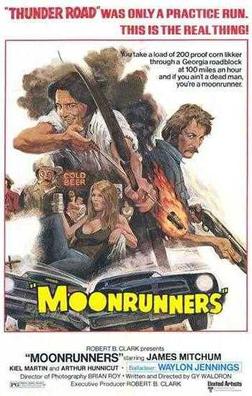
Moonrunners (1975, directed by Gy Waldron)


Does this sound familiar?

Grady and Bobby Lee Hagg (played by Kiel Martin and Jame Mitchum) are just some good ol’ boys, never meaning no harm, but they’ve still been in trouble with the law since they day they were born.  They live in rural Georgia, on a farm owned by their Uncle Jesse (Arthur Hunnicutt).  Uncle Jesse’s an expert on two things: the Bible and how to brew the best whiskey.  Uncle Jesse is moonshiner with integrity.  No one knows his formula and he won’t sell his moonshine to just anyone.  He doesn’t want anything to do with the New York mob and their efforts to move in on the moonshine racket.

Uncle Jesse’s main rival is Jake Rainey (George Ellis), the corpulent county commissioner who used to be Jesse’s business partner but who now is in league with the Mafia.  Jake and the Hagg boys have a rivalry that is sometimes friendly but still dangerous.  Helping Jake control the county is a formerly honest lawman named Rosco P. Coltrane (Bruce Atkins).

The Hagg boys are on probation so they can’t leave the county and they can’t carry guns.  Instead, they hunt with bow and arrow.  They drive a fast car that they’ve named Traveller (after General Lee’s horse).  Grady dreams of going to Nashville with Beth Anne Eubanks (Chris Forbes) and becoming a country music star.  Bobby is a laid back race car driver who is having an affair with Jake Rainey’s wife.

The film follows the Hagg boys as they transport moonshine, outrun the police, and occasionally get into bar fights.  The movie was shot on location on Georgia, features several car chases, and it’s narrated by country singer Waylon Jennings.

Moonrunners was filmed in 1973 but not released until 1975.  It didn’t get much attention when it was released but it did go on to inspire a television series called The Dukes of Hazzard.   Even considering the show’s popular success and current cult status, Moonrunners is still a largely unknown film.  (It’s so obscure that Warner Bros. was reportedly shocked to discover that they were required to pay several million in royalties to the film’s producers before they could move ahead with their own film adaptation of The Dukes of Hazzard.)  However, Moonrunners is superior to The Dukes of Hazzard in every way.

Of course, being better than The Dukes of Hazzard may seem like a low bar to clear but Moonrunners is still one of the better moonshiner films out there.  The car chases are genuinely exciting and well-filmed and the cast feels authentic.  Arthur Hunnicutt and George Ellis both seem like they naturally belong next to a still while James Mitchum and Kiel Martin are well-paired as Grady and Bobby Lee.  Mitchum, in particular, channels the laconic charisma of his father, Robert.  Not surprisingly, Moonracers is far rougher and has more of an edge than The Dukes of Hazzard.  The TV show may have been for kids but the movie is not.

It’s a B-movie, of course.  The soundtrack, which is full of outlaw country, is sometimes obtrusive.  I burst out laughing at the film’s most dramatic moment because Waylon Jennings suddenly started singing a song called “Whiskey Man.”  The DVD release appears to have been copied straight from a VHS tape so the images were often grainy.  It’s not a perfect movie but I still enjoyed Moonrunners for what it was, a celebration of fast cars, pretty girls, and rebellious attitudes.  Your collection of car chase films is incomplete without it!

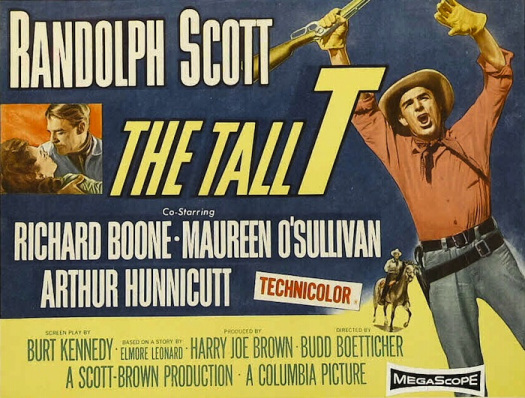
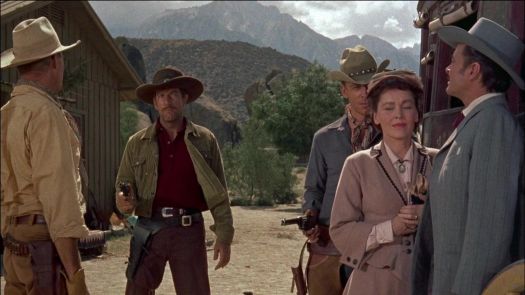
Well of Loneliness: Randolph Scott in THE TALL T (Columbia 1957)


gary loggins's avatarcracked rear viewer

I’ve told you Dear Readers before that Randolph Scott stands behind only John Wayne in my personal pantheon of great Western stars. Scott cut his cowboy teeth in a series of Zane Grey oaters at Paramount during the 1930’s, and rode tall in the saddle throughout the 40’s. By the mid-50’s, Scott and his  producing partner Harry Joe Brown teamed with director Budd Boetticher and writer Burt Kennedy for seven outdoor sagas that were a notch above the average Westerns, beginning with SEVEN MEN FROM NOW. The second of these, THE TALL T, remains the best, featuring an outstanding supporting cast and breathtaking location cinematography by Charles Lang, Jr.

Scott plays Pat Brennen, a friendly sort trying to make a go of his own ranch. Pat, who comically lost his horse to his old boss in a wager over riding a bucking bull, hitches a ride with his pal Rintoon’s…

View original post 449 more words