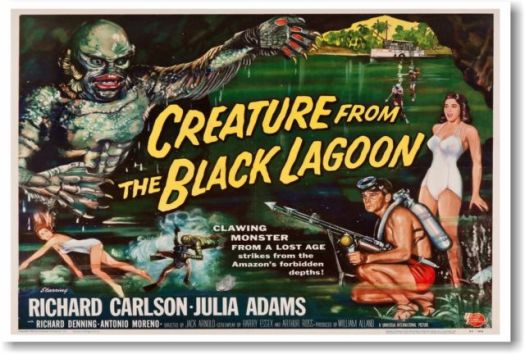
By the early 1950’s, the type of Gothic horrors Universal was famous for had become passe. It was The Atomic Age, and science fiction ruled the roost, with invaders from outer space and giant bugs unleashed by radiation were the new norm. But the studio now called Universal-International had one more ace up its collective sleeve: THE CREATURE FROM THE BLACK LAGOON, last of the iconic Universal Monsters!
Scientist Dr. Maia, exploring “the upper reaches of the Amazon” with his native guides, discovers a fossilized hand that may be the evolutionary “missing link”. Taking his finding to the Institudo de Biologia Martima, he teams with ichthyologist David Reed, David’s pretty assistant/fiancé Kay Lawrence, institute chief Dr. Mark Williams, and fellow scientist Dr. Thompson to form an expedition. They charter the steamer The Rita, skippered by Captain Lucas, and head down the river into the Black Lagoon. Maia’s Indian guides…
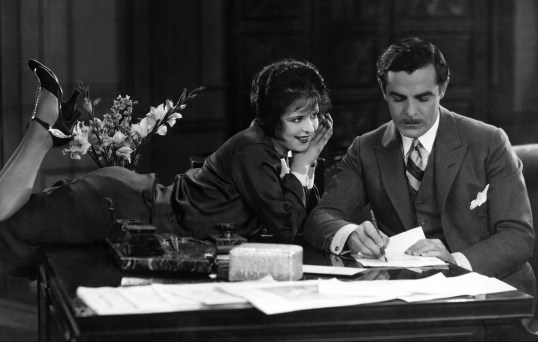
If I could be any character from a silent film, I would want to be Betty Lou Spence, the heroine of the classic 1927 film, It.
As played by the beautiful Clara Bow, Betty has It. What is It, you may ask? That’s the question that this film sets out to answer. The movie starts out with a title card that read, “That quality possessed by some which draws all others with its magnetic force. With ‘It’ you win all men if you are a woman and all women if you are a man. ‘It’ can be a quality of the mind as well as a physical attraction.” Throughout the film, every man who sets his eyes on Betty automatically says that she has “it.” Though the film never explicitly says so, it’s pretty obvious that “It” is a combination of sensuality, intelligence, and inner strength.
It is sex.
And yes, since she’s played by Clara Bow, Betty Lou Spencer definitely has ‘it’ and she knows what to do with it as well.
However, one thing that Betty doesn’t have is a lot of money. Instead, she’s a proud and poor shopgirl who sets her sights on her wealthy and handsome employer, Cyrus Waltham (played by Antonio Moreno). Realizing that the uptight Cyrus will never notice her while at work, Betty accepts a date with Cyrus’s irresponsible best friend Monty (William Austin). Knowing that Cyrus and his girlfriend will also be there, Betty asks Monty to take her to a fancy restaurant. While Monty orders their food, Betty stares shocked at the high prices on the menu. Why just the appetizers cost $2.00!
Ah, 1927.
Eventually, Betty does manage to get Cyrus’s attention. After spending a day slumming with her down on Coney Island, Cyrus attempts to kiss Betty. Betty responds by slapping him and telling him, “So, you’re one of those minute men — the minute you meet a girl, you think you can kiss her!”
The next day, things get a bit more complicated when Betty discovers that two social workers have shown up at the apartment of her best friend, Molly (Priscilla Bonner). Molly is a single mother and the social workers have shown up to take away her baby. Betty boldly steps forward, claiming that she is the baby’s true mother and that, since she has a job, the social works have no reason to take away her baby.
One of the snooty social workers (who, needless to say, does not have it) stares down here nose at Betty and asks, “And where is your husband?”
Betty stares straight back at her and replies, “That’s none of your business.”
Seriously, nobody tells Betty Lou Spence what to do.
Since this movie was made in 1927, everyone is scandalized. Cyrus, obviously miffed that he couldn’t even get a kiss from an unwed mother, dumps her. Betty responds by quitting her job. A title card informs us that Betty may have needed the money but her pride was far more important to her. What makes this movie unique, especially when compared to even some contemporary films, is that Betty is not punished for putting her pride before money or romance. Instead, the film celebrates her independence.
The rest of the film deals with her getting her own brand of vengeance on Cyrus. In the end, Betty gets her man but she gets him on her own terms. Again, take a minute to consider that this film, made nearly 90 years ago, not only features a liberated woman but celebrates her as well.
After this film, Clara Bow became known as the “It Girl,” and it’s easy to see why. In the role of Betty Lou Spence, Bow epitomizes the perfect combination of outward sensuality and inward strength. Whether she’s sarcastically telling off a rude customer, defending her best friend, or saving the life of her romantic rival, Clara Bow epitomizes both sex and independence. In the end, she pursues her man not out of obligation but out of desire. When she does find her happy ending, she finds it on her own terms.
Those of us in 2013 have a lot to learn from the It Girl of 1927.
As anyone who knows me can tell you, Lisa Marie doesn’t do water.
Seriously, I have a very intense fear of drowning and, while I might enjoy laying out by the pool during the summer, you’re never going to catch me actually going anywhere near the deep end. I’m the epitome of the girl who loves the beach but hates the ocean. As a result, I have a hard time with movies the feature swimmers thrashing about in the water or ancient monsters coming up to the surface in search of swimsuit-clad victims.
For lack of a better term, these films freak me out.
Sometimes, however, it’s fun to be freaked out. Perhaps that’s why I so love the 1954 monster classic, The Creature From The Black Lagoon.
Like all good B-movies from the 1950s, The Creature From The Black Lagoon starts off with a lot of stock footage and a stuffy narrator telling us about how the Earth was created and how mankind originally evolved from a creature that crawled out of the sea. The narrator manages to cover all the bases by including a few Biblical quotes with his explanation of how evolution works.
From the beginning of mankind, we fast forward to the 1950s. A fossilized claw has been discovered in the Amazon and a group of scientists think that it could be evidence of the missing link in human evolution. Mark (Richard Denning), who is kind of a jerk, funds an expedition to the Amazon to search for more evidence. Accompanying Mark is hunky young scientist David (Richard Carlson) and David’s girlfriend, Kay (Julie Adams). Traveling on a boat captained by the rather gruff Lucas (Nestor Paiva), they go to the camp where the fossil was originally discovered. However, once they arrive, they discover that everyone in the camp has been killed. Lucas suggests that the camp was attacked by a jaguar.
Lucas, needless to say, is totally incorrect. The film isn’t called The Jaguar From The Black Lagoon. It’s called The Creature From The Black Lagoon and the creature, also known as the Gill-Man (played by Ben Chapman when on land and by Ricou Browning whenever he’s underwater), is none too happy about these strangers invading his home. Soon, the Gill-Man is stalking the expedition as they move up and down the Amazon River.
The Creature From The Black Lagoon is probably best known for the dream-like sequence in which Kay, wearing a white bathing suit that is simply to die for, swims in the Amazon River without realizing that the Creature is following just a few feet below her. This scene (which does little to help with my aquaphobia) is one of the most iconic in the history of monster cinema. Expertly framed by director Jack Arnold, this scene is distinguished by the graceful movement of both Julie Adams and Ricou Browning. It’s as close as a monster movie has ever gotten to duplicating ballet.
Ultimately, like all good monster films, the Creature from the Black Lagoon is on the side of the monster. The members of the expedition are, for the most part, interchangeable and, when the Gill-Man attacks, he’s acting more out of self-defense than out of hostility. The expedition, after all, has invaded his home. Like many 50s B-movies, the theme for The Creature From The Black Lagoon is not that people should be careful while investigating mysteries but that most mysteries are best left unsolved.
When you combine one of the genre’s most iconic monsters with Jack Arnold’s atmospheric direction, the end result is one of the best B-movies ever made.


 Through the Shattered Lens