A Blast From The Past: Dragnet 1968 3.1 “Public Affairs: DR-07” (dir by Jack Webb)


May 1st is a day of many holidays, including Law Day.

President Dwight D. Eisenhower first proclaimed May 1st to be Law Day in 1958 and apparently, it’s been celebrated every year since.  On Law Day, Americans are meant to reflect on the role of law in the foundation of the nation and also consider its importance to the social order.

To observe this year’s Law Day, I’m happy to present our readers with my favorite episode of Dragnet 1968.  

Dragnet began as a radio program in 1949 before making it’s way over to television in 1951. Each episode starred (and the majority were directed by) Jack Webb, who played a no-nonsense cop named Joe Friday. Friday narrated every episode, dropping trivia about the history of Los Angeles while also showing viewers how the cops went about catching criminals. Despite what is commonly believed, Joe Friday never said, “Just the facts, ma’m,” but he did investigate each case with the cool determination of a professional who kept his emotions under control. The majority of Dragnet’s episodes were based on actual cases that were worked by the LAPD, hence the opening declaration of, “The story you are about to see is true.”

On television, Dragnet originally ran from 1951 to 1959, during which time Dragnet also became the first television series to be adapted into a feature film. Jack Webb decided to relaunch Dragnet in 1966 and he produced a made-for-television movie that followed Friday and his latest partner, the far more talkative Bill Gannon (Harry Morgan), as they worked multiple cases over the course of one long weekend.  That made-for-television movie led to a series that ran from 1967 to 1970.

The second television series is the best-remembered version of Dragnet, beloved for its scenes of Friday and Gannon debating the issues with a motely collection of hippies, campus radicals, and pipe-smoking academics.  Jack Webb viewed Friday as being the voice of the common American, who supported the troops, supported the president, and who wanted to spend the weekend grilling in peace.  Friday was the middle-aged suburbanite who wanted to the kids to stay off the grass, whether it was on his front lawn or being sold on a college campus.  These episodes were often campy.  It’s hard not to smile while listening to Friday and Gannon deadpan their way through conversations with flakey long-haired hippies.  It was often obvious that the writers of Dragnet had never actually had any experiences with the hippies, beyond what they saw on the evening news.  And yet, as silly as things often were, the show is an interesting time capsule of the time in which it was made.  If nothing else, it’s a chance to see the 60s through the eyes of the other side.

My favorite episode was the show’s third season premiere.  It originally aired on September 19th, 1968 and it features Joe and Gannon appearing on a talk show.  The subject of the show: “The Fuzz Who Needs Them?”  Joe and Gannon argue on behalf of the fuzz.  Appearing on the other side of the panel are a pipe-smoking academic (Stacy Harris) and the publisher (Howard Hesseman, credited as Don Sturdy) of an underground newspaper.  Questions are asked from the audience.  John Dietz (played by Lou Wagner, who also plays Harlan Arliss on CHiPs) wants to know why drug are illegal.  Mondo Mabamba (Dick Anthony Williams) wears blue glasses and demands to know why the cops are always sitting in squad cars.  Overseeing the show is the evil Chuck Bligh (Anthony Eisley).  Friday struggles to hold back his disgust as the newspaper publisher throws a “Make Love Not War” pin at him.

This an interesting episode, if just because both sides are allowed to make their case and, in a rarity for Dragnet, neither Friday nor Gannon change anyone’s mind.  On the one hand, the academic and the publisher are both portrayed as being fairly obnoxious.  On the other hand, Howard Hesseman delivers his lines with such sharpness that his character cannot be as easily dismissed as the usual Dragnet hippie.  Chuck Bligh’s talk show predicts the political panel shows of today and it’s interesting to see how we’re still debating many of the same issues that were raised in this episode.

Here is today’s Blast From The Past:
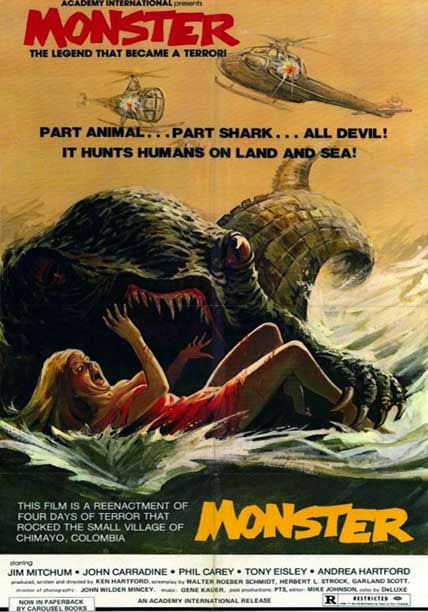
Horror On The Lens: Monstroid: It Came From The Lake (dir by Kenneth Hartford)


Monster_aka_-Monstroid,_It_Came_from_the_Lake-_poster_1980

Today, we have a little indie film from 1980.  This film was released under several names, including Monster.  However, I prefer the title under which it has been included in several Mill Creek box sets: Monstroid: It Came From The Lake!

Monstroid tells the story of what happens when a monster emerges from a lake and starts killing people in Columbia.  Superstitious villagers blame a local woman whom they believe to be a witch.  Even though the town priest (and no horror fan should be surprised to discover that the priest is played by John Carradine) claims that he can exorcise the evil spirits that have possessed her, the villagers would rather burn her at the stake.  Meanwhile, the local Big Evil Corporation has sent in Travis (James Mitchum) to take care of the monster!

And what a monster!  Listen, there’s a lot of negative things that I could say about this low-budget film but the monster is simply adorable and must be seen by anyone who appreciates the rubber monsters that populated horror films in the days before CGI.

Plus, how can you resist a film that features not only Robert Mitchum’s son but John Carradine as well?

Enjoy Monstroid: It Came From The Lake!

https://www.youtube.com/watch?v=S7fJtMG8Kn8

Horror on the Lens: Dracula vs. Frankenstein (dir by Al Adamson)


Zandor Vorkov is Dracula!

John Blood is Frankenstein’s monster!

Together … THEY SOLVE CRIMES!

No, actually, they don’t.  If anything, they cause crimes to happen.

First released in 1971 and directed by Al Adamson, Dracula vs. Frankenstein may not be a good film but it’s definitely an unforgettable film.  Yes, it may be thoroughly inept but it’s also perhaps the strangest take on the Dracula/Frankenstein rivalry that you’ll ever see.

Plus, it’s one of the final films of Lon Chaney, Jr.  Unfortunately, Lon doesn’t exactly look his best in Dracula vs Frankenstein...

Speaking of slumming celebrities, long before he played Dr. Jacoby and inspired America to shout, “Dig yourself out of the shit!,” Russ Tamblyn played a biker named Rico in this movie.

Also, like every other exploitation film made in 1971, Dracula vs. Frankenstein features hippies, leading to the age old question: who needs the supernatural when you’ve got LSD-crazed hippies running around?

Another age old question: Is Dracula vs. Frankenstein merely inept or is it a classic of bad filmmaking?

Watch below and decide for yourself.

Enjoy!

Horror On The Lens: Monstroid: It Came From The Lake (dir by Kenneth Hartford)


Monster_aka_-Monstroid,_It_Came_from_the_Lake-_poster_1980

Hi there and welcome to October!  This is our favorite time of the year here at the Shattered Lens because October is horror month.  For the past three years, we have celebrated every October by reviewing and showing some of our favorite horror movies, shows, books, and music.  That’s a tradition that I’m looking forward to helping to continue this year.

So, let’s start things off with a little indie film from 1980.  This film was released under several names, including Monster.  However, I prefer the title under which it has been included in several Mill Creek box sets: Monstroid: It Came From The Lake!

Monstroid tells the story of what happens when a monster emerges from a lake and starts killing people in Columbia.  Superstitious villagers blame a local woman whom they believe to be a witch.  Even though the town priest (and no horror fan should be surprised to discover that the priest is played by John Carradine) claims that he can exorcise the evil spirits that have possessed her, the villagers would rather burn her at the stake.  Meanwhile, the local Big Evil Corporation has sent in Travis (James Mitchum) to take care of the monster!

And what a monster!  Listen, there’s a lot of negative things that I could say about this low-budget film but the monster is simply adorable and must be seen by anyone who appreciates the rubber monsters that populated horror films in the days before CGI.

Plus, how can you resist a film that features not only Robert Mitchum’s son but John Carradine as well?

Enjoy Monstroid: It Came From The Lake!

Happy October!

Embracing the Melodrama #18: The Naked Kiss (dir by Sam Fuller)


The Naked Kiss

When I first decided to do this series on embracing the melodrama, I knew that I would have to include at least one film from Sam Fuller.  A former war hero and tabloid journalist, Sam Fuller made films that felt like a punch in the face to everything that he considered to be hypocritical about American society.  Fuller’s films may have been B-movies and they certainly were unapologetic about being melodramas but, at the same time, they were — at the time of their release — some of the only films willing to deal with controversial subject matter.  While the rest of American filmmakers embraced safety, Fuller could always be counted on to be dangerous.

For instance, at a time when most films were celebrating “good girls” and punishing the bad ones with unplanned pregnancies and bad reputations, Fuller directed a film in which the heroine was a former prostitute and the main villains came from every corner of respectable society.  That film was 1964’s The Naked Kiss.

The Naked Kiss opens with a scene as striking and as memorable as one of the tabloid headlines that Fuller would have cranked out back in his days as a journalist.  Kelly (Constance Towers), a prostitute, attacks her pimp with her purse (with the camera often standing in for the pimp’s point-of-view so, for a good deal of the scene, Kelly appears to be striking those of us in the audience).  During the struggle, Kelly’s wig is knocked from her head, revealing her to be bald.

Fleeing from her pimp, Kelly ends up in the town of Grantville, where her first customer turns out to be Griff (Anthony Eisley), the chief of police.  Once they’ve completed their business, Griff informs Kelly that it might be a better idea for her to find a more permissive town in which to set up operations.  However, Kelly has decided that Grantville would be the perfect place for her to escape from her past and start a new life.

Despite Griff’s continued attempts to get her to leave town, Kelly finds a job working, with handicapped children, in a pediatric ward.  Full of empathy for children who have been just as abused as she has, Kelly proves herself to be an excellent nurse.  She is also soon dating the most powerful and popular man in town, J.L. Grant (Michael Dante).  Grant, at first, seems to be the perfect man and Kelly soon falls in love with him.  Even after she reveals the truth about her past, Grant says that he wants to marry her.

However, things change when Kelly drops by Grant’s mansion one day and discovers Grant on the verge of molesting a little girl.  (Making the scene all the more disturbing is the children’s song that plays in the background through almost the entire scene.)  Grant explains that he’s a deviant, just like her.  Kelly’s reaction forces both her and the citizens of Grantville to confront the truth about who they really are.

Though The Naked Kiss is often overshadowed by Fuller’s Shock Corridor (which was released the year before), The Naked Kiss is actually the better film of the two.   Along with Fuller’s lively direction and Constance Towers’ strong performance as Kelly, The Naked Kiss is also distinguished by Stanley Cortez’s atmospheric black-and-white cinematography.  The scenes in which Kelly sings with the children and then discovers Grant with his potential victim could both be textbook examples of how to properly stage a scene.  This unapologetically tawdry film is also an undeniably great one and you can watch it below!