Horror Film Review: The Pit and the Pendulum (dir by Roger Corman)


The second of Roger Corman’s Edgar Allan Poe adaptations, 1961’s The Pit and The Pendulum opens in much the same way as The Fall of the House of Usher.  A young Englishman (played by John Kerr) rides a horse across a colorful but desolate landscape.  A castle sits in the distance.

Of course, as opposed to  the 19th Century British setting of The Fall of the House of Usher, The Pit and the Pendulum takes place in 16th Century Spain, at a time when the country was still scarred by the horrors of the Inquisition.  And Francis Barnard is not traveling to the castle to see his fiancée but instead, he’s searching for information about the disappearance of his sister, Elizabeth (played by the one and only, Barbara Steele).  At the castle, Francis meets Elizabeth’s husband, Nicholas (Vincent Price) and Nicholas’s sister, Catherine (Luana Anders).  Nicholas explains that Elizabeth died under mysterious circumstances, while suffering from a rare blood disorder that seemed to quickly sap away her will to live.  Nicholas’s best friend, Dr. Leon (Anthony Carbone), explains that Elizabeth died of fright after she locked herself in one of the iron maidens in the castle’s torture chamber….

Oh yes, the castle has a torture chamber.  Nicholas’s father was a leader of the Inquisition and he used the castle as a place to conduct his business.  Nicholas’s father was a madman who suspected that his wife was cheating on him.  One day, while young Nicholas was exploring the torture chamber, he witnessed his father murder both his wife and his brother.  Nicholas watched as his mother was entombed alive and ever since, he’s been terrified of the idea of premature burial.  In fact, his fear that he may have buried alive Elizabeth while she was still alive is driving him mad.  The sudden arrival of the suspicious Francis doesn’t help matters….

The Pit and the Pendulum opens with splashes of color spreading across the screen, a sign that Corman was once again in a pop art state of mind when he directed this film.  The Pit and The Pendulum takes everything that worked (and didn’t work) about The Fall of the House of Usher and it turns it all up by a notch or two.  The castle is even more gothic.  Vincent Price’s Nicholas is even more mentally fragile than his Roderick Usher, though Nicholas is also a quite a bit more sympathetic.  If Roderick was a control freak who used his family’s curse as an excuse to embrace his own authoritarian tendencies, Nicholas is just a frail man suffering from PTSD.  He’s definitely more of a victim than a victimizer … or, at least, he is at first.  Much like Mark Damon is The Fall of the House of the Usher, John Kerr is a bit of a stiff in the role of Francis but it doesn’t matter.  Vincent Price is the main attraction here and Corman’s direction shows that he understood that.

And then there’s the Pendulum.  It takes a while for the Pendulum and its swinging blade to make an appearance but when it does, it lives up to the hype.  The Pendulum swings and Corman goes all out, zooming into Price’s crazed eyes while the Pendulum comes closer and closer to its latest victim.  The images are tinted red and green and the Pendulum itself seems to swing in a slow motion, the cinematic equivalent of a nightmare come to life.

The Pit and the Pendulum is a wonderful work of gothic pop art.  Featuring Vincent Price at his most wonderfully unhinged, this is a film we should all watch this Halloween.
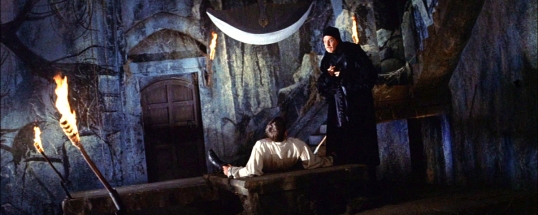
Pit and the Pendulum (1961, dir by Roger Corman, DP: Floyd Crosby)
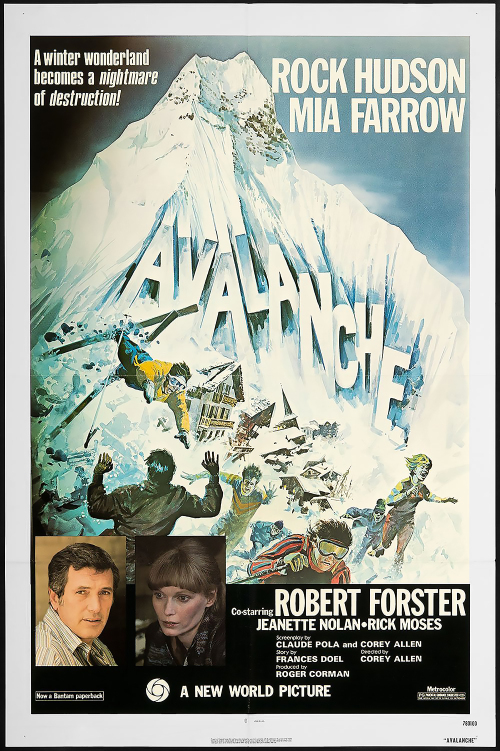
 

Film Review: Avalanche (dir by Corey Allen)


The 1978 film Avalanche tells the story of a beautiful resort that’s been built in the mountains of Colorado.  Self-righteous photographer and activist Nick Thorne (Robert Forster) keeps insisting that it’s not environmentally safe to build a resort up in the mountains.  According to him, there’s too much snow building up and it’s inevitably going to lead to an avalanche.

The owner of the resort, David Shelby (Rock Hudson), insists that Nick doesn’t know what he’s talking about.  Sure, David may have had to cut a few ethical corners to get his resort built and he may currently be under criminal investigation but that doesn’t make David a bad guy.  All he wants is to have a nice and expensive resort located in the most beautiful and dangerous place on Earth.  Does that make him a bad guy?

Unfortunately, if David was watching the film with the rest of us, he would be aware of all the shots of snow ominously building up on the side of the mountain.  However, David would still probably be distracted by the presence of his ex-wife, Caroline (Mia Farrow).  David would love to get back together with Caroline but Caroline finds herself growing attracted to Nick.  When David isn’t chasing after Caroline, he’s trying to keep his mother, Florence (Jeanette Nolan), from drinking all of the liquor in the resort.  Good luck with that!  Florence is an eccentric old person in a disaster film so, of course, she’s going to be drunk off her ass for the majority of the run time.

There are other dramas occurring at the resort, of course.  TV personality Mark Elliott (Barry Primus) is upset because his ex, Tina (Cathey Paine), is hooking up with arrogant skier Bruce Scott (Rick Moses).  Bruce is upset because Tina expects him not to cheat on her.  Ice skater Cathy Jordan (Pat Egan) is hoping to conquer her insecurities.  Rival ice skater Annette River (Peggy Browne) is …. well, she’s there.  To be honest, I’m not really sure what the whole point of the ice skating rivalry was since they all end getting buried in snow regardless.  Then again, maybe that is the point.  An avalanche doesn’t care about your personal dramas.  All it cares about is destroying tacky resorts that overuse wood paneling.

Yes, the avalanche does come crashing down the mountain eventually.  It takes a while, though.  There’s almost an hour of Rock Hudson walking around with a pained look on his face before the snow finally comes crashing down.  For all of Nick’s talk about how the avalanche would probably be the result of too many people skiing, it actually happens because someone crashes a plane into one of the mountains.

Obviously, the avalanche is the main reason why anyone would want to watch a movie called Avalanche.  Anyone with any knowledge of the disaster genre knows that no one watches these movies for the human drama.  They watch them because they want to see at least 10 minutes of solid destruction.  A disaster movie can get away with almost anything as long as the disaster itself looks good.

The disaster in Avalanche does not look particularly good.  This film was directed by Roger Corman and, despite being one of the most expensive films that Corman ever produced, the avalanche effects are definitely a bit cut-rate.  At the same time, the cheapness of the special effects does provide the film with its own odd charm.  Just consider the scene where one of the ice skaters gets covered in snow while spinning around with a triumphant smile on her face.  (Sure, she might be dead and she’ll certainly never make it to the Olympics but at least she finally mastered a fairly basic skating move.)  The avalanche effects are super imposed over the image of the skater spinning but it’s obvious that it didn’t occur to anyone to tell the skater, “Hey, act like there’s a gigantic amount of snow crashing down on you!”  It’s so inept as to be charming, like when a child draws a really ugly picture but it’s cute because at least they tried and, as a result, you wait until the child leaves your house before you throw it away.

The thing I love about Avalanche is how everyone is even more ineffectual after the avalanche than they were before it.  Usually, in a movie like this, the disaster leads to unexpected heroism and the villains getting the comeuppance.  In this one, the avalanche just inspires more stupidity.  Fire trucks and ambulances literally collide with each other while heading for the resort.  At one point, a group of fireman set up a net directly underneath someone falling out of a ski ramp chair just for the person to somehow land a few inches to the left of them.  Though the film sets David Shelby up to be the villain, it’s hard not to feel that everyone at the resort is just an idiot.

Listen, I love Avalanche.  It’s terrible but it’s a lot of fun and the less-than special effects go along perfectly with the overheated (or, in some cases, underheated) performances.  Rock Hudson wanders through the movie with a strained smile on his face that has to be seen to be believed while Mia Farrow and Robert Forster both try so hard to make their underwritten characters credible that you can’t help but kind of appreciate their devotion to a lost cause.  If nothing else, the shots extras reacting to superimposed shots of the avalanche makes this film worth a look.  This is a cheap and silly movie and if you don’t enjoy it, I don’t know what’s wrong with you.

Halloween Havoc!: A BUCKET OF BLOOD (AIP 1959)


gary loggins's avatarcracked rear viewer

buckb11

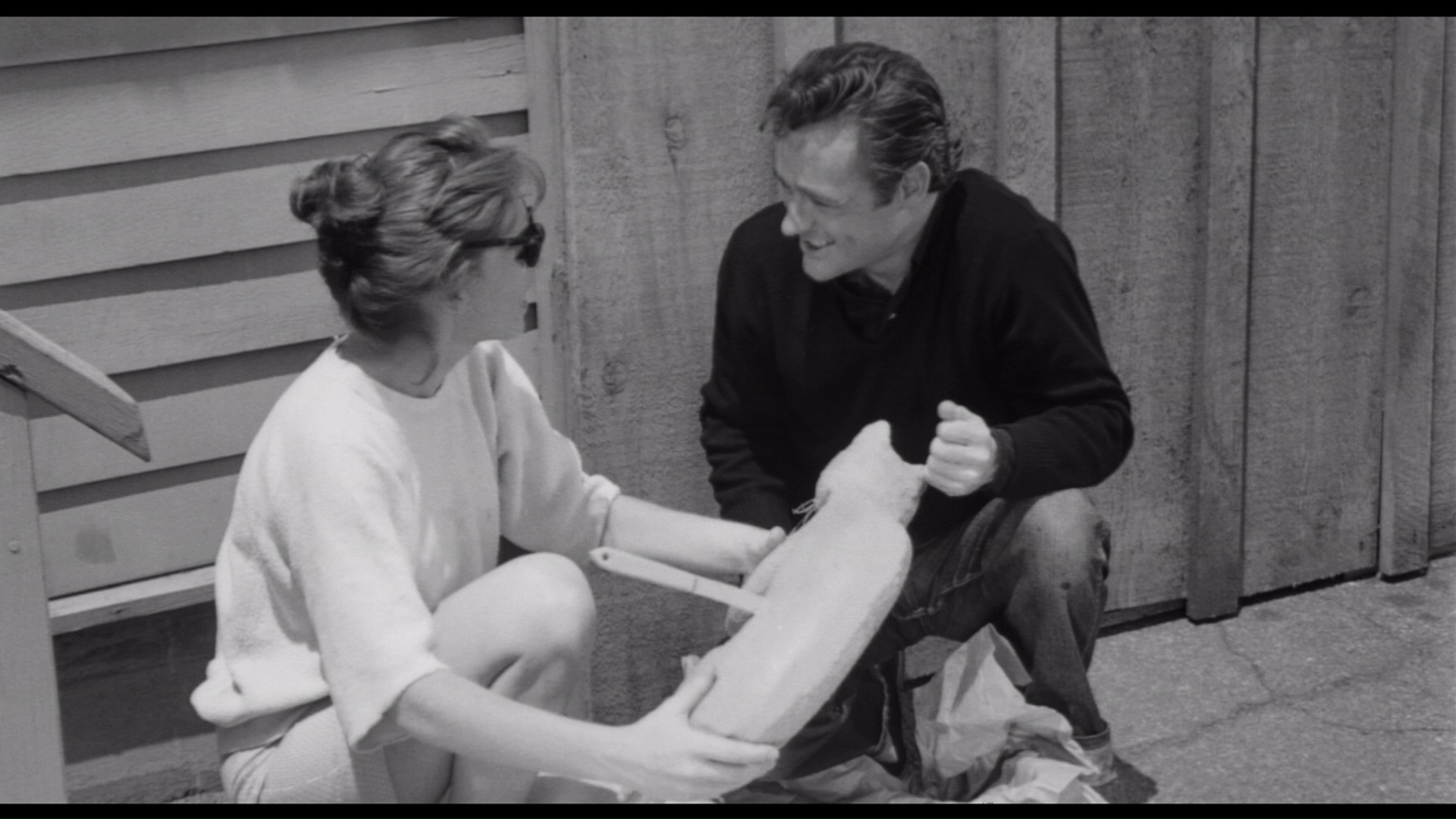
We can’t have Halloween without a good Roger Corman movie, and A BUCKET OF BLOOD is one of my favorites. This 1959 black comedy is a precursor to Corman’s THE LITTLE SHOP OF HORRORS, and I actually prefer it over that little gem. A BUCKET OF BLOOD skewers the pretentiousness of the art world, the 50’s beatnik scene, and the horror genre itself with its story of nerdy Walter Paisley, a busboy at a hipster coffee house learns making it as a famous artist can be murder!

buckb2

Walter’s a no-talent nebbish longing to be accepted by the pompous clientele at The Yellow Door, especially beautiful hostess Carla. When he accidentally kills the landlady’s cat, Walter covers it in clay (with the knife still protruding in poor little Frankie!), and brings it in to work. The grotesque sculpture causes a stir among the patrons, and Walter is congratulated for his brilliant work ‘Dead Cat’. Beatnik…

View original post 558 more words