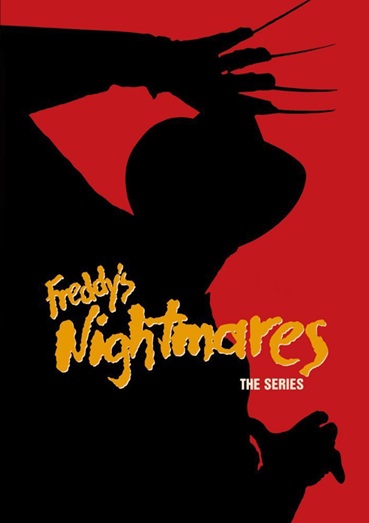
Welcome to Late Night Retro Television Reviews, a feature where we review some of our favorite and least favorite shows of the past! On Fridays, I will be reviewing Freddy’s Nightmares, a horror anthology show which ran in syndication from 1988 to 1990. The entire series can be found on Tubi!
This week, two more people fall victim to Springwood, Ohio.
Episode 2.2 “Heartbreak Hotel”
(Dir by William Malone, originally aired on October 15th, 1989)
“Learn to use the proper pronouns …. OR DIE!” Freddy shouts at us this week and he has a point.
When tabloid reporter Roger Dittano (John Stinson) is sent to Springwood to write a story about an Elvis sighting at a local hotel, he discovers that everything he writes comes true. He writes about a woman having a demon child and, a few minutes later, a pregnant maid goes into labor and gives birth to a deformed stillborn baby. Roger writes about a man being electrocuted in a bathtub and, shortly afterwards, he’s nearly electrocuted while taking a bath.
When Roger discovers that a newspaper publisher (played by Stacy Keach, Sr., father of the better-known Stacy Keach) is staying at the hotel, he comes up with the following story. “Newspaper publisher leaves empire to reporter after he drinks poison.” Hey, Roger — who drank the poison!? The reporter or the newspaper publisher? As you can guess, Roger’s vague wording leading to him drinking arsenic and dying as the publisher laughs and says, “Oh, and I’m leaving my empire to you!”
That was actually a pretty clever story. For once, the show actually did the work to set up the twist. Roger spends the entire episode being told that he’s a sloppy writer. In the end, that sloppiness kills him.
The second story also has a twist but it’s nowhere near as interesting. An amnesiac named Jerry (Richard Cox) wakes up in a hospital after a car accident. A woman (Anne Lockhart) claims to be the Jerry’s wife. A teenage girl (Tammy Ames) claims to be Jerry’s daughter. Jerry goes home with both of them and is soon haunted by nightmares in which he sees himself killing a man. You can probably guess that Jerry is not married and he does not have a daughter. This story had a lot of noir atmosphere — right down to a saxophone wailing away on the soundtrack — but it was also pretty predictable.
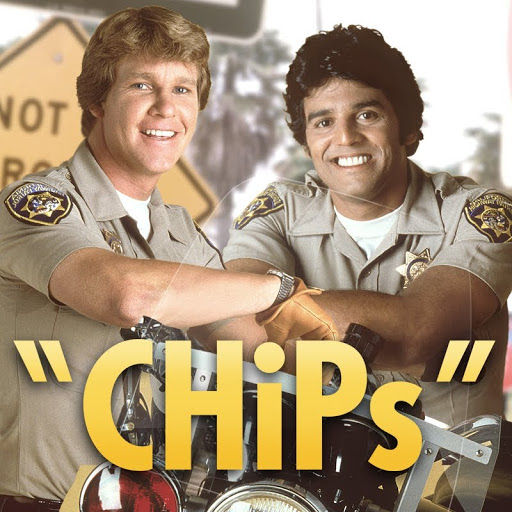
Welcome to Late Night Retro Television Reviews, a feature where we review some of our favorite and least favorite shows of the past! On Mondays, I will be reviewing CHiPs, which ran on NBC from 1977 to 1983. The entire show is currently streaming on Prime!
Sorry, last night’s review of CHiPs was pre-empted by my own need to get some rest after spending the previous few days dealing with the worst sinus pain ever. (Well, maybe not ever but it was still pretty bad….) Here’s last night’s episode of CHiPs, just a few hours late! Regularly scheduled programming will resume soon.
Episode 3.17 “Return of the Supercycle”
(Dir by Bruce Kessler, originally aired on October 27th, 1979)
The Supercycle is back! A thief on a supercharged motorcycle is robbing jewelry storefronts. Baker takes the old Highway Patrol Supercycle out of storage so that he can go after the new Supercycle. Baker suspects that the Roy Yarnell (George O’Hanlon, Jr) might be up to his old Supercycle tricks again but it turns out that Roy is innocent. Instead, it’s his mechanic.
In other words: SUPERCYCLE SUPERCYCLE SUPERCYCLE!
Ponch spends the majority of this episode in a hospital bed. Early on in the episode, Ponch crashes his motorcycle while chasing the new Supercycle and seriously injures himself. Apparently, the crash was real and Estrada actually did injure himself. Watching the episode, it’s easy to see that the show dealt with Estrada’s injuries by just giving all of Ponch’s lines to Baker. For once, Baker is the one who bends the rules and gets to do all the cool stuff. He even gets to romance a visiting member of the Highway Patrol, Kathy Mulligan (Anne Lockhart). In any other episode, Ponch would have been the one doing all of that so it’s interesting to get to see Baker actually get to have a life for once. And yes, before anyone asks, Estrada finds an excuse to remove his shirt even when he’s relaxing in a hospital bed. No hospital gowns for Estrada!
The sad thing is that Larry Wilcox was definitely a better actor than Erik Estrada and he also looked a lot more believable on a motorcycle. But, this episode shows that Estrada just had more screen presence. As easy as it is to make fun of Ponch, Estrada’s over-the-top displays of vanity were often just what CHiPs needed. Estrada may not have been a great actor but he amusing to watch. Wilcox has a much more laid back presence. He’s a believable cop but he’s just not as much fun to watch as Estrada.
Probably the most amusing thing about this episode is that, when Estrada (or his stuntman pretending to be Estrada) is lying on the pavement, Wilcox cannot bring himself to really act convincingly concerned or worried. CHiPs is a bit infamous for the fact that Larry Wilcox and Erik Estrada did not have a great working relationship. That’s all I could think about as I watched Baker casually step over Ponch’s prone form on the street.
Anyway, this episode has some spectacular motorcycle jumps and some good chase footage. There was an occasionally amusing subplot where the men of the Highway Patrol worried that Kathy was reporting their behavior to Sacramento. (Grossman, played by the invaluable Paul Linke, made me laugh with his sudden emphasis on doing everything by the book.) The Supercycle was cool. Everyone should have one.
The 1986 film, Troll, opens with Harry Potter moving into a San Francisco townhouse.
Okay, it’s not that Harry Potter. Troll was produced long before the first Harry Potter book was even published so it’s fair to assume that it’s just a coincidence that this film — about trolls, magic, and faeries — just happens to feature not just one but two characters named Harry Potter. Harry Potter, Sr. (Michael Moriarty) is a typical, dorky father figure. Indeed, he’s such a conventional figure that it’s a bit hard to understand why the always neurotic Michael Moriarty was cast in the role. Harry’s son is named Harry Potter, Jr. (Noah Hathaway). Harry, Jr. is a teenager who is shocked by how bratty his little sister, Wendy (Jenny Beck), becomes after the family moves into their new apartment.
Why is Wendy acting like such a brat? It’s because Wendy has been kidnapped by Torok the Troll (Phil Fondacaro), a grotesque creature who not only abducts Wendy but also steals her appearance so that he can safely move around the world of the humans. Torok, himself, was once a powerful wizard but, centuries ago, he and an army of faeries tried to destroy all the humans in the world. Their plan didn’t work and, as punishment, Torok was turned into a troll.
But now, somehow, Torok is free and he’s taking over the apartment building. One by one, he tracks down each tenant and casts a spell which turns them into a mythological creature, like a gnome or a wood nymph. All of the apartments turns into lushly overgrown forests. Among those tenants that get transformed are Sonny Bono and a young Julia Louis-Dreyfus. I have a feeling that, when Sonny later ran for Congress, he did not include his appearance in Troll in any of his campaign literature. As for Louis-Dreyfus, she was reportedly angered once when a talk show host (I think it was Jay Leno) showed footage from this film while interviewing her. It’s not so much that Julia Louis-Dreyfus isn’t a convincing wood nymph as much as it’s the fact that she’s Julie Louis-Dreyfus and it’s just difficult to imagine her appearing in such a stupid role. This, of course, was her first film and everyone has to start somewhere.
Anyway, realizing that he has to rescue his little sister, Harry Potter, Jr. gets some help from the local witch, Eunice St. Clair (Joan Lockhart). Eunice gives Harry a magic spear to take with him in his quest. It’s not really that much of quest, however. Troll is a low-budget film that was produced by Albert Band so this is not the film to watch if you’re expecting some sort of elaborate fantasy epic.
One positive thing that I will say for Troll is that some of the troll makeup is effective. The plot maks absolutely zero sense but Director John Carl Buechler specialized in creating memorable monsters on a budget and he manages to do that with Troll. And, despite all of the people getting turned into monsters, Troll is a largely good-natured film. It’s not a deliberately cruel or even gory film. It’s a dumb little horror/fantasy film that features Sonny Bono turning into a plant and Julie Louis-Dreyfus turning into a wood nymph. It’s dumb but it’s mild and generally inoffensive.
Finally, I should also note that it is in no way connected to Troll 2. Troll 2, after all, is about goblins.
The 1983 film, 10 to Midnight, opens with LAPD detective Leo Kessler (played by legendary tough guy Charles Bronson) sitting at his desk in a police station. He’s typing up a report and taking his time about it. A reporter who is in search of a story starts to bother Leo.
“Jerry,” Leo tells him, “I’m not a nice person. I’m a mean, selfish son-of-a-bitch. I know you want a story but I want a killer and what I want comes first.”
It’s a classic opening, even if Leo isn’t being totally honest. Yes, he can be a little bit selfish but he’s really not as mean as he pretends to be. He may not know how to talk to his daughter Laurie (Lisa Eilbacher) but he is also very protective of her and he wants to be a better father than he’s been in the past. He may roll his eyes when he discovers that Detective Paul McAnn (Andrew Stevens) is the son of a sociology professor but he still tries to act as a mentor to his younger partner. Leo may complain that the criminal justice system “protects those maggots like they’re an endangered species” but that’s just because he’s seen some truly disturbing things during his time on the force and, let’s face it, Leo has a point. When one of Laurie’s friends is murdered, Leo is convinced that Warren Stacy (Gene Davis) is the murderer and he’s determined to do whatever he has to do to get Warren off the streets. “All those girls,” Leo snarls when he sees Warren, his tone letting us know that his mission to stop Warren is about more than just doing his job.
Warren Stacy is handsome, athletic, and he has good taste in movies. (He’s especially a fan of Butch Cassidy and the Sundance Kid. Just don’t try to trick him by saying Steve McQueen played the Sundance Kid.) Warren is also a total creep, the type of guy who complains that a murder victim “wasn’t a good person,” because she trashed him in her diary. When Leo takes a look around Warren’s apartment, he finds not only porn but also a penis pump. (“It’s for jacking off!” Leo yells at Warren, enunciating the line as only Charles Bronson could.) Warren is also a murderer but he’s a clever murderer, the type who sets himself up with an alibi by acting obnoxiously in a movie theater. Warren strips nude before killing his victims, in order to make sure that he doesn’t leave behind any evidence. (This film was made in the days before DNA testing.)
Leo knows that Warren is guilty but, as both his gruff-but-fair captain (Wilford Brimley, naturally) and the D.A. (Robert F. Lyons) point out, he has no way to prove it. When Warren starts to stalk Laurie and her friends (including Kelly Preston), Leo decides that he has no choice but to frame Warren. But when Warren’s amoral attorney, Dave Dante (Geoffrey Lewis, giving a wonderfully sleazy performance), threatens to call McAnn to the stand, McAnn has to decide whether to tell the truth or to join Leo in framing a guilty man.
10 to Midnight is a violent, vulgar, and undoubtedly exploitive film, one that features a ham-fisted message about how the justice system is more concerned with protecting the rights of the accused as opposed to lives of the innocent. And yet, in its gloriously pulpy way, this is also one of Bronson’s best films. It’s certainly my personal favorite of the films that he made for Cannon.
Director J. Lee Thompson and Charles Bronson were frequent collaborators and Thompson obviously knew how to get the best out of the notoriously reserved actor. Bronson was not known for his tremendous range but he still gives one of his strongest performances in 10 to Midnight, playing Leo as being not just a determined cop but also as an aging man who is confused by the way the world is changing around him. Stopping Warren isn’t just about justice. It’s also about fighting back against the the type of world that would create a Warren Stacy and then allow him to remain on the streets in the first place. Interestingly, though Leo doesn’t hesitate when it comes to framing Warren, he is also sympathetic to McAnn’s objections. Unlike other Bronson characters, Leo doesn’t hold a grudge when his partner questions his methods. Instead, he simply know that McAnn hasn’t spent enough time in the real world to understand what’s at stake. McAnn hasn’t given into cynicism. He hasn’t decided that the best way to deal with his job is to be a “mean son of a bitch.” Bronson and Andrew Stevens, who had worked together in the past, have a believable dynamic. McAnn looks up to Leo but is also conflicted by his actions. Leo may be annoyed by McAnn’s reluctance but he also respects him for trying to be an honest cop. Their partnership feels real in a way that sets 10 to Midnight apart from so many other films about an older cop having to deal with an idealistic partner.
One of the most interesting things about the film is Leo’s relationship with his daughter, Laurie. Over the course of the film, Leo and Laurie go from barely speaking to bonding over liquor and their shared regrets about the state of the justice system. When McAnn first meets Laurie, she’s offended when McAnn suggests that she takes after her father. But, as the film progresses, she comes to realize that she and Leo have much in common. (To be honest, I related quite a bit to Laurie, especially as I’ve recently come to better appreciate how much of my own independent nature was inherited from my father.) Lisa Eilbacher and Charles Bronson are believable as father-and-daughter and they play off of each other well. The scenes between Laurie and Leo give 10 to Midnight a bit more depth than one might otherwise expect from a Bronson Cannon film. Leo isn’t just trying to protect his daughter and her roommates from a serial killer. He’s also trying to be the father who he wishes he had been when she was younger. He’s trying to make up for lost time, even as he also tries to keep Warren Stacy away from his family.
As played by Gene Davis, Warren Stacy is one of the most loathsome cinematic villains of all time. Warren’s crimes are disturbing enough. (Indeed, the surreal sight of a naked and blood-covered Warren Stacy stalking through a dark apartment is pure nightmare fuel.) What makes Warren particularly frightening is that we’ve all had to deal with a Warren Stacy at some point in our life. He’s the sarcastic and easily offended incel who thought he was entitled to a phone number or a date or perhaps even more. As I rewatched this movie last night, I wondered how many Warrens I had met in my life. How many potential serial killers have any of us unknowingly had to deal with? Warren tries to strut through life, smirking and going out of his way to let everyone know that he knows more than they do but the minute that Leo turns the table on him, Warren starts whining about he’s being treated unfairly. During his final, disturbing rampage, Warren yells that his victims aren’t being honest with him, blaming them for his actions. The film deserves a lot of credit for not turning Warren into some sort of diabolical and erudite supervillain. He’s not Hannibal Lecter. Instead, like all real-life serial killers, he’s a loser who is looking for power over those to whom he feels inferior and for revenge on a world that he feels owes him something. He’s a realistic monster and that makes him all the more frightening and the film all the more powerful. Warren is the type of killer who, even as I sit here typing this, could be walking down anyone’s street. He’s such a complete monster that it’s undeniably cathartic whenever Leo goes after him.
How delusional is Warren Stacy? He’s delusional enough to actually taunt Charles Bronson! At one point, Warren informs Leo that he can’t be punished for being sick. Warren announces that, when he’s arrested, he might go away for a while but he’ll be back and there’s nothing Leo can do about it. (The suggestion, of course, is that Warren will be back because he committed his crimes in California and all the judges were appointed by a bunch of bleeding heart governors. Warren may not say that out loud but we all know that is the film’s subtext. Some people may agree with the film, some people may disagree. Myself, I’m against the death penalty because I think it’s a prime example of government overreach but I still cheered the first time that I heard Clint Eastwood say, “Well, I’m all torn up about his rights,” in Dirty Harry.) How does Leo react to Warren’s taunts? I can’t spoil the film’s best moment but I can tell you that 10 to Midnight features one of Bronson’s greatest (and, after what we’ve just seen Warren do, most emotionally satisfying) one-lines.
The title has nothing to do with anything that happens in the film. In typical Cannon fashion, the film’s producers came up with a snappy title (and 10 to Midnight is a good one) and then slapped it onto a script that was previously called Bloody Sunday. Fortunately, as long as Bronson is doing what he does best, it doesn’t matter if the title makes sense. And make no mistake. 10 to Midnight is Bronson at his best.
Welcome to Retro Television Reviews, a feature where we review some of our favorite and least favorite shows of the past! On Sundays, I will be reviewing the made-for-television movies that used to be a primetime mainstay. Today’s film is 1985’s Gidget’s Summer Reunion! It can be viewed on Tubi!
Back in the 1970s, when the rest of the country was worrying about political corruption, inflation, and an out-of-touch president with an embarrassing family, Gidget, Jeff, and their friends were carefree California teenagers who spent all of their time either hanging out on the beach or running into the ocean with a surfboard. It was a time when they had not a care in the world and, obviously, it couldn’t last forever.
Nearly 10 years later, Gidget (Caryn Richman) and Jeff (Dean Butler) are now married and their surfboards have been safely stored away in the garage. Jeff works as an architect and it’s obvious that his new boss, Anne (Mary Frann), wants to make their professional relationship into something personal. Gidget, meanwhile, owns her own travel agency and, apparently, it’s a success even though Gidget rarely seems to spend much time at the office. Gidget is hyperactive and a bit self-absorbed and, as such, she usually only shows up at work long enough to tell her employees about her latest problems before then running out of the office in an impulsive attempt to fix everything.
What problems do Gidget and Jeff have? Well, for one thing, they live in a giant house despite the fact that they’re nearly broke. They’re both workaholics and, as a result, they don’t spend as much time together as they used to. They got married and then they became strangers. It’s been years since they last went down to the beach. When Gidget’s niece, Kim (Allison Barron), wants to learn how to surf, it doesn’t even occur to her to ask her aunt or her uncle. Instead, she ends up hanging out with a sleazy, beer-drinking surfer named Mickey (Vincent Van Patten).
Fear not! Gidget has a plan! Jeff’s birthday is coming up and Gidget decides that it would be a great idea to use her travel agent powers to get the entire gang back together again. She wants to bring all of the old surfers back to help celebrate Jeff’s big day. The only problem is that the old gang isn’t entirely easy to find. Plus, one of Gidget’s tour guides has to drop out of leading a tour in Hawaii. Gidget is forced to go in his place. Can she get back from Hawaii in time to save Jeff from Anne and Kim from Mickey? And even more importantly, will she ever be able to track down the old gang? Will the movie end with a bunch of balding guys surfing while the Beach Boys play on the soundtrack? Can you guess the answer?
The best thing that can be said about Gidget’s Summer Reunion is that the beach looked nice and the Hawaii scenes reminded me of the wonderful summer that my family and I spent in Hawaii. And the film is correct when it points out that adulthood is never as easy as we expected it to be when we were teenagers. However, the film suffers from the fact that a lot of Gidget’s problems could have been solved by Gidget actually taking a few minutes to think before acting. It’s one thing to be free-spirited and impulsive. It’s another thing to totally lack common sense. For instance, Gidget and Jeff’s old surfboards are stolen out of the back of Gidget’s convertible and, while you can certainly feel bad for Gidget’s loss, you do have to wonder what she was expecting when she basically just left them out in the open, where anyone could get their hands on them. Jeff isn’t off the hook either, as it was pretty much obvious to everyone but him that Anne was trying to get him to cheat on his wife. Gidget and Jeff are a cute couple but they don’t seem to have a brain cell between them.


 Through the Shattered Lens