Horror Film Review: Teenage Monster (dir by Jacques R. Marquette)


The 1958 film Teenage Monster opens in the late 1800s.  Gold prospector Jim Cannon (Jim McCullough) has got a nice little home with his wife, Ruth (Anne Gwynne) and their young son, Charlie.  One day, Jim and Charlie are out looking for gold when a meteor falls from the sky and crashes right in front of them.  Jim is killed, which I guess is an occupational hazard for anyone who works outside.

(Seriously, you never know when a meteor might crash on top of you.  There might be one about to slam into your home right this minute.  Read quickly.)

Charlie survives the meteor crash but he’s still bathed in radiation.  Ruth takes Charlie home and she keeps him locked up in a back room for his own safety.  Seven years pass and Charlie (Gilbert Perkins) is now a teenager.  Unfortunately, he’s a very old-looking teenager.  Standing nearly seven feet tall, he has long hair and a full beard and he can’t really speak beyond a few grunts.  Occasionally, Charlie manages to get out of the back room and Ruth has to look for him.  She understands that the 19th Century is no place for a radioactive mutant boy.

When Ruth discovers gold, she’s able to buy a house in town.  Unfortunately, living in town means that Charlie notices a young woman named Kathy North (Gloria Castillo).  Smitten with her, Charlie kills her jerk of a boyfriend and decides to bring her home.  Ruth pays Kathy to keep silent about Charlie but it turns out that Kathy has other plans.  Realizing that Charlie is in love with her and will do anything that she commands, she tells him to start killing people around town.

Teenage Monster may seem like an odd title for a western about a boy who gets mutated by a radioactive space rock.  Charlie is technically a teenager but he looks like he’s nearly 60.  The film uses the radiation as an excuse for Charlie’s rapid aging and his grown spurt.  Randomly blaming everything on radiation is one thing that B-movies of the 50s and the 60s definitely all had in common.  I suppose if space radiation could have brought the dead back to life in Night of the Living Dead, it could have also transformed Charlie into a teenage monster.  As far as B-movies were concerned, J. Robert Oppenheimer had a lot to answer for.  Of course, if this movie were made today, Charlie’s transformation would have somehow been due to climate change.

As for the film itself, it’s short and that’s definitely a good thing.  The idea of combining B-horror and the old west is an intriguing one but the movie doesn’t really do that much with it.  Yes, there are gunmen and deputies but they could have just as easily been modern-era outlaws and lawmen without really changing much about the film.  Director Jacques Marquette was a former cinematographer who went into directing so it’s a bit odd that the film has a flat, rather bland look to it.  On the plus side, Anne Gwynne gives a better performance than the material deserved.

Keep your kids away from radiation, everyone.  Other than cheap, clean energy and countless advances in medicine and science, nothing good ever seems to come from it.

Horror Film Review: Black Friday (dir by Arthur Lubin)


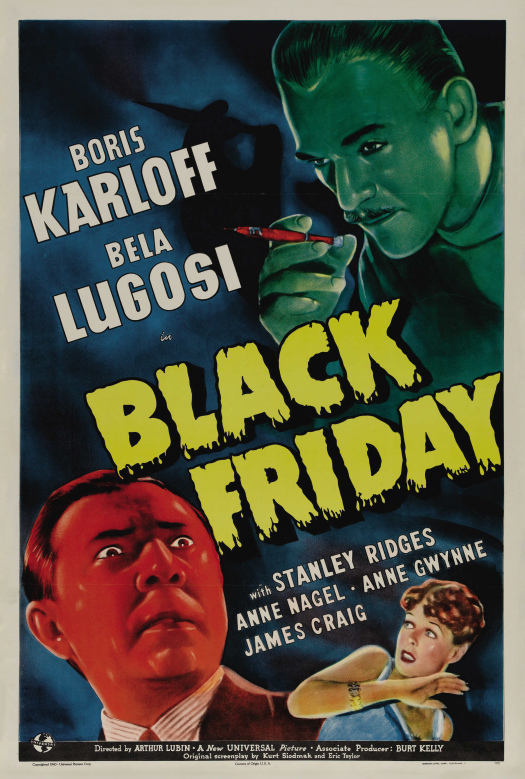
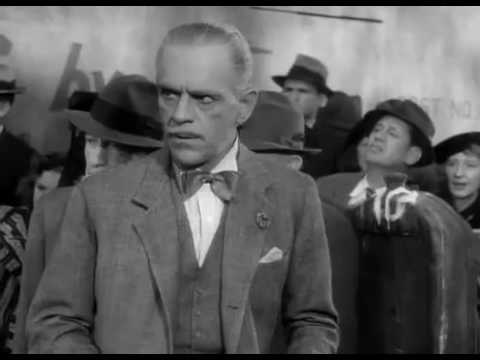
The 1940 film, Black Friday, opens with Dr. Ernest Sovac (Boris Karloff), a once-respected scientist, being led out of his cell on Death Row and being taken to the electric chair.  As he enters the death chamber, he hands one of the gathered reporters his journal.  Dr. Sovac says that he wants the reporter to know the true story of how he came to be on Death Row.  While the police strap Dr. Sovac into the electric chair, the reporter reads the journal.

It’s flashback time!

Months earlier, Dr. Sovac’s best friend, an befuddled English professor named George Kingsley (Stanley Ridges), is nearly fatally injured when he has the misfortune to get caught in the middle of an attempt to assassinate a gangster.  In order to save George’s life, Sovac performs a brain transplant, giving George part of the gangster’s brain.  George does recover but now he’s got the gangster inside of his head, trying to take control.  Much like Dr. Jekyll, George continually switches identities and becomes a viscous hoodlum who is looking for revenge against those who betrayed him, including gang boss Eric Marnay (Bela Lugosi).

Dr. Sovac, however, is more concerned with the fact that, before he died, the gangster apparently hid a good deal of money somewhere.  Sovac wants that money for himself so that he can build his own laboratory and hopefully help other people with otherwise incurable brain conditions.  Sovac tells himself that, once he gets his hands on the money, he can find a way to rid George of his evil alternative personality.  But until George finds the money, Sovac is content to allow George to continue turning into a murderous gangster.  Things, however, come to a head when George starts to threaten Sovac’s daughter (Anne Gwynne).

Black Friday is yet another Universal Horror Film featuring Boris Karloff was a mad scientist.  What makes Dr. Sovac a compelling character is that he starts out with the best of intentions.  He just wants to save the life of his best friend and Sovac’s desperation is increased by the fact that George himself was just an innocent bystander when he was injured.  Later, when Sovac starts searching for the gangster’s money, his intentions are again not necessarily bad.  He sincerely wants to do some good with that money and he uses those good intentions to justify allowing George to do some very bad things.  In the end, Sovac becomes so obsessed with being able to fund his laboratory that he loses sight of the price that both he and George are having to pay.  Karloff does a great job of playing Sovac, showing how a kind man manages to lose track of his morals until it is too late.  Stanley Ridges is also well-cast as George and does an excellent job of switching back and forth from being a befuddled professor to a ruthless gangster.  There’s an excellent scene in which George, attempting to teach his class, suddenly hallucinates that all of his students have become gangsters.  Ridges does a great job playing it.

Reportedly, the film was originally conceived with Karloff playing George and Bela Lugosi playing the role of Dr. Savoc.  However, Karloff said that he would rather play Savoc and, as such, Lugosi lost a role for which he probably would have been very well-cast.  Since Lugosi was a bit too naturally sinister for the role of George, he instead had to settle for a small role as a gang leader.  Lugosi, it should be said, is a convincing gangster but it’s still hard not to be disappointed that, in this film, he and Karloff don’t share any scenes together.

Previous Universal Horror Reviews:

  1. Dracula (1931)
  2. Dracula (Spanish Language Version) (1931)
  3. Frankenstein (1931)
  4. Island of Lost Souls (1932)
  5. The Mummy (1932)
  6. The Invisible Man (1933)
  7. The Bride of Frankenstein (1935)
  8. Dracula’s Daughter (1936)
  9. Son of Frankenstein (1939)
  10. The Invisible Man Returns (1940)
  11. The Wolf Man (1941)
  12. Ghost of Frankenstein (1942)
  13. Invisible Agent (1942)
  14. Frankenstein Meets The Wolf Man (1943)
  15. Son of Dracula (1943)
  16. House of Frankenstein (1944)
  17. The Invisible Man’s Revenge (1944)
  18. House of Dracula (1945) 
  19. Creature From The Black Lagoon (1954)

Horror Film Review: House of Frankenstein (dir by Erle C. Kenton)


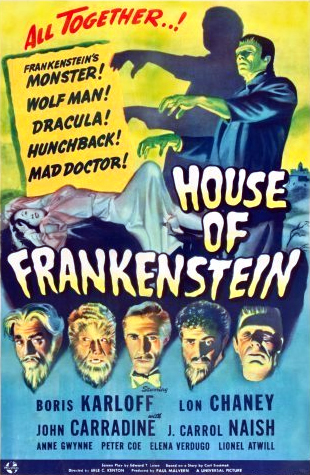
House of Frankenstein opens in a prison.  Dr. Gustav Neimann (Boris Karloff), the bother of one of Baron Frankenstein’s assistants, has been convicted of robbing graves and attempting to carry on the Baron’s work.  Dr. Neimann’s faithful assistant is the hunchback, Daniel (J. Carroll Naish).  Daniel is loyal to Neimann because Neimann has promised to someday place Daniel’s brain in a stronger body.

When a sudden earthquake allows Neimann and Daniel to escape, they waste no time in getting revenge on Neimann’s enemies.  First, they murder a traveling showman named Prof. Lampini (George Zucco) and steal both his identity and his mobile horror exhibit.  Included in the exhibit is a coffin that Lampini claimed held the skeleton of Dracula.  (There’s even a stake sticking out of the skeleton’s chest.)  When Neimann returns to his original hometown, he removes the stake from the skeleton so that he might use it on the Burgomaster, Hussman (Sig Ruman).  The skeleton transforms into Dracula (John Carradine).  Because he is relieved to have been brought back to life, Dracula does not attack Neimann but instead agrees to help Neimann get revenge on Hussman in return for Neimann looking after his coffin.  Dracula soon learns that he should have thought twice before trusting either Neimann or Daniel.

Neimann moves on, stopping off at Frankenstein’s village and recovering the bodies of both Frankenstein’s Monster (Glenn Strange) and Larry Talbot (Lon Chaney, Jr.) from the frozen chamber in which they were trapped at the end of Frankenstein Meets The Wolf Man.  Revived from suspended animation, Larry immediately starts whining about how much his life sucks.  (I love The Wolf Man but subsequent films turned Larry into the whiniest of the Universal monsters.)  Neimann promises to put Larry’s brain in a new body if he helps to revive the Monster.  Larry agrees.  Meanwhile, Daniel falls in love with a gypsy girl named Ilonka (Elena Verdugo) while Ilonka falls in love with Larry.  Daniel wants Neimann to put his brain in Larry’s body, Larry won’t stop whining about the approaching full moon, and the villagers are getting suspicious!

House of Frankenstein has never been a favorite of critics or horror historians and the film does have its share of flaws.  For instance, though it would have been fun to see Bela Lugosi return to his signature role, John Carradine seems like ideal casting for Dracula.  Unfortunately, Dracula is only in the film for about ten minutes and he comes to an end that really doesn’t feel worthy of a character of his stature.  The film reduces Larry Talbot to just being a dumb lug who won’t stop feeling sorry for himself.  Finally, Glenn Strange has the right physique for the Monster but, much as with John Carradine, he is underused.

That said, I still enjoyed House of Frankenstein.  A lot of that is because of Boris Karloff, who brings a lot of sly humor to his performance as the mad scientist.  (That said, Karloff himself later said that he did the role solely for the money and was bored with the whole thing.)  J. Carroll Naish turns Daniel into a rather sympathetic henchman, one who is so desperate to be “normal” that he’s willfully blinded himself to the fact that Neiman really doesn’t care about anyone other than himself.  (In many ways, he’s the equivalent of the hapless characters that Michael Ripper later played for Hammer Films.)  Finally, Elena Verdugo brings a lot of life to the stock role of the dancing gypsy girl who falls in love with Larry Talbot despite the fact that Larry is kind of a dumb lug.

For a modern viewer, the main appeal of House of Frankenstein is that it is one of the original Universal horror films, even if it came out long after the first Dracula and Frankenstein films.  As such, it has all the things that we associate with and love about those films.  There’s a ruined castle.  There’s angry villagers.  The cast is full of Universal horror mainstays, including Lionel Atwell and Anne Gwynne.  And, yes, the film features a mob descending on the castle with torches.  Flaws and all, House of Frankenstein is an enjoyable time capsule.  It’s a horror film from a far more innocent age and it’s one that remains a fun watch.

Previous Universal Horror Reviews:

  1. Dracula (1931)
  2. Dracula (Spanish Language Version) (1931)
  3. Frankenstein (1931)
  4. Island of Lost Souls (1932)
  5. The Mummy (1932)
  6. The Invisible Man (1933)
  7. The Bride of Frankenstein (1935)
  8. Dracula’s Daughter (1936)
  9. Son of Frankenstein (1939)
  10. The Wolf Man (1941)
  11. Ghost of Frankenstein (1942)
  12. Frankenstein Meets The Wolf Man (1943)
  13. Son of Dracula (1943)
  14. Creature From The Black Lagoon (1954)

Halloween Havoc!: BLACK FRIDAY (Universal 1940)


gary loggins's avatarcracked rear viewer

The Twin Titans of Terror, Boris Karloff and Bela Lugosi, reteamed for their fifth film together in 1940’s BLACK FRIDAY. Horror fans must’ve been salivating at the chance to see the duo reunited after the success of the previous year’s SON OF FRANKENSTEIN, but left the theaters let down upon discovering Boris and Bela share no scenes together, and the bulk of the action is carried by character actor Stanley Ridges in a dual role.

The movie’s a variation on the old Jekyll & Hyde theme, with a twist: instead of a secret formula, the change occurs via brain transplantation! The preposterous premise finds Karloff on death row as Dr. Ernst Sovac, walking that last mile to his fate in the electric chair. Sovac hands his notes and records to a sympathetic newspaper reporter, and our film begins in earnest. Flashbacks relate the tale of kindly old English literature Professor…

View original post 415 more words