Retro Television Review: Highway to Heaven 3.3 “For The Love Of Larry”


Welcome to Late Night Retro Television Reviews, a feature where we review some of our favorite and least favorite shows of the past!  On Thursdays, I will be reviewing Highway to Heaven, which aired on NBC from 1984 to 1989.  The entire show is currently streaming on Freevee and several other services!
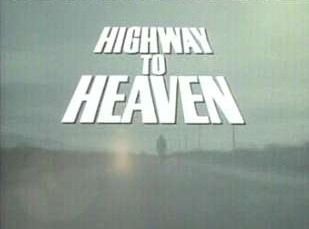
This episode features a very good boy.

Episode 3.3 “For the Love of Larry”

(Dir by Michael Landon, originally aired on October 8th, 1986)

At the start of this episode, we find Jonathan and Mark on a dangerous assignment.  They’re in the city and apparently, they’re working as undercover cops and trying to catch a local drug dealer.  At least, I assume that the people working with Jonathan and Mark were supposed to be cops.  None of them were in uniform so I guess they have just as easily been a neighborhood vigilante group.  As Jonathan and Mark prepare to confront the dealer, Jonathan says that the scourge of drugs is the greatest threat that American will ever face.

It’s a heavy assignment but it doesn’t really seem like a Highway to Heaven sort of assignment.  Usually, Mark and Jonathan are specifically assigned to help someone.  This time, though, it appears that they’ve just been assigned to help the cops do their job.  Jonathan and Mark don’t really do anything that any other cop couldn’t have done.  Mark gets excited when the dealer tries to shoot him because he’s convinced that God is causing the bullets to miss him.  Only after the dealer is captured does Jonathan reveal that God didn’t do Mark any favors.  Mark just got lucky.

Mark’s earned a break!  He and Jonathan drive off to another one of those small towns that always seem to show up on this show.  They rent a cabin for a few days.  However, Mark’s attempts at relaxation are continually interrupted by a dog.  First, the dog runs in front of the car.  Then, the dog somehow shows up at the cabin.  Even though Mark took the dog to a shelter, the dog somehow managed to get out and track Mark down.

Eventually, Mark and Jonathan figure out that they need to follow the dog.  The dog leads off the main road, to an overturned car that is hidden away in the woods.  A father and a son, both badly injured but still alive, are in the car.  Jonathan and Mark are able to rescue them but then they notice that the dog is in the back seat and was apparently killed in the crash.

The camera pans up to the sky and gets lost in the clouds.  Suddenly, the dog’s ghostly form appears and seems to actually wink at the audience, letting us know that the dog may have died but his spirit stayed on Earth long enough to rescue his owners.  (The Larry of the title is the son of the dog’s owner.)

Did this episode make me cry?  You better believe this episode made me cry!  I’m not even a dog person and I was still sobbing at the end of this episode. As I’ve mentioned before, there’s an earnest sincerity at the heart of this show that makes it effective even when it should be silly.  Having the dog appear in the clouds is the type of thing that a lot of shows probably would have screwed up.  In lesser hands, it would have been too heavy-handed and overly sentimental to work.  But, on this show, it does work.  It helps that the dog was cute.

This was a simple episode but sometimes, it’s the simple episodes that work the best.
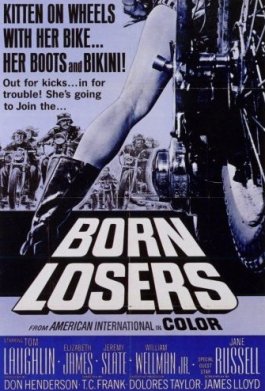
Shattered Politics #24: The Born Losers (dir by Tom Laughlin)


Born Losers

For the past few days, I’ve been in the process of reviewing 94 films about politics and politicians.  With that in mind, you may be wondering why, after reviewing films like The Last Hurrah, Sunrise at Campobello, and Advise & Consent, I am now reviewing a 1967 biker film called The Born Losers.

It all comes down to Billy Jack.  In the 70s, Tom Laughlin would write, direct, and star in two hit films — Billy Jack and The Trial of Billy Jack.  In these films, Laughlin played the title character.  Billy Jack was everything that you could hope for in a counter-culture hero.  First off, as an American Indian, he was an authentic American as opposed to just another European intruder.  He was a war hero, who had served as a Green Beret in Vietnam.  He often carried a gun with him, which meant that he understood and supported the 2nd Amendment and good for him!  Billy Jack was also a master of hapkido, which meant that he could kick ass in the most visually appealing way possible.

Even more importantly, Billy Jack called the Man out on his racism and his intolerance.  Billy Jack was an environmental activist before anyone else.  Billy Jack went on vision quests.  Billy Jack was anti-war.  Billy Jack was a pacifist.  And, of course, Billy Jack ended up killing a lot of people but they were all bad guys.

By making and distributing Billy Jack himself, Laughlin became an independent film pioneer and made history.  He also became a counter-culture hero and Billy Jack remains a cult figure even today.  But what a lot of people don’t realize is that Billy Jack first appeared in Born Losers and that, in the little seen Billy Jack Goes To Washington, he eventually ended up serving in the U.S. Senate.

When you consider that Billy Jack would eventually be Sen. Jack, that means the Born Losers isn’t just a low-budget, violent biker film.  Instead, it’s the exploitation version of Young Mr. Lincoln.  It’s a chance to see what Billy Jack was doing before he became a statesman.

(And rest assured, the other three Billy Jack films will be reviewed before Shattered Politics ends.)

As we discover at the start of Born Losers, pre-politics Billy Jack was just an enigmatic veteran who lived in the mountains of California.  When we first see Billy, he’s walking along a grassy hill.  A deer safely runs by the camera.  A rabbit pops its head out of a hole in the ground and looks relieved to see Billy.  If I’m being a little bit snarky, it’s because I’ve seen all of the Billy Jack films and I know how often this exact scene is played out over the course of the franchise.  But, in all fairness, it’s actually a fairly well-done and visually appealing scene and, as an actor, Laughlin had the presence to pull it off.

A far less pretty scene is occurring in the town of Big Rock, where teenagers are showing up to hang out on the beach and are being harassed by a group of bikers, the Born Losers of the title.  The Born Losers are an odd collection of bikers, with half of them looking like extras from Sons of Anarchy and the other half looking like the type of hipsters that I always see whenever I go to a movie at the Alamo Drafthouse.  Their leader (Jeremy Slate) is named Danny but the rest of the gang are known by their nicknames.

(For instance, there’s Crabs.  Why is he called Crabs?  “Because he’s got them!” Danny helpfully explains.)

After the Born Losers rape four girls, they launch a campaign of violence and intimidation to keep the girls from testifying in court.  Billy comes to the aid of one of the girls, Vicky (Elizabeth James, who also wrote the script).  I related to Vicky, largely because she does things like ride a motorcycle while wearing a white bikini, which is exactly the sort of thing that I would do if I lived in California.

Now, there’s a lot of negative things that I could say about Born Losers.  It’s talky.  With the exception of Laughlin and Slate, it’s obvious that the majority of the cast was made up of amateurs.  The final half of the film drags as you wait for an ending that you have probably already predicted.

But you know what?

I actually like The Born Losers.  Hidden underneath all of the exploitation trappings and heavy-handed moralizing, this is a very sincere film.  Whatever they may have lacked in budget or subtlety, Laughlin’s films made up for in sincerity.  And, as strange as it may be to say about a film that features four rapes and is padded out with a thoroughly gratuitous striptease, The Born Losers is not a misogynistic film.  Both Laughlin the director and Billy Jack the character are on the side of the victims of the Born Losers and when the film calls out society for blaming the victims instead of the rapists, it does so with a fury that elevates the entire film above your typical 1967 biker film.

And, while I don’t know if I’d ever vote for Billy Jack, there’s nobody I’d rather have on my side.