Musical Film Review: Heartbeat (dir by John Nicolella)


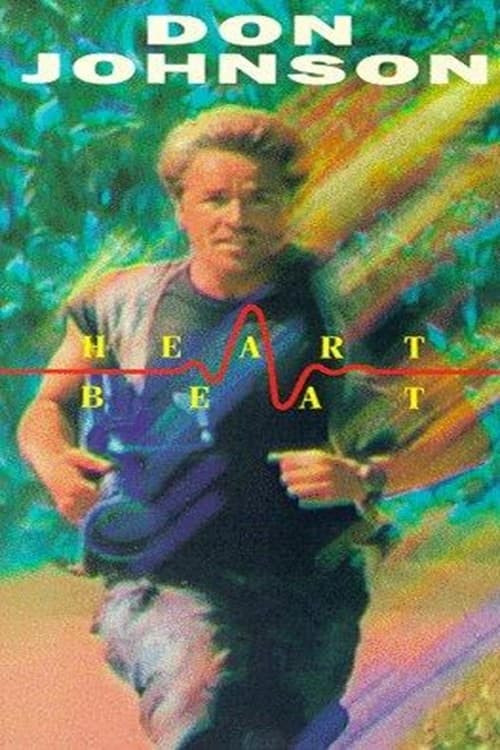
1987’s Heartbeat opens with Don Johnson in an unidentified Central American country.

Rebels are moving through the jungles.  Helicopters are flying over villages and firing off missiles.  In the middle of it all is Don Johnson, playing a character identified as being “The Documentary Filmmaker.”  Johnson carries a large movie camera with him, recording all of the violence and the carnage.  Is Johnson trying to expose the evils of the government?  Is he trying to expose the rebels?  Is he just an adrenaline junkie who can’t help but go to the most dangerous places in the world?  I have no idea and I’m not sure that the film does either.

A bomb explodes.  Johnson is thrown back.  Soon, Don Johnson is being carried into a dark room on a stretcher.  It appears that he might be dying but, even as his heartbeat is slowing down, his spirit is still hanging around and having flashbacks to the attack on the village, which we just saw less than a minute ago.  Eventually, Johnson’s spirit has other flashbacks.  He remembers talking to Paul Shaffer.  He remembers his strained marriage to an unnamed woman played by Lori Singer.  He remembers his youth as the son of a Las Vegas showgirl who is played by Sandahl Bergman.  (Bergman also played a showgirl in Bob Fosse’s All That Jazz and her scenes in this film often feel as if they’ve been directly lifted from Fosse’s classic film.)  David Carradine shows up as someone who might be Johnson’s father or who might just be some random guy rolling dice in the backroom of a strip club.  Johnson remembers his friendship with a graffiti artist (Giancarlo Esposito), who has a sister (Angela Alvarado) who was a prostitute.  The main message seems to be that the Documentary Filmmaker recorded the dangers of the world while also trying to remain emotionally detached, much like Robert Forster in Medium Cool.  Now that he’s dying, he’s left to wonder whether he made the right choice in refusing to get personally involved.

Oh, and did I mention that this film is basically a 65-minute music video?  Don Johnson sings through the entire movie, in a style that does its best to imitate the tough growl and soulful yearning of Southern rock and roll but which ultimately only serves to show that Johnson made the right decision in focusing on acting instead of singing?

After I came across this film on Lettrboxd and then watched it on YouTube, I did a bit of research (which is a fancy way of saying that I spent a minute reading a Wikipedia entry) and I discovered that, at the height of his Miami Vice success, Johnson released his debut country rock album, Heartbeat.  Heartbeat the film was something that Johnson made in order to promote Heartbeat the album.  Directed by frequent Miami Vice director John Nicollela, Heartbeat the film is so self-indulgent and determined to prove that Don Johnson is a soulful artist that it becomes oddly fascinating to watch.  Johnson’s Documentary Filmmaker is a bit of a cad but the film seems to argue that 1) it’s not really his fault because women find him to be irresistible, 2) it’s really his mom’s fault for getting a job, and 3) it ultimately doesn’t matter because the Filmmaker is a great artist whose work will live on even after he dies.  It’s a vanity film for a vanity album and it’s all so vain that it becomes hard to look away from.

In the end, both the music from the album and the promotional film leave one feeling that, in 1987, Don Johnson might have had an unreasonably high opinion of his musical abilities.  That said, as anyone who has seen Cold In July can tell you, Don Johnson eventually did become a very good actor.

Retro Television Review: Miami Vice 3.3 “Killshot”


Welcome to Retro Television Reviews, a feature where we review some of our favorite and least favorite shows of the past!  On Mondays, I will be reviewing Miami Vice, which ran on NBC from 1984 to 1989.  The entire show can be purchased on Prime!

This week, another friend of Crockett’s is in trouble!

Episode 3.3 “Killshot”

(Dir by Leon Ichaso, originally aired on October 10th, 1986)

Crockett and Tubbs are working undercover as Burnett and Cooper to take down drug lord Morales (Roger Pretto).  Morales is one of the most powerful drug lords in Miami but he’s still not connected enough to know that Burnett and Cooper are undercover cops.  I know that I bring this up nearly every time I write about this show but it just baffles me that Crockett and Tubbs are somehow still able to maintain their covers despite the fact that those covers have gotten blown in numerous episodes and Crockett makes no effort to act any differently when he’s pretending to be Burnett.  At least Tubbs uses his fake Jamaican accent whenever he’s pretending to be Cooper.  Crockett doesn’t even bother to change his suit before pretending to be Burnett.

That said, they’ve somehow managed to keep Morales from discovering that they’re cops.  So, Morales instead focuses on manipulating a customs agent, Frank Ariolla (Carlos Cestero).  Frank’s brother, Tico (Fernando Allende) is an up-and-coming jai alai player.  (That’s the sport, prominently featured in Miami Vice‘s opening credits, in which the players use a wicker to both catch and launch a ball.)  However, Tico also has a raging cocaine problem.  In fact, the drug often leaves him impotent.  When a prostitute suggests that Tico might not be attracted tp women, Tico goes crazy and blacks out.  When he wakes up, the prostitute appears to be dead and madam Isabel Batista (Maria Duval) says she’ll protect Tico for a price.  Frank has to work as a double agent or Isabel and Morales will send a tape of Tico attacking the prostitute to the police.

(For the record, the prostitute was only pretending to be dead as a part of a plot to frame Tico.  But then Isabel had her killed for real.)

Trying to protect his brother, Frank agrees to work for Morales.  But when a guilt-stricken Tico makes a mistake during a match that leads to him getting killed when he’s stuck in the head by the ja alai ball, will Crockett and Tubbs be able to stop Frank from taking his own violent vengeance on both Morales and Isabel?  As you probably already guessed, this is yet another Miami Vice episode the ends with a freeze frame and an off-screen gunshot as Crockett yells, “No!”

If there’s one thing that has stayed consistent over the first three seasons of Miami Vice, it’s that it does not pay to be a friend of Sonny’s.  From Jimmy Smits getting blown up in the pilot to Ira Stone dying last week to Frank throwing his life away to avenge his brother in this week’s episode, anyone who has ever been close to Crockett seems to end up having terrible luck.  I’m stunned that Tubbs has managed to survive for as long as he has.

As for this episode, Crockett and Tubbs both seemed to be sidelined in favor of the story of Frank and Tico.  It’s always weird when Crockett and Tubbs become supporting characters on their own show.  Carlos Cestero and Maria Duval both gave good performances, which is good because it helps to distract from the fact that Morales is a fairly dull villain and Tico is not a particularly compelling character.  For the most part, this episode works best as a commercial for ja alai, which looks a hundred times more exciting than most sports.  Certainly, its fast action and the constant danger of sudden death makes it the ideal sport for Miami.

Late Night Retro Television Reviews: Gun 1.6 “Father John”


Welcome to Late Night Retro Television Reviews, a feature where we review some of our favorite and least favorite shows of the past!  On Tuesdays, I will be reviewing Gun, an anthology series that ran on ABC for six week in 1997.  The entire show is currently streaming on Tubi!

Tonight, we finish up Gun!

Episode 1.6 “Father John”

(Dir by Jeremiah S. Chechik, originally aired on May 31st, 1997)

Father John, the final episode of Gun, is also one of its worse.  The only thing keeping it from being the absolute worst is that Robert Altman directed that episode that dealt with the country club presidency and then there was that episode with Daniel Stern as the guy having an elaborate Hollywood fantasy and, of course, there was last week’s episode with Kirsten Dunst…. actually, now that I think about it, of the six episodes of Gun that were produced, Father John is in the top 3 but only by default.

The episode stars Fred Ward as John Farragut, a newspaper columnist who is also a recovering alcoholic and who is always struggling to keep up with his alimony payments to his ex-wife, Joyce (Brooke Adams).  John doesn’t have much faith in the world but he has always worshiped his Uncle John, a priest for whom he was named.  When Uncle John dies, nephew John is shocked to discover that his uncle not only died with a lot of money hidden away in his room but that he also owned the pearl-handled gun that appears in every episode of this series.  What secrets were being hidden by Uncle John!?

Nephew John sets out to find out.  At first, he assumes that his Uncle must have been having an affair with a woman named Gloria (Angela Alvarado) but he then comes to learn that Gloria (whose real name is Gabriella) is a refugee who was rescued from a sex trafficking ring by his uncle.  Uncle John had the gun to protect Gabriella and now, it’s time for his nephew to continue to protect her.

It sounds pretty straight-forward and, to be honest, there really aren’t any unexpected twists in this episode.  That said, the episode itself is incredibly overwritten.  We not only get to watch as living John tries to solve a very simple mystery but, even worse, we have to listen to his narration as he tells us the details of what he’s doing.  Of course, we can already see what he’s doing so it all feels a bit redundant.  The narration itself is so hard-boiled that it feels almost like a parody of the detective genre and I found myself wondering why anyone would want to read anything written by a man whose narration is essentially a collection of clichés.  John Farragut is the type of guy who says, “If you sleep with dogs, you wake up with fleas,” as if he think he’s the first person to ever come up with it.  Surprisingly, Fred Ward is very much miscast as John Farragut.  With his weathered face and his weary tone, it’s hard to buy Ward as someone who 1) still hero-worships anyone and 2) would still be crying about having never met his father.  Farragut appears to be nearly 50 and he’s still whining about stuff that most people get over or have figured out by the time they graduate college.  Farragut’s actions often only make sense if you accept that idea that he is impossibly naïve about the world and that’s not the feeling one would ever get from a character played by Fred Ward.

With this episode, Gun ends on a boring note but, then again, it was never a particularly exciting series to begin with.  For all the notable actors who appeared in Gun, it’s hard to think of any stand-out episodes or performances.  If I had to rank the episodes, it would go something like this:

  1. Ricochet 
  2. Columbus Day
  3. Father John
  4. The Hole
  5. The Shot
  6. All The President’s Women

That’s not a very impressive list, to be honest.  Gun perhaps would have worked better if there had been some sort of continuity as far as the gun itself was concerned.  Perhaps the show would have worked if there had been a feeling of the gun following a natural journey from owner to owner.  Instead, it just randomly showed up in each story and sometimes, it was important and, far more often, it was just a prop.  The show certainly had nothing to say about American gun culture.  It was an uneven show.  The opening credits featured U2 covering Happiness Is Warm Gun and Bono’s overbaked interpretation of the lyrics felt appropriate for this show’s flashy but shallow style.

Next week, there will be a new show in this time slot.  What will it be?  Uhmmmm …. ask me next week.

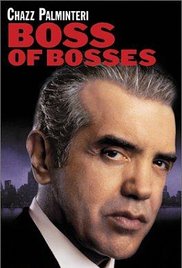
A Movie A Day #29: Boss of Bosses (2001, directed by Dwight H. Little)


bossWho was the boss of bosses?  According to this movie, he was Paul Castellano.  A cousin-by-marriage to the notorious crime boss Carlo Gambino, Castellano grew up in New York City and first became a made man in the 1930s.  After four decades of loyal service, Castellano succeeded Carlo as the boss of the Gambino Crime Family.  As portrayed in this movie, Castellano attempted to keep the Gambinos out of the drug trade and tried to steer both his biological and his crime family into legitimate businesses.  However, not everyone appreciated Castellano’s vision of the future and, in 1985, he was assassinated on the orders of his eventual successor, John Gotti.

Considering that this biopic was made for TNT and was directed by Dwight H. Little (who was best known for directing films like Halloween 4 and Free Willy 2), it’s probably not surprising that not a single mob cliché goes unturned in Boss of Bosses.  At first, I had a hard time accepting Chazz Palminteri as Castellano because Palminteri sounded exactly like Joe Mantegna voicing Fat Tony on The Simpsons.  Once I got over the vocal similarities, I saw that Palminteri was actually giving a very good, noncartoonish performance as Castellano but the film itself never convinces us that Castellano was anything more than a forgettable placeholder between the reigns of the legendary Gambino and the flamboyant Gotti.

Boss of Bosses, which is also known as Godfather of New York, is currently available on YouTube.