Chow Yun-Fat is the GOD OF GAMBLERS (1989)!


There aren’t that many times in your life when you watch a movie that completely catches you by surprise. My initial viewing of the GOD OF GAMBLERS circa 1997 is one of those times in my life. Up to that point I had only seen Chow Yun-Fat in the John Woo classics THE KILLER and HARD-BOILED, and I was beginning the process of trying to find and watch as many of his films as possible. When my Tai Seng VHS tape of GOD OF GAMBLERS arrived in the mail, I was very excited to pop it in the VCR and watch another badass Chow Yun-Fat classic! I wasn’t quite prepared for what I was about to see…

The film’s opening credits feature Ko Chun (Chow Yun-Fat), the world famous, mysterious “God of Gamblers” in Tokyo for a match with Ueyama, (Yasuhiro Shikamura), Japan’s top gambler. Ko Chun looks unbelievably cool in his dark suit and slicked back hair (Killer style), as he strolls into the casino, accompanied by the film’s rousing main theme, flanked by his beautiful girlfriend Janet (Sharla Cheung) and his personal assistant and friend, Ko Yee (Fong Lung). After being soundly defeated by Ko Chun, Ueyama asks the God of Gamblers to take on the dangerous Singaporean gambler Chan Kam-sing (Hon-Lam Pau), the Demon of Gamblers, in a high stakes poker match on his behalf. It seems the “demon” had beaten Ueyama’s father in a gambling match a few years earlier by cheating, ultimately driving the man to suicide. Ko Chun agrees to help Ueyama get his revenge. Knowing it could get dangerous, Ueyama assigns Dragon (Charles Heung), a former Vietnamese special forces soldier, to be Ko Chun’s bodyguard. The stage seems to be set for badass action and tricky gambling and then….

Walking home a night later after besting another group of duplicitous gamblers, Ko Chun falls into a booby trap that was set by Knife (Andy Lau) to screw around with his Indian neighbor who’s been getting on his nerves. Ko’s resulting fall and bump on the head causes him to have amnesia and revert to the mental level of a small child. Knife and his girlfriend Jane (Joey Wong), take him in and try to figure out who he is. The couple soon learns that the only thing that can calm him down and keep him from screaming is giving him his favorite chocolate treats. Knife, who’s obsessed with gambling, but is not very good at it, soon enlists “Chocolate,” his nickname for the stranger, to help him with some of his get-rich-quick, gambling schemes. Along the way, Knife discovers that Chocolate has amazing gambling skills even though he acts like a child. At first he tries to exploit him for his own purposes, but over time Knife begins to care about Chocolate and decides he will try to get him some help.

Will Chocolate get hit by a car, smash his head through the driver’s side window and turn back into Ko Chun? Will his friend Ko Yee, who’s always been jealous of Ko Chun’s success, align himself with Chan Kam-sing and murder Janet? Will Dragon turn out to be one badass bodyguard? Will Ko Chun / Chocolate grab two pistols and kill a group of assassins in slow motion? Will the God of Gamblers face off against the Demon of Gamblers in international waters and win? Will he remember Knife who has turned out to be a good friend to him?
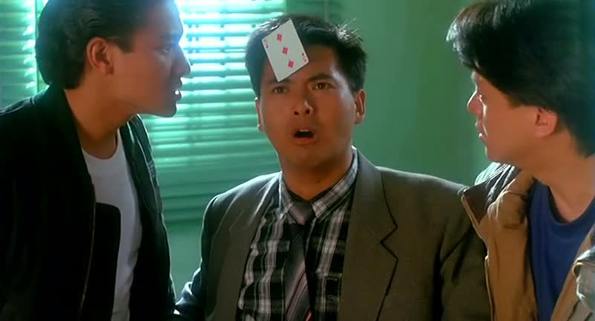
For the first 30 minutes of GOD OF GAMBLERS, I was getting the exact Chow Yun-Fat I was expecting with his unmatched charisma completely dominating the proceedings. And then he hits his head. When I first watched this film I had never seen Chow in a comedy so I wasn’t expecting how over the top he would go. Watching the “coolest actor in the world” scream uncontrollably and beg for chocolates was something I wasn’t emotionally prepared for at the time and I specifically remember that “WTF” feeling that came over me. I had also never seen a “Wong Jing film” so I didn’t understand the extreme changes in tone that the film would undergo, one of the trademarks of his films. One minute I’m watching a suave Chow Yun-Fat, the next minute I’m watching crude, goofy comedy with Andy Lau and Shing Fui-On, and a little later there’s a man raping a corpse. What I soon realized was that in the world of 1980’s Hong Kong cinema, the rules are much different than American films and you never know what you might see next. That unique nature of Hong Kong cinema hooked me completely and it became my obsession for the next several years with Chow Yun-Fat as my favorite leading man. GOD OF GAMBLERS gave me an entertaining film while opening up a whole new world of entertainment. 

GOD OF GAMBLERS was a huge box office hit and started a new craze in the Hong Kong film industry for gambling films. Stephen Chow, another huge star in Hong Kong, released the movie ALL FOR THE WINNER just a year later in 1990 where he would play the “Saint of Gamblers.” It would be an even bigger hit than GOD OF GAMBLERS. The Saint of Gamblers and the God of Gamblers’ protege Knife (Andy Lau) would join forces in Wong Jing’s proper sequel GOD OF GAMBLERS II (1990). Gong Li would even join the fun with Stephen Chow in GOD OF GAMBLERS III: BACK FROM SHANGHAI (1991). Chow Yun-Fat finally returned to the role of Ko Chun in 1994 in THE RETURN OF THE GOD OF GAMBLERS. While not as strong as the original, it was another crazy entry in the series and another huge box office smash. 

The last things I want to mention about GOD  OF GAMBLERS are its two main stars, Chow Yun-Fat and Andy Lau. Chow Yun-Fat is incredible in the role of Ko Chun / Chocolate. He’s so cool and he’s also genuinely funny. He’s so charming in the role and it’s no shock that Hong Kong audiences and critics were completely enamored by him. When this film was made in 1989, Chow had won the previous two years Hong Kong Film Awards (the Hong Kong Oscar) for best Actor for John Woo’s A BETTER TOMORROW (1986) and Ringo Lam’s CITY ON FIRE (1987), a film that would heavily influence Quentin Tarantino’s RESERVOIR DOGS (1992). Chow would get nominated twice for his 1989 movies GOD OF GAMBLERS and ALL ABOUT AH-LONG, winning the award for the latter. Dominating both the box office and awards shows, Chow Yun-Fat was the unquestioned greatest leading man in Hong Kong cinema at the time. Andy Lau is another huge star in the world of Hong Kong entertainment. A dual threat, Lau was not just a leading movie star in the industry, he was also one of its biggest pop stars, where he is known as one of the “Four Heavenly Kings of Cantopop.” To this day, Andy Lau is still a huge star in Hong Kong cinema. With that said, I’ve never thought that his character of Knife was one of his best. He’s a pretty selfish asshole for much of the film before having a change of heart near the end. He was so good in the following year’s A MOMENT OF ROMANCE (1990), as well as later films like RUNNING OUT OF TIME (1999) and INFERNAL AFFAIRS (2002). He’s incredibly talented, but his shallow character ultimately suffers in comparison to Chow Yun-Fat’s incredible performance in this film. 

If it’s not obvious, I highly recommend GOD OF GAMBLERS to any adventurous viewer who’s willing to simply follow the story wherever it goes. If nothing else, just sit back and enjoy Chow Yun-Fat in one of my favorite performances in Hong Kong cinema, or any other cinema for that matter.  
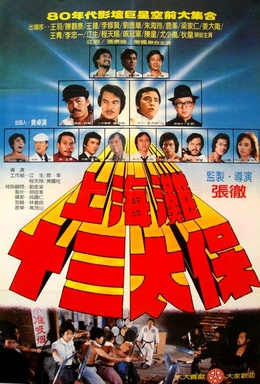
International Film Review: Shanghai 13 (dir by Chang Cheh)


A Hong Kong-Taiwanese co-production that was first released in 1984, Shanghai 13 takes place during the early days of World War II in Asia, when the conflict was primarily viewed as being between Japan and China.  With the help of a thief named Black Hat (Jimmy Wang Yu), a low-level but patriotic Shanghai bureaucrat named Mr. Gao (Chiang Ming) steals a report that details the collaboration between Japan and a puppet regime that has been installed in Northern China.  Mr. Gao hopes to take the documents to Hong Kong, where he will be able to safely publish them and reveal just how corrupt the Chinese collaborators are.  Needless to say, the collaborators would rather this not happen and they are determined to assassinate Mr. Gao before he boards the last boat to Hong Kong.

Fortunately, Mr. Gao is not alone.  The 13 Rascals have been called in to protect Mr. Gao.  Who are the 13 Rascals?  They are a collection of talented marital artists and they are all patriots, determined to reveal the truth about what is happening in Northern China.  The 13 Rascals are played by an ensemble of Hong Kong and Taiwanese film veterans.  One appears after another, each getting their chance to show off what they can do while defending Mr. Gao.  Many of the rascals lose their lives to protect Mr. Gao but that seems to be the point of the film.  No sacrifice is too much when its done to protect the honor of one’s country.

To really understand what’s going on with Shanghai 13, it probably helps to know a bit about not only the Second Sino-Japanese War and the subsequent chain of events that led to the Republic of China relocating its central government to Taiwan.  My knowledge of these events is pretty much Wikipedia-level and I’m not going to present myself as being an expert.  That said, it’s pretty obvious that Mr. Gao, who is forced to leave his home city by a corrupt and ruthless government, is meant to serve as a stand-in for both Taiwan and Hong Kong (or, at least, Hong Kong before it was transferred to Chinese control).  Just as the Rascals will sacrifice their lives to protect Mr. Gao, they would do the same for Taiwan and Hong Kong.  The implication, of course, is that the audience should do the same.

Fortunately, if international politics are not your thing, Shanghai 13 can also be enjoyed as just a non-stop action film.  Admittedly, the film does get off to a bit of a slow start.  (If you’ve ever wanted to see every little detail of how to crack a safe, this is the film for you.)  Once the fighting begins, it’s pretty much nonstop and more than a little bloody.  Faces are kicked.  Bones are shattered.  Clawed gloves are worn.  One man carries a killer fan and laughs whenever anyone tries to remove it from his hands.  The film is full of Hong Kong and Taiwanese stars, all of whom get their chance to show off their moves and the majority of whom also get a dramatic death scene.  One man gets impaled a pole and still announces that he would rather die with honor than surrender.  (And, needless to say, he drops dead shortly afterwards.)  There’s enough slow motion to keep any slo mo of doom enthusiast happy.  The final battle takes place in a ship yard and features combatants jumping on top of shipping crates.  It’s exciting and weird.

Throughout it all, Mr. Gao stands in the background and watches.  Mr. Gao is not a fighter and he can only watch while everyone else in the movie sacrifices their lives so that Mr. Gao can reveal the truth about China’s puppet regime.  If this was an American film, I’m sure that the last-standing hero would probably get angry with Mr. Gao, much as Snake Plissken did with the President in Escape From New York.  But in Shanghai 13, all that matters is that Mr. Gao is a patriot.  He’s a man trying to protect his nation from a corrupt government and, for that reason, 13 people are willing to risk their lives to protect him.  We could use more people like the 13 Rascals.

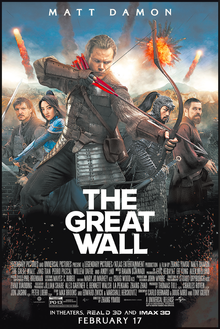
Playing Catch-Up: The Great Wall (dir by Zhang Yimou)


Remember The Great Wall?

The Great Wall came out in February.  Before it was released, I saw the trailer and I thought, “Well, that looks like it might be fun.”  However, I never actually saw the film when it was in theaters.  I think I was still recovering from Fifty Shades Darker when The Great Wall was released so I put off going to see it.  I thought to myself, “That’ll be around for a while.”  Of course, I was wrong.  The Great Wall played for two weeks and then it was gone.

That may not sound like a big deal when you consider the reviews that The Great Wall received.  If not for the fact that Fifty Shades Darker was released a week earlier, The Great Wall would have been the first critical disaster of 2017.  Seriously, the critics hated The Great Wall with a passion that took even me by surprise.  The comments went beyond the usual snarkiness to outright hatred.  Suddenly, The Great Wall — which, to judge from the trailer, looked like a harmless little monster movie — was being held up as an example of everything wrong with modern filmmaking.

The film was even attacked for starring Matt Damon.  As I said before, I thought the trailer looked like fun but, apparently, other critics watched that trailer and found themselves asking, “How dare Matt Damon appear in a movie that’s set in eleventh century China!?” And you know what?  I get it.  Whenever I’m watching a movie about aliens invading the 11th Century, my immediate concern is whether or not the film is historically accurate.  It’s bad enough that Americans are being taught that Matt Damon could survive on Mars.  Do they also have to be told that Matt Damon saved China from the space lizards!?

Even though I missed The Great Wall when it was playing in theaters, I knew that it was a film that I would see eventually.  Whenever a film gets totally slaughtered by the critics, I feel like I have almost a duty to watch the film and judge for myself.  Some of that’s because I don’t trust the majority of critics.  And some of it’s because, as a natural born contrarian, I’m always hopeful for any chance to go against the consensus.  Last month, I finally watched The Great Wall and you know what?

It’s not that bad.

Now, it should be understood that being not that bad doesn’t necessarily mean that The Great Wall is a good movie.   It’s a deeply silly movie and, occasionally, it’s also a profoundly dumb one.  Matt Damon plays a European mercenary who is sneaking around China, searching for gunpowder.  After he is captured by the Chinese and brought to the Great Wall, he is enlisted to help battle a bunch of space lizards.  Apparently, the space lizards attack the wall every 60 years but, this year, they’re arriving early.  Or something like that.  I really couldn’t follow the mythology of the space lizards and that’s probably for the best.  The Great Wall is not a film that demands or benefits from a good deal of deep thought.  This is one of those films where the best plan is to not ask too many questions because the answers probably won’t make any sense anyway.

As dumb as The Great Wall may be, it’s an undeniably entertaining movie.  Under the direction of Zhang Yimou, The Great Wall is a visual feast, full of epic landscapes and swooping cameras.  When a seemingly limitless number of space lizards appear out of nowhere and suddenly charge the wall, it’s impossible not to get caught up in the exciting silliness of it all.  When the Chinese army takes their positions on the Great Wall and prepare to repel the invasion, it doesn’t matter that none of the characters are particularly fleshed out.  Instead, you’re just overwhelmed by the vibrant colors of their armor and the determined fierceness of their expressions.  The Great Wall is shamelessly over the top and nicely self-aware.  This a movie that knows that it is ludicrous and occasionally incoherent and you know what?  The Great Wall is perfectly fine with that.

For all the criticism that he received for appearing in the movie, Matt Damon is ideally cast.  Whenever Damon is on screen, it’s as if he’s entered into a conspiracy with the viewer.  Matt Damon is one of the few actors who can maintain his balance while walking that thin line between drama and parody.  With every arched eyebrow and slightly sarcastic line reading, Damon is saying, “Sure, this is all kind of stupid.  But aren’t we having fun?”

When The Great Wall eventually shows up on the SyFy channel, it’s going to be fun movie to live tweet.  Some films were just meant to be watched and appreciated with a group of your snarkiest friends.  The Great Wall is one such film.