In Body Chemistry III, Jim Wynorski and Andrew Stevens take over the venerable franchise and things quickly get meta.
Alan Clay (Andrew Stevens, who also produced) is a TV director who wants to make serious films about the environment but his producer, Bob (Robert Forster), is only interested in exploitation films. His wife, soap opera star Beth Chaney (Morgan Fairchild). wants Alan to direct her in a great role but Alan tells her, “I’m not a creative artist, Beth! I’m a TV director who specializes in women-in-jepordy thrillers!” That should make Alan the perfect choice to make a movie about Claire Archer.
Having gotten away with murdering both of her two previous lovers and her boss at the radio station, Dr. Claire Archer (Shari Shattuck, replacing Lisa Pescia) is now hosting her own TV talk show, Looking At You With Claire Archer. She has also written a best-selling textbook called Sex and Violence and Vice Versa. Her former colleague, Freddie (Chick Venerra, taking over the role played by Dave Kagen in the first film), has quit the sex research game is now a screenwriter. He wants to write a script about Claire but he can not convince her to sign over the rights to her story. Maybe a night with Alan can change her mind.
Claire’s soon up to her old tricks. Alan wants to break it off with her, Freddie is figuring out that Claire is a murderer, and Beth wants to play her in the movie.
Featuring no one from either of the two original Body Chemistry films (even when Freddie sees a picture of Big Chuck from Part 2, an anonymous extra has replaced Morton Downey, Jr) and shot in Jim Wynorski’s signature “drop your top,” straight-to-video style, Body Chemistry 3 is a deliberate parody of the genre. It’s easy to recognize Robert Forster’s Bob as being a stand-in for Body Chemistry‘s executive producer, Roger Corman while Freddie is the most obnoxious screenwriter since the one Tim Robbins killed in The Player. All of that makes Part 3 more interesting than the first two Body Chemistry films. If the sultry Lisa Pescia had returned to play Dr. Archer, it might even be a classic. Shari Shattuck gives a game performance but lacks the demented intensity that Pescia brought to the role.
For tomorrow’s movie a day, Wynorski and Stevens return but Shannon Tweed takes over the role of Claire Archer in Body Chemistry 4: Full Exposure.
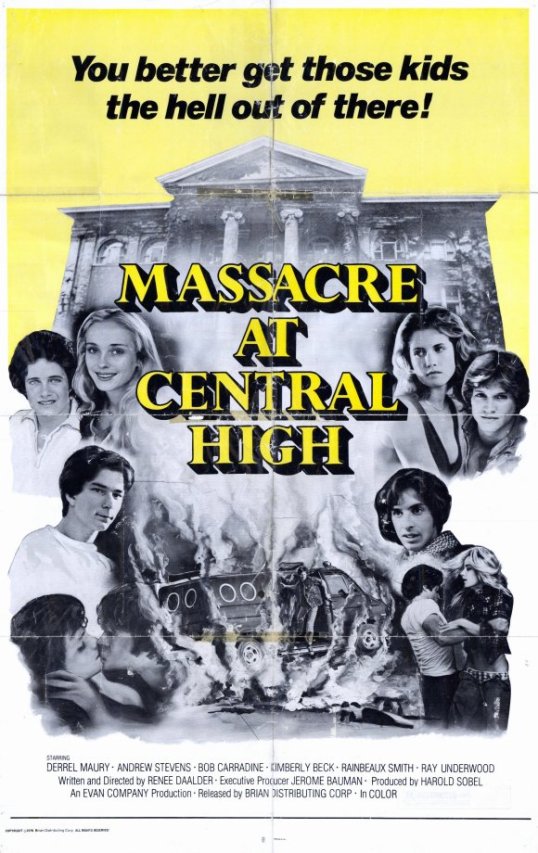
With a title like Massacre at Central High, you probably think that this 1976 film is a low-budget slasher film. However, you’re totally wrong. Instead of being a low-budget slasher film, Massacre at Central High is a low-budget political allegory and it’s a pretty good one at that. It’s also not exactly an easy film to see (I had to watch it off of a scratchy, old VHS tape), which is unfortunate because it’s probably one of the best exploitation films of the 1970s.
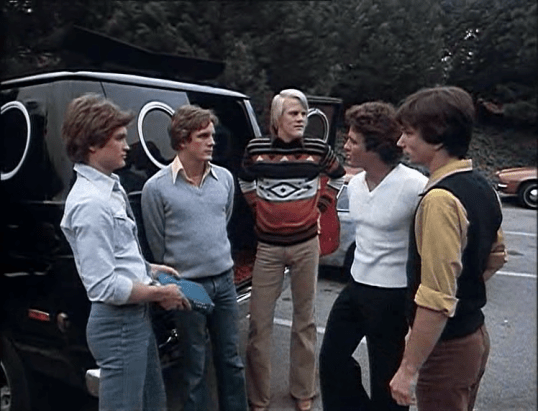
Massacre at Central High takes place at a high school in Southern California. The first thing that you notice about Central High is that there aren’t any adults around. The students don’t ever appear to go to class. Instead, they spend their time roaming the halls. The school is run by four wealthy jocks who enforce order, repress independent thought, and spend most of their time hanging out in an exclusive lounge. Of the four ruling jocks, Mark (Andrew Stevens) is the most sensitive, an overall nice guy who doesn’t approve of the excesses of the others but, at the same time, isn’t willing to stand up to them either.
The Ruling Clique
As for the other students, they spend their time being alternatively harassed and cared for by the jocks. They’re told, of course, that everything is for their own good and that their survival depends on the survival of Central High. Spoony (Robert Carradine) is caught and punished for spraying political graffiti on the lockers. Oscar (Jeffrey Winner) is regularly bullied by the jocks on account of his weight. School librarian Arthur (Dennis Kort) is attacked for being an intellectual. When Rodney (Rex Steven Sikes) makes the mistake of parking his car in one of the jock’s space, they react by stealing and wrecking his car.
Things start to change when track star David (Derrel Maury) transfers to Central High. David is an old friend of Mark’s and, at first, Mark attempts to get him to join the ruling clique. However, David is disgusted by the other jocks and starts to stand up for the oppressed students. The jocks (with the exception of Mark) respond by lowering a car down on David’s leg, crushing it.
No longer able to run track and now moving with a permanent limp, David refuses to tell anyone the truth about how he injured his leg. Instead, he returns to school and gets his revenge, methodically murdering all of the jocks except for Mark. Mark and his girlfriend Theresa (Kimberly Beck) now find themselves transformed into societal pariahs within the halls of Central High. Meanwhile, the formerly oppressed students step up to fill the power vacuum and, to David’s disgust, they quickly turn out to be just as bad as their now deceased oppressors.
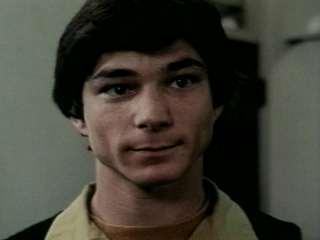
David Is Disappointed
Now realizing that most revolutions are waged by the lower class against the upper class for the sole benefit of the middle class and that there’s absolutely no way to bring any real change to Central High, David instead makes plans to destroy the entire high school…
Surreal and dream-like, Massacre at Central High is a potent allegory that takes the concept of absolute power corrupting absolutely to its logical extreme. It’s a film that celebrates revolution while, at the same time, asking, “What’s the point?” It’s a film that looks at politics, society, and culture and actually has the courage to suggest that it might be better just to give up on all of it. Featuring excellent performances from Maury, Beck, and Stevens and wonderfully off-center direction from Rene Daalder, Massacre at Central High is not an easy film to track down but it’s definitely one worth seeing.
For our latest entry in the 44 Days of Paranoia, let’s take a look at one of the silliest films ever made, Brian DePalma’s 1978 horror/thriller hybrid The Fury.
The Fury opens on a beach in Israel. CIA veteran Peter (Kirk Douglas, who grimaces up a storm) is hanging out with his teenage son Robin (Andrew Stevens) and his friend and colleague Ben Childress (John Cassavetes). Two things quickly become apparent.
First off, Robin has psychic powers. We know this because Peter is obsessed with protecting him from being captured by a shadowy government agency that wants to use his power as a weapon.
And secondly, Ben is evil. We know that Ben’s evil because he’s played by John Cassavetes. As one of the first truly independent filmmakers, Cassavetes would often raise the money to make his fiercely individualistic films by playing villains in bad B-movies, like this one.
Ben, in fact, is so evil that he’s arranged for terrorists to attack the beach. After Peter is apparently killed in a ludicrously violent gunfight, Ben takes off with Robin.
However, Peter is not dead! Somehow, despite the fact that both the beach and the ocean were pretty much blown up with him on it, Peter survived and now, he’s looking for his son. Peter makes his way to Chicago where he calls up his girlfriend, Hester (Carrie Snodgress), and says things like, “I want your body, baby.”
Hester, meanwhile, works at the Paragon Clinic, which is run by Dr. James McKeever (Charles Durning) who, himself, is secretly working for Ben. The Paragon Clinic is a front to try to discover other teenage psychics and to turn them into weapons as well. The newest patient is Gillian (Amy Irving), a teenage girl who might be able to help Peter track down his son.
Of course, what Peter doesn’t take into account is that, in his absence, Robin has turned into a power-mad sociopath who spends his time doing things like killing tourists at amusing parks…
Wow, that’s a lot of plot, isn’t it? And, with all of that, I haven’t even gotten into what happens during the second half of the film!
The Fury is an enjoyably silly film, an awkward attempt to combine DePalma’s previous film, Carrie, with a paranoia-fueled political thriller. There’s a certain charm to a film that takes itself so seriously and yet, at the same time, manages to be totally over-the-top and ludicrous.
For example, just consider the performances of the high-powered cast and the fact that none of the actors appear to be acting in the same film. Playing a character who is a bit of a hero by default (because, seriously, how stupid did he have to be to not realize that Ben was evil to begin with), Kirk Douglas grimaces so manfully that Peter’s stupidity almost starts to feel like a satiric comment on hyper-masculinity. John Cassavetes, on the other hand, is so disdainful of the film that he actually rolls his eyes while delivering some of his more melodramatic lines. Meanwhile, Carrie Snodgress is forced to say things like, “Here comes the Pony Express!” and Charles Durning brings the full weight of his talent to deliver lines like, “If you’re having your monthlies, I don’t want you near the patient.”
And finally, there’s Amy Irving. In DePalma’s Carrie, Irving played Sue Snell, the sole survivor of a psychic rampage. In The Fury, Irving gets to play the psychic and she gives such a dramatic and emotional performance that you almost get the idea that she was trying to challenge Sissy Spacek. “This is how you play a psychic, Sissy!” she seems to be shouting. Of course, the big difference is that Carrie was actually a good film whereas The Fury is a bad film that happens to be watchable.
Finally, no review of The Fury is complete without talking about Brian DePalma’s direction. To put it lightly, Brian DePalma directs the Hell out of The Fury and the effect is something like what an episode of Agents of SHIELD would look like if directed by Martin Scorsese. The entire film is a collection of tracking shots, zoom lenses, and sweeping overhead shots with the camera only stopping long enough to linger over scenes of violence and spilled blood. In perhaps the film’s most ludicrous scene, Amy Irving runs away from the clinic in slow motion while the orchestral score plays out on the soundtrack. We get close-ups of Irving’s face and close-ups of the faces of her pursuers. One character gets shot multiple times but we don’t hear the gunshots. Instead, we only hear the music and watch as the character overacts and dies in slow motion. It’s almost as if DePalma was trying to win a bet by achieving the most counter-productive use of slow motion in film history.
Ultimately, The Fury is so thoroughly silly and over-the-top that it simply has to be seen.

 Through the Shattered Lens