Brad reviews THE STONE KILLER (1973), starring Charles Bronson!


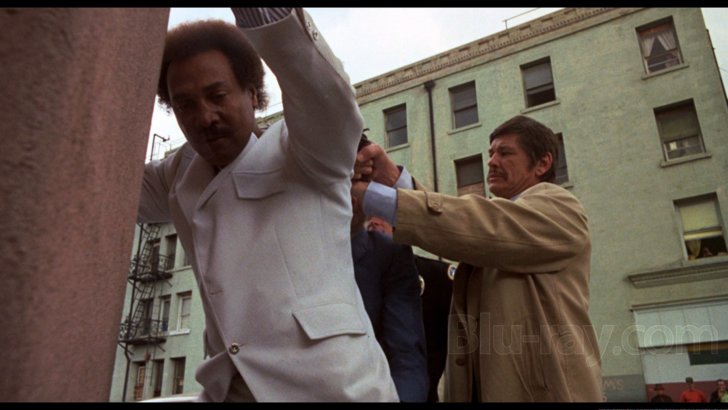
THE STONE KILLER opens in Spanish Harlem with detective Lou Torrey (Charles Bronson) following a young man, who had just shot a cop, into an abandoned building. When the young man refuses to turn himself in, and even tries to shoot Torrey, he gets blown away. In trouble with his superiors on the force, and being dragged in the press for the shooting, Torrey decides to change locations and continue his law enforcement career under his friend Les Daniels (Norman Fell) in Los Angeles. Soon after he arrives in Los Angeles, Torrey and his partner Mathews (Ralph Waite) are working a case against a drug dealer, when they arrest “Bootlace” Armitage (Eddie Firestone), a drug addict, but also a well-known hitman from New York. Torrey is delivering the “mechanic” back to New York for outstanding warrants when Armitage says that he is willing to give up some big information on “Wexton” in exchange for a reduced sentence. When Armitage is gunned down in what is obviously a professional hit, it’s clear that there is something going on that involves the name Wexton. We soon learn more as we meet mafia leader Al Vescari (Martin Balsam). As Vescari walks through a cemetery, he tells the leader of his operation, Lawrence (Stuart Margolin), of his plans to get revenge for a string of mafia killings that occurred 42 years earlier by using “stone killers,” in this case, former military men with no connection to the mob. As the film moves forward, Detective Lou Torrey and his fellow cops will eventually put the pieces together and find themselves taking on these “stone killers” and the mob! 

I’ll just go ahead and say up front that I’m a big fan of THE STONE KILLER these days, but that’s because the movie has grown on me over the years with repeat viewings. When I first watched the film as a teenager in the 1980’s, I enjoyed it as a tough cop film, but it wasn’t one of my favorites. I think that part of the reason I didn’t appreciate it as much back then is the more convoluted plot of the film. Most Bronson films have simple and easy to follow plot lines, but THE STONE KILLER includes a somewhat complicated mafia assassination plan, and it also sends the cops on wild goose chases that have nothing to do with the actual story. Watching the film as an adult, I appreciate Director Michael Winner taking us with him on some of those 1970’s flavored tangents that include getting to hang out with some hippies at an ashram, as well as some unjustly accused black militants. 

Even though the plot is more complicated than the average Charles Bronson film, director Michael Winner gives us some of the best action sequences of Charles Bronson’s career. There are two sequences in particular that stand out to me. After the impressive opening scenes where Torrey blows away the gun wielding young man in Spanish Harlem, it takes a while to get to the next extended action sequence, but it’s definitely worth the wait. The scene involves Detective Torrey in a car chase where he’s after one of the stone killers, Albert Langley (Paul Koslo), who’s on a motorcycle. In an era of great car chases, this is a doozy that features many amazing and dangerous stunts. The late 60’s and early 70’s are an embarrassment of riches for cinematic car chases and this one stands the test of time. The next great action sequence occurs later in the film when Detective Torrey and the cops bust the home and facility where the killers have trained for the planned massacre. Bronson is still in his physical prime in 1973, and his athletic prowess is clearly on display as he slides across floors, jumps on tables, and does anything else that is required to take down the bad guys. The film is not wall to wall action, but what’s here is as badass as it gets. 

Detective Lou Torrey is a really good role for Charles Bronson. In his best roles, Bronson is tough, but you can also tell that he cares about other people. That’s definitely the case here as he consistently shows empathy for some of the people he’s after. For example, at the beginning of the film, he has to shoot the young man in Spanish Harlem in self-defense, but he later explains to his sister that he didn’t want to do it, even expressing some understanding of how the young man may have found himself in that situation. A little later while arresting a drug dealer with his partner Mathews, Torrey is clearly disgusted when his partner uses racial slurs during the arrest. Torrey then talks to the man with respect and gets the needed information to arrest the man buying the drugs. There are further examples later in the film as he deals with other drug addicts and militants. I say none of this to insinuate that Bronson’s character is weak in any way. Rather, he seems to want to do his job and arrest criminals in a professional manner. He’s also a complex character in some ways as he will bend the rules to get what he needs if he has to. He does end up punching the car thief, Jumper (Jack Colvin), a couple of times during an interview. While this is definitely not legal, in the context of this film, it’s required in order to get to the facts of the case. Bronson is actually quite great in the film. 

Besides international superstar Charles Bronson, Michael Winner put together an amazing cast for THE STONE KILLER. Martin Balsam had won an Oscar a few years earlier, and he’s good here as the mafia boss with four decades worth of patience for revenge. Ralph Waite is also excellent as Bronson’s incompetent, racist partner Mathews. It’s hard to believe the guy would go on to play Papa Walton based on the ignorance he shows in both this film and in the Bronson/Winner collaboration CHATO’S LAND from the prior year. It’s fun watching both Norman Fell and John Ritter work together in this film, especially knowing that they would be making television history a few years later on the classic TV sitcom “Three’s Company.” The last two actors I want to mention are Stuart Margolin as the leader of the stone killers, Lawrence, and Paul Koslo as the bi-sexual badass musician Albert Langley. Both actors, especially Koslo, are good here and would have important roles with Bronson the next year as well. Margolin was an important character in DEATH WISH, and Koslo may have even outdone his work here the next year as a particularly slimy weasel in MR. MAJESTYK. Oh yeah, be sure to look for a short, uncredited cameo from B-movie queen Roberta Collins! I also want to shout out the musical score from Roy Budd, who also did the score for GET CARTER (1971). Thanks to Budd’s work, the opening credits are very cool and memorable. 

THE STONE KILLER was marketed as Charles Bronson’s “Dirty Harry” and meant to be his breakout hit in America. Unfortunately, while the film was an international hit, the actual grosses in the United States were respectable but not as much as the filmmakers had hoped for. As such, we didn’t get any more entries in the case log of Detective Lou Torrey and Bronson would have to wait another year for his American box office breakout with DEATH WISH. But that’s okay because THE STONE KILLER has stood the test of time as an excellent 1970’s cop film, emerging in my personal rankings as a major feather in the cap of Charles Bronson’s career. 
Retro Television Review: Decoy 1.14 “Bullet of Hate”


Welcome to Retro Television Reviews, a feature where we review some of our favorite and least favorite shows of the past!  On Thursdays, I will be reviewing Decoy, which aired in Syndication in 1957 and 1958.  The show can be viewed on Tubi!

This week, Casey solves her easiest case yet!

Episode 1.14 “Bullet of Hate”

(Dir by Teddy Sills, originally aired on January 13th, 1958)

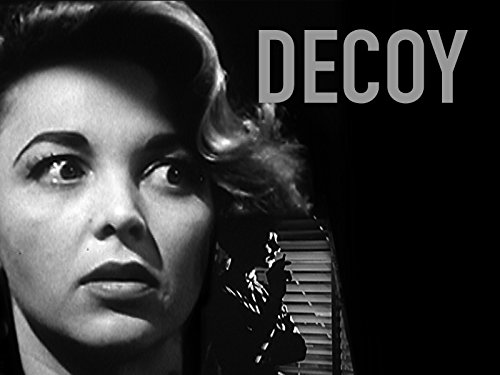
This week, Casey doesn’t go undercover.  Instead, she’s just a uniformed police officer who responds to fight between teenage Stella (Sandra Whiteside) and her adoptive aunt, Mary (Joanna Roos).  Casey takes sympathy on Stella, who isn’t a bad kid but who is rebelling against her heartless Aunt Mary and Uncle Lester (Alfred Ryder).  When Mary ends up getting shot, Stella is the number one suspect and Stella herself even thinks that she’s responsible.  But, of course, it turns out that Stella has been framed by Lester.

The main problem with this episode is that we watch as Lester frames Stella by giving her a gun.  When Stella fires the gun during an argument, Mary isn’t injured but she does faint.  Stella flees.  Lester then uses the gun to actually shoot Mary.  Since we know that Lester committed the crime, there’s not really any suspense when Casey starts to suspect that Stella’s been set up.  We already know she’s been set up and we also know that, since Lester is an idiot, Casey is going to be able to easily solve the case.  And since we know that Casey is good with a gun, we’re not that surprised when Casey ends up taking Lester out (in self-defense, of course!).  This isn’t like Columbo or the first season of Poker Face where the killer is so diabolically clever that we can’t wait to see how the hero manages to trick them into confessing.  Lester’s just a dummy.

Joanna Loos and Alfred Ryder both went overboard as the villainous aunt and uncle but Sandra Whiteside was effective as the desperate Stella.  Apparently, this was one of only two roles that Whiteside played in her career.  She gives a strong performance.

This is my final Decoy review for 2025.  Retro Television Reviews is going on break for the holidays so that I can focus on Awards Season and Christmas movies!  Decoy will return on January 8th, 2026.

Retro Television Review: Indict & Convict (dir by Boris Sagal)


Welcome to Retro Television Reviews, a feature where we review some of our favorite and least favorite shows of the past!  On Sundays, I will be reviewing the made-for-television movies that used to be a primetime mainstay.  Today’s film is 1974’s Indict & Convict!  It  can be viewed on YouTube.

There’s been a murder!

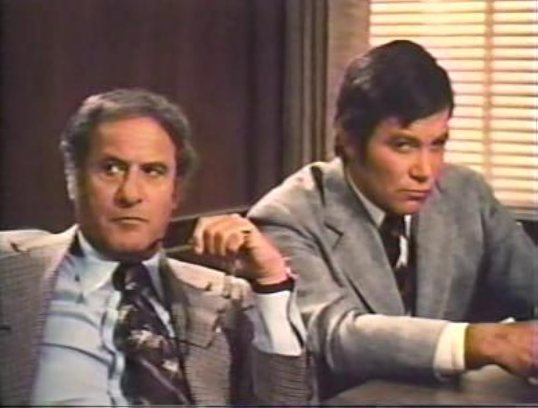
The wife of Assistant District Attorney Sam Belden (William Shatner) has been found, shot to death.  Making things especially awkward is that the body of her lover is found next to her.  Though Belden is the obvious suspect, he has an alibi for the time of the murders.  He claims that he was in Las Vegas, attending a convention.  Two gas station attendants remember seeing him filling up his car with gas at around the same time that his wife and her lover was being shot.

Attorney General Timothy Fitzgerald (Ed Flanders) is not so sure that Belden is innocent.  He instructs two of his top prosecutors to check out Belden’s story and to see if there’s enough evidence to not only indict but also to convict.  Bob Matthews (George Grizzard) is a veteran prosecutor and he’s the one who narrates the story for us.  Assisting him is Mike Belano, who is played by the always likable Reni Santoni.  Just three years before this movie aired, Santoni played Harry Callahan’s partner in Dirty Harry.  There was just something about Santoni’s friendly but determined demeanor that made him perfect the role of the supportive partner or assistant.

The film is very much a legal procedural, with the emphasis on not only the investigation but also on the strategies and the techniques that are used in the courtroom by Matthews and defense attorney DeWitt Foster (Eli Wallach).  In many ways, it feels like a forerunner to Law & Order.  Usually, I love court procedurals but Indict & Convict was a bit too slow and high-minded for its own good.  Maybe it’s because I’ve been spoiled by all of the legal shows that I’ve seen but I have to admit that I spent a good deal of Indict & Convict wanting the prosecutors to get on with it.  Flanders, Grizzard, Santoni, and Wallach were all ideally cast but the film itself sometimes got bogged down with all the debate about the best way to win a conviction.  It’s a shame because the story itself is an intriguing one and I actually enjoyed the movie’s use of spinning newspaper headlines to let us know what had happened in between scenes.  Also, as a classic film fan, I enjoyed seeing Myrna Loy as the judge.  She didn’t get to do much other than say, “Sustained” and “Overruled,” but still …. Myrna Loy!

Most people who watch this film will probably do so out of the hope of seeing some trademark Shatner overacting.  William Shatner doesn’t actually get to say much in this film.  He spends most of the running time sitting silently at the defense table.  Towards the end, he does finally get a chance to deliver a brief speech and it’s everything you could hope for.  Shatner takes dramatic pauses.  Shatner emphasizes random words.  Every line is delivered with the subtext of, “Pay attention, Emmy voters!”  Eventually, Shatner would learn the value of laughing at oneself but apparently, that lesson had not yet been learned when he did Indict & Convict.

The Raiders (1963, directed by Herschel Daughtery)


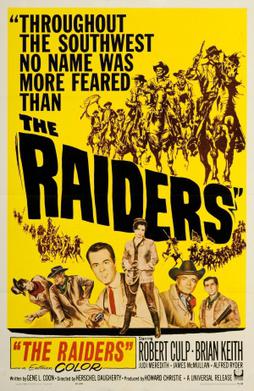
In the years immediately following the Civil War, seven Texas cattleman, led by Col. John McElroy (Brian Keith), try to drive their cattle into Missouri.  The terrains proves treacherous and the local Pawnees refuse to allow the cattlemen to pass through their land without paying a hefty fee for the right.  McElroy and his followers go to Fort Hays and demands that the local railroad magnate, Huntingon Lawford (Addison Richards), extend his line into Texas.  When both Lawford and martinet Calvary officer Capt. Benton (Alfred Ryder) refuse to help, McElroy and his man start sabotaging the railroad’s western expansion.

This brings them into conflict with Wild Bill Hickok (Robert Culp), Buffalo Bill Cody (Jim McMullan), and Calamity Jane (Judi Meredith), all of whom are working for the railroad!  Hickok is an old friend of McElroy’s and Cody is sympathetic to McElroy’s cause but will they be able to broker a peace between the two sides?  When Captain Benton plans to lure McElroy into a trap where he and his friends will fired on with a Gatling gun, it’s up to Cody and Hickok to try to prevent a massacre.

The Raiders starts out as a downbeat look at a cattle drive in the years when America was still trying to rebuild from the devastation of the Civil War.  Brian Keith was one of those actors who was always ideally cast in westerns and war movies and he’s convincing as the tough but fair-minded McElroy.  If the film had just been about McElroy, it would have been a good B-western.  Instead, it brings heavily fictionalized versions of Wild Bill Hickock, Buffalo Bill Cody, and Calamity Jane into the story.  Robert Culp, Jim McMullan, and especially Judi Meredith all overact in their roles and a lot of time is wasted on subplots like Calamity Janes being in love with Wild Bill and Buffalo Bill trying to prove himself to the older man.

The Raiders started out as a made-for-TV movie and it appears that it was a pilot for a proposed TV show about Calamity Jane and the Bills.  (Brian Keith is even listed in the credits as being a “special guest star.”)  When the pilot wasn’t picked up, the film was given a theatrical release but The Raiders still has the flat look and unimaginative editing of a television show.  No matter how authentic Brian Keith’s performance might be, he can’t make up for the fact that the majority of the film was clearly shot on a studio backlot.

Film Review: Tracks (1977, dir by Henry Jaglom)


The 1977 film, Tracks, opens somewhere in America.

Jack Falen (Dennis Hopper) sits on a bench, waiting for a train.  He’s wearing a military uniform.  He claims that he’s a 1st sergeant.  He claims that he’s just returned from Vietnam.  He’s traveling with a flag-draped coffin.  He says that the coffin contains the remains of his best friend from Nam.  Jack is accompanying the coffin back to his friend’s hometown.  Jack says that he’s going to make sure that his friend gets a proper burial.

From the minute we meet Jack, we get the feeling that there’s something off about him.  He’s a little bit too quick to smile and, when he laughs, it’s the guttural sound of someone who has learned how to show joy by watching other people but who has perhaps never felt it himself.  Sometimes, he’s quiet.  Sometimes, he is loquacious and verbose.  When he does speak, he rarely looks anyone in the eyes.  Jack is jumpy, as if he’s constantly afraid that he’s about to be exposed as a liar.

Soon, Jack is riding a train across the country.  While the rest of the passengers look out the windows and takes in the American landscape, Jack nervously wanders around the train.  He gets involved in a regular chess game.  He befriends a mysterious man named Mark (Dean Stockwell).  He starts a tentative relationship with a student named Stephanie (Taryn Power).  He tells anyone who will listen that he’s traveling with the body of his best friend.  When a black Korean war vet complains that Jack is acting like he’s the only person who lost a friend in a war, an offended Jack replies that his friend was black.

Jack sees things.  When he sees that the other passengers are assaulting Stepanie, he pulls out a small gun and aims it at the back of the train, just to suddenly realize that Stephanie is sitting unbothered at the back of the train.  While we know that Jack was hallucinating the attack on Stephanie, we still wonder if he really pulled out that gun.  If he did, no one else seems to have noticed.

Sometimes, the passengers say things to Jack that don’t seem to make any sense, leaving Jack staring at them in confusion.  Other times, Jack sees dark figures walking through the train.  At night, he wanders around naked.  Jack spends the trip watching the other passengers with a slightly dazed look on his face.  He plays chess with a man who later insists that he’s never played chess with Jack.  Sometimes, he thinks that he and Stephanie are outside of the train.  When Mark approaches Jack and asks for help, Jack explains that he can’t help anyone.  While a soundtrack of old World War II propaganda songs thunders in the background, Jack struggles to keep track of what’s real and what isn’t.

And so does the audience.  As we watch, it occurs to us that Jack’s stories about Vietnam don’t really seem to add up.  Add to that, we never actually saw Jack board the train.  Instead, we saw him sitting on a bench and waiting for the train.  We’re left to wonder if the train’s real or if the whole movie is just a figment of Jack’s damaged imagination.  And what about the coffin?  Tracks is full of unanswered questions but, in the film’s incendiary final moments, we do learn the truth about that coffin … maybe.

Henry Jaglom has been making independent films for several decades now.  Tracks is one of his better films, if just because Jaglom’s loose, seemingly improvised style actually works well at communicating Jack’s own struggle to keep up with what’s really happening and what he’s imagining.  As deceptively random as the film’s collections of scenes may appear, it’s all anchored by Dennis Hopper’s wonderfully unhinged performance.  Hopper brings a method actor’s intensity to Jack’s struggle to not only keep straight what’s real and what isn’t but also to keep his fellow passengers from understanding that he’s deeply unbalanced.  This film was made during Hopper’s drug-fueled lost years and he plays Jack like a man who is desperately trying to keep the world from seeing that he’s in the throes of withdrawal.  Unlike Hopper, Jack’s addiction isn’t to drugs.  Instead, Jack’s addicted to war, or at the very least his obsession with war.  (By the end of the movie, you have your doubts about whether Jack’s ever been to Vietnam or not.)  The use of World War II propaganda songs on the soundtrack may occasionally get annoying but they actually play up the contrast between our often simplistic view of war and the far more complex reality.

If nothing else, I would recommend Tracks for Hopper’s performance.  As well, since he co-stars with Dean Stockwell, it’s easy to imagine Tracks as being a bit of a prequel to Blue Velvet.  Who’s to say that Jack Falen didn’t change his name to Frank Booth?