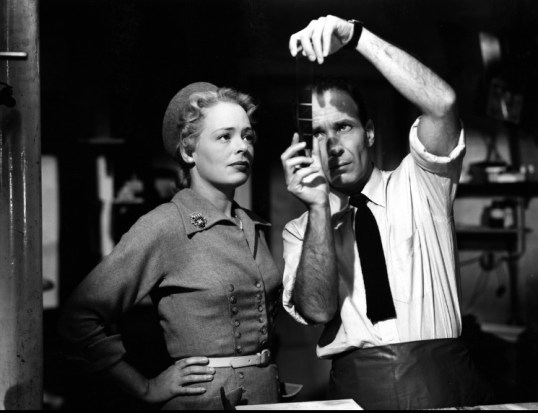
At Gunpoint (1955, directed by Alfred L. Werker)


When a gang of outlaws attempt to rob a bank in the small frontier town of Plainview, the local sheriff is one of the first people to get gunned down.  It falls upon two local men, George Henderson (Frank Ferguson) and storeowner Jack Wright (Fred MacMurray), to run the outlaws out of town.  While most of the gang escapes, Jack and Henderson manage to kill the gang’s leader, Alvin Dennis.

At first, Jack and Henderson are declared to be heroes and Henderson is appointed sheriff.  However, when Henderson is found murdered, the town realizes that Alvin’s brother, Bob (Skip Homeier), has returned to get revenge.  The inevitable confrontation is delayed by the arrival of a U.S. marshal who stays in town for two weeks to maintain the peace but everyone knows that, once he leaves, Bob is going to be coming after the mild-manned Jack.  The townspeople go from treating Jack like a hero to shunning him.  They even offer Jack and his wife (Dorothy Malone) money to leave town but Jack refuses to give up his store or to surrender to everyone else’s fear.

At Gunpoint is a diverting variation on High Noon, with Fred MacMurray stepping into Gary Cooper’s role as the upstanding man who the town refuses to stand behind.  What sets At Gunpoint apart from High Noon is that, unlike Cooper’s Will Kane, MacMurray’s Jack Wright isn’t even an experienced gunslinger.  Instead, he’s a mild-mannered store owner, the old west’s equivalent of an intellectual, who just managed to get off a lucky shot.  If he can’t find a way to get the cowardly town to back him up, there’s no way that he’s going to be able to defeat Bob and his gang.

At Gunpoint features an excellent cast of Western character actors, including John Qualen, Irving Bacon and Whit Bissell.  Especially good is Walter Brennan, playing one of the only townspeople to have any integrity.  While this western may not have the strong political subtext or the historical significance of High Noon, it’s still a well-made example of the genre.  It’s a western that even people who don’t normally enjoy westerns might like.
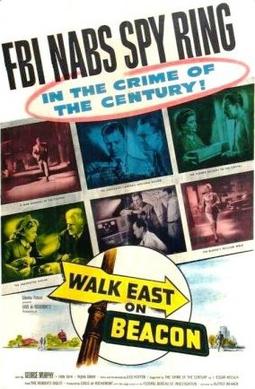
18 Days of Paranoia #17: Walk East On Beacon! (dir by Alfred L. Werker)


From 1952 comes Walk East On Beacon, a mix of spy thriller and film noir that highlights the efforts of the FBI to expose and take down a communist sleeper cell working right in the United States of America!  (Cue the dramatic music.)

One need only check out the opening credits to see what type of film Walk East On Beacon is going to be.  We’re told early on that the film was “suggested” by a Reader’s Digest article that was written by none other than the director of the FBI, J. Edgar Hoover. The title of that article was “The Crime of the Century: The Case of A-Bomb Spies” and it dealt with the FBI investigation that led to the arrest, conviction, and controversial execution of two Russian spies, Julius and Ethel Rosenberg.  I haven’t read the article but judging by the fact that it was written by Hoover and published in Reader’s Digest, I think it’s fairly safe to guess that it wasn’t particularly concerned with things like protecting the First Amendment, civil rights, or the freedom to hold any ideological belief regardless of how unpopular it may be with the general public.  (Of course, I would be remiss if I didn’t also point out that most historians now agree that, despite what many on the Left claimed over the decades, the Rosenbergs were indeed guilty of being spies and they played a very central role in the Russians discovering the secret to making atomic bombs.)

In the film, George Murphy plays an FBI agent named Jim Belden.  According to J. Hoberman’s book, An Army of Phantoms, the FBI specifically requested that Murphy be cast in the lead role because Murphy was an outspoken anti-communist.  (Murphy would also later be elected to the U.S. Senate.)  Project Falcon, a super-secret U.S. program, has been infiltrated by spies and Belden has been assigned to track down and capture their ringleader.  He does this by using a number of techniques that were probably considered pretty high tech back in 1952, stuff like hidden cameras and secret microphones.  He even brings in a group of lip readers to watch silent footage of two possible spies speaking so that they can tell him what the spies are talking about.  You don’t have to worry about a thing with Jim Belden on the case!

As for the members of the spy ring, they’re a mixed bunch.  Some of them are just bad people who have betrayed their country just because it’s the evil thing to do.  Others are people who idealistically joined the Communist Party years ago because they wanted to help their fellow man and, instead, they’ve now found themselves forced to spy against their country.  Prof. Albert Kafer (Finlay Currie) doesn’t want to betray America but he’s been told that his son will be executed if he doesn’t cooperate.  Kafer goes to the FBI.

As you can probably guess, this is not a particularly subtle film.  The communists are all evil and the FBI is doing its best to protect the loyal citizens of America and, if you’re going to question the legality or the ethics of their methods …. well, why don’t you just move to Russia and tell Stalin about it, okay!?  Interestingly enough, the film is shot like a film noir, with an emphasis on shadows and dark streets and desperate men trying to escape their fate.  But it has none of the moral ambiguity that one usually expects to find in a film noir.  Instead, it presents a thoroughly black-and-white view of the world.  All of the communists are either neurotic or cruelly evil while the FBI is professional, bland, and rather humorless.  There’s really only one moment — where a blackmailed spy admits to his wife that he’s been trapped into betraying his country — where the film seems to come to life.  Otherwise, this is a rather dry film, one that even comes with officious voice over narration.

While the film may not work as a thriller, it is somewhat fascinating as a historical document.  The film was shot on location in Boston and, while I realize this may just be the history nerd in me talking, it’s still somewhat interesting to see what an major American city looked like in 1952.  (It looks remarkably clean.)  As well, the film really delves into the minutia of stuff that today seems mundane but which probably took audiences by surprise in 1952, stuff like wiretapping, drop points, and how even a condolence card could be used to send a secret message.  If nothing else, the film’s portrait of a world where anyone — from a cab driver to an atomic scientist — could be a spy certainly provides a interesting snapshot of 1950s paranoia.

Other Entries In The 18 Days Of Paranoia:

  1. The Flight That Disappeared
  2. The Humanity Bureau
  3. The Private Files of J. Edgar Hoover
  4. The Falcon and the Snowman
  5. New World Order
  6. Scandal Sheet
  7. Cuban Rebel Girls
  8. The French Connection II
  9. Blunt: The Fourth Man 
  10. The Quiller Memorandum
  11. Betrayed
  12. Best Seller
  13. They Call Me Mister Tibbs
  14. The Organization
  15. Marie: A True Story
  16. Lost Girls

30 Days of Noir #20: He Walked By Night (dir by Alfred L. Werker and Anthony Mann)


The 1948 film noir, He Walked By Night, opens with a policeman named Rawlins on his way home from work.  As he drives down the street, he sees a man walking alone at night.  Because there’s been a number of recent burglaries in the area and the man’s a stranger, Rawlins decides to pull over and ask the man for his ID.

What Rawlins doesn’t realize is that the man is Roy Morgan (Richard Basehart) and yes, Roy is indeed the burglar.  Roy is something of a mystery man.  (Needless to say, Morgan is not his real last name.)  In the pre-Internet age, he has very carefully and very meticulously avoided leaving any sort of paper trail.  He lives, by himself, in a small apartment, his only companion being an adorable dog and the police scanner that Roy uses to always stay a few steps ahead of the cops.  When Rawlins pulls him over, it’s the closest that Roy has ever come to being caught.  Roy get out of the situation by shooting the cop and then running into the night.

The rest of the film deals with the efforts of two police detectives (played by Scott Brady and James Cardwell) and their captain (Roy Roberts) to discover who shot Rawlins and bring him to justice.  It’s not easy because not only has Roy done a good job of obscuring his very existence but his police scanner always gives him advanced warning whenever they cops start to close in on him.  The only lead that the cops have is a salesman named Paul Reeves (Whit Bissell).  Reeves has been buying and reselling the electronic equipment that Roy’s been stealing from houses all over Hollywood.  When Reeves tells the cops that he had no idea the stuff was stolen, the cops all share a weary roll of the eye.  No matter whether Reeves is telling the truth or not, he’s now the key to tracking down a cop killer….

He Walked By Night is a police procedural and, while the plot may sound familiar, the film is elevated by the atmospheric direction of Alfred Werker and an uncredited Anthony Mann.  As visualized by Werker and Mann, the streets of Los Angeles have never been darker and more menacing.  Roy emerges from the fog to commit his crimes and then disappears back into the mist, like some sort of paranormal spirit.  The film reaches its high point when the police chase their quarry through the sewers of Los Angeles, a scene that will remind many of the famous finale of The Third Man.

Though the film offers up clues to Roy Morgan’s motivation, he remains an enigma for much of the film.  Richard Basehart plays him as a paranoid man who only seems to be confident and happy when he’s stealing or when he’s outsmarting the police.  In many ways, regardless of whether he escapes the police or not, Roy’s destined to spend his life trapped in a prison of his own design.  Even hiding out on the fringes of society, Roy knows that his time is limited.  There’s only so many times one person can escape their fate.  Until he’s either captured or killed, Roy is destined to always walk the night, alone.

The Fabulous Forties #21: Shock (dir by Alfred L. Werker)


The 20th film in Mill Creek’s Fabulous Forties box set was Frank Capra’s Meet John Doe.  Since I had already watched and reviewed Meet John Doe for last year’s Shattered Politics series of reviews, I decided to skip forward to the next film.

That film turned out to be the 1946 psychological thriller, Shock (not to be confused with Mario Bava’s masterpiece of the same name).

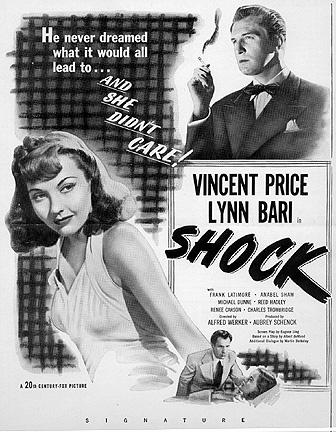
Shock_movie_poster

Shock opens with a young housewife named Jane Stewart (Anabel Shaw) waking from a dream, getting out of bed, looking out a window, and seeing something rather serious happening in the house next door.  A man and a woman are arguing.  Though Jane doesn’t recognize the man, horror fans will immediately realize that he’s Vincent Price, without a mustache.  As Jane watches, the man beats the woman to death.  When Jane’s husband, Lt. Paul Stewart (Frank Latimore), returns home, he discovers that Jane is in a catatonic state.

Paul calls the local cranky physician, Dr. Harvey (Charles Trowbridge), to the house.  Dr. Harvey takes one look at Jane and announces, “She’s in shock!”  (YAY!  WE HAVE A TITLE!)  Paul looks confused so Dr. Harvey goes on to explain, “She’s had a great shock.”  Unfortunately, Dr. Harvey is not trained to deal with shock but he knows someone who is.  That man’s name is Dr. Richard Cross.

Soon Dr. Cross shows up and — OH MY GOD, IT’S VINCENT PRICE!  That’s right — Dr. Cross not only caused Jane’s shock but now he’s going to treat it!  Or is he?  Though Dr. Cross claims to be wracked with guilt over the murder, his nurse, Elaine Jordan (Lynn Bari), is less concerned about it.  In fact, since Elaine is also his mistress, she’s rather happy that Dr. Cross has murdered his wife.  Now, she just has to convince him to murder Jane before she recovers from her shock.

(Interestingly enough, Dr. Cross’s plan involves treating Jane with insulin shock therapy, which would seem to indicate that Dr. Cross has seen Dr. Kildare’s Strange Case too many times.)

I had high hopes for Shock, largely because of the presence of Vincent Price.  From what I’ve read, the box office success of Shock changed the course of Price’s career.  Before Shock, Price was a character actor who occasionally got a good supporting role.  After Shock, he was transformed into the horror icon who we all know and love today.  Shock was the first time that Price was cast in the type of mad scientist role that would later become his trademark.  For that reason, Shock has an important place in the history of cinematic terror.

But, unfortunately, Shock itself is kind of forgettable.  It’s pretty much your standard thriller, one that makes the mistake of revealing Price’s villainy from the start.  (It would have been far more effective if the film tried to shock us with the realization that Price is the bad guy.)  It’s always fun to watch Vincent Price in a movie but he actually gives a rather subdued performance here and, as a result, he’s not as much fun as he would be in his later films.  In other words, Shock is no House On Haunted Hill.

That said, Shock is definitely a piece of film history and, as such, it’s worth watching.  And here it is: