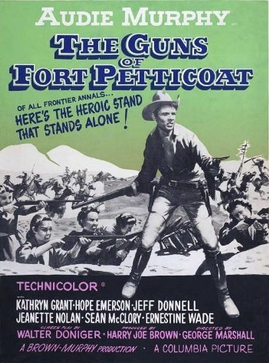
The Guns of Fort Petticoat (1957, directed by George Marshall)


During the waning days of the Civil War, Lt. Frank Hewitt (Audie Murphy) is a man without a country.  A Texan, he joined the Union Army even as his home state was voting to secede from the United States.  In the Army, Hewitt is viewed with distrust by his autocratic superior, Col. John Chivington (Ainslie Pryor).  When Hewitt learns that Chivington has ordered a surprise attack on an unarmed local Indian tribe in order to drive them into Texas where they will attack the nearest settlement for revenge, Hewitt deserts the Army to warn the people left in his hometown.

When Hewitt arrives, he discovers that all of the men in town have left to join the Confederate Army.  Only their wives, mothers, and sisters remain.  Though Hewitt is, at first, accused of being a traitor, he sticks around and trains the women on how to fight not only the incoming Comanches but also any outlaws who ride into town looking to take advantage of the situation.

The Guns of Fort Petticoat is an interesting B-western that holds up well today.  Even though the film ends with a Comanche attack, it’s made clear that the attack would not have happened if not for the actions Col. Chivington.  Chivington, who doesn’t care that the victims of his actions would not be Confederate soldiers but instead just helpless woman and children, is the film’s true villain, even if he only appears in the first and final scenes.  Audie Murphy, who was America’s most decorated World War II veteran, not only starred in but produced the movie.  Murphy was a stiff actor but he looked believable in uniform and obviously knew how to convincingly shoot a rifle and that’s all this role really demands of him.  Kathryn Grant plays the woman who goes from distrusting Hewitt to falling in love with him and she and Murphy work well together.  The final battle between the women and the Comanches is exciting and well-shot by veteran western director George Marshall.  The movie’s final scene may not be totally believable but it’s still very satisfying.

Fans of the western genre and Audie Murphy will find much to enjoy about The Guns of Fort Petticoat.
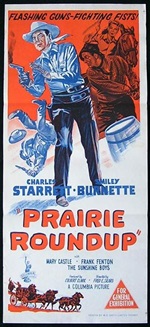
Prairie Roundup (1951, directed by Fred F. Sears)


Steve Carson (Charles Starrett) is wanted for murdering the Durango Kid!

I know that sounds confusing because Steve Carson is the Durango Kid.  The bandit that Carson shot was just disguised as the Durango Kid but actually, he was just a dim-witted outlaw who was set up by Buck Prescott (Frank Fenton), a rustler who was run out of Texas by Steve and who was trying to find a way to stop Steve from investigating his new scheme to cheat a bunch of ranchers in Santa Fe.

Steve is taken to jail but luckily, Smiley Burnette is around to help him break out.  Smiley and Steve head to Santa Fe, where they get jobs working as cowhands at the Eaton Ranch and work to expose Prescott and his gang as being responsible for a series of stampedes.  Smiley sings some songs and Steve resurrects the Durango Kid from the dead.

This was one of the later Durango Kid films.  The range war plot is one that showed up in many Durango Kid films but Prairie Roundup adds something new to the formula but having Steve framed for murdering himself.  Steve could prove his innocence by revealing that he’s actually the Durango Kid but Steve is determined to maintain his secret identity.  I’ve seen several Durango Kid films and I still don’t really understand why Steve felt he needed a secret identity in the first place.  But Prairie Roundup shows the extent to which he’ll go to keep it.

There’s plenty of fight and horse chases, more than enough to keep western fans happy.  Smiley Burnette gets to throw some punches along with singing all of his usual songs.  It’s also nice to see the lovely Mary Castle in the role of Toni Eaton, the daughter of one of the ranchers who has been targeted by Prescott.  Featuring less stock footage than usual, Prairie Roundup is a worthy entry in the Durango Kid series.

Bonanza Town (1951, directed by Fred F. Sears)


The frontier community of Bonanza Town has been taken over by the corrupt businessman, Krag Boseman (Myron Healey).  No one can stand up to Krag because the local judge (Luther Crockett) is under Boseman’s control.  The judge’s son (Ted Jordan) writes to the Durango Kid and asks him to come to Bonanza Town and lead a group of vigilantes to overthrow Boseman.

The Durango Kid, whose real name is Steve Ramsay (Charles Starrett) somehow receives the letter and heads into town.  As Steve, he gets a job working for Boseman and looks for evidence that Boseman is actually being bankrolled by a notorious outlaw named Henry Hardison (played by the film’s director, Fred Sears).  As the masked Durango Kid, he defuses the vigilante’s violent plan and, with the help of Smiley Burnette, he investigates what Boseman has on the judge.

Charles Starrett played the Durango Kid in 131 films.  In fact, he appeared in so many movies that the majority of Bonanza Town is made up of flashbacks from 1947’s West of Dodge City.  Despite all of the flashbacks, Bonanza Town is one of Starrett’s better films, featuring an interesting story and good performances from both Fred Sears and Luther Crockett.  Sears shows some imagination with his staging of the many gunfights and, as always, Starrett is convincing riding a horse and carrying a gun.

Bonanza Town is a fairly serious film and Smiley Burnette’s trademark comedic relief feels out of place but the kids in 1951 probably enjoyed it.  While everyone else is shooting guns and committing murder, Smiley is running his barber shop and turning a potato into a musical instrument.  While the Durango Kid dispenses frontier justice, Smiley sings a song and leaves his customers bald.  They were a good team.