Retro Television Reviews: T and T 2.11 “Hard Way Home”


Welcome to Retro Television Reviews, a new feature where we review some of our favorite and least favorite shows of the past! On Fridays, I will be reviewing T. and T., a Canadian show which ran in syndication from 1987 to 1990.  The show can be found on Tubi!

T and T is back …. with a kidnapping!

Episode 2.11 “Hard Way Home”

(Dir by Al Waxman, originally aired on January 23rd, 1989)

Joe has the worst luck when it comes to making new friends!

One of the main themes of the second season of T and T has been T.S. (and, occasionally, Amy) acting as a mentor for teenage Joe Casper.  The season began with Joe losing his mother to a bomb that was set by Canadian Neo-Nazis.  T.S. apparently adopted Joe and now, the kid spends all of his time at Decker’s gym.  Whenever Joe makes a new friend, they either turn out to be a criminal or a victim of a crime.

This week, Joe’s new friend is George Papadopolous (David Stratton), who invites Joe to toss a football around with him in the park.  However, once they get to the park, George is grabbed by a couple of thugs and tossed into the trunk of a car.  Joe chases the car and even grabs onto the bumper but ultimately, he can’t save George.

When a banged-up Joe returns to Decker’s gym, T.S. assures him that his new scars will make him the most popular kid at his school.  Joe then calls George’s father and is told that the whole kidnapping was a prank and that he shouldn’t call the police.  This sounds strange to T.S. so he investigates on his own.

It turns out that George’s father is Peter (George Sperdakos), a big man in Toronto’s Greek mafia.  Someone has kidnapped George and is demanding a huge ransom.  Members of the Greek community are all donating their own money to help Peter raise the amount.  Because Joe was able to get the license plate number of the car that George was tossed into, it doesn’t take long for T.S. to discover that George was abducted by Peter’s rival, a used car dealer named Frangos (George Touliatos).  However, Frangos is not working alone.  It turns out that Peter arranged the kidnapping of his own son so that he could pocket the ransom money!

Needless to say, thinks work out in the end.  George is freed and Peter is arrested.  At first, Amy tells T.S. that there is no way that she would ever agree to represent Peter because 1) she knows that Peter is guilty and 2) Peter can’t afford to pay.  But then the members of Greek community (who are apparently very forgiving) donate their own money to convince Amy to defend Peter in court.  Does Amy win the case?  The episode ends before we find out.

This episode really showed the disadvantage of trying to tell a story like this in just 30 minutes.  There was never any suspense over who kidnapped George because there was only time to introduce one suspect!  Peter turning out to be in on it was a nice twist but it came out of nowhere because there really wasn’t any time to properly set it up.  This would have been a good hour episode but, at 30 minutes, it just felt rushed and it didn’t have any fun Mr. T line readings.  Toronto looked nice and cold but otherwise, this was a forgettable episode.
Quiet Killer (1992, directed by Sheldon Larry)


When wealthy teenager Sarah Dobbs (Kathleen Robertson) vomits up blood and then drops dead in the middle of New York City, the coroner’s office is baffled as to what killed her.  As far as anyone knows, Sarah has just been suffering from the flu, which she apparently contracted when she was recently overseas.  However, there is one doctor in New York who thinks that she knows what’s happening.  Dr. Nora Hart (Kate Jackson) takes one look at Sarah’s case and decides that the Black Death — the same plague that wiped out half of the world’s population in 54 AD — has come to New York!

Nora wants to shut down the city immediately but Mayor Carmichael (Al Waxman) says that would not only lead to mass panic but it would also an economic disaster.  Working with a team of other doctors (including Jerry Orbach, who is always a welcome presence in New York films), Dr. Hart tries to track down everyone who Sarah came into contact with and quarantine them before both a panic and a pandemic breaks out.  Unfortunately, one congressman (Howard Hesseman!) doesn’t want to go into quarantine because that would mean admitting that he was in Manhattan to visit his mistress.  Despite everyone’s best efforts, mass panic follows.

Quiet Killer (which is also known as Black Death) is a made-for-TV movie that used to show up on late night television throughout the 90s.  It’s a typically overwrought disaster film and it’s easy to laugh at some of the dialogue and some of the acting.  (Kate Jackson is particularly wooden in the lead role.)  The first time I saw it, I thought the most interesting thing about it was that it featured Howard Hesseman as a congressman.  For those who know Hesseman best for playing characters like Dr. Johnny Fever on WKRP, it’s strange to see him playing a member of the establishment.  Hesseman isn’t bad in the role but it never makes sense that he wouldn’t be able to think of a way to explain away his presence in Manhattan.  You would think a politician would be better at coming up with an alibi or that he could have pulled some strings to keep it from being revealed that he had been quarantined.  Instead, he decides to just run off and potentially infect the entire nation.  That’s not what I pay my tax dollars for.

Quiet Killer is a good example of how real-life events can shape how we view a film.  Up until just a few months ago, this would have seemed like just another cheesy disaster movie.  Watch it today and it feels prophetic.  Hopefully, by this time next year, it will be back to just being cheesy.

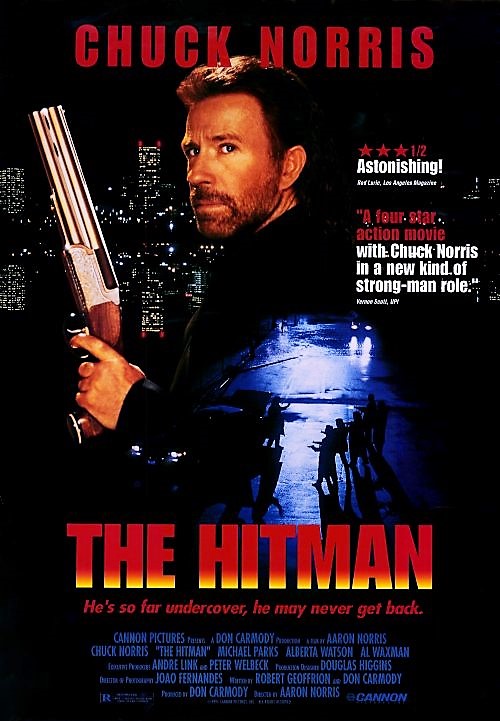
The Hitman (1991, directed by Aaron Norris)


When cop Cliff Garrett (Chuck Norris) gets shot by his corrupt partner, Ronny Delaney (Michael Parks), he dies and nearly gets to go to heaven.  However, at the last minute, the doctor’s manage to bring Cliff back to life.  Since everyone believes Cliff to be dead, his superiors come up with a brilliant plan.  What if Cliff changes his name to Grogan, grows his hair long, and goes undercover as a hitman?

Cliff’s up for it and is soon working for an Italian mobster named Marco Luganni (Al Waxman).  Marco wants to eliminate all of the other mobsters in town but he also has to deal with a bunch of drug-dealing Iranians who are trying to move in on his territory.  Cliff soon works his way into the inner circle and plays all sides against each other.  What’s strange is that Cliff manages to fool everyone into thinking that he’s Grogan despite the fact that all he’s really doing is wearing his hair long.  In fact, the only person who he doesn’t fool is his former partner, Delaney.  Delaney is not happy to discover that Cliff is still alive and sets out to take him out once and for all.

Because this is a Chuck Norris film, there’s a subplot where Cliff helps a bullied youth named Tim (Salim Grant) learn how to stick up for himself.  One thing that set Chuck Norris apart from other 80s action heroes is that Chuck always tried to teach all the kids in the audience of his R-rated films a good lesson about staying off drugs, standing up to bullies, and not doubting the American way.  I always have mixed feelings about this aspect of Chuck’s films because the message scenes usually don’t fit in with the rest of the narrative and it’s always questionable if a film featuring Chuck killing people is the right place for a wholesome life lesson but, at the same time, Chuck is so sincere that these scenes usually feature his best acting.  When Tim beats up a bully and then Chuck beats up the bully’s father, it really makes you realize that someone missed an opportunity by not making a movie where Chuck Norris played a computer science teacher who prepared his students not just for a career in STEM but also taught them how to put the members of football team in their place.  In the case of The Hitman, the crime subplot and the bullying subplot come together when Delaney decides to use Tim to strike at Cliff.

The Hitman is one of Chuck’s later films, which means the budget is lower than the films he did for Cannon and the action scenes are not as elaborate.  Chuck’s brother, Aaron, directs and he does okay but he’s no Joe “Missing In Action” Zito or Menahem “Delta Force” Golan.  The fight scenes are competently done in a workmanlike manner but they’re never as exciting as what we’ve come to expect from the Norris brand.  The main appeal here is to see Chuck Norris and Michael Parks in the same movie.  Chuck, as always, underplays while Parks, as always, overplays and it’s always entertaining to watch them go at each other.  Otherwise, The Hitman is for Chuck completists only.

Monster Chiller Horror Theatre: Deadly Companion (1980, directed by George Bloomfield)


Deadly Companion starts with John Candy sitting in a mental institution and snorting cocaine while happily talking to his roommate, Michael Taylor (Michael Sarrazin).  Michael has been in the institution ever since the night that he walked in on his estranged wife being murdered.  Because of the shock, he can’t remember anything that he saw that night.  When his girlfriend Paula (Susan Clark) comes to pick Michael up, Michael leaves the institution determined to get to the truth about his wife’s murder.  Once Michael leaves, John Candy disappears from the movie.

Michael suspects that his wife was killed by her lover, Lawrence Miles (Anthony Perkins) but there is more to that night than Michael is remembering.  Deadly Companion is a typical low-budget shot-in-Toronto thriller from the early 80s, with familiar Canadian character actors like Michael Ironside, Al Waxman, Kenneth Welsh, and Maury Chaykin all playing small roles.  Michael Sarrazin is a dull lead but Anthony Perkins gets to do what he did best at the end of his career and plays a thoroughly sarcastic bastard who gets the only good lines in the film.

What’s interesting about Deadly Companion isn’t the predictable plot and it’s certainly not Michael Sarrazin.  Instead, what’s strange is that several cast members of SCTV show up in tiny supporting roles, though none of them get as much of a chance to make as big an impression as John Candy.  Deadly Companion is a serious thriller that just happens to feature Candy, Joe Flaherty, Eugene Levy, Catherine O’Hara, and Dave Thomas.  It’s strange to see Michael Sarrazin trying to figure out who killed his wife while Eugene Levy loiters in the background.  It leaves you waiting for a punchline that never comes.

The SCTV people are in the film because it was directed by George Bloomfield, who also directed several episodes of SCTV.  Since this film was made before SCTV really broke into the American marketplace, it was probably assumed that no one outside of Canada would ever find the presence of John Candy in a dramatic murder mystery distracting.  Of course, when Deadly Companion was later released on VHS in the late 80s, Candy and the SCTV crew were all given top billing.

Lisa Reviews An Oscar Nominee: Atlantic City (dir by Louis Malle)


(With the Oscars scheduled to be awarded on March 4th, I have decided to review at least one Oscar-nominated film a day.  These films could be nominees or they could be winners.  They could be from this year’s Oscars or they could be a previous year’s nominee!  We’ll see how things play out.  Today, I take a look at the 1981 best picture nominee, Atlantic City!)

Welcome to Atlantic City, New Jersey!

It’s a city with a storied past and an uncertain future.  It’s a place where old men on street corners can tell you stories about meeting Bugsy Siegel in the lobby of an old hotel that’s just been demolished.  The decrepit remains of old Atlantic City co-exists next to half-completed luxury casinos and hotels.  It’s a place where business deals are celebrated in the Frank Sinatra Suite and where a woman trying to make a very important phone call might find herself being serenaded by Robert Goulet.

It’s also the home of Lou (Burt Lancaster).  From the minute we first see Lou, it’s obvious that he’s a man past his time.  He walks up and down the worst streets of Atlantic City, dressed in a gray suit and trench coat.  With his white mustache and his coolly professional manner, he looks like he belongs in an old movie and not hanging out in his shabby apartment or drinking in the local bar.  When Lou was younger, he was acquainted with all of the big names: Siegel, Luciano, Costello, Lansky.  Of course, he wasn’t ever much of a mobster.  He used to run numbers.  If pressed, he’ll tell some interesting stories but it’s not difficult to tell that he’s lying.  (At one point, it’s mentioned that Lou’s Mafia nickname was Numbnut.)  Now, Lou is an old man.  Much like a condemned Atlantic City hotel, he’ll soon be due for demolition.  He spends most of his time taking care of Grace (Kate Reid), the widow of a mobster.  When he’s not responding to Grace’s demands, he watches his neighbor, Sally (Susan Sarandon).

Sally is originally from Canada.  She came to America looking for a better life and ended up working as a waitress.  Under the strict tutelage of Joseph (Michel Piccoli), Sally is learning how to be a blackjack dealer.  Someday, she hopes that she’ll be able to move out of her apartment and into a communal house on the beach.  Until then, she works hard every day and then returns to her apartment, little realizing that she’s being watched by Lou.

And then David shows up.

David (played by Canadian character actor Robert Joy) is Sally’s estranged husband.  Sally knows that David can’t be trusted but she reluctantly allows him and his pregnant girlfriend (Hollis McLaren) to stay with her for a few days.  David has stolen a large amount of cocaine from the Philadelphia mob.  David wants to sell it but he quickly discovers that no one in Atlantic City is willing to deal with someone who they don’t know.  Fortunately, for David, he runs into Lou.  Lou, looking for a chance to be a real gangster and also wanting a chance to get closer to Sally, agrees to help David sell the cocaine.  Unfortunately, for David, two hit men from Philadelphia have traced him to Atlantic City and are determined to not only get their cocaine back but to also kill David as well.

It may sound like the set up for a standard crime thriller but Atlantic City is actually a thoughtful meditation on getting older, falling in love, and dealing with the fact that things change.  Lou is a relic of the past, looking for one last chance to make his mark before, like the older buildings on the boardwalk, he’s demolished and forgotten about.  Sally and David are the dreamers, hoping to build a future in America.

Louis Malle directs at a leisurely pace.  Those looking for a hyperkinetic gangster film will be disappointed.  There’s only two acts of violence in Atlantic City and Malle presents both of them in a low-key, matter-of-fact fashion.  Instead, Malle focuses on exploring the lives and dreams of the film’s characters and Burt Lancaster rewards that attention with an absolutely outstanding performance as a dignified man who knows his best days are behind him but who still refuses to give in to defeat.  It’s one of Lancaster’s best performances and he was rewarded with an Oscar nomination for best actor.

Atlantic City was nominated for best picture but lost to Chariots of Fire.

Boobs, Music, and Sci-Fi: Heavy Metal (1981, directed by Gerald Potterton)


Heavy MetalI think I was twelve when I first saw Heavy Metal.  It came on HBO one night and I loved it.  So did all of my friends.  Can you blame us?  It had everything that a twelve year-old boy (especially a 12 year-old boy who was more than a little on the nerdy side) could want out of a movie: boobs, loud music, and sci-fi violence.  It was a tour of our secret fantasies.  The fact that it was animated made it all the better.  Animated films were not supposed to feature stuff like this.  When my friends and I watched Heavy Metal, we felt like we were getting away with something.
Based on stories from the adults-only Heavy Metal Magazine, Heavy Metal was divided into 8 separate segments:

Soft Landing (directed by Jimmy T. Murakami and John Bruno, written by Dan O’Bannon)

Heavy Metal opens brilliantly with a Corvette being released from a space shuttle and then flying down to Earth, surviving reentry without a scratch.  Who, after watching this, has not wanted a Space Corvette of his very own?

http://www.youtube.com/watch?v=DWMPe3wF9jQ

Grimaldi (directed by Harold Whitaker)

On Earth, a terrified young girl listens a glowing green meteorite called the Loc-Nar tells her that it is the source of all evil in the universe.  This sets up the rest of the film, which is made up of stories that the Loc-Nar tells about its influence.  The Loc-Nar is the film’s MacGuffin and, seen today, one of Heavy Metal’s biggest problems is that it has to find a way to force the Loc-Nar into every story, even if it meant sacrificing any sort of consistency about what the Loc-Nar was capable of doing.  Even when I was twelve, I realized that the Loc-Nar was not really that important.

Harry Canyon (directed by Pino Van Lamsweerde, written by Daniel Goldberg)

In this neo-noir tale, futuristic cabby Harry Canyon (voiced by Richard Romanus) is enlisted to help an unnamed girl (voiced by Susan Roman) to find the Loc-Nar.  Slow and predictable, Harry Canyon does feature the voice of John Candy as a police sergeant who attempts to charge Harry for police work.

den_1268427864Den (directed by Jack Stokes, written by Richard Corben)

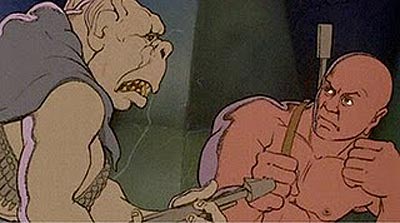
Nerdy teenager David (voiced by John Candy) finds a piece of the Loc-Nar and is transported to the world of Neverwhere, where he is transformed into Den, a muscular, bald warrior.  As Den, David gets to live out the fantasies of Heavy Metal‘s target audience.  On his new planet, Den rescues an Earth woman from being sacrificed, overthrows an evil queen and a sorcerer, and gets laid.  A lot.  Den is the best segment in Heavy Metal, largely because of the endearing contrast between the action onscreen and John Candy’s enthusiastic narration.

Captain Sternn (directed by Paul Sebella and Julian Harris, written by Bernie Wrightson)

heavy-metal_captain-sternOn a space station orbiting the Earth, Captain Lincoln F. Sternn is on trail for a countless number of offenses.  Though guilty, Captain Sternn expects to be acquitted because he has bribed the prosecution’s star witness, Hanover Fiste.  However, Hanover is holding the Loc-Nar in his hand and it causes him to tell the truth about Captain Sternn and eventually turn into a bloodthirsty giant. Captain Sternn saves the day by tricking Hanover into getting sucked out of an air lock.
Captain Sternn was a reoccurring character in Heavy Metal Magazine and his segment is one of the best.  Eugene Levy voices Captain Sternn while Joe Flaherty voices his lawyer and Dean Wormer himself, John Vernon, is the prosecutor.  Even National Lampoon co-founder Douglas Kenney provided a voice.

 B-17 (directed by Barrie Nelson, written by Dan O’Bannon)

After the Loc-Nar enters Earth’s atmosphere, it crashes into a bullet-riddled World War II bomber, causing the dead crewmen within to reanimate as zombies.  Scored to Don Felder’s Heavy Metal (Takin’ a Ride), B-17 is one of the shorter segments and its dark and moody animation holds up extremely well.

http://www.youtube.com/watch?v=ELUP-oZQKM4

So Beautiful and So Dangerous (directed by John Halas, written by Angus McKie)

Nubile Pentagon secretary Gloria is beamed aboard a spaceship that looks like a giant smiley face.  While she has sex with the ship’s robot captain, the two crew members (voiced by Harold Ramis and Eugene Levy) pour out a long line of cocaine and shout “Nosedive!” before snorting up every flake.  So Beautiful and So Dangerous is so juvenile and so ridiculous that it is actually all kinds of awesome.

Taarna

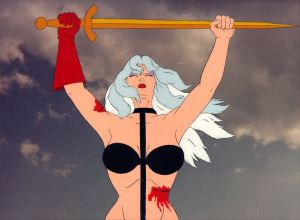
SacrificedIn the film’s final and most famous segment, Taarna, the blond warrior was featured on Heavy Metal‘s poster, rides a pterodactyl across a volcanic planet, killing barbarians, and finally confronting the Loc-Nar.  She sacrifices herself to defeat the Loc-Nar but no worries!  We return to Earth where, for some reason, the Loc-Nar explodes and the girl from the beginning of the film is revealed to be Taarna reborn.  She even gets to fly away on her pterodactyl.  Taarna was really great when I was twelve but today, it is impossible to watch it without flashing back to the Major Boobage episode of South Park.
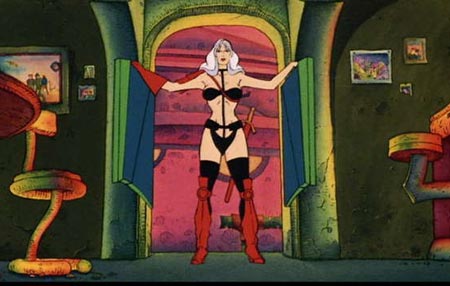
Much like Taarna, Heavy Metal seems pretty silly when I watch it today.  But when I was twelve, it was the greatest thing ever.

Taarna_Heavy_Metal


Back To School #26: Class of 1984 (dir by Mark L. Lester)


http://www.youtube.com/watch?v=-wFVpKYNvRU

“I am the future!” — Peter Stegman (Timothy Van Patten) in Class of 1984 (1982)

In many ways, the classic exploitation film Class of 1984 feels like an update of Blackboard Jungle.  An idealistic teacher Andrew Norris (Perry King) takes a job teaching at a crime-ridden inner city school.  There are a few differences.  For one thing, the teacher in Class of 1984 teaches music.  The graffiti-covered school in Class of 1984 looks a hundreds times worse than the one in Blackboard Jungle.  Sidney Poitier is nowhere to be seen in Class of 1984 though Michael J. Fox does show up as one of the good students.  Bad student Peter Stegman (Timothy Van Patten) and his gang are a lot more colorful and flamboyant than Vic Morrow ever was in Blackboard Jungle.

And, of course, the main difference between Blackboard Jungle and Class of 1984 is that, in the former film, teacher Glenn Ford’s liberal idealism ultimately defeated the forces of juvenile delinquency.  Ford may have been tempted to turn violent but, ultimately, he appealed to the better instincts of his other students and the world was better for it.

In Class of 1984, Andy Norris may start off as a liberal idealist but, ultimately, he reveals himself to be just as violent as his students.  And again, the world appears to be better for it.

(I imagine that, when this film was originally released, a lot of teachers probably watched it as a form of wish-fulfillment.)

Now, Andy’s actions may be extreme but he has his reasons.  Just consider everything that happened to him after he started teaching.

First off, his best friend and fellow teacher Terry Corrigan (Roddy McDowall) was driven insane by the school’s students.  Terry eventually ended up teaching while pointing a gun at his entire class.  (The scene where McDowall finally gets his class to pay attention is one of the best in the film, largely due to McDowall’s excellent performance.  The look of happiness that crosses his face when a student finally gives him the correct answer is both disturbing and funny at the same time.)

Secondly, his best student (that would be Michael J. Fox) ended up getting stabbed in the cafeteria by one of Stegman’s goons.

And finally, Stegman and his gang assaulted Andy’s wife.

Can you blame Andy Norris for taking the law into his own hands?

Now, me,  I have a tendency towards being a bleeding heart when it comes to those living on the fringes of society.  I’m against the death penalty.  I’m against the war on drugs.  I’m against violence.  I believe in compassion.  I believe in understanding.  I believe in love.  But even with all that in mind, I couldn’t help but enjoy Class of 1984.  Some of that is because the film is surprisingly well-acted.  You find yourself really caring about the characters played Perry King and Roddy McDowall and you also find yourself really hating Peter Stegman and his goons.  I don’t care how compassionate you are, there’s something very cathartic about watching Andy finally get back at his tormentors.  And then there’s the fact that, of all the directors to work in what has been termed the “exploitation” field, Mark Lester is one of the best.  He’s one of those directors who knows exactly how to tell a story and what buttons to push to get the proper emotional respect.

But mostly, the film works because of Timothy Van Patten’s performance as Peter Stegman.  Van Patten makes Stegman into one of the definitive teenage psychos.  As intimidating as Van Patten is, his best moments come when the film reveals the type of person that Stegman could have been if not for the fact that he’s a total sociopath.  At one point, when Andy tries to kick him out of music class, Stegman responds by sitting down at a piano and playing a beautiful piece of music.  Perhaps my favorite Stegman moments comes late in the film, when he’s seen sweetly talking to his devoted (and clueless) mother.

Not surprisingly for a film that was released over 30 years ago, Class of 1984 is undeniably dated.  But it doesn’t matter because Class of 1984 captures a universal and timeless truth.  There are always going to be frustrated teachers and dangerous students.  The only thing that changes is how society deals with the frustration and the danger.

class of 1984 a