Retro Television Review: Miami Vice 4.17 “Hell Hath No Fury”


Welcome to Retro Television Reviews, a feature where we review some of our favorite and least favorite shows of the past!  On Mondays, I will be reviewing Miami Vice, which ran on NBC from 1984 to 1989.  The entire show can be purchased on Prime!

This week, Trudy is once again the main character.  Fortunately, there’s no UFOs this time around.

Episode 4.17 “Hell Hath No Fury”

(Dir by Virgil W. Vogel, originally aired on March 11th, 1988)

Alan Beaks (Don Harvey), the scion of a prominent Florida family, has been released from prison after serving only a few years for raping a black school teacher named Ellen Mason (Carla Brothers).  Beaks claims that he’s reformed and, at the start of the episode, he appears on a talk show where the audience agrees that Alan Beaks is the perfect example of someone who has straightened out his life.

“I wouldn’t want it to happen to me,” one woman in the audience says, “but if it did, I would hope he would be as charming as Alan Beaks.”

Beaks now wants to make a public apology to Ellen.  However, she refuses to see him.  When she starts to get threatening phone calls, both she and her best friend Trudy are convinced that Beaks is the one calling.

Castillo, however, doesn’t want Trudy to have anything to do with Ellen or Beaks.  It’ll make the Vice Quad look bad, he says.  (Since when has Castillo ever used that type of logic?)  Still, when Ellen hires a hitman (John Finn) to kill Beaks, the Vice Squad finds itself involved.  No one on the Squad has any sympathy for Beaks and they don’t make much of an effort to protect him.  When a shootout leaves both Beaks and the hitman dead, Castillo tells the members of the Squad that they have failed and if they’re not going to full commit themselves to the job, they can transfer to another department.  Meanwhile, even with Beaks dead, Ellen is still getting phone calls, implying the Beaks was actually not her stalker.  The episode ends with a terrified Ellen listening as the caller threatens her….

Here’s my number one question about this episode: Why didn’t anyone trace the calls?  Ellen, the victim in a high-profile rape case, is getting calls from someone threatening to harm her.  That right there seems like the sort of thing that the police would normally investigate.  Trudy is Ellen’s best friend.  Trudy knows about the calls.  Trudy is a cop.  So, why didn’t the Vice Squad try to track down the caller?  If they could have proven that Beaks was the caller, Beaks would have gone back to prison.  If it turned out that someone else was the caller, that person would have gone to prison.  Beaks would still be free but at least Ellen wouldn’t be getting threatened every ten minutes.  In the past, that’s what would have happened on this show.  For some reason, this episode features everyone forgetting how to act like a cop.

In the end, this episode tried to deal with a lot of issues — tabloid journalism, rehabilitation, vigilante justice, racism, classism — but it ultimately felt like fan faction that was written by someone who really didn’t know much about the show or the characters.  (One would think that Gina, a rape survivor who gunned down her rapist during the first season, would have some thoughts on Ellen’s plan but instead, she spends the episode cheerfully exchanging one-liners with Switek.)  This was another Season 4 disappointment.

Retro Television Review: Miami Vice 2.11 “Back In The World”


Welcome to Retro Television Reviews, a feature where we review some of our favorite and least favorite shows of the past!  On Mondays, I will be reviewing Miami Vice, which ran on NBC from 1984 to 1989.  The entire show can be purchased on Prime!

This week, an old friend of Sonny’s comes to Miami.

Episode 2.11 “Back In The World”

(Dir by Don Johnson, originally aired on December 6th, 1985)

Directed by Don Johnson himself, Back In The World opens in the closing days of the Vietnam War.  A war correspondent named Ira Stone (played by Bob Balaban) has discovered that the bodies of American soldiers are being packed with heroin before being shipped back to the United States.  He shares the discovery with his best friend, a young Marine named Sonny Crockett.

Ten years later, Sonny is a member of Miami Vice and laughing as he watches the DEA go all out to arrest two rich kids who have a few pounds on weed on them.  Meanwhile, Ira Stone is still a journalist but it’s been a while since he’s had a major byline.  Stone has become known for being erratic and paranoid.  His own wife (played by Patti D’Arbanville, who was Johnson’s girlfriend at the time this episode was filmed) describes Stone as being a crazed junkie who spends his time chasing imaginary enemies.  Sonny discovers just how paranoid Stone has become when Stone approaches him and asks for help in exposing the truth about the heroin trade.

Stone has a lot of theories, the majority of which involve rogue elements of the CIA.  Sonny agrees to help Stone investigate a lead but he’s skeptical of Stone’s theories.  But then someone launches a mortar attack on Sonny and Stone while they’re talking on a motorboat.  “INCOMING!” Stone yells as Sonny steers the boat through a shower of explosions.  As out there as Ira Stone may be, he’s obviously made someone uncomfortable.

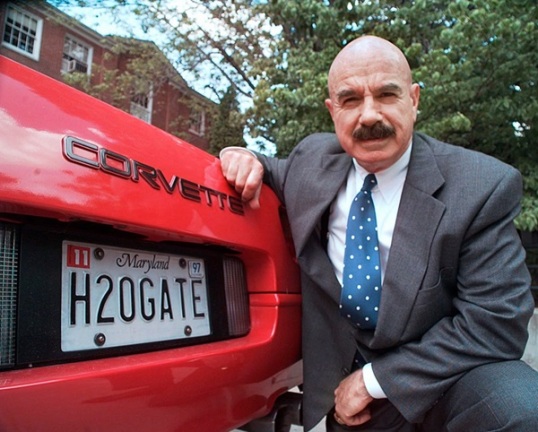
Could that someone be William Maynard (G. Gordon Liddy, who was one of the Watergate burglars)?  Maynard is a former (and maybe current) CIA agent who, in Vietnam, was renowned for his ability to track down and destroy the enemy.  Now, Maynard lives in a Miami mansion with his wife (Susan Hatfield) and a mute servant who has a tendency to show up whenever someone needs to be killed.   While Crockett and Stone investigate Maynard, Tubbs and Switek (who is dressed as a leather-clad biker for some reason) investigate an exotic drug currier named Dakotah (Iman).

It’s an intriguing story but it ends on a rather conventional note, with Crockett and Tubbs launching an assault on one of Maynard’s mansions in the Everglades.  It’s probably not a coincidence that the Everglades are filmed to resemble a Vietnamese jungle.  At one point, Crockett nearly shoots in Tubbs by mistake, a stark reminder of the confusion that comes with combat.  In the end, Maynard escapes, Stone is seriously wounded, and the heroin trade continues.  There aren’t many happy endings to be found in Miami.

This was an uneven but entertaining episode.  The use of The Doors on the soundtrack was occasionally effective and occasionally heavy-handed.  The opening Vietnam montage was done well but it fell apart as soon as middle-aged and gravelly-voiced Don Johnson showed up as a fresh-faced Marine in his 20s.  That said, once the action moved to Miami and the present day, Don Johnson was never less than convincing as a battle-scarred veteran still trying to come to terms with what happened in Vietnam.  G. Gordon Liddy was entertaining as Maynard, even if it was obvious that acting was not his main thing.  Bob Balaban’s manic intensity (“INCOMING!”  “MEDIC!”) made Ira Stone into a fascinating character.  A visit by Crockett and Stone to a VA hospital not only leads to an important lead but it also allows the show to discuss the shameful way that America treated (and treats) veterans of unpopular wars.  Johnson did a good job directing the episode but it still never quite escaped the shadow of the thematically-similar Bushido.

Incidentally, my father used to have a “G. Gordon Liddy For President” bumper sticker.  And I’ve got a beat-up copy of Liddy’s autobiography, one that I purchased from Recycled Books in Denton a few years ago.  After watching this week’s episode, I think I’ll give it a read.