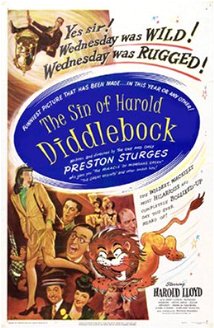
The 42nd film in Mill Creek’s Fabulous Forties box set was a 1947 comedy called The Sin of Harold Diddlebock.
As a classic film lover, I really wish that The Sin of Harold Diddlebock was better than it actually is. The film was a collaboration between two of the biggest names in cinematic comedy history: director/writer Preston Sturges and legendary actor Harold Lloyd. In fact, this was the first film that Sturges directed after leaving the studio system so that he could make bring his unique brand of satire to life without having to deal with interference. He managed to convince Harold Lloyd to come out of retirement to star in the movie and the film even works as a quasi-sequel to one of Lloyd’s most beloved silent comedies, The Freshman. In a perfect world, The Sin of Harold Diddlebock would have been a comedy masterpiece that would have perfectly shown off the talents of both men.
Unfortunately, that’s really not the case. The Sin of Harold Diddlebock is consistently amusing but it’s never quite as funny as you want it to be. This is one of those films that sounds like it should be hilarious but, when you actually watch it, you see that the film is oddly paced and Lloyd never seems to be fully invested in his role. I suppose the natural inclination would be to blame this on interference from the notoriously eccentric Howard Hughes, who co-produced the film with Sturges. After Harold Diddlebock failed at the box office, Hughes withdrew it and spent three years personally reediting the film before re-releasing it under the title Mad Wednesday. However, by most reports, Hughes wasn’t really the problem. If Wikipedia is to be believed (and God do I hate starting any sentence with that phrase), Lloyd and Sturges did not have a good working relationship. As sad as that is, it’s also understandable. Geniuses rarely work well together.
The Sin of Harold Diddlebock does get off to a good start, seamlessly incorporating the last reel of The Freshmen with footage shot for Harold Diddlebock. (Somewhat sweetly, the film starts with a title card informing us that the what we are about to see was taken from The Freshman.) After college freshman Harold Diddlebock scores the winning touchdown in a football game, impressed advertising executive J.E. Waggleberry (Raymond Walburn) offers Harold a job. However, Harold wants to finish college so Waggleberry tells Harold to look him up in four years.
Four years later, recently graduated Harold goes to Waggleberry for a job and discovers that J.E. Waggleberry has totally forgotten him. Harold ends up working in the mailroom but is told that, as long as he is ambitious and smart, he will easily move up in the company. 22 years later, Harold is still working in the mailroom. He is secretly in love with Miss Otis (Frances Ramsden). Of course, he was also in love with each of Miss Otis’s six older sisters, all of whom worked at the company before the current Miss Otis. Harold bought an engagement ring when the oldest Otis sister was with company. Years later, he’s still carrying it with him and dreams of giving it to the current Miss Otis.
However, that might be difficult because Harold has just been fired. J.E. Waggleberry feels that Harold’s unambitious attitude is setting a bad example. As severance, Harold is given a watch and $2,946.12.
The normally quiet and reserved Harold reacts to losing his job by doing something very unusual for him. He goes to a bar and, with the help of a con man (Jimmy Conlin) and a bartender (Edgar Kennedy), he gets drunk. The bartender even creates a special drink called the Diddlebock. Harold drinks it and wakes up two days later, wearing a huge cowboy hat and owning a bankrupt circus…
And it only gets stranger from there….
While The Sin of Harold Diddlebock doesn’t quite work, I appreciated the fact that it not only created its own surreal world but that it just kept getting stranger and stranger as the film progressed. It was Harold Lloyd’s final film and there’s even a scene where he and a lion end up on the edge of a skyscraper that’s almost as good as the famous comedic set pieces from his silent classics. It’s a pity that the film doesn’t really come together but I’d still recommend seeing it just for history’s sake.
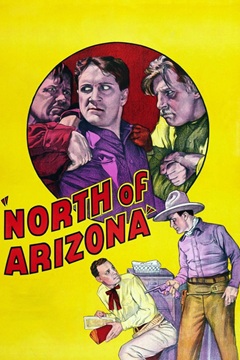 Newly hired ranch foreman Jack Loomis (Jack Perrin) comes to the aid of two Indians who were nearly swindled out of their land during a card game. The Indians inform Jack that his new boss, George Tully (Al Bridge), is actually a crook and the ranch is just a front for his criminal activities. When Jack says he doesn’t want to be a part of Tully’s schemes, Tully and his men frame Jack for a robbery.
 Through the Shattered Lens