Icarus File No. 17: Che! (dir by Richard Fleischer)


Che Guevara!

By most accounts, Che Guevara epitomized the excesses and the hypocrisies of the extreme Left.  He spoke of the class struggle while remaining an elitist himself.  He oversaw thousands of executions and advocated for authoritarian rule.  In his writings, he frequently revealed himself to be a racist and a misogynist.  By arguing that the Russians should be allowed to bring nuclear missiles to Cuba, he brought the world to the brink of destruction.  However, he also died relatively young and he looked good on a t-shirt.  Decades after he was executed by the Bolivian Army in 1967 (or was it the CIA?), he remains an icon for college students and champagne socialists everywhere.

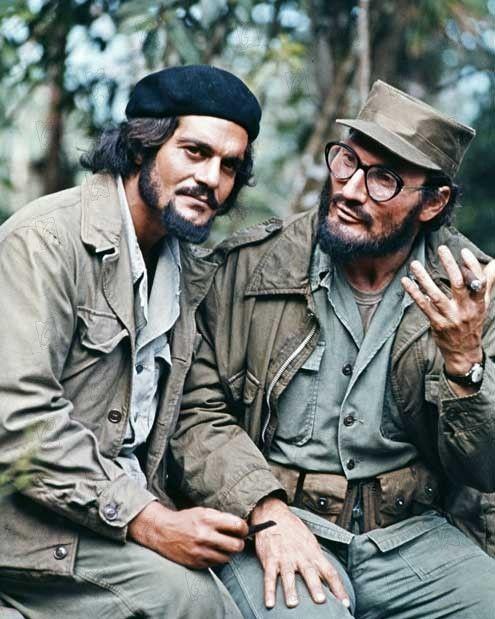
The film about Che! was released in 1969, two years after his death.  Starring the Egyptian actor Omar Sharif as Che Guevara, Che! opens with Guevara already a martyr and then quickly gives way to flashbacks.  Various actors pretending to be Cuban appear and speak directly to the audience, debating Che Guevara’s legacy.  Some describe him as being a violent thug who killed anyone who displeased him.  Others describe him as a visionary doctor who sacrificed his comfortable existence for the people.  It’s a rather conventional opening and one that hints that Che! is going to try to have it both ways as far as Che’s legacy is concerned.  But it’s still effective enough.  A montage of soldiers and rebels creates the proper feeling of a society on the verge of collapse.

And then Jack Palance shows up.

Palance first appears creeping his way through the Cuban jungle with a group of soldiers behind him.  Palance is chomping on a cigar and he wears the intense look of a man on a mission.  My initial reaction was that Palance was playing one of the CIA agents who sent to Cuba to try to assassinate Fidel Castro or to set up the Bay of Pigs invasion.  I kept waiting for him to look at the camera and launch into a monologue about why, for the safety of America, he had been dispatched the topple Cuba’s communist government.  Imagine my shock when Omar Sharif called Palance, “Fidel.”

Yes, that’s right.  Jack Palance plays Fidel Castro!  As miscast as the suave Omar Sharif is as Che Guevara, nothing can prepare one for seeing Jack Palance playing Fidel Castro.  Needless to say, there is nothing remotely Cuban or even Spanish about Jack Palance.  He delivers his lines in his trademark terse Jack Palance voice, without even bothering to try any sort of accent.  (And, needless to say, both he and Sharif speak English through the entire film.)  Anyone who has ever seen a picture of a young Fidel Castro knows that, while he shared a family resemblance with Justin Trudeau, he looked nothing like Jack Palance.  Eventually, Palance puts on a fake beard that makes him look even less like Castro.  When one of our narrators mentions that Castro was a great speaker, the film cuts to a scene of Palance spitting out communist slogans with a noted lack of enthusiasm.  When Castro takes control of Cuba, Palance looks slightly amused with himself.  When Che accused Castro of selling out the revolution, Palance looks bored.  It’s a remarkably bad piece of casting.  Seeing Palance as Castro feels like seeing John Wayne as Genghis Khan.  Thank goodness Hollywood never tried anything that silly, right?  Anyway….

As for the rest of the film, it hits all the expected notes.  The film was made in the very political year of 1969, a time when the New Left was ascendant and many considered Che Guevara to be a hero.  However, since this was a studio production, Che! tries to appeal to both college radicals and their parents by taking a “both sides” approach to Che Guevara.  Here’s Che teaching an illiterate farmer how to read.  Here’s Che overseeing a bunch of dissidents being executed.  Here’s Che getting angry at Castro for not being properly enthusiastic about housing Russian nuclear missiles.  Here’s Che talking about a moral revolution.  Here’s Che trying to start an unwanted war in Bolivia.  Here’s Che talking to Sid Haig — hey, Sid Haig’s in this film!

Like so many mainstream political films of the 60s and today, Che! tries to be political without actually taking any firm positions.  One is tempted to say that is the film’s downfall.  Of course, the film’s real downfall is casting Jack Palance as Fidel Castro.

There’s no way to recover from that.
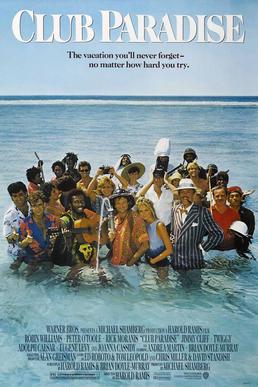
Club Paradise (1986, directed by Harold Ramis)


I think I was nine or ten years old when I first saw Club Paradise on HBO.  I remember thinking it was pretty funny.

I recently rewatched Club Paradise and I discovered that ten year old me had terrible taste in movies.

Robin Williams plays Jack Moniker, a Chicago fireman who gets blown out of a building while rescuing a dog.  Living off of his disability payments, he retires to the island of St. Nicholas, which is basically Jamaica but with less weed.  Jack and reggae musician Ernest Reed (Jimmy Cliff) open up their own Club Med-style resort, Club Paradise.  Jack doesn’t know much about the resort business but he does know how to put together a good brochure.  Almost the entire cast of SCTV shows up at Club Paradise, looking for a tropical vacation.  Things quickly go wrong because Jack doesn’t know how to run a resort and there’s also an evil developer (played by Brian Doyle-Murray) who wants Club Paradise to fail so that he can get the land.

Club Paradise has got a huge and impressive cast, the majority of whom probably signed on because they were looking forward to a paid Caribbean vacation.  Peter O’Toole plays the British-appointed governor of St. Nicholas.  Twiggy plays Jack’s girlfriend.  Joanna Cassidy plays a reporter and Adolph Caesar is cast in the role of St. Nicolas’s corrupt prime minister.  Because the film was directed by Harold Ramis, it is full of Ramis’s co-stars from SCTV.  Andrea Martin tries to get her husband to enjoy the islands as much as she’s enjoying them.  Joe Flaherty is the crazed pilot who flies people to the resort.  Rick Moranis and Eugene Levy play two nerdy friends who are both named Barry and who are only interested in scoring weed, getting laid, and working on their tan.  Rick Moranis and Eugene Levy playing nerds?  It’s a shock, I know.

There’s enough funny people in Club Paradise to ensure that there are a few isolated laughs.  Not surprisingly, the movie comes to life whenever Moranis and Levy are onscreen.  (If I had to guess, I imagine they were the reason why ten year-old me liked this movie so much.)  Needless to say, Jimmy Cliff also provides a killer soundtrack.  But Club Paradise ultimately doesn’t work because the script is too disjointed and it feels more like an uneven collection of skits than an actual film.  It’s impossible to tell whether we’re supposed to think of Club Paradise as being the worst resort ever or if we’re supposed to be worried that the bad guys will shut it down.  For a movie like this, you need a strong central presence to hold things together.  Unfortunately, Robin Williams’s style of comedy is too aggressive for the role of Jack.  The role was originally written for Bill Murray and it shows.  Most of Jack’s lines sound like things you would expect Bill Murray to say in his trademark laid back fashion and it is easy to imagine Murray redeeming some of Club Paradise‘s weaker scenes simply by attitude alone.  Instead, Robin Williams is so frantic that you never buy he could be happy living a laid back life on a Caribbean island.  As played by Williams, Jack often comes across as being unreasonably angry at everyone staying at Club Paradise and it’s hard to care whether or not he manages to save his resort or not.

Club Paradise was a bomb at the box office.  Harry Shearer, who was originally credited with working on the screenplay, hated the movie so much that he requested his name be removed from the credits.  (Instead, credit is given to Edward Roboto.)  As a result of the film’s failure, it would be 7 years before Harold Ramis would get to direct another movie.  Fortunately, that movie was Groundhog Day and this time, Ramis was able to get Bill Murray.

Lisa Reviews An Oscar Nominee: A Soldier’s Story (dir by Norman Jewison)


http://www.youtube.com/watch?v=SG1mF1jtul0

Set during World War II, 1984’s A Soldier’s Story opens with a murder.

On a rural road outside of a segregated army base in Louisiana, someone has gunned down Sergeant Vernon Walters (Adolph Caesar).  At the time, Walters was staggering back to the base after a night of heavy drinking.  Both the local authorities and Watlers’s fellow soldiers assume that the murder was the work of the Ku Klux Klan.  Captain Richard Davenport (Howard Rollins) isn’t so sure.

Captain Davenport is the officer who has been assigned to investigate the murder.  From the minute that he arrives at the base, the soldiers stare at him.  As Cpl. Ellis (Robert Townsend) explains it, the enlisted men are shocked because they’ve never seen a black officer before.  Some of the soldiers admire Davenport while other view him with suspicion, wondering what Davenport must have done or who he must have sold out to earn his commission.

Meanwhile, the other officers (who are all white) view Davenport with a combination of condescension and hostility.  Col. Nivens (Trey Wilson) only allows Davenport three days to wrap up his investigation and assigns the polite but skeptical Capt. Taylor (Dennis Lipscomb) to work with him.  Taylor suspects that Walters may have been murdered by the openly racist Lt. Byrd (Wings Hauser!).  Davenport, however, isn’t so sure.  Even though the official story is that Walters was a tough but fair sergeant who was respected by his company, Davenport suspects that one of them may have killed him.

Davenport and Taylor start to interview the soldiers who actually had to deal with Walters on a daily basis.  Through the use of flashbacks, Walters is revealed to be a far more complex man than anyone knew.  We see that Walters was a man who was bitterly aware of the fact that, even after a lifetime of military service, he was destined to always be treated as a second-class citizen by the nation that he served.  Unable to strike out at the men who the army and society had placed over him, Walters instead struck at the men serving underneath him.  While the man in Walters’s company wait for word on whether or not they’ll be allowed to serve overseas, Davenport tries to determine if one or more of them is a murderer.

A Soldier’s Story was adapted from a play but director Norman Jewison is careful to prevent the material from becoming stagey.  Effortlessly transitioning from the film’s present to flashbacks of the events that led to Walters’s murder, Jewison crafts both an incendiary look at race relations and a compelling murder mystery.  He’s helped by a strong cast of predominately African-American actors.  In one of his earliest roles, Denzel Washington plays Pfc. Peterson with a smoldering intensity.  David Alan Grier and Robert Townsend, two actors known for their comedic skills, impress in dramatic roles.  Seen primarily in flashbacks, Adolph Caesar turns Walters into a complex monster.

And yet, with all the talent on display, it is Howard Rollins who ultimately steals the movie.  As  a character, Captain Davenport has the potential to be a rather thankless role.  He spends most of the movie listening to other people talk and, because of his status as both an officer and a black man in the rural south, he’s rarely allowed to show much anger or, for that matter, any other emotion.  However, Rollins gives a performance of such quiet intelligence that Davenport becomes the most interesting character in the movie.  He’s the ultimate outsider.  Because of his higher rank and his role as an investigator, he can’t fraternize with the enlisted men but, as an African-American, he’s still expected to remain separate from and differential to his fellow officers.  As the only black officer on a segregated base, Davenport is assigned to stay in an empty barrack.  One of the best scenes in the film is Davenport standing alone and surveying the stark layout of his temporary quarters.  The expression on his face tells you everything you need to know.

(Towards the end of the film, when Davenport finally gets a chance to drop his rigid facade and, if just for one line, be himself, you want to cheer for him.)

A Soldier’s Story was nominated for best picture but it lost to another theatrical adaptation, Milos Forman’s Amadeus.


A Movie A Day #37: The Challenge (1970, directed by Alan Smithee)


A U.S. spy satellite has crashed onto an uninhabited island in the Pacific Ocean.  Both the United States and an unnamed communist country (described as being “a fifth-rate China,” but obviously meant as a stand-in for not only China but North Korea and North Vietnam as well) have both lay claim to the satellite.  To prevent a possible war, the two countries agree to a compromise.  One American and one communist will be dropped off on the island and will fight to the death.  The survivor gets the satellite.  The communists send the disciplined Yuro (Mako).  The American select Jacob Galley (Darren McGavin), a grizzled Vietnam veteran-turned-mercenary.  Jacob is armed with the latest advancements in weaponry, including a double-barreled sub-machine gun.  Yuro is armed mostly with his wits and an endless supply of booby traps.  Jacob and Yuro fight to a stand still, growing to respect each other even as each tries to kill the other.  However, both countries are willing to cheat to win the challenge.

Originally made for television, this is one of the many films to have been credited to Alan Smithee, the pseudonym that directors used to use whenever they felt that the finished film, usually because of studio interference, did not properly represent their vision.  According to the imdb, The Challenge was actually directed by veteran television directed George McGowan, whose other credits includes episodes of shows like Fantasy Island, Starsky and Hutch, and Charlie’s Angels.  I am surprised that McGowan chose to take his name off of The Challenge because, for a television movie, it’s not bad.  The Vietnam analogy is laid on a little thick but the action is exciting and both McGavin and Mako give excellent performances as the two very different combatants.

The Challenge can be viewed on YouTube.  Keep an eye out for a very young Sam Elliott, in the role of America’s insurance policy.

original_thechallenge5