The TSL’s Daily Horror Grindhouse: Frightmare (dir by Pete Walker)


Frightmare_FilmPoster

Since I already reviewed one British film about cannibalism earlier today, I figured why not review another one?  Pete Walker’s film Frightmare was released in 1974, two years after the release of Death Line.  You have to wonder what was going on in British society in the early 70s that led to so many cannibal films.  When watched together, Frightmare and Death Line present a vision of a society that was devouring itself, both literally and figuratively.

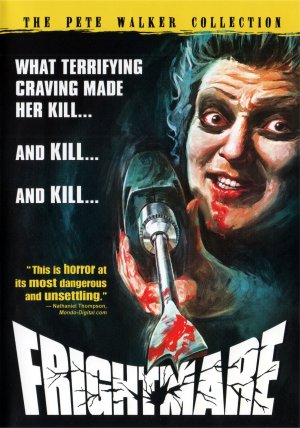
Frightmare tells the story of Dorothy (Shelia Keith) and Edmund Yates (Rupert Davies).  Dorothy is a fortune teller who has something of a violent temper.  Edmund is her loving but abused husband.  However, Dorothy has more than just a temper.  She also has a taste for human flesh.  She’s just spent 15 years in prison, convicted of killing and eating a man.  However, she has now been “found sane,” (and that’s a term that is repeated, with increasing irony, throughout the entire film) and she has been released.  She’s even reading fortunes again!

Jackie (Deborah Fairfax) is Edmund’s daughter by his first marriage.  She’s devoted to her father and, at the same time, scared of her mother.  She doesn’t believe that her mother is truly sane, despite the fact that her psychiatrist boyfriend, the well-meaning but arrogant Graham (Paul Greenwood), continues to remind her that Dorothy has been “found sane.”  Jackie knows that Dorothy still wants to eat human flesh so, every weekend, she takes the train to Dorothy’s home and delivers meat.  Jackie tells Dorothy that it’s human flesh but, in reality, it’s just a placebo.  When Graham finds out what Jackie’s doing, he is outraged.  After all, Dorothy has been found sane!

Jackie, however, has other things to worry about.  Her younger half-sister, the rebellious Debbie (Kim Butcher), is living with her.  Along with dating an obnoxious biker, Debbie also resents the fact that Jackie is obviously Edmund’s favorite.  And, as quickly becomes clear, Debbie is as much of a sociopath as her mother…

Speaking of which, Dorothy may have been found sane but it’s obvious that she’s not.  (Throughout the film, no matter how erratic Dorothy’s behavior becomes, Graham continually assures us that she has been found sane.)  It also become obvious that Jackie’s placebos are not doing the trick.  Dorothy is once again murdering the random people who come to get their fortunes told.  And Edmund is helping her cover up the crimes, all the while pathetically telling anyone who will listen, “They said she was sane….they said she was sane…”

Frightmare is one of those films that you really do have to see in order to understand just how effective it is.  It’s an undoubtedly pulpy story and there’s not a subtle moment to be found in the entire film but it doesn’t matter.  Frightmare is properly named because it is pure nightmare fuel.  This is a film that work both as a family melodrama and a satire on the trust that people put into authority (the authorities said that Dorothy was sane so, everyone assumes, she must be) but ultimately, this is an intense and frightening little film.  That’s largely due to Sheila Keith’s ferocious performance.  She turns Dorothy into a force of cannibalistic nature.

Feel free to have a Death Line/Frightmare double feature.  Just don’t expect to have much of an appetite afterward…
The TSL’s Daily Horror Grindhouse: The House of the Devil (dir by Ti West)


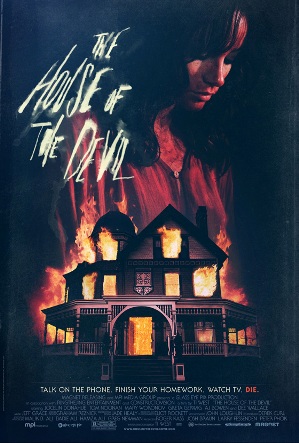
When was the last time you actually saw a good movie on Chiller?  Seriously, it doesn’t happen that often and perhaps that’s why, when, a few years ago, I curled up on the couch and watched 2009′s The House of the Devil on Chiller, I wasn’t expecting much.  However, I was pleasantly surprised to discover that The House of the Devil is actually one of the most effective low-budget horror films that I’ve seen in a while.

The plot of House of the Devil is pretty simple.  Samantha (a likable performance from Jocelin Donahue) is a college student who has just moved into her first apartment.  However, Samantha can’t really afford to pay the rent so she agrees to take a babysitting job for the mysterious Mr. Ullman (Tom Noonan, who is just so creepy in this film).  Ullman offers her one hundred dollars to come babysit for the night.  Samantha agrees and, with her skeptical friend Megan (Greta Gerwig, who is hilarious here), drives out to Ullman’s home.  It turns out that Ullman lives in an isolated house out in the country and that he actually doesn’t have any children.  Instead, he wants Samantha to babysit his aging mother while he goes into town so he can watch the lunar eclipse which just happens to be happening on that exact night!  Samantha is reluctant but agrees to stay when Ullman offers to pay her $400.00.

And can you guess where this story is headed?

This film isn’t titled House of the Devil for nothing.

The_House_of_the_Devil


As I said before, I wasn’t expecting much from The House Of The Devil.  I was honestly expecting it just to be a typical, low-budget Chiller horror film, good for nothing more then maybe a laugh or two and maybe a few memorably silly gore effects.  Having now seen the film, I’m very happy to say that I was incorrect.  The House of the Devil is a well-made, effectively creepy horror film and it’s one that other horror filmmakers could very much learn from.

Don’t get me wrong.  The plot of House of the Devil isn’t going to win any points for creativity.  Even if the film didn’t open with a wonderfully self-concious title card informing us that the movie is “based on a true story” of Satanic activity, it would be pretty easy to figure out that nothing good is going to happen once Samantha goes into the house.  But that actually works to the film’s advantage.  The House of the Devil feels like an old ghost story told at a sleepover.  You know where the story’s heading but you get scared nonetheless because, ultimately, it’s the type of story that plays on the fears that everyone has.

Also, in the style of the scary ghost story told by a storyteller with a flashlight pointed up at her chin, The House of the Devil understands that the best horrors are the ones produced by an overstimulated imagination.  With the exception of two or three scenes, this is not a gory film nor is it a film that sadistically lingers over scenes of torture and carnage.  Instead, director Ti West takes his time to set up both the story and the characters.  This is a film where the horror comes more from a carefully constructed atmopshere than any sort of easy shock effects.  As a result, this is a horror film that actually stays with you after you watch it.

The House of the Devil is a film that I’m very happy to recommend.

The TSL’s Daily Horror Grindhouse: The Hollow (dir by Sheldon Wilson)


Syfy-movie-The-Hollow

So, earlier today, I finally got around to watching the latest SyFy original film, The Hollow.  (The Hollow originally aired last Saturday but I missed it because I was going from Halloween party to Halloween party, wandering around in chilly and wet weather without much on and eventually coming down with a cold as a result.)  Now, it may seem strange to review a made-for-TV movie as a part of a series of grindhouse film reviews but, much like They Found Hell, The Hollow probably would have played at the grindhouse if there was still a grindhouse around for it to play at.

As for the film itself, it was a story of death, curses, family dysfunction, and sisterhood.  The Hollow takes place on Shelter Island.  To be honest, just the name Shelter Island should let you know that something bad is going to happen.  I mean, Shelter Island sounds too similar to Shutter Island for it to be a totally safe place.  One hundred years ago, a legendary storm wiped out the island’s population.  Over the century, the island has recovered and new people have moved in.  But now, another storm is threatening to hit and that storm is bringing a curse with it!  Soon, the island will be attacked by monsters that appear to be made out of dirt and fire…

Of course, the monsters aren’t the only ones coming to Shelter Island.  There are three sisters as well — Sarah (Stephanie Hunt), Marley (Sarah Dugdale), and Emma (Alisha Newton).  Coming from a dysfunctional family, they’re planning on spending Halloween in a cabin on the island and working on their fractured relationship.  Unfortunately, those plans are interrupted by the arrival of the monsters.  As the sisters try to find some way to get off the island, Emma suddenly vanishes.  Sarah and Marley search for her, while dealing not only with the monster but also with other survivors, some of whom are more helpful than others.

I actually really enjoyed The Hollow.  Why?  Well, it all comes down to three things:

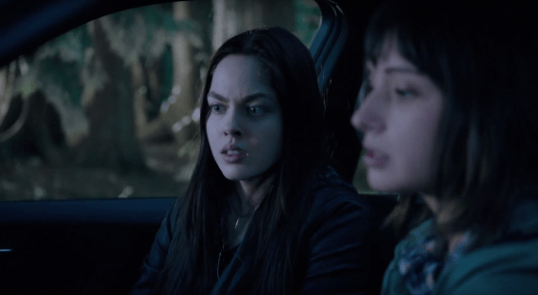
Number one, Shelter Island was extremely creepy!  This film is full of images of characters running through a seemingly endless forest, with all the trees enshrouded by a thick fog.  Director Sheldon Wilson took full advantage of the menacing possibilities of his location.  When it comes to a horror film — especially a low-budget one — never underestimate the importance of atmosphere.

Number two, the monsters were genuinely scary and well-done.  You never knew where they were going to suddenly show up and, as a result, you were kept off-balance throughout the entire film.

Finally, the main reason I enjoyed The Hollow was because Stephanie Hunt, Sarah Dugdale, and Alisha Newton were perfectly cast and believable as the three sisters.  I’m the youngest of four sisters and, needless to say, there were many scenes to which I could relate.  Since you believed their relationship and cared about them as characters, this brought a bit more depth to The Hollow than you might otherwise have expected.

The Hollow was a nice surprise.  Keep an eye out for it on the SyFy channel.

The TSL’s Daily Horror Grindhouse: Hands of the Ripper (dir by Peter Sasdy)


MPW-27513

The 1971 Hammer film Hands of the Ripper tells the story of Anna (Angharad Rees), a woman living in Victorian England who has a few issues.

What type of issues, you may wonder?  Well, first off, she’s the daughter of the infamous serial killer known as Jack The Ripper.  When she was just a baby, her father killed her mother while Anna watched from her crib.  Now, years later, the teenage Anna is working for a fake medium named Mrs. Golding (Dora Bryan).  It’s Anna’s job to stand behind the curtain and provide the ghostly voices whenever Mrs. Golding is holding one of her fake seances.

One such séance is attended by both a sleazy member of Parliament named Dysart (Derek Godfrey) and a progressive psychiatrist named Dr. John Pritchard (Eric Porter).  When Mrs. Golding’s ruse is discovered, she decides to “give” Anna to Dysart.  However, this plan falls apart when Anna suddenly goes crazy, grabs a fireplace poker, and murders Mrs. Golding.  Dysart flees the scene, leaving Anna, who claims to have no memory of attacking anyone, with John.  Assuming that he can cure her, John takes Anna in and set her up at his house.

Well, it turns out that curing Anna will not be quite as easy as John assumed.  For one thing, Anna is extremely repressed and often refuses to open up to him.  Also, there’s the fact that Anna keeps killing people.  Whenever anyone stands to close to Anna or kisses her on the cheek, Anna goes into a trance and hears her father’s voice demanding that she kill.  John, convinced that he can save Anna, continues to cover up every murder.

I really wasn’t expecting much from Hands of the Ripper.  In fact, I have to admit that the main reason I dvred it off of TCM was because I thought this might be the film in which Klaus Kinski played Jack the Ripper.  I was wrong, of course.  The Kinski Jack the Ripper film was called Jack the Ripper and it was directed by Jess Franco.  Hands of the Ripper, on the other hand, is a Hammer film that was released in 1971, at a time when Hammer was struggling to stay relevant in an ever-changing cinematic landscape.  Perhaps that’s why the murders in Hands of the Ripper were gory, even be the bloody standards of Hammer Films.

Interestingly enough, though the film was made over 40 years ago, the murders themselves remain quite shocking.  I can only imagine how audiences in 1971 reacted to them.  The scene where Anna suddenly attacks a housekeeper made me flinch, as did a later scene in which one of Anna’s victims stumbled out onto a crowded street, minus an eye.  Angharad Rees gave a good performance as Anna, one that keeps you guessing as to whether or not she’s just crazy or if maybe she really is possessed by the spirit of her father.

Hands of the Ripper is a good Hammer film, one that combines the usual Hammer tropes with a bit more psychological depth than one might expect.  This is one to keep an eye out for.

The TSL’s Daily Horror Grindhouse: Faceless (dir by Jess Franco)


FacelessPoster1988

Whenever it comes time to review a film like 1988’s Faceless, movie bloggers like me are faced with a very important question.  Which name should we use for this film’s prolific director?  The director was born Jesus Franco Manera and, for a very small handful of his 200+ film, he’s actually credited by his full name.  However, for the majority of his films, he dropped the Manera.  Sometimes, he is credited as Jesus Franco and then other times, the director’s credit reads Jesse Franco or just simply Jess Franco.

Myself, I usually prefer to go with “Jess Franco,” because it just seems to go with his “never give up” style of filmmaking.  At the same time, it seems rather appropriate that Franco is known by more than one name because he was a director with a many different personas, occasionally a serious artist, occasionally a subversive prankster, and sometimes a director-for-hire.  Franco was a lover of jazz and his films often had a similarly improvised feel.  Sometimes, the results were, to put it lightly, not very memorable.  But, for every Oasis of the Zombies, there was always a chance that Franco would give the world a film like Female Vampire.  The imdb credits Franco with directing 203 films before his death in 2013 but it’s generally agreed that he probably directed a lot more.  A lot of his films may not have worked but the ones that did are memorable enough to justify searching for them.

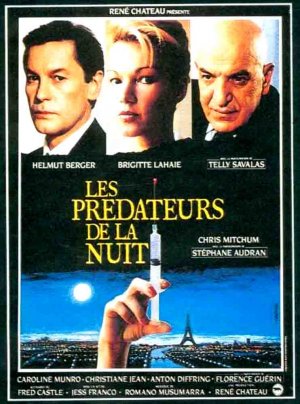
Faceless is Franco’s take on Eyes Without A Face, as well as being something of a descendant of his first film, The Awful Dr. Orloff.  All three of these films deal with a doctor trying to repair a loved one’s disfigured face.  In Faceless, the doctor is Dr. Flammad (Helmut Berger), a wealthy and decadent Paris-based plastic surgeon.  One night, while out with his sister Ingird (Christiane Jean) and his nurse and lover Nathalie (Brigitte Lahaie, the former pornographic actress who appeared in several of Jean Rollin’s best films, including the brilliant Night of the Hunted), Dr. Flammad is confronted by a former patient.  Flammad botched her operation so the patient tries to get back at him by tossing acid in his face.  However, Ingrid shoves Flammad out of the way and ends up getting splashed by the acid instead.

Now disfigured, Ingrid spends her time hidden away in Flammad’s clinic and wearing a mask.  Flammad and Nathalie start to kidnap models and actresses, searching for a perfect face.  Flammad’s plan is to perform a face transplant, giving Ingrid a new and beautiful face.

Needless to say, a face transplant is not a simple thing to do.  In order to get some advice, they go to the mysterious Dr. Orloff (Howard Vernon) and Orloff directs them to a Nazi war criminal named Dr. Moser (Anton Diffring).  Now, if you’re not familiar with Franco’s work, the scene with Dr. Orloff will probably seem like pointless filler.  However, if you are a Francophile, you will feel incredibly relieved to see Howard Vernon suddenly pop up.  When it comes Franco’s films, a Howard Vernon cameo is usually a good sign.

Flammad’s search for the perfect face is complicated by the fact that his assistant, the moronic Gordon (Gerard Zalcberg), keeps accidentally killing and otherwise damaging all of the prospects.  As the bodies continue to pile up, Nathalie even points out that there’s “too many dead bodies” in the clinic.

(Of course, Nathalie isn’t doing much to solve that problem.  When the film got to the moment where Nathalie plunged a syringe into one troublesome patient’s eye, I ended up watching the movie between my fingers.)

Eventually, Nathalie kidnaps a coke-addicted model named Barbara (Caroline Munro).  Flammad thinks that Barbara might finally be the perfect face that they’ve been looking for but there’s a problem.  (Actually, two problems if you count Gordon…)  Barbara’s father (Telly Savalas) is a wealthy industrialist and he wants his daughter back.  He hires an American private investigator, Sam Morgan (Chris Mitchum, looking a lot like his father Robert), to track her down.

Actually, it’s not that much of a problem.  It quickly turns out that Sam is kind of an idiot.  Plus, since he’s American, nobody in Paris wants to help him.  A Paris police inspector orders him to go home, yells at him for always chewing gum, and then adds, “You are not Bogart!”

And things only get stranger from there…

Faceless is one of Franco’s better films, a mix of over-the-top glamour (Faceless was filmed in Paris, after all) and grindhouse sleaze.  Though there is a definite storyline, the film still feels like an extended improvisation, with characters and plot points coming out of nowhere and then disappearing just as quickly.  If we’re going to be totally honest, the film is kind of a mess but it’s a glorious and stylish mess, one that is never less than watchable.

One of the great tragedies of American politics is that Chris Mitchum has twice been defeated when he ran for a seat in the U.S. House of Representatives (though he did come close to winning in 2014).  Not only would it be great to have Robert Mitchum’s son as a member of Congress but it would be even better to know that our laws were being written, in part, by the star of Faceless.  Unfortunately, Chris is sitting out the 2016 election.  Hopefully, he’ll reconsider and file for at least one office.

Run, Chris, run!

Don’t Not Watch These 6 Trailers For October!


Hi there!  It’s time for another edition of Lisa Marie’s Favorite Grindhouse and Exploitation Film Trailers!  Now, the trailer kitties have gone out and found not only 6 grindhouse trailers for us but 2 bonus trailers as well!

Warning: some of these trailers are NSFW.  So, watch with caution!

Don’t Look In The Basement (1973)

Don’t Open The Window (1974)

Don’t Open The Door (1975)

Don’t Go In The House (1979)

Don’t Answer The Phone (1980)

Don’t Go In The Woods (1981)

And finally, here’s two bonus trailers!

Don’t Look Back (1967)

Don’t! (2007)

What do you think, Trailer Kitty?

kitty


The TSL’s Daily Horror Grindhouse: Godmonster of Indian Flats (dir by Fredric Hobbs)


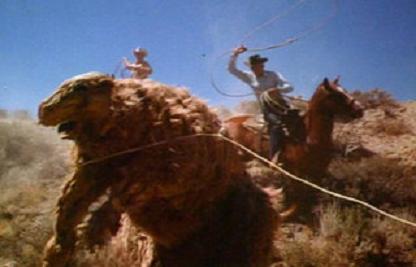
Occasionally, before the main movie starts, the Alamo Drafthouse will show a clip from an old movie.  In this clip, a picnic is ruined by the sudden appearance of a giant mutant sheep.  Everyone screams while the sheep stares at them with that passive sheep look.  Whenever this clip is shown, the audience laughs.  And it is pretty silly, especially when it’s seen devoid of any another context.

Myself, I have to admit that I’m always amused when that clip is shown because I know that I’m probably one of the few people in the audience who knows that the scene comes from a 1973 film called Godmonster of Indian Flats.  Thanks to Something Weird Video, I have actually seen the entire film and I know that it’s probably the best movie ever made about a giant mutant sheep.

Of course, it’s also the only movie ever made about a giant mutant sheep.

Having sat through Godmonster a handful of times, I’m assuming that it was meant to be satirical.  At least, I hope it was meant to be a satire.

While Godmonster may be best known as being a film about mutant sheep, the majority of the movie’s screen time is actually devoted to the culture of the town of Virginia City, Nevada.  Virginia City is a tourist town, where everyone dresses like they belong in the old west and where tourists enjoy watching carefully staged gunfights and hanging out at the old-fashioned saloon/brothel.  The mayor of the town is evil old Mayor Silverdale (exploitation vet Stuart Lancaster).  Mayor Silverdale is determined to keep the town in the past and, as such, he is upset when a real estate agent named Barnstable (Christopher Brooks) shows up and starts trying to convince people to sell their land.

So, Mayor Silverdale and Sheriff Gordon (Robert Hirschfield, who has some truly impressive sideburns) decide to frame Barnstable for murder.  It turns out that Gordon owns a dog who knows how to play dead.  One day, when they see Barnstable engaged in target practice, Gordon shouts, “YOU SHOT MY DOG!”  The dog rolls over and plays dead.  Everyone in town believes that Barnstable murdered Gordon’s dog and it turns out that everyone in town loved that dog.  They even have a funeral, with a tiny casket.

(Don’t worry, the casket’s empty.  As Gordon explains to Silverdale, the dog is visiting relatives in the next town over.)

So, the entire town decides to practice some frontier justice on Barnstable.  However, as the mob chases after Barnstable, they end up stumbling across a laboratory.  And, inside the lab, is a mutant. 8-foot tall sheep.  The sheep escapes the lab and one member of the lynching party is accidentally killed.  The town blames the sheep but actually, the sheep is a gentle, well-meaning mutant.  Meanwhile, Mayor Silverdale views the sheep as another way to make money…

It’s up to Prof. Clemens (E. Kerrigan Prescott) and his hippie assistant, Mariposa (Karen Ingenthron) to protect the sheep.  But where did the sheep come from?  Well, Clemens explains that it all has to do with toxic nerve gas and ecological destruction…

Anyway, I’m probably making Godmonster of Indian Flats sound more interesting than it actually is.  It’s never as much fun as you would expect a movie about a giant sheep to be.  But, even with that in mind, where else are you going to see a giant sheep wandering throughout the desert?

Seriously, this is one of those movies that you should see at least once.  It may not be any good but it is one of a kind.

godmonster_of_indian_flats

The TSL’S Daily Horror Grindhouse: Devil Monster (dir by S. Edwin Graham)


Devil_Monster_(1946)_-_Title

Oh my God, where to begin with this?

Okay, how about with a few confessions.

Number one, I came across the 1946 film Devil Monster in my 100 Horror Classic Movie Pack from Mill Creek.  The main reason that I decided to watch and review it was because it only had a running time of 64 minutes.  (On a good night, I have a 10-minute attention span.)

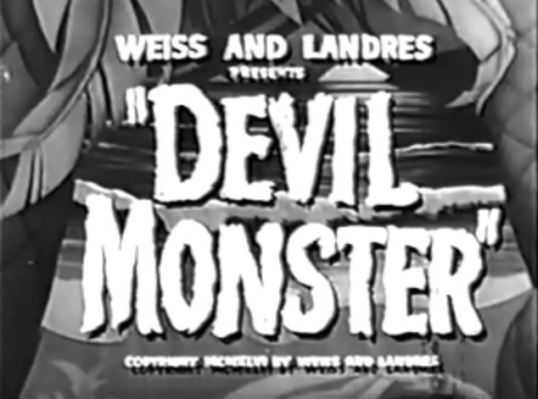
Number two, I guess it’s debatable whether or not Devil Monster really qualifies as horror movie.  I mean, it is called Devil Monster.  And there’s a big stingray that shows up during the final 10 minutes of the film and it rips off someone’s arm.  I assume the stingray is meant to be the devil monster of the title.  It’s not really scary but it’s supposed to be.  What matters is that, from the title and some of the dialogue, it’s obvious that an attempt was made to sell this movie as being at least partially a horror film.

Finally, you may have noticed that I mentioned that Devil Monster was a 1946 film.  Well, that’s actually debatable.  Devil Monster was apparently released in 1946 but, according to Wikipedia and the imdb, it’s actually a re-edited version of a 1936 film called The Sea Fiend.  Footage from The Sea Fiend was apparently mixed with stock footage and scenes lifted from other random films.  (One scene, featuring a bunch of island natives dancing, was clearly lifted from a silent film.)  The film was then dubbed over and a heavy-handed, nonstop narration was added in an attempt to link all of these random scenes together.  So, even though Devil Monster was released in 1946, it was actually filmed, in pieces, much earlier.

And really, that’s the main thing that I liked about Devil Monster.  It’s not that the film is in any way good or memorable.  (Well, it is memorable but mostly in a WTF sort of way.)  Instead, it’s a testament to the “never give up” attitude of the best B-filmmakers.  The producers of Devil Monster took a bunch of random footage, crammed it all together, and created something that resembles a movie.  Good for them.

As for the movie itself, it’s about a bunch of tuna fishermen who take the boat out and decide, in between searching for tuna, to stop by an island and pick up Jose (Jack Del Rio), who has been hiding out on the island ever since he was shipwrecked.  The problem is that Jose doesn’t want to go home and, after he’s forcefully dragged onto the boat, he decided to sail the boat into a part of the ocean that is home to the Devil Monster.  But then once the Devil Monster shows up, Jose changes his mind about killing everyone.  He jumps overboard and gets into a fight with the Devil Monster and … well, you simply have to watch it to truly understand how ludicrous this fight truly is.  Basically, footage of Jose throwing punches was superimposed over footage of a stingray in the ocean.  As a result, the scene features Jose punching the stingray and the stingray not reacting at all.  On top of all that, Jose is somewhat transparent.  You can literally see the ocean through him.  And, in the scenes where Jose is supposed to be swimming, you can see the hands of the crew holding him up in the air.

(Meanwhile, as we watch all this, we hear — but do not see — the tuna fishermen cheering Jose on.  “Get that devil fish, Jose!” someone yells.)

Of course, before that exciting scene, we get to see a battle between an octopus and a moray eel.  They are supposed to be at the bottom of the ocean but it’s obvious that they are actually in an aquarium.  How obvious?  Obvious enough that the studio lights are reflected in the glass and that the octopus tentacles gets stuck on the side of the aquarium in a few scenes.

And, before we watch the octopus/eel battle, the fisherman stop off at an island, where they meet a bunch of topless native girls.  We don’t actually see the fisherman interact with the natives.  Instead, we just hear the narrator tell us how much they enjoyed hanging out with the girls.  The natives, of course, change ethnicity from scene-to-scene, depending on from which source the footage has been lifted.

One of my favorite parts of this film comes at the end.  That’s where the boat captain’s son spots Jose and says, “There he is now.”  We then see Jose walking, before cutting back to the exact same footage of the son saying, “There he is now,” followed by the exact same footage of Jose walking.

My other favorite part of the film comes about 40 minutes in.  That’s when the screen goes black and we’re presented with a title card that reads, “One Moment Please, While We Change Reels.”

Of course, there’s also the scene where one of the fishermen suddenly yells, “TUNA!  TUNA!  TUNA!”  He’s just sounds so excited.

Devil Monster is in the public domain and can be found on YouTube.  Watch it at least once, just so you can say that you’ve seen it.

The TSL’s Daily Horror Grindhouse: The Nun (dir by Luis De La Madrid)


The Nun (2005, directed by Luis De La Madrid)

When talking about the 2005 Spanish horror film The Nun, it’s best to admit one thing from the start.  This film has got an absolutely terrible ending.

It seems to be the unwritten rule of modern horror that every movie has to have a “shocking” twist that’s revealed during the film’s final 10 minutes.  Occasionally, the twist is so well-done and memorable that it will actually redeem an otherwise forgettable film.  Far too often, the twist turns out to be so predictable that most filmgoers will have guessed what it is within the first few minutes of the film.  And then you’ve got a film like the Nun, where the twist will be so bad and so illogical that it’ll actually cause you to hate the entire film regardless of how effective it may have been before the twist was revealed.

I’ve debated with myself whether or not to just say “Spoilers be damned!” and reveal film’s twist in this review.  Seriously, it literally comes from out of nowhere and it’s so ludicrous that I almost feel like I have a responsibility to warn you about what the film has up its sleeve.  However, after a lot of thought, I’ve decided not to give the specifics of the twist.  Instead, I’m just going to tell you that it’s there and it’s really, really stupid.  It’ll probably make you hate the entire film.  If you ever find yourself watching The Nun, maybe you should stop watching around the 90 minute mark, just so you don’t have to deal with “twist.”

Because, seriously, until that twist shows up, The Nun is actually a pretty well-done ghost story.

The movie tells the story of Sister Ursula, an insane nun who terrorizes six of her students until eventually, they end up fighting back and accidentally drowning her.  They hide her body in a nearby pond and go on with their lives.  However, 18 years later, the pond is drained and the former classmates start to die one by one.

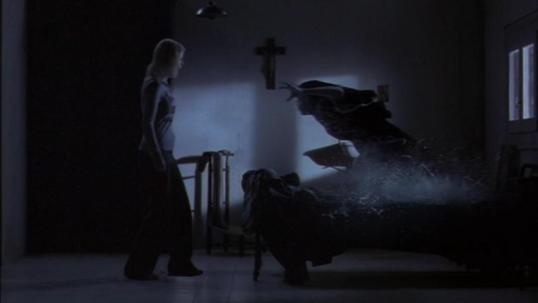
Whenever it rains or a bathtub overflows or water drips from a leaky faucet, a murderous apparition of the Sister Ursula is formed from the drops of water.  It may be because I was raised Catholic and I’ve actually experienced Catholic school firsthand but I thought that the apparition of Sister Ursula was one of the most effective cinematic ghosts that I’ve seen in a long time.  Forming from clouds of mist and with a permanently enraged expression on her twisted face, Sister Ursula is a nightmare personified and, as long as she’s lurking about in the shadows, it doesn’t matter that the film itself doesn’t make much sense.  Sister Ursula is scary and the scenes where she takes revenge on her former students are truly frightening.

But the film couldn’t be happy just being the type of simple (but effective) ghost story that would keep you awake at a slumber party.  Instead, the film has to introduce that terrible “twist” during the final ten minutes and, as a result, the entire film collapses.

Sometimes, it’s better just to keep things simple.

The TSL’s Daily Horror Grindhouse: Deathdream (dir by Bob Clark)


deathdream_poster_01

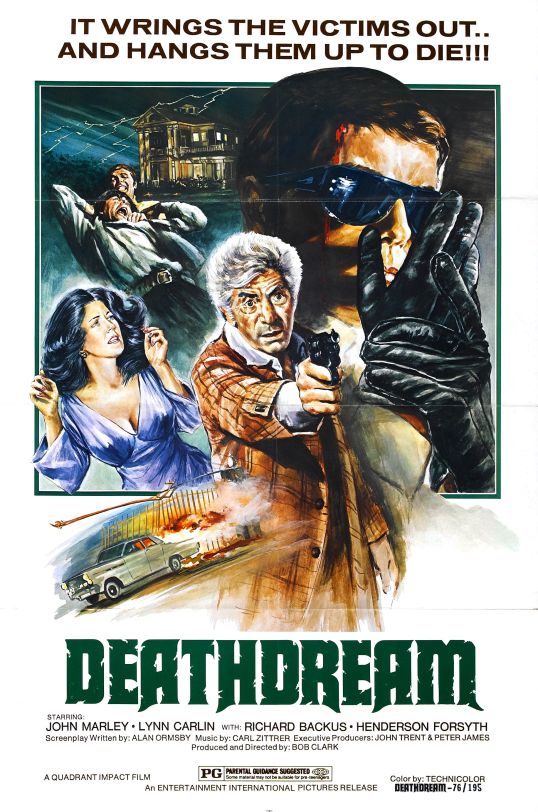
The 1974 film Deathdream opens with American soldier Andy Brooks (played by Richard Backus) on patrol in Vietnam. When he’s suddenly shot by an unseen sniper, he hears his mother’s voice calling out to him, telling him that he promised to come home. With the voice filling his head, Andy closes his eyes.

Sometime later, back in America, Andy’s family has been informed that Andy was killed in action. His father (John Marley, who you might recognize as the man who played Jack Woltz in The Godfather) and his younger sister (Anya Ormsby) have managed to accept the fact that Andy is dead but his mother (Lynn Carlin) remains in denial. Oddly enough, his mother is apparently proven to be correct in her doubts when Andy suddenly shows up at the front door.

The family (and, eventually, the entire community) welcomes Andy home but it quickly becomes apparent that Andy has returned as a far different person than when he left. Now pasty and emotionless, Andy spends most of his day sitting around listlessly. It’s only at night that Andy seems to have any energy and he spends those hours wandering around town and hanging out in the local cemetery.

It quickly becomes apparent to his father that Andy is no longer quite human. However, his devoted mother continues to insist that nothing is wrong with Andy and, once it becomes apparent just what exactly Andy is doing in order to survive, she becomes just as fanatical about protecting him as his father is about destroying him.

Not surprisingly, Deathdream is more than just a zombie film.  When Andy suddenly shows up on his family’s doorstep, he’s more than just a decaying monster.  He’s also a metaphor for the unease that viewers in the 70s would have felt about the state of American society.  (Of course, in many ways, contemporary viewers share that same unease.)  Andy goes off to war and it literally robs him of his humanity.  I would also argue that, in its way, Deathdream serves as a satire of the type of complacent society that sends young people off to fight for their lives and then expects them to come back exactly the same as they were before they left.  No matter how strange Andy’s behavior becomes, the people around him are willing to either ignore it or make excuses for it.  Andy’s mother emerges as a stand-in for everyone who willfully refuses to acknowledge the human consequences of war.

Deathdream is one of those wonderful horror films that deserves to be better known than it is. Deathdream was an early credit for the legendary effects artist Tom Savini and, while the film itself is not especially gory, Savini’s work can definitely be seen in the scenes where Backus’s body slowly decays. Screenwriter Alan Ormsby and director Bob Clark (who later went on to direct the far different A Christmas Story) perfectly creates and maintains a deceptively low-key atmosphere of perpetual unease while the cast elevates the entire film. Backus makes for an all-too plausible ghoul and Marley is great as a man struggling to understand what his son has become. The film is totally stolen, however, by Lynn Carlin who is both poignant and frightening as Andy’s devoted mother.

If you haven’t discovered Deathdream yet, this Halloween is the perfect season to do so.