The TSL’s Horror Grindhouse: Teenage Caveman (dir by Roger Corman)


Who is the Teenage Caveman?

Believe it or not, he’s Robert Vaughn.  Vaughn, who would later go on to appear in The Magnificent Seven, The Man From UNCLE, Bullitt, The Towering Inferno, and Hustle, was 26 years old when he played a nameless caveman in Roger Corman’s 1958 film, Teenage Caveman.  At the age of 26, Vaughn looked like he was closer to 35 and he certainly didn’t resemble a teenager.  Despite wearing a loin cloth, he also didn’t appear to be a caveman.  If he was a caveman than he was certainly a well-groomed caveman and perhaps the only caveman to understand how to use hairspray.  Seriously, his hair is perfect in this film.

As for the film itself, it’s about a primitive tribe of people who live in a rocky wasteland.  However, just across the river, there’s a land that’s full of plants and animals.  It would obviously be a much better place to live and Vaughn’s teenage caveman is totally annoyed that the older folks on the tribe refuse to cross the river.  They claim that a monster lives in the river and that it will kill anyone who tries to cross.  Being a rebellious teenager, Vaughn decides to cross the river anyway.  He convinces a group of friends to go with him.  When they reach the river, they meet and fight the monster and they also discover that the monster was doing more than just guarding the river.  It all leads to a plot twist that feels as if it was added at the last possible second.

In a later interview, Robert Vaughn referred to Teenage Caveman as being the worst film in which he ever appeared.  He went on to suggest that it was the worst film ever made.  Those are bold words coming from someone who appeared in as many bad films as Robert Vaughn did.  That said, I do think that Vaughn was being a bit too hard on Teenage Caveman.  For what it is — an extremely low-budget film that barely runs over an hour — Teenage Caveman is entertaining if you’re in the right mood for it.  It’s hard not to smile at the cavepeople, with their modern haircuts and their very American accents.  As well, the film features the same stock footage of dinosaurs fighting that appeared in countless other B-movies of the time and, again, it’s hard not to smile at the actors valiantly trying to pretend that there are dinosaurs fighting just a few feet away from them.  And while that final plot twist may come out of nowhere, it’s just random enough to be interesting.  Worst film of all time?  With all respect to the teenage caveman, I have to disagree.  It’s a B-movie and, if you enjoy B-movies, you’ll enjoy this one.  And let’s give some credit to Robert Vaughn.  He gives an earnest performance, even though he later said that he felt foolish every time he stepped out on the set.  Add to that, his hair is perfect.

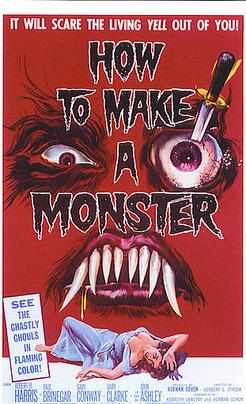
The TSL’s Horror Grindhouse: How To Make A Monster (dir by Herbert L. Strock)


How do you make a monster?

According to this 1958 film, the man to ask is Pete Dumond!

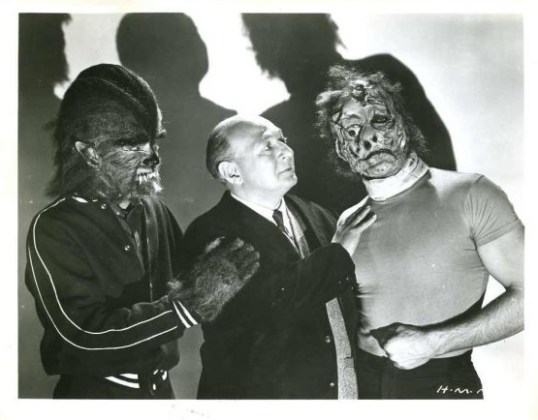
As played by Robert H. Harris, Pete Dumond is the chief make-up artist at American International Pictures.  He’s so good that he can easily transform handsome teen idols like Tony Mantell (Gary Conway) and Larry Drake (Gary Clarke) into convincing monsters.  Everyone loves Pete but there’s a problem.  As the new studio head explains it, horror just isn’t that popular anymore.  Teenagers are no longer interested in seeing movies about werewolves and Frankenstein’s Monster.  Instead, teens now only care about rock and roll.  Elvis has killed horror!

(Actually, the film argues that a recording artist named John Ashley killed horror.  At the time this movie was made, John Ashley was under contract to American International Pictures and the film even includes a dance number where Ashley performs his latest hit.  Ashley wasn’t a bad singer but it’s still hard to believe that he could have killed horror.  That said, the choreography is fun and every horror movie needs at least one random dance number.)

Sadly, Pete is about to be out of a job.  However, what the studio heads don’t realize is that Pete is more than just a makeup artist!  He’s also a master hypnotist!  Soon, Pete is using a special foundation cream to hypnotize Tony and Larry.  Once he has them under his control, he sends them, in full costume, on a mission to kill anyone who thinks that horror is dead!

There’s a lot of enjoyment to be found in How To Make A Monster.  The film not only takes place at American International Pictures but it was produced by AIP as well, so the entire movie is basically full of in-jokes that would only be appreciated by B-movie fans.  For instance, the makeup effects that Pete creates are the same ones that were used in I Was A Teenage Frankenstein and I Was A Teenage Werewolf.  (Gary Conway wore the Frankenstein makeup in both Teenage Frankenstein and this film.)  Towards the end of the film, when Larry and Tony confront Pete at his home, the walls are decorated with all of the monsters that Pete has created throughout the years and attentive viewers will recognize them as coming from such previous AIP films as The She-Creature, It Conquered The World, and Invasion of the Star Creatures.  (Seriously, I loved seeing the big crab monster from It Conquered The World hanging on Pete’s wall.  I’m sure horror and sci-fans in the 1950s felt the same way.)  While the majority of the film is in black-and-white, the scenes in Pete’s home are in full and vibrant color, as if AIP was announcing, “This is what makes the movies fun!”

Needless to say, How To Make A Monster is not a film that was ever meant to be taken seriously.  Instead, it’s a rather cheerful send-up of both the film business and AIP’s own status as a B-studio.  (At times, I felt like the film could just as easily have been called Sam Arkoff’s The Player.)  Watching the film, one gets the feeling that it was largely made as a lark, an inside joke amongst friends.  As such, it’s impossible to dislike this energetic little film.  Director Herbert L. Strock keep the action moving along and, in the lead role, Robert H. Harris gives exactly the type of over-the-top performance that this material needs.

If you’re a fan of 50s drive-in movies, How To Make A Monster is a film that you simply must see!

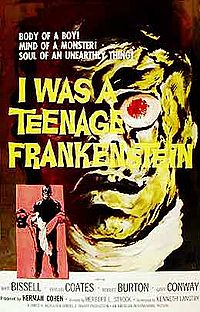
The TSL’s Horror Grindhouse: I Was A Teenage Frankenstein (dir by Herbert L. Strock)


“I was a teenage Frankenstein!”

“Of course you were, dear.”

Sadly, that dialogue does not appear in I Was A Teenage Frankenstein.  Oh well, we can’t have everything….

This 1957 film tells the story of Professor Frankenstein (Whit Bissell), an English scientist who comes to America and promptly sets about trying to create his own creature.  I guess we shouldn’t be surprised, considering that his name is Frankenstein and all.  I mean, when you’ve got a name like that, there are certain expectations that you have to live up to.  You’re not going to become a stand-up comedian or the janitor at the local grocery store.  When you’ve got a name like that, you’re expected to tamper in God’s domain and screw things up.  With a famous name comes great expectations.  Frankenstein …. Kennedy …. Kardashian …. it’s pretty much all the same.

Anyway, the professor is lucky enough to come across a fatal car crash.  This supplies him with exactly the dead body that he needs.  He takes the corpse to his laboratory where, with help of some spare body parts that he just happened to have lying around, he manages to bring the dead teenager back to life!

There’s just one problem.

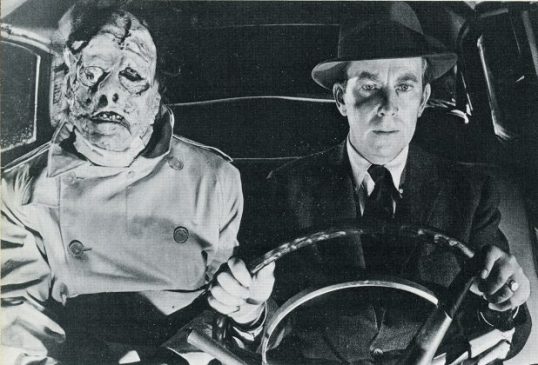
The teenager (played by Gary Conway) now looks like this:

Yep, Teenage Frankenstein is definitely not ready for his public debut.  No one’s happy about this.  Not the professor.  Not the professor’s assistant.  Even the professor’s secretary is upset about what’s going on in the laboratory.  Not even the alligator that Prof. Frankenstein for some reason keeps around the lab is particularly happy about how the operation turned out.

What’s a Teenage Frankenstein to do?  Well, he can always sneak out of the lab but, whenever he does, it seems like someone inevitably ends up dead.  Obviously, Prof. Frankenstein is going to have to find a new face for his creation but from where?  Well, luckily, there is a lover’s lane nearby….

I Was A Teenage Frankenstein was produce by American International Pictures to capitalize on the success of I Was A Teenage Werewolf.  (Whit Bissell plays a mad scientist in both movies and gets the best line in It Was A Teenager Frankenstein when he yells, “Answer me!  You have a civil tongue in your head!  I know, I sewed it in there!”)  Unfortunately, while the monster makeup is indeed impressive, I Was A Teenage Frankenstein is never as much fun as I Was A Teenage Werewolf.  While the teenage werewolf had an entire town to explore, Teenage Frankenstein is pretty much stuck in that lab.  Whereas the teenage werewolf spent his movie running wild, Teenage Frankenstein spends all of his time doing whatever the professor orders him to do.  As a result, I Was A Teenage Frankenstein is a much slower film and also lacks the rebellious subtext of I Was A Teenage Werewolf.

That said, I Was A Teenage Werewolf was enough of a box office success that both the werewolf and the Frankenstein makeup were later used in How To Make A Monster.

The TSL’s Horror Grindhouse: I Was A Teenage Werewolf (dir by Gene Fowler, Jr.)


Tony Rivers (Michael Landon), the lead character in 1957’s I Was A Teenage Werewolf, is a teenager.  You probably already guessed that from the film’s title but, as we all know, titles can be misleading.  Teenagers were very popular in the 50s, after all.

But no, Tony is actually a teenager.  In fact, he’s one of those troubled teenagers that were all the rage in the late 50s.  He lives for kicks and spends too much combing his hair.  He skips school.  He stays out late.  He gets into fights with other teenagers.  He’s not dumb, mind you.  He has plenty of friends and a girlfriend (Yvonne Lime) who only wants the best for him.  He just has a hard time controlling his temper and his father (Malcolm Atterbury) isn’t sure what to do with him.

However, Detective Donavon (Barry Phillips) has a possible solution!  After the police are called to break up one of Tony’s fights, Donavon suggests that maybe Tony should seek professional counseling.  In fact, maybe he could go see Dr. Brandon (Whit Bissell)!  Dr. Brandon is a widely respected hypnotherapist and he has an office right next to the local airplane factory.  Only the best therapists are allowed to practice next to the airplane factory.  Everyone knows that.

Even though he doesn’t want to, Tony finally agrees to see Dr. Brandon.  Even if he doesn’t say it, you can tell that Tony is thinking, “This is totally squaresville.  Really melvin, maaaaaan….” the whole time.  But Brandon gets results!

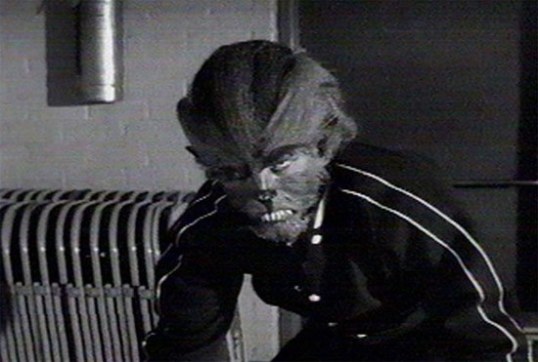
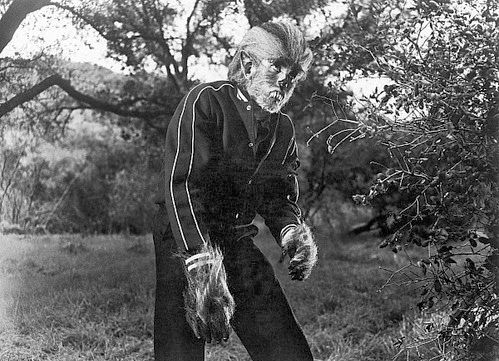
In fact, you could argue that he gets too many results.  After twice hypnotizing Tony and telling him to think of himself as being a wild animal, Tony becomes just that!  That’s right, Tony turns into a werewolf and he’s soon running around town — in his letterman jacket! — and killing anyone that he comes across.

Whenever Tony transforms back into a human, he regrets what he’s done.  Unfortunately, it turns out that almost anything can cause Tony to turn back into a wolfman.  Most werewolves need a full moon.  All Tony needs is to hear the sound of the school bell….

To be honest, I imagine that most people who watch this film do so because they want to see a werewolf creating chaos while wearing a high school letterman jacket.  Considering that this was a low-budget film made to play as half of a double feature, the werewolf makeup is actually fairly impressive and that letterman jacket adds just the right touch of weirdness to the whole affair.

Make no mistake, it’s an entertaining and deeply silly film but, at the same time, it does have an interesting subtext.  One could argue that Tony’s transformation into a werewolf serves as a metaphor for his struggle to grow up.  Neither werewolves nor juvenile delinquents can control themselves and Michael Landon gives a performance that’s just sensitive enough to justify calling this one Werewolf Without A Cause.

That said, the main appeal of this film is definitely the chance to see a werewolf in a letterman jacket.

The TSL’s Horror Gindhouse: Flesh Feast (dir by Brad Grinter)


Oh, poor Veronica Lake.

In the 1940s, Veronica Lake was undoubtedly a star.  She appeared in Preston Sturges’s classic comedy, Sullivan’s Travels.  She played the femme fatale in a series of classic film noirs.  She proved herself to be just as capable of playing comedy as she was playing drama.  By wearing her hair down and often allowing it to fall over her right eye, she created the peek-a-boo hairstyle.  She was briefly a star and a fashion icon but she also developed a reputation for heavy drinking and being difficult to work with.  During World War II, the U.S. government actually requested that Lake change her hairstyle in order to decrease incidents of women, many of whom were working factories as a part of the war effort, getting their hair tangled in the machinery.  Lake did so, cutting her long hair and going for a more practical look.  Her career never recovered.

The years following her 1940s heyday would not easy ones for Veronica Lake.  Along with multiple divorces, she also struggled with alcoholism and with the IRS.  Lake spent much of the 50s in England.  When she returned to the States in the 60s, she was arrested several times for public drunkenness and eventually took a job as a waitress to pay the bills.  A news story about her life as a waitress renewed some interest in Veronica Lake, as did the publication of her memoirs in 1969.  As so often happened with former stars who fell on hard times, she considered taking roles in the type of low budget films that she wouldn’t have even been offered when she was at the height of her fame.

That brings us to Flesh Feast.

In Flesh Feast, Veronica Lake is cast as Dr. Elaine Frederick.  Living in a dilapidated mansion in Florida, Dr. Frederick believes that she has discovered the perfect way to not only look younger but to also reverse the aging process itself!  It involves maggots, lots and lots of maggots.  For just a few dollars, Dr. Frederick will apply maggots to your skin and, like magic, they’ll suck away the years.  That may sound disgusting but, whenever the viewer is show Dr. Frederick working in her laboratory, it’s obvious that the maggots are instead grains of rice.

Dr. Frederick is approached by a group of South American neo-Nazis who want Dr. Frederick to use her maggots to make their leader young again.  They refuse to tell her the name of their leader but you can guess who it is, right?  I mean, he’s living in Argentina.  He’s in hiding.  The rest of the world thinks that he’s dead.  He’s German.  He used to be involved in the government …. oh, okay, I’ll tell you.  It’s Hitler.  The group wants Dr. Frederick to use her maggots to make Hitler young again.  Dr. Frederick agrees but it turns out that she’s only interested in getting revenge!

There’s a lot of negative things you can say about Flesh Feast but it’s perhaps the only film to feature Veronica Lake laughing as a bunch of maggots eat Hitler’s face.  Don’t get me wrong.  It takes forever to actually reach that moment.  There’s a whole subplot about a journalist trying to investigate Dr. Franklin’s experiments.  As well, Dr. Franklin’s assistant is an undercover government agent and she keeps stumbling across dead bodies at inopportune times.  The first 70 minutes of Flesh Feast are about as draggy and boring as any movie that I’ve ever seen.  But, after all that, you get to see Veronica Lake kill Hitler.  Some would say that’s definitely worth the price of admission!

Flesh Feast was Veronica Lake’s final movie.  (She not only starred in the film but she co-produced it as well.  Director Brad Grinter was also responsible for Blood Freak.)  It was filmed in 1967 but not released until 1970, after the publication of her memoirs renewed interest in her career.  Unfortunately, Flesh Feast didn’t exactly do well at the box office.  Lake would die just three years later, at the age of only 50.  But her films and her performances will live forever.

The TSL’s Horror Grindhouse: The Day Time Ended (dir by John “Bud” Cardos)


At the start of 1980’s The Day Time Ended, the Williams Family has relocated to the desert!  

(Why the desert?  I have no idea.  I’ve been told that the hot air of the desert would be ideal for my asthma but then I’d have to live in the desert and, from what I’ve seen in the movies, bad things always happen in the desert.  If it’s not aliens, it’s zombie cowboys.)

Grandpa (Jim Davis), Grandma (Dorothy Malone), Richard (Christopher Mitchum, looking a lot like his father, Robert), Beth (Marcy Lafferty), and their young daughter, Jenny (Natasha Ryan) have moved into a very nice ranch house that appears to be sitting in the middle of nowhere.  The house comes with a barn, a few horses, and …. ALIENS!

At first, Jenny is the only one to notice the strange blue light that keeps glowing behind the barn.  But soon, the rest of the family is seeing UFOs and weird (but kind of cute) creatures are knocking on the front door and saying hi.  Lizard men appear in the distance and beckon for the family to follow them.  Soon, the house itself is being zapped through time and space….

This is going to be a short review but, then again, The Day Time Ended is a short movie.  With a running time of only 75 minutes (not including the end credits), The Day Time Ended feels less like a movie and more like an extended episode of The Twilight Zone.  That said, if it was an extended episode of The Twilight Zone, it would be considered to be one of the more enjoyable episodes of the series.  While none of the characters are particularly complex or deeply written, the cast is believable as a family and everyone does a good enough job that the viewer won’t want to see anything bad happen to any of them.  (I’m also happy to say that all of those horses are really pretty and — fear not! — for once, no harm befalls any of the animals.)  The motives of the aliens are kept ambiguous throughout the film, leaving the viewers as confused and intrigued as the family and the final shot is somehow both silly and tremendously satisfying at the same time.  The Day Time Ended is a B-movie but it’s an entertaining B-movie.

Directed by B-movie specialist, John “Bud” Cardos, this is one of those movies where the cheapness of the special effects add to the film’s charm.  Initially, the UFOs are represented by lights darting through the sky.  (Residents of Texas will immediately think of our beloved and yet unexplained Marfa Lights.)  When the UFOs are finally seen in close-up, they are obviously plastic models but, in this age of excessive CGI, there’s something undeniably charming about the idea of going to the trouble to build plastic models.  The claymation aliens are adorable!  Seriously, there are some films that you just can’t help but kind of love and, for me, The Day Time Ended is one of those films.

6 Horrific Trailers For October 24th, 2022


7 more days of Horrorfest.

7 more days of Halloween.

And you know what that means, right?

It’s time for a new edition of Lisa Marie’s Favorite Grindhouse Trailers!

  1. I Drink Your Blood/I Eat Your Skin (1970)

It’s a double feature like none other!  The majority of the trailer (understandably, in my opinion) is devoted to clips from I Drink Your Blood.  What is I Drink Your Blood about?  It’s about a little kid who gets rid of a bunch of annoying hippies by giving them food that has been infected with rabies!

2. Grizzly (1976)

Wow, I wonder where they got the idea for this movie from!

3. The Crater Lake Monster (1977)

Awwww!  What a cute monster!

https://www.youtube.com/watch?v=0jv4cNQOSQs

4. Cathy’s Curse (1977)

Beware of Cathy …. and her doll too!

5. Jennifer (1978)

A bullied teenage girl has psychic powers …. hmmmm, this sounds familiar….

6. The Children (1980)

“Something terrifying has happened to the Children!”  This actually a pretty scary film but somehow, the trailer is even scarier.

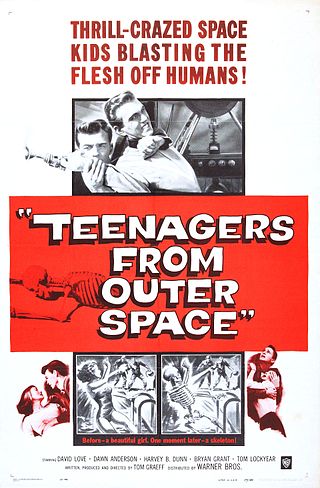
The TSL’s Horror Grindhouse: Teenagers From Outer Space (dir by Tom Graeff)


The aliens have landed in California!

And they’re teenagers!

That may sound like the set up of a 1960s beach movie but actually, Teenagers From Outer Space is an oddly somber little movie from 1959.  Now, just to be clear, somber does not necessarily equal good.  There’s a lot of humor to be found in Teenagers From Outer Space but next to none of it’s intentional.  Instead, this attempts to be a serious-minded movie that happens to be about intergalactic teens.

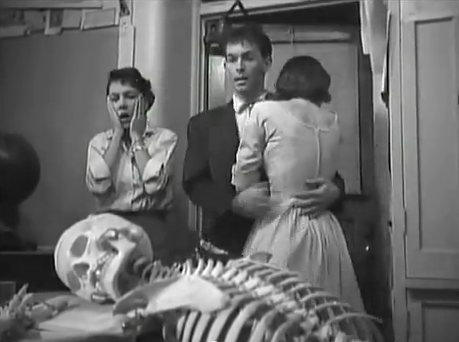
The teenagers are named Thor (Bryan Grant) and Derek (David Love).  They’ve been sent down to Earth so that they can raise Gargons, which are these lobster creatures that are considered to be a gourmet delicacy on their own world.  Thor is the arrogant and insensitive alien who thinks that he’s too good for Earth and reacts to nearly every social situation by pulling out his ray gun and firing.  (Whenever Thor vaporizes anyone, a perfectly white skeleton — the type that you’d expect to see hanging in a classroom — is left behind.)  Derek is sensitive and moody.  He’s got the soul of a poet.  He doesn’t want to vaporize people.  Instead, he wants to explore Earth and maybe hang out in a coffee house while reading Kerouac.  Though Derek may never actually say it, it’s obvious what’s going through his mind whenever he looks at the other teenagers from outer space.  “The scene is totally squaresville, man,” Derek thinks, “Real melvin.  Exploring planets with peaceful intentions is where it’s at!”

Anyway, Derek decides to run away and explore Earth on his own.  He ends up renting a room in a boarding house owned by Grandpa (Harvey B. Dunn) and his daughter, Betty (Dawn Bender).  Betty is immediately attracted to Derek, despite the fact that she already has a boyfriend (who is played by the film’s director, Tom Graeff).  She’s not particularly surprised when Derek tells her that he’s from outer space.  Nor is she upset when he reveals that, shortly after arriving on Earth, Thor vaporized her dog.  (Judging from her nonplussed reactions to everything, I’m assuming that Betty was an avid reader of both Sartre and Camus.)

As for Grandpa, he spends most of his time hanging out on the front porch and talking to strangers.  For instance, when Thor comes by and demands to know where Derek is, Grandpa cheerfully tells him.  This, of course, leads to a lot of innocent people being vaporized but Grandpa never seems to feel particularly bad about it.  Certainly, no one in the movie ever takes the time to point out how much trouble could have been avoided if Grandpa wasn’t so talkative.

Derek really just wants to stay on Earth but Thor knows that Derek is secretly the son of their planet’s leader and therefore, cannot be allowed to run away.  Why doesn’t Derek know this?  I have no idea.  It’s possible the movie explained this turn of events while I was busy wondering why no one seemed to be upset about all the skeletons that were turning up around town.

Anyway, as I said, there aren’t many intentional laughs to be found in Teenagers From Outer Space but there’s plenty of unintentional ones.  Between Betty’s calm acceptance of everything that Derek tells her and David Love’s continually confused stare and blank line readings, it’s impossible not to smile while watching this movie.

Teenagers From Outer Space was written, directed, and produced by Tom Graeff. Shortly after this film came out, Graeff took out an ad in the Los Angeles Times and proclaimed himself to be the second coming of Christ.  Hey, why not?  After you make a movie like Teenagers From Outer Space, I suppose it seems like anything could be possible.  Unfortunately, Graef committed suicide in 1970 and he didn’t get to see his misbegotten little film find a second life as a cult favorite.

Teenagers From Outer Space.  It’s not very good but it certainly is watchable.

TSL’s Horror Grindhouse: Queen of Blood (dir by Curtis Harrington)


Queen of Blood (1966, dir by Curtis Harrington, DP: Vilis Lapenieks)

Here’s a question: what happens when Roger Corman buys the rights to two Russian science fiction films, decides to jettison basically everything but the special effects footage, and then hires experimental filmmaker Curtis Harrington to shoot an entirely new film around that footage?

You end up with the 1966 film, Queen of Blood!

Not that that’s a bad thing, mind you. Queen of Blood is actually pretty good and director Harrington manages to smoothly integrate the Russian footage with the new footage. Basically, it works out so that you’ll see a Russian shot of the spaceship taking off or landing and then you’ll see a shot of John Saxon, Dennis Hopper, or Basil Rathbone sitting on a set and pretending like they’re in space.

The film opens with Dr. Faraday (Basil Rathbone) discovering that aliens have been transmitting a message to Earth. They’re sending an ambassador to meet with the Earthlings but the aliens’ spaceship ends up crash landing on Mars! Faraday arranges for an Earth spaceship, the Oceano, to go to Mars and rescue the ambassador.

Aboard the Oceano is a cast made up of a few familiar faces. John Saxon plays Allan, who is the de facto leader of the expedition and also engaged to marry Dr. Faraday’s assistant, Laura (Judi Meredith). A young-looking Dennis Hopper is Paul Grant, an astronaut. Don’t get too excited about Hopper being in the cast. Queen of Blood was made when Hopper was still trying to pursue mainstream film stardom so he gives a rather bland performance here. There’s a few scenes where you can tells that Hopper is on the verge of smirking at some of his dialogue but, for the most part, he plays the role extremely straight. Rounding out the crew is Anders (Robert Boon) and Tony (Don Eitner), neither one of whom would go on to star in Easy Rider, Blue Velvet, or Nightmare on Elm Street.

It’s a difficult journey. The Oceano keeps running into Russian-filmed turbulence on the way to Mars. When they do land, they discover that the ambassador (Florence Marly) is waiting for them to rescue her. She doesn’t talk much nor does she have any interest in eating Earth food. She does seem to like every member of the crew except for Laura. Of course, the ambassador’s defining trait is that she likes to drink blood….

All things considered, Queen of Blood works pretty well. While none of the performances are particularly memorable (though Basil Rathbone does bring some old school class to what is essentially a cameo role), Curtis Harrington does a great job creating and maintaining a properly ominous atmosphere. It takes a while for the crew to finally find the Queen of Blood but, when they do, Harrington gets every bit of creepiness that he can out of the character. The film even ends on an appropriately dark note, suggesting that the human race may be just too stupid to survive.

Queen of Blood is an entertaining B-movie. Watch it the next time you’re in the mood for some intergalactic blood-sucking fun!

The TSL’s Horror Grindhouse: Scissors (dir by Frank De Felitta)


The plot of the 1991 film, Scissors, is not easy to describe. That’s not because the plot is particularly clever as much as it’s because it doesn’t make much sense.

Basically, Sharon Stone plays a woman named Angela Anderson. She is oddly obsessed with scissors and terrified about getting close to anyone. She’s been getting hypnotherapy from Dr. Carter (Ronny Cox) in an effort to understand why she’s so repressed but she doesn’t seem to be getting anywhere. This could possibly have something to do with the fact that Dr. Carter is continually distracted by the adulterous activities of his wife, Ann (Michelle Phillips).

Angela lives in a lonely but surprisingly big apartment with only her cat for company. Her cat is named Midnight and he’s a black cat so he automatically became my favorite character in the film. Living next door to her are two twin brothers. Alex (Steve Railsback) is a soap opera star. Cole (Railsback, again) is an artist in a wheelchair who continually paints cartoonish pictures of Angela being attacked by a man with a big red beard.

Then, one day, Angela goes out to buy some scissors. When she returns and gets on the elevator to head back up to her apartment, she’s attacked by a man …. A MAN WITH A RED BEARD! Fortunately, Angela is able to stab him with her scissors. After the man with the red beard runs off, Angela is discovered in the elevator by Alex and Cole. Alex and Angela fall in love. Cole’s not too happy about that.

Following so far?

Angela get a call about a job interview, one that requires her to go to a stranger’s apartment. Despite the fact that the film has spent nearly an hour setting up Angela as being intensely agoraphobic, she has no problem going to this apartment. However, once she enters the apartment, she finds herself locked in! She also discovers that the red-bearded man is also in the apartment. Fortunately, he’s dead. Unfortunately, it appears that he was killed by Angela’s scissors. There’s also a raven in the apartment. The raven continually taunts Angela, saying, “You killed him!” Let’s just be happy that Edgar Allan Poe wasn’t around to see this.

Trapped in the apartment, Angela has flashbacks to her past. Is Angela the murderer? Is all of this just happening in her mind? Or is someone trying to drive her over the edge?

Though Scissors is set up as a psychological horror film, it’s really more of an extended acting exercise for Sharon Stone. Stone wanders around the apartment. She talks to herself. She had a nervous breakdown or two. She discusses life with a puppet. Every single scene seems to be designed to make audiences go, “Wow, she really can act!” but, despite all of the histrionics on display, Angela is still a very one note character. By making her obviously unstable from the start, the film doesn’t really leave the character with much room to develop or take us by surprise. The film attempts to end on a bit of an ambiguous note as far as Angela’s character is concerned but that type of ambiguity has to be earned. There’s nothing to Stone’s performance to indicate that there’s anything about Angela that isn’t totally on the surface. To suggest that there was more to her than originally appeared is to insult the audience’s ability to discern hidden depths.

The film does eventually wrap up its mystery and present a solution of sorts. Unfortunately, it’s a totally unsatisfying solution and one that’s dependent on otherwise intelligent people coming up with a ludicrously overcomplicated scheme to deal with one not particularly complicated problem. It’s all pretty forgettable but at least the cat survives.