This song from Walk Hard: The Dewey Cox Story has to be the most romantic song ever written.
This song from Walk Hard: The Dewey Cox Story has to be the most romantic song ever written.
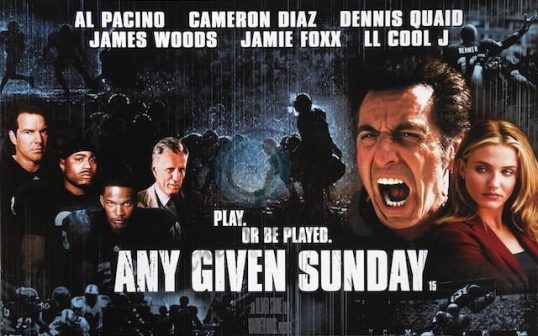
I once read an article where Al Pacino’s lock room speech in Oliver’s Stone 1999 football film, Any Given Sunday, was described as being the most inspirational locker room speech ever.
I don’t really know if I agree with that.
I mean, to be honest, Al Pacino’s Tony D’Amato kind of looks really beaten down in this scene. It looks like, instead of spending the previous night studying game film and coming up with plays, the coach spent the previous night out drinking. If I was one of his players, I would be wondering if the coach was hungover and I might reset that. I might be like, “Hey, I’ve been staying off cocaine all week for this game and then coach shows up looking like he’s just killed Frank Lopez. Someone get Aaron Eckhart in here — he’s the coach we need!” Also, for the most part, his speech seems to be more about him than the team. It’s like, “I’ve got failed marriages, I’ve got this, I’ve got that …. life is a game of inches!” Well, that’s great, Tony, but how are we going to win the game? “I got problems!” Well, we’ve all got problems, coach! I mean, he’s talking to a room full of people who probably can’t stand up without hearing a hundred different things going snap in their knees.
Do locker room speeches really make that much of a difference? I’ve seen enough sports films that I often wondered this. Is it a requirement that a coach give a speech? If the coach refused to give a speech, the team would still be obligated to go out there and play hard, right? As I’ve said many a time, I really don’t get the point of long speeches but some of that is because of the ADD. There’s no way that I could listen to anyone talk about life being a game of inches for four minutes. I would just zone out.
What if a coach filibustered and just kept going and going in his speech? Would the team have to forfeit?
Would it have been more effective to show the team the Willie Beamon music video as opposed to forcing them to listen to a speech from hung over Tony D? Well, probably not. If I remember correctly, the team did win the big game and they did it even after Dennis Quaid got injured for like the 100th time. So, I guess the speech did work. That shows you everything I know about football.
Anyway, I know a lot of people love this speech. I mean, there’s a reason why it showed up in that car commercial. And, to be honest, it worked pretty well in that commercial. Certainly, it made more sense to use Tony’s “life is a game of inches” speech as opposed to Robin Williams’s poetry speech from Dead Poets Society. (Car commercials are weird.) So, in honor of those people and Super Bowl Sunday, here is the Tony D’Amato Any Given Sunday locker room speech:
Phil saw his shadow. We all know what that means!
Today, the Shattered Lens wishes a happy birthday to Whit Stillman! Let’s do the sambola!
Both the scene and the dance are from 2011’s Damsels in Distress.

Happy birthday, David Lynch!
One of the things that makes David Lynch so special is that he’s willing to take risks and somehow, he always manages to get away with the type of things that would drive you crazy if any other director tried them. For instance, what other director could end an 18-hour film on a note of ominous and disturbing ambiguity and have viewers say, “That was perfect!”
That’s the talent of David Lynch.
Today’s scene that I love comes from Twin Peaks: The Return. Agent Cooper returns someone who might be Laura Palmer to her home in Twin Peaks. However, it appears that the Palmers have either left the house or perhaps they haven’t even moved in yet.
“What year is this?” Cooper asks.
In the night, someone says, “Laura?”
Laura screams.
I know there are some who says that we need a new season of Twin Peaks to explain all of this. I’m not sure that I agree, though I’d love to see everyone again. But, to be honest, I feel this is the perfect ending to Lynch’s American dream.
Rest in peace, the great French director Jean-Jacques Beineix.
The chase scene below is from a film that I need to soon rewatch, Beineix’s 1982 masterpiece, Diva.
Today, the Shattered Lens wishes a happy 81st birthday to the one and only Faye Dunaway. In honor of this day, I want to share a scene that I love from 1967’s Bonnie and Clyde.
Now, Bonnie and Clyde was not Dunaway’s first film. After appearing on Broadway, she was cast as a hippie kidnapped in a forgettable crime comedy called The Happening. Otto Preminger, who could always spot talent even if he didn’t always seem to understand how to persuade that talent to work with him, put her under contract and featured her as the wife of John Phillip Law in his legendary flop, Hurry Sundown. (Dunaway later said she had wanted to play the role of Michael Caine’s wife, a part that went to Jane Fonda and she never quite forgave Preminger for giving her a less interesting role.) Dunaway reportedly did not get along with Preminger and didn’t care much for the films that he was planning on featuring her in. One can imagine that she was happy when Warner Bros. bought her contract so that she could star opposite Warren Beatty in Bonnie and Clyde.
Despite the fact that the real-life Bonnie Parker was notably shorter and certainly nowhere as glamorous as as the actress who was selected to play, Faye Dunaway proved to be the perfect choice for the role. Bonnie and Clyde proved to be a surprise hit and an Oscar contender. It made Dunaway a star, a fashion icon, and it resulted in her first Oscar nomination. Dunaway would go on to appear in such classic 70s films as Chinatown, The Towering Inferno, Three Days of the Concord, and Network before her unfortunate decision to star as Joan Crawford in Mommie Dearest would slow the momentum of her career. Unfortunately, she would later become better known for having a difficult reputation and for engaging in some very public feuds, with the press often acting as if Dunaway was somehow uniquely eccentric in this regard. (To Hollywood, Dunaway’s sin wasn’t that she fought as much as it was that she fought in public.) Though Dunaway’s career has had its ups and downs, one cannot deny that when she was good, she was very, very good.
In this scene, from Bonnie and Clyde, Bonnie Parker (played by Faye Dunaway) writes a poem and tries to craft the future image of Bonnie and Clyde. Though it has none of the violence that made Bonnie and Clyde such a controversial film in 1967, this is still an important scene. (Actually, it’s more than one scene.) Indeed, this scene is a turning point for the entire film, the moment that Bonnie and Clyde goes from being an occasionally comedic attack on the establishment to a fatalistic crime noir. This is where Bonnie shows that, unlike Clyde, she knows that death is inescapable but she also knows that she and Clyde are destined to be legends.
(Of course, Dunaway and Beatty — two performers who one epitomized an era but only work occasionally nowadays — are already legends.)
In 1925, on this very date, Lee Van Cleef was born in Somervillve, New Jersey. In honor of what would have been Lee Van Cleef’s 97th birthday, here he is with Klaus Kinski and Clint Eastwood in For A Few Dollars More.
There’s not a lot of dialogue in this scene but when you had actors like Eastwood, Kinski, and Lee Van Cleef, you didn’t need a lot of dialogue to make an impression.
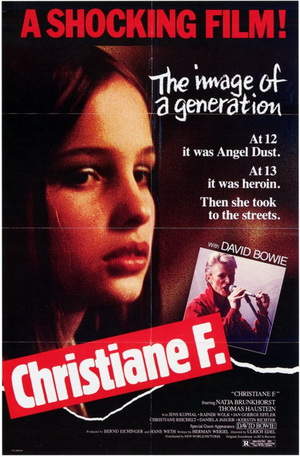
Today would have been David Bowie’s 75th birthday. Though it’s been six years since David Bowie passed, he remains an iconic cultural force. He is missed, as both a musician and an actor.
In honor of the man’s birthday and his legacy as a performer, today’s scene that I love is from the 1981 German film, Christiane F. Directed by Uli Edel and based on a true story, Christiane F. is the story of a 13 year-old drug addict. It’s a powerful film, though perhaps not one to watch if you’re dealing with any sort of severe depression. David Bowie both composed the film’s soundtrack and appeared in the film himself.
Here, he performs Station to Station while Christiane F. watches. The scene perfectly captures not only Christiane F.’s fascination with Bowie but also Bowie’s charisma as a performer. The scene was shot an actual concert that David Bowie performed in Berlin, though the shots of Christiane F. and her friends watching were filmed separately.
Today is Nicolas Cage’s birthday!
How old is Nicolas Cage today? It doesn’t matter. Nicolas Cage is timeless. He has no age. You could say that Nicolas Cage has always been there and will always be there.
On a more realistic note, you could say that Nicolas Cage is the nephew of director Francis Ford Coppola and that he started his film career as Nicolas Coppola. (That was the name he used when he made his film debut with a small role in Fast Times At Ridgemont High.) Not wanting people to assume that he only got work because of his family connections, Nic soon changed his last name to Cage in honor of Marvel’s Luke Cage. Nicolas Cage has gone on to become one of the best-known actors in the world, an iconic figure of sorts. When he’s good, Nicolas Cage is great. When he’s appearing in a bad film, Nicolas Cage is often fascinating. Cage may have a reputation for being an eccentric and for appearing in almost anything but often Cage’s brand of weirdness is just what is needed to elevate a film like Mandy or Pig from good to great.
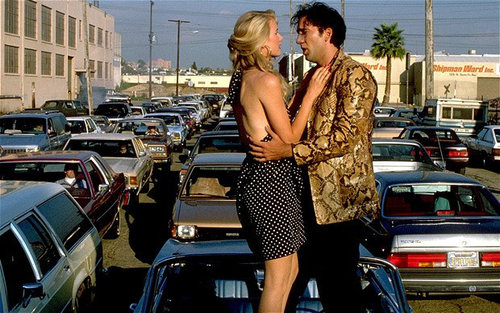
In honor of his birthday, here are two scenes that I love from a very good film, David Lynch’s Wild At Heart. Watch as Nicolas Cage explains the meaning of his snakeskin jacket. Stick around to watch Nicolas Cage serenade Laura Dern with the world’s greatest Elvis impersonation.
Happy birthday, Nicolas Cage!
 Through the Shattered Lens