Thrilling Mystery ran from 1935 to 1951, though, like many pulp magazines, it would change its name a few times towards the latter part of its run. Thrilling Mystery started out with supernatural-themed stories. In the 40s, it shifted away from the supernatural and became another hard-boiled crime magazine. The covers below are all from Thrilling Mystery‘s early, horror-themed days.
Unfortunately, I haven’t been able to find any information on who was responsible for doing any of these covers. If any of our readers can help shed some light on who should be credited for these covers, please let us know!
Released way back in January (and, in fact, I think it may have been the first horror movie released in 2020), The Grudge is the latest film to tell the story of a house where ghosts compel inhabitant after inhabitant to kill themselves and their families. Look, we all know how it works. We’ve all seen Ju-on. We all know that it begins with someone dying while extremely angry or extremely sad and then a curse being passed on from person to person. The original Japanese films are frightening while the American versions tend to get bogged down in all of the usual horror clichés. We all know how these things work.
Anyway, this version of TheGrudge takes place, for the most part, at 44 Reyburn Drive, where a number of people die over the course of the film. The Grudge is told in a nonlinear fashion, so we hope back and forth in time. We meet a lot of different people and sit through a lot of different stories but none of them are particularly interesting. Two real estate agents discover that their unborn child is going to have a rare genetic disorder. An elderly couple prepare for an assisted suicide. A nurse is haunted by the things that she saw while she was working in Japan. A detective obsesses on all of the murders. In the present day, another detective (Andrea Riseborough) tries to figure out why so many murders are connected to the house. It’s difficult to really get caught up in her investigation because we already know the answer.
It’s all pretty dull. Maybe if I had never seen any of the other Grudge films, I would have found this movie more interesting but The Grudge doesn’t really bring anything new to the table. All it really does is remind you of how formulaic the American version of franchise has always been. Of course, everyone’s going to die and, of course, there’s going to be a shock ending. (Interestingly enough, the international version has a different ending.) It’s all rather boring and it’s hard not to get annoyed that the film assembled a truly amazing cast and then basically didn’t anything with them. Consider some of the people in this film: Andrea Riseborough, Demian Bichir, John Cho, Betty Gilpin, Lin Shaye, Jacki Weaver, William Sadler, Frankie Faison. Wasting a cast with that much talent really does amount to cinematic malpractice. It seems like it should be an impossible mistake to make but The Grudge somehow manages to do it.
The film’s nonlinear format doesn’t add much to the story. I mean, you know everyone’s going to die eventually so having the story told in random chunks and pieces doesn’t really add any sort of suspense. One could argue that the film does deserve some credit for being as dark as it is. I mean, it does kill the type of sympathetic characters who, normally, would survive other horror films. But, even with that in mind, it’s all just kind of boring. I don’t hold a grudge against anyone for trying to reboot the franchise but this film just doesn’t bring anything new to the table.
4 Shots From 4 Films is just what it says it is, 4 shots from 4 of our favorite films. As opposed to the reviews and recaps that we usually post, 4 Shots From 4 Films lets the visuals do the talking!
This October, we’ve been using 4 Shots From 4 Films to pay tribute to some of our favorite horror directors! Today, we recognize Texas’s own Tobe Hooper!
4 Shots From 4 Films
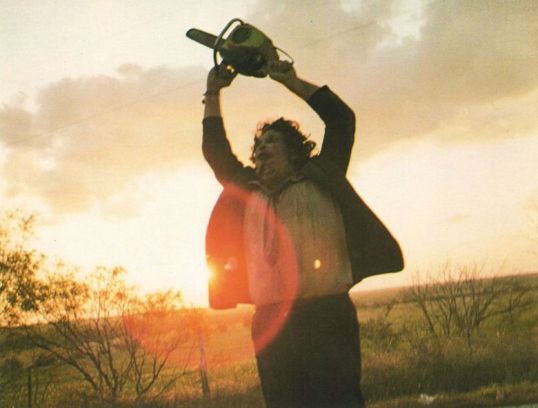
The Texas Chainsaw Massacre (1974, dir by Tobe Hooper)
Today’s horror on the lens is a made-for-tv movie directed by Wes Craven.
First televised in 1984, Invitation to Hell is a wonderfully over-the-top depiction of what happens when an engineer (Robert Urich) sells out and goes to work for a big evil corporation. Long story short, Satan (in the form of Susan Lucci) takes over his family. Admittedly, this film does start slowly but, in the end, it’s a lot of fun.
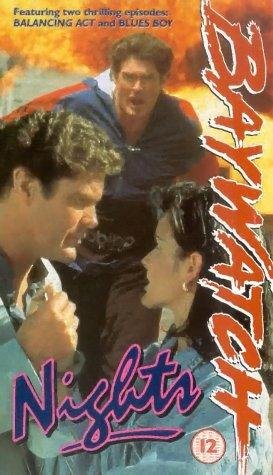
Tonight’s episode of Baywatch Nights originally aired on February 16th, 1997.
In this episode of Baywatch Nights, David Hasselhoff and Angie Harmon are hired to track down a missing man and his daughter. Their search leads to them becoming literally trapped inside a virtual reality where they either have to defeat the crazed Game Master (Vincent Schiavelli) or die! There’s even a scene where Angie Harmon has to pick up and roll a giant die! Taking full advantage of the inherent ludicrousness of David Hasselhoff’s screen persona, this is an episode that has to be seen to be believed.
A lot of people die over the course of this 2005 film but none of them are particularly likable so who cares.
A remake of the Herschell Gordon Lewis classic (though Lewis’s film only featured Two Thousand Maniacs!), 2,001 Maniacs is about a small town called Pleasant Valley in Georgia. During the Civil War, Union soldiers killed 2,001 of the residents of Pleasant Valley so, as a result, the angry spirits of the town will not be happy until they’ve killed 2,001 Northerners. Luckily, for them, some yankee college students come driving through on their way to Daytona Beach for Spring Break. That means it’s time to bring out the hooks, the blades, the flames, and all the other things that can be used to dismember people on screen. It’s a bloody good time in Pleasant Valley.
The mayor of Pleasant Valley is played by Robert Englund and, if nothing else, Englund brings a lot of demented glee to the role. One thing that I’ve always liked about Englund is that, even though he could probably get away with it, he’s always refused to coast on the fact that he’s a horror icon. No matter the quality of the film in which he’s appearing, Englund always goes all out and gives a memorable performance. As played by Englund, the mayor comes across as being an affable and welcoming guy, or at least he does until he starts killing people. The viewers automatically know that the mayor’s a bad guy because they know the type of role in which Robert Englund typically gets cast. But, and this is the important, you can at least understand why the film’s victims didn’t automatically run in fear as soon as they met him. The mayor is all about hospitality. (That, and bloody revenge.)
Anyway, it’s tempting to view 2,001 Maniacs as being some sort of statement about Confederate war memorials but …. eh. I mean, again, it’s tempting but I think it’s ultimately kind of pointless. This is not a subversive film. This is not a film that’s attempting to scratch the surface of any major issues. This is just another gory film that examines the amount of ways someone’s body can pulled apart. That’s not necessarily a bad thing. There’s a lot of classic horror films that are centered around people dying in gory ways. The problem with 2,001 Maniacs is that, since none of the people dying are particularly interesting, you don’t really care about how they die or even the fact that they’re dead. “Oh hey,” you find yourself saying, “at least I won’t have to listen to that guy talk anymore.”
Despite being a bit on the dull side for most of its running time, 2,001 Maniacs does have an effective final few minutes. There’s a big battle between a survivor and a ghost that is surprisingly well-directed and would have been exciting if we actually cared about whether or not the survivor was actually going to …. well, survive. As for the film itself, it ends on a properly macabre note. I actually laughed at the film’s ending, even though perhaps I shouldn’t have. Again, it all comes down to not really caring that much about anyone in the movie.
Anyway, 2,001 Maniacs didn’t do much for me. The Lewis version is still the version to go with. Thank God for Robert Englund, though. That man can act.
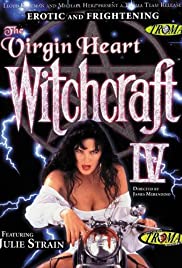
Witchcraft IV continues the endless story of William Spanner, warlock-turned-attorney.
When this movie begins, William is no longer working for the public defender’s office. Instead, he now handles insurance law. He comments that it’s been years since he last used his powers and he’s happy that he is, once again, living a normal life. However, when Lily Wild (Lisa Jay Harrington) shows up at his office and tells him that her 17 year-old brother, Pete Wild (Orien Richmond), has been arrested for a murder that he didn’t commit, William agrees to serve as Pete’s attorney.
The police are convinced that Pete not only murdered his girlfriend but that he’s also a serial killer who has been responsible for killing at least six other women and removing their hearts. With the police refusing to be of much help and also apparently withholding evidence so that it doesn’t inspire a copycat killer (?), William decides that the only way to defend Pete is to solve the murder on his own.
Searching the scene of the crime, William finds a matchbook with the word “Coven” on it. Coven is a club and William’s investigation leads him to both a stripper named Belladonna (Julie Strain) and Santara (Clive Pearson), the club owner who makes aspiring rockers famous in return for their immortal soul. Santara has not only a very famous father but also a connection to William. No matter how much William tries to escape his past, he keeps getting pulled back in.
Witchcraft IV is unique among the franchise in that it features William narrating his story. William obviously learned how to narrate by watching old film noirs but it’s appropriate because Witchcraft IV is more of a direct-to-video neonoir than a horror film. The horror and supernatural elements are there, of course. But Witchcraft IV is more interested in the mystery aspect of the story than the horror aspect. Unfortunately, the mystery itself isn’t particularly challenging and it seems as if William, given his past, should have been able to figure things out quicker than he did.
The best thing that Witchcraft IV has going for it is Julie Strain in the role of Belladonna. Strain gives a typically uninhibited and forceful performance, one that suggests that, if she had been born many years earlier, she could have had a good career as a noir femme fatale.
Witchcraft IV was directed by James Merendino, who later achieved cult success with SLC Punk! This would also be the last time that Charles Solomon would play the role of William Spanner. In Part V, the role would be played by Marklen Kennedy.
From 1986’s Deadly Friend, directed by Wes Craven:
Now, it should be noted that this scene was not in Craven’s initial cut of the film. Craven envisioned Deadly Friend as being a melancholy love story about a teenage boy who brings his dead girlfriend back to life. Elvira, the lady who loses her head, originally had a much less graphic death scene but Warner Bros. wants to take advantage of Craven’s reputation for being a horror director so they demanded a more extreme version and that’s what Craven delivered.
In my opinion, this scene is just ludicrous enough to work. The studio’s demands were a bit silly so Craven supplied them with perhaps the silliest death scene that he ever directed. That said, I do think Craven’s original version of Deadly Friend sounds like a nicer movie.
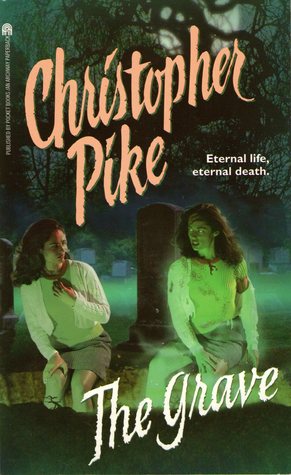
It opens with a college student named Ted Lovett thinking that he’s going to meet a woman in the woods, just to instead get captured by a cult who strip him naked and then bury him alive. We then jump over to the story of Kerri, who is a typical 90s YA heroine — she’s got a job at a record store, her sister is dead, her father abandoned the family, her mom is hooked on cocaine, and her boyfriend is clingy loser. It’s the boyfriend part that bothers Kerri the most. She’s totally bored with him but just can’t bring herself to sit down with him and tell him that it’s over.
Then, one day, the mysterious and handsome Oscar shows up in the record store and soon, Kerri is spend the night over at his place and kind of cheating on her boyfriend. I say “kind of” because Kerri doesn’t really consider him to be a boyfriend, despite the fact that they’re dating and they’ve slept together a few times. With her mother still abusing drugs and Oscar acting all mysterious, Kerri has a lot to deal with but all of that drama is nothing compared to what happens when Oscar tosses Kerri into a freezer.
So, is Oscar a part of the cult that buried poor Ted Lovett? Or is he the ghost of Ted Lovett and this all a part of grand plan to turn Kerri into a half-dead, half-living zombie who is pregnant with the modern day equivalent of Pan, a hooved God who will maybe save the world but maybe not?
Yes, The Grave is an odd book. There’s a lot going on in The Grave. In fact, there’s probably a little bit too much going on. The Grave is only a 194 pages long, which means that Kerri is often surprisingly quick to accept the strangest explanations for what’s going on. If you learned that you had been selected to give birth to a satyr that’s going to save the world but, in order to do so, you have to basically die first, you’d probably demand a bit more of an explanation than Kerri does. I know that I would.
Speaking of Kerri, how much drama can one person have in their life? Abandoned by her father, haunted by her sister’s death, and forced to deal with her mom’s cocaine addiction, just one of those would have been enough but tossing all three in there just feels like overkill. And that’s eve before she becomes pregnant with Pan.
With The Grave, you get the feeling that Christopher Pike just tossed a bunch of random stuff at the wall to see what would stick. It’s a mess but occasionally, it’s entertaining in its messiness. If nothing else, it has an important lesson to impart about not putting yourself in a situation where you can be buried alive. That’s an important lesson to learn.




 Through the Shattered Lens