October Positivity: My Brother’s Crossing (dir by Ricky Borba)


I have to admit that, when I see Joe Estevez’s name in the credits, I’m usually not expecting to see him cast as a saintly man whose faith holds his family together and gives people a reason to keep on living.

That’s nothing against Joe Estevez.  Estevez is the youngest brother of actor Martin Sheen and there’s definitely a family resemblance between the two.  That said, while Martin is best-known for playing priests and absurdly left-wing presidents, Joe Estevez has often been cast as villains.  If Joe Estevez plays a cop, you can bet he’ll turn out to be dirty.  If he plays a politician, he’ll turn out to be corrupt.  If he’s a CEO, you can bet his company is going to be pouring sludge into the reservoir.  Some actors just get typecast as villains and that seems to be the case with Joe Estevez.

That makes My Brother’s Crossing a definite change-of-pace.  Estevez appears as Bobby Clark, a former fireman who rides a motorcycle and who tells all of his bickering relatives, including brother JT (Daniel Roebuck), that they need to turn their lives over to God.  Bobby is married to Pam (Eliza Roberts) and they’re both beloved members amongst their community.

One night, both Bobby and Pam are killed when they collide with a car.  The driver of the car is CJ Martin (James Black), a pastor.  As a stunned CJ sits in an ambulance, he’s approached by a biker (Duane Whitaker) who introduces himself as Pastor Mike Price.  Pastor Mike says a prayer over CJ.  As he walks away, he’s approached by two EMTs who say, “Pastor, we want to serve your God.”  Mike looks up to Heaven and gives praise to Bobby for bringing people to God, even in death.

Yep, this is one of those movies.  It’s a low-budget, not particularly well-made, painfully slow faith-based movie.  CJ is forgiven by Bobby’s daughter and indeed, the entire Clark family eventually comes to forgive him.  He’s even invited to eat dinner with surviving members of the family.  At first, JT is driven by his need for revenge but, ultimately, he not only insists that CJ not be charged with vehicular manslaughter but he also pays CJ’s fine for reckless driving.  “Praise Jesus,” CJ says.  Oh, the mixed feelings!  I’m all about forgiveness but everything about the accident suggests that the vehicular manslaughter charge was totally justified.  Forgiving someone doesn’t mean that there shouldn’t be consequences for their actions.

To be honest, though, I almost feel guilty about giving this film a negative review, just because it’s based on a true story and it’s told so earnestly (if also amateurishly).  My father died a few months after he was involved in a car accident.  This woman and her lawyers attempted to sue his estate after he passed and, for months, I was consumed by hatred for her and the people representing her in court.  Eventually, I realized that I had to let go of that hate and I had to forgive her, if just so I could move on.  That doesn’t mean that I’m obligated to like her, though.  I did give that some thought while I watched this movie and that’s probably the compliment that I can give My Brothers’s Crossing.

The TSL Horror Grindhouse: Dance of the Damned (dir by Katt Shea)


In 1989’s Dance of the Damned, Cyril O’Reilly plays a vampire with a sensitive side.

The Vampire is out on his nightly prowl.  He goes to a strip club where he finds himself drawn to a dancer named Jodi (Starr Andreef).  The Vampire is drawn to Jodi because Jodi is thinking of committing suicide.  It’s her son’s birthday and the boy’s father refuses to even let her see him.  The Vampire approached Jodi and says the wants to talk to her because he hasn’t talked to anyone in a long time.  He offers to pay Jodi one thousand dollars if she’ll come back to his house and have a conversation with him.

Because the Vampire doesn’t drive, they take a city bus back to his place.  While sitting on the bus, they are harassed by two wannabe punks.  The Vampire pierces one of their eyes with the stem of a rose.  Oddly, Jodi barely notices.

At the house, the Vampire reveals his fangs and explains that he rarely feasts but tonight is one of those nights when he does.  He says that he picked Jodi because he could sense her loneliness and could tell that she wanted to die.  He also explains that, contrary to the vampire mythology, Jodi will not turn into a vampire after he drinks her blood.  Instead, she’ll just die.  Jodi’s response is to shoot the Vampire several times.  The bullets fall off of his body.

Jodi and the Vampire end up talking.  In fact, Dance of the Damned often feels more like a one-act play than a traditional vampire film.  Both Jodi and the Vampire are lonely and they discuss what its like to feel like they have nothing in the world.  The Vampire cannot exist in the daylight and, as a stripper, Jodi’s life is centered around the night as well.  When Jodi learns that the Vampire has never been to the beach because he never felt like there was much point in going during the night, Jodi insists that they go immediately.  The Vampire discovers what sand feels like.  He struggles to walk on it which was kind of weird but whatever.  At least the movie was trying to do something different!

The main theme of the film is that both the Vampire and Jodi are outsiders.  The Vampire was born a vampire and has no idea what it’s like to be a mortal being that can safely walk around in the daylight.  Because he has scars from a childhood incident with the humans, even the Vampire’s own people have rejected him.  Jodi, meanwhile, has been rejected by conventional society because she’s a stripper and now, she can’t even see her own child.  They are two outsiders who are linked together by their feelings of being lost.  Over the course of the night, they fall in love but it’s obvious that only one will still be around the next night and it’s also fairly obvious which one it will be.

I liked Dance of the Damned, though I imagine that it might be too talky for a lot of fans of the horror genre.  It’s more of a dual character study than a traditional vampire film.  Just as she did with films like Poison Ivy and The Rage: Carrie 2, director Katt Shea uses the horror genre as a way to explore the pressure that society puts on women to act, look, and dress a certain way.  Shea’s direction is moody and atmospheric and she gets an excellent performance from Starr Andreef.  Dance of the Damned is not a film for everyone but for those who are looking for a little emotional honesty to go along with their horror, it’s an intriguing film.

October Hacks: Out of the Dark (dir by Michael Schroeder)


In 1989’s Out of the Dark, a man dressed in a clown costume is killing phone sex operators.  He lurks in the darkness and jumps out of the shadows to commit his dastardly crimes.  Especially during the first hour or so, the film has its share of both suspense and gruesome moments.  In the style of Italian giallo and pre-Halloween American slasher pics, the film actually tries to create some mystery about who the killer could be.  Lt. Frank Meyers (Tracey Walter) suspects that the killer might photographer Kevin Silvers (Cameron Dye).  Kevin and his girlfriend, Kristi (Lynn Danielson-Rosenthal), think that the police should be taking a closer look at David Stringer (Bud Cort), an accountant who has an office in the same building as the phone sex company.  Meanwhile, Detective Langella (Divine) thinks that the murders might be linked to a serial killer who is targeting prostitutes.

The main problem with Out of the Dark is that it’s pretty obvious from the start who the killer is and it’s hard not to judge the people who can’t figure it out for themselves.  The movie doesn’t really offer up enough viable suspects to keep you guessing and than it spends so much time trying to make it look like one of the suspects is guilty that any experienced film watcher will automatically know that he isn’t.  The viewers are supposed to be shocked by the killer’s identity but there’s nothing shocking about it.  It’s pretty obvious.

On the plus side, Out of the Dark does have a one-of-a-kind cast.  Divine and Tracy Walter play detectives.  Bud Cort is intense and nerdy as the bitter accountant.  Cameron Dye is vacuously handsome as the photographer.  Geoffrey Lewis shows up as an alcoholic.  Lainie Kazan plays an aging prostitute.  Tab Hunter drives a car.  Paul Bartel manages a motel and gets upset when he sees the blood pooling in one of his rooms.  And finally, Karen Black plays the owner of the phone sex company and gives a far better performance than the material actually deserves.  Black brings some much needed emotional reality to the film.

As I said at the start of this review, Out of the Dark has its moments.  The clown costume is truly creepy and the opening murder is all the more disturbing because it happen outside and in a public park.  (You do have to wonder how no one noticed a weirdo dressed like a clown wandering around.)  A scene in which the clown attacks a phone sex operator who has agreed to serve as bait is also well-done and genuinely frightening.  The story moves at a quick and steady pace and it deserves some credit for ending on a definitive note as opposed to trying to copy the ambiguity that was so popular with other slasher films of the era.

If only the identity of the killer had actually been a surprise, Out of the Dark would probably be considered a classic.  As it is, it’s just another well-made slasher film.

Clash of the Titans (1981, directed by Desmond Davis)


High atop Mt. Olympus, Zeus (Laurence Olivier) and his fellow Gods look down on Earth and jealously manipulate its citizens.  When Zeus impregnates Danae (Vida Taylor), the daughter of the King of Argos, she and her son Perseus (Harry Hamlin) are banished to sea.  Zeus responds by ordering Poseidon (Jack Gwillim) to release the Kraken.

Years later, when Callibos (Neil McCarthy), the son of the Goddess Thetis (Maggie Smith), destroys all but one of Zeus’s flying horses, Zeus transformer Callibos into a tailed monster.  Thetis tries to get her revenge by having Callibos kill Perseus but instead, Perseus chops off Callibos’s hand, comes to possess Pegasus, the last of the flying horses, and also wins the right to marry Andromeda (Judi Bowker).

At the wedding, Cassiopeia (Sian Phillips) declares Andromeda to be even more beautiful than Aphrodite (Ursula Andress).  Big mistake.  Aphrodite demands that Andromeda by sacrificed to the Kraken.  Along with Pegasus, Ammon (Burgess Meredith), Thallo (Tom Pigott-Smith), and robot owl, Perseus goes on a quest to get the snake-haired head of Medusa so he can turn the Kraken into stone.

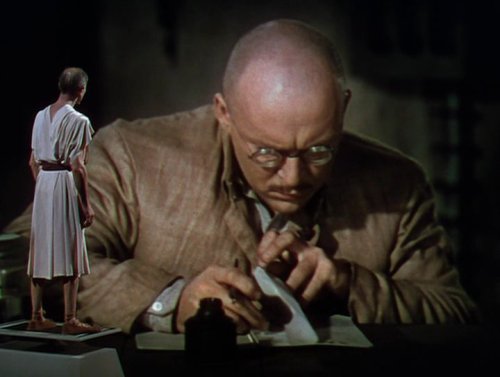
There’s a lot that I love about Clash of the Titans, from the Ray Harryhausen’s stop-motion special effects to the blind witches who pass one eyepiece among them to Burgess Meredith’s performance as Ammon.  I even like the robot owl.  But the thing that has always made the biggest impression on me is that Mt. Olympus is portrayed as having a shelf that holds a figurine for every human in the world.  The Gods casually move the pieces around and transform them on whims.  Of all the films that have been based on Greek mythology, Clash of the Titans is one of the few that really captures the idea of the Gods essentially being a bunch of petty and jealous libertines who view humans are just being their playthings.

Let’s not overthink Clash of the Titans, though.  The main appeal of Clash of the Titans is that it’s just a good, old-fashioned adventure movie.  In this age of CGI and humorless heroes, it’s hard not love the film’s mix of old-fashion stop-motion animation, strong characters, and occasional moments of humor.  (I like the owl and I won’t apologize for it.)  Also, Medusa has appeared in a lot of movie but she’s never been scarier than in this movie.  Who can forget the yellow glow of her eyes, followed by men turning to stone?  Who can forget the hiss of her tail or the moment when Perseus waits to strike while trying not to look into her eyes?  Beyond Medusa, who can forget the Kraken rising from the sea or the blood of Callibos giving birth to giant scorpions?  Without CGI, Clash of the Titans still captures the feel of living in a different time and a different land.  Clash of the Titans brings mythology to life in a way that few other films have been able to,

I loved the original Clash of Titans when I was a kid.  I rewatched it last month and I happy to say that I love it still.

Horror Scenes That I Love: Crimson Peak


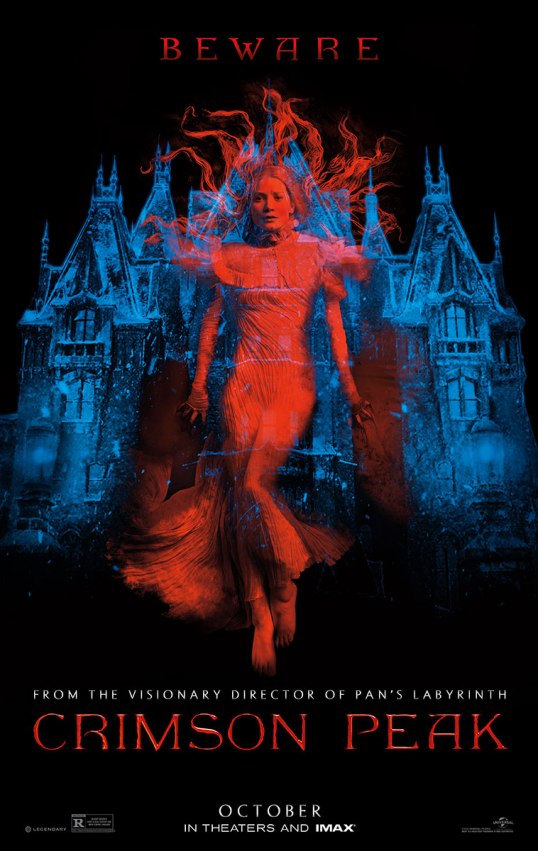
Since it’s Guillermo Del Toro’s birthday, it just seems appropriate that today’s horror scene that I love should be one of my favorite scenes from one of my favorite Del Toro movies.

Here’s the opening of 2015’s haunting (and, in my opinion, underrated) Crimson Peak!

October True Crime: Guilty Until Proven Innocent (dir by Paul Wendkos)


This 1991 made-for-TV movie opens with a murder in a Brooklyn park.  The year is 1979 and a group of teenagers are accosted by two men carrying guns.  The men rob the teenagers of their drugs and guns.  One person is killed.  When the police arrive, almost everyone says that it was too dark to see anything.  However, a 15 year-old named Jimmy O’Neill (Tristan Tait) says that he saw the faces of the men.

At the police station, the detective (Mark Metcalf) shows him a picture of a man named Billy Ferro (Zachary Mott) and Jimmy identifies him as one of the gunmen.  The detective then produces a picture of a 19 year-old named Bobby McLaughlin (Brendan Fraser) and asks if Bobby was the other man.  When Jimmy hesitates, the detective says that McLaughlin has been arrested with Billy in the past.

Of course, the truth of the matter is that, while Bobby has been arrested in the past, he’s never been arrested for anything as serious as murder and he’s never met Billy Ferro.  The man who had been arrested in the past with Ferro was named Harold McLaughlin.  The detective accidentally grabbed the wrong picture.

Bobby, a high school drop-out who lives with his foster parents (played by Martin Sheen and Caroline Kava), is arrested and charged with second degree murder.  It doesn’t matter that Bobby passes a polygraph because the results are not admissible in court.  It doesn’t matter what Bobby has an alibi because the prosecutor portrays all of his friends as being a collection of stoners and losers.  It doesn’t matter what Bobby has never even met Billy Ferro because Ferro isn’t going to help anyone out, even someone who he knows is being falsely convicted.  Bobby is convicted of second degree murder and sent to prison.

For the next seven years, while Bobby tries to survive prison, his foster father attempts to prove his son’s innocence.  With the police refusing to help, Bobby’s father is forced to launch his own investigation but it seems like no matter what he discovers, it’s not enough to get Bobby out of prison.  Still, neither he nor Bobby gives up.  Neither one will accept a system in which you’re guilty until proven innocent….

For most people who choose to watch this film, I imagine it will be because of that “Introducing Brendan Fraser” credit.  Fraser gives a very good performance in this film, playing Bobby as basically well-meaning but directionless teenager who finds himself trapped in a nightmare.  Of course, the majority of this film is Martin Sheen yelling about the injustice of it all.  This is the type of crusader role that Sheen has played often.  As was often the case when he was cast in films like this, there’s nothing subtle about Sheen’s performance but it’s not really a role that needs or demands subtlety.

Though this was made-for-television and, as such, is never quite as critical of the system as perhaps it should be (if anything, the film argues that one should trust the system to eventually do the right thing, even if it does so seven years too late), it still shows how one cop’s mistake can ruin an innocent’s man life.  It’s all the more effective because it’s based on a true story.  Of course, I immediately knew the cop shouldn’t be trusted because he was played by Mark Metcalf.  Niedermeyer as a cop?  That’s definitely not going to end well.

4 Shots From 4 Horror Films: 1940s Part One


This October, I’m going to be doing something a little bit different with my contribution to 4 Shots From 4 Films.  I’m going to be taking a little chronological tour of the history of horror cinema, moving from decade to decade.

Today, we take a look at the first few years of 1940s.

4 Shots From 4 Horror Films

Dr. Cyclops (1940, dir by Ernest B. Schoedsack)

Dr. Cyclops (1940, dir by Ernest B. Schoedsack)

The Wolf Man (1941, dir by George Waggner)

The Wolf Man (1941, dir by George Waggner)

Cat People (1943, dir by Jacques Tourneur)

Cat People (1942, dir by Jacques Tourneur)

I Walked With A Zombie (1943, dir by Jacques Tourneur)

I Walked With A Zombie (1943, dir by Jacques Tourneur)

Horror Film Review: Trilogy of Terror (dir by Dan Curtis)


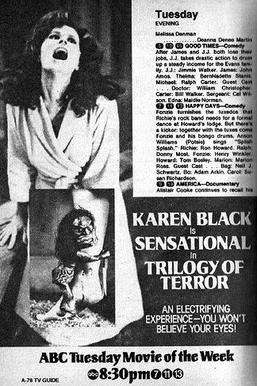
1975’s Trilogy of Terror is a true classic, a rare made-for-television horror film that could have just as easily and effectively been released in theaters.

As one can surmise from the title, it features three stories.  Each story is directed by Dan Curtis and written by Richard Matheson.  Each story also features Karen Black in the lead role, giving Black a chance to play not just one but four very different characters over the course of one film.  One of the things that makes this film work so well is Karen Black’s totally committed performance.  Sadly, Karen Black later expressed some regret about having appeared in the film because it led to her being typecast as a horror actress, which she definitely hadn’t been before.  (One need only watch Karen Black in Five Easy Pieces, Nashville, or Family Plot to see what a good actress she was.  Even in something like Easy Rider, where she had only a small role and very few lines, her talent is obvious.)  As a result, Black was no longer considered for the big studio films that she had appeared in previously and instead, she spent the remained of her career appearing in low-budget horror films.  That’s a shame because Trilogy of Terror really does show what a strong actress Black was.

The first segment features Black as Julie, a seemingly uptight teacher who somewhat surprisingly agrees to go out on a date with Chad (Robert Burton), a sleazy college student.  Chad drugs Julie’s drink during their date and later undresses her and takes pictures which he then uses in an attempt to blackmail Julie into basically being his sex slave.  Julie, however, turns out to have a big secret of her own and Chad discovers too late that he was the one who was being manipulated.  This segment was the least interesting of the three stories but the ending was very satisfying.  Anyone who has ever dated a “nice guy” who turned out to actually be a jerk will enjoy Julie’s revenge.

The second segment is enjoyably sordid, an over-the-top soap opera that I can’t talk too much about without spoiling the plot.  Black plays Millicent, a repressed brunette, who is hatefully obsessed with her twin sister, blonde Theresa (Black again).  Millicent fears that Therese is planning to corrupt and destroy her boyfriend, Thomas (John Karlen).  Millicent explains to her therapist (George Gaynes) all of the terrible things that Therese has done.  Of course, the truth turns out to be much more complicated.  This story was entertaining and featured a surprisingly effective twist.

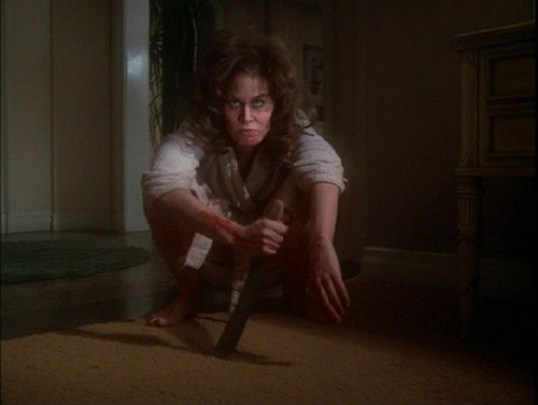
The third segment is the one that everyone remembers.  Amelia (Karen Black) lives alone in a high-rise apartment and has recently purchased, as a present for her anthropologist boyfriend, a wooden fetish doll in the form of a misshapen aboriginal warrior with pointed teeth and a spear.  The doll comes with a scroll that explains that the doll is inhabited by the spirit of a Zuni hunter and that the only thing keeping the doll from coming to life is the gold chain adorning the doll.  Of course, the chain eventually falls off and Amelia finds herself being pursued through her apartment by a viscous doll that is obsessed with killing her.  This is the simplest and the scariest of the Trilogy of Terror’s three stories.  It’s easy to say that it’s just a doll until it pops out of nowhere and stabs Amelia in the ankle.  This story ends on a properly dark note and that final image of Karen Black is haunting.

For a fifty year-old film, Trilogy of Terror holds up remarkably well.  Watch it and witness just how good an actress Karen Black truly was.

Trilogy of Terror (1975, dir by Dan Curtis. DP: Paul Lohmann)

Horror Film Review: The Creation of the Humanoids (dir by Wesley Barry)


Oh, how I love this oddity from 1962.

The Creation of the Humanoids takes place in the 23rd Century.  A nuclear war has wiped out 92% of the human population.  The radiation has caused many of the survivors to become sterile.  The birth rate has plummeted to 1.4% and humanity is at risk of slowly dying out.  The majority of the remaining humans have dealt with this news by becoming lazy and decadent.  They live in luxurious apartments and they basically refuse to do anything themselves.  Instead, all of the work is done by blue-skinned androids, the Humanoids that some dismissively refer to as being “clickers.”  The Humanoids were not designed to have human emotions or thoughts but some appear to be developing them.  The Order of Flesh and Blood want to destroy the Humanoids, especially when they hear rumors that a Humanoid has been created who is indistinguishable from an actual human.  The Order of Flesh and Blood fears that the Humanoids are plotting to take over the world and replace humanity and …. they’re right!

Of course, the film suggests that might not be such a bad thing.  The majority of the humans that we meet in The Creation of the Humanoids don’t seem to have much interest in continuing on with their lives.  Having destroyed most of their civilization with a pointless nuclear war and now being unable to conceive, they seem to be content to laze about and wait for the end to come.  Ironically, the only humans that seem to care about the future of their race are a bunch of fanatics.  The Humanoids may move and speak stiffly but at least they’re making plans for the future and seem to actually care about the world in which they exist.

The Creation of the Humanoids was made for a very low-budget and with only the most rudimentary of sets.  The luxury apartments all look very similar and very simple and yet that adds to the sense of ennui that runs through the entire film.  The same can be said of the costumes, which are largely made up of jumpsuits and Confederate army caps that were reportedly rented from a local costume store.  The drab costumes capture the feel of a society where being creative or imaginative is no longer rewarded and any sign of free thought is considered to be a threat.  It’s the type of society that always seems to follow as a result of the empty promises of Marx and Coca-Cola.  Fortunately, the film’s producers did pay extra so that the film could be shot in color, the better to highlight the blue tint of the Humanoids and the darkness outside of the city. They also wisely hired veteran cinematography Hal Mohr, who brings some visual flair to the project.  Realizing that the film was extremely talky and that it featured characters who didn’t move around a lot, Mohr used creative camera angles and old-fashioned “glamour” lighting to give the film an interesting look.  The film ultimately becomes a work of pop art and it’s not a surprise that Andy Warhol described Creation of the Humanoids as being his favorite film.

I like the film too.  The stilted but philosophical dialogue, the atmosphere of ennui, the casting of Plane Nine From Outer Space’s Dudley Manlove as a Humanoid, and the moment when Dr. Raven (Don Doolittle) breaks the fourth wall to speak directly the audience, it all adds up to something that is wonderfully bizarre and thoroughly unforgettable.

The Creation of the Humanoids (1962, dir by Wesley Barry)