Horror Film Review: The Return of the Vampire (dir by Lew Landers)


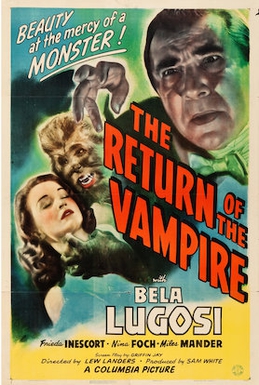
1943’s The Return of the Vampire opens in 1918.

Lady Jane Ainsley (Frieda Inescort) and her colleague, Dr. Walter Saunders (Gilbert Emery), suspect that there might be a vampire active in London.  After reading a book on vampirism that was written by Dr. Armand Tesla, they manage to find the vampire’s coffin.  As the vampire’s servant — a werewolf named Andreas (Matt Willis) — watches, Lady Jane and Dr. Saunders drove a metal stake through the vampire’s heart.  It turns out that the vampire was none other than Armand Tesla himself!  Andreas turns back into a normal person and becomes Lady Jane’s assistant.

Jump forward to the 1940s.  During an attack by the Germans, a bomb explodes over Tesla’s grave and exposes not just his coffin but also the metal pole in the middle of his skeleton.  Two workmen assume that the pole is just bomb debris and they remove it.  Tesla (Bela Lugosi) promptly comes back to life and Andreas turn back into a werewolf.  Tesla sets out to get revenge on Lady Jane and the daughter of Dr. Saunders, Nicki (Nina Foch).

The Return of the Vampire is an interesting film.  Since the film was not made by Universal Pictures, it could not use the name “Dracula” for its vampire but it’s obvious from the start that Armand Tesla is meant to be Dracula.  Tesla wears his Dracula costume, speaks in his Dracula voice, and gives his Dracula performance.  To his credit, Lugosi actually gives a very strong performance in The Return of the Vampire.  His anger towards the people who staked him feels very real and there’s nothing of the intentional campiness that marred some of Lugosi’s later performances.  Lugosi leaves little doubt that Tesla is not only evil but he’s someone who truly enjoys being evil.  He can’t leave England until he gets his revenge on the people who previously defeated him.  For all the talk of stakes, sunlight, and crosses, the vampire’s true weakness is its own vanity and its inability to let go of a grudge.

As a history nerd, I found myself fascinated with how the film worked the then-current Blitz into its story.  The main villain may have been played by Bela Lugosi but the Germans definitely played their role as well, launching the bombing raids that distracted the authorities from the vampire in their midst.  Indeed, it’s probably not coincidence that it was a German pilot who brought Tesla back to life in the first place.  The German pilot is shot down but not before he drops a bomb on Tesla’s crypt.  The film says to be aware of the outside threat but to also be aware that threats can come from the inside as well.  While the Germany terrify the citizens of London, the vampire coolly moves through the night.

Clocking in at a fast-paced 69 minutes, The Return of the Vampire also features a stiff upper lip Scotland Yard inspector (Miles Mander) who, of course, is skeptical of the existence of vampires.  At the end of the film, he asks his subordinates if they believe in vampires.  They reply that they do.  He then looks at the camera and asks us, “And do you, people?”

Well, do you?

Join #MondayMania For The Wrong Boy Next Door!


Hi, everyone!  Tonight, on twitter, I will be hosting one of my favorite films for #MondayMania!  Join us for The Wrong Boy Next Door!

You can find the movie on Prime and then you can join us on twitter at 9 pm central time!  (That’s 10 pm for you folks on the East Coast.)  See you then!

Bonus Horror On The Lens: The Devil Bat (dir by Jean Yarborough)


Because today would have been Bela Lugosi’s birthday, it seems appropriate to showcase him in a bonus horror on the lens!

In the 1940 film, The Devil Bat, the owners of a company in the small town of Heathville are super-excited because they’re going to be given their head chemist, Dr. Paul Carruthers (Bela Lugosi), a bonus check of $5,000.  However, since Carruthers’s inventions have made millions for the company, he is offended by the small check and decides that the best way to handle this would be to sue in court and demand fair compensation …. just kidding!  Instead, Dr. Carruthers sends his army of giant bats to kill the families of his employers.

The Devil Bat was produced by Production Releasing Corporation, a poverty row studio that specialized in shooting quickly and cheaply.  Going from Universal to PRC was technically a step down for Lugosi but The Devil Bat is actually an excellent showcase for Lugosi and he gives one of his better non-Dracula performances as the embittered Dr. Carruthers.  Indeed, one can imagine that Lugosi, who played such a big role in putting Universal on the map, could relate to Carruthers and his bitterness over not being fairly rewarded for the work he did to make others wealthy.

Enjoy The Devil Bat, starring the great Bela Lugosi!

Horror On The Lens: Monster From Green Hell (dir by Kenneth G. Crane)


I hate wasps!

A lot of that is because I’ve never been stung by a wasp so I have no idea whether or not I’m allergic.  Considering that I’m allergic to almost everything else, it just seems likely that I would be allergic to wasps as well.

Another reason why I dislike wasps is that, opposed to hard-working honey bees, wasps just look evil.  They fly straight at you.  They get tangled in your hair.  They try to build their nests right next to your air conditioning unit.  They’re the worst!

1957’s Monster From Green Hell is all about evil wasps.  A group of scientists, working with the space program, come up with the brilliant idea of sending wasps into space.  When the wasp rocket crashes back to Africa, it leads to giant wasps and paralyzed victims.  Can the scientists who created the problem fix things?  Or will nature have to take care of itself?

Watch and find out!  This film is one of many “giant monster’ films to come out of the 50s but it’s perhaps more interesting as an examination of the fears of what would happen when mankind finally went into space.  Today, we take space exploration for granted.  In 1957, it was very exotic and, I imagine to some, very frightening.

One final note: Barbara Turner, the female lead in this film, is also the mother of actress Jennifer Jason Leigh.


Monday Live Tweet Alert: Join Us for Killdozer!


As some of our regular readers undoubtedly know, I am involved in hosting a few weekly live tweets on twitter and occasion ally Mastodon.  I host #FridayNightFlix every Friday, I co-host #ScarySocial on Saturday, and I am one of the five hosts of Mastodon’s #MondayActionMovie!  Every week, we get together.  We watch a movie.  We snark our way through it.

Tonight, for #MondayActionMovie, the film will be 1974’s Killdozer!

It should make for a night of fun viewing and I invite all of you to join in.  If you want to join the live tweets, just hop onto Mastodon, pull up Killdozer on YouTube, start the movie at 8 pm et, and use the #MondayActionMovie hashtag!

Enjoy!


October Positivity: Redeemed (dir by David A.R. White)


In 2014’s Redeemed, Ted McGinley plays Paul Tyson.

Paul is married to Beth (Teri Copley) and is a respected businessman who is in charge of a cybersecurity firm.  His latest project is Jericho which, if successful, could revolutionize the way that information is protected online.  A Brazilian firm is interested in buying Paul’s company, which could make Paul a very wealthy man.

However, Paul has some secrets.  Work on Jericho has not gone as smoothly as one might hope and Paul suspects that it might be due to corporate espionage.  Paul is several thousand dollars in debt and the bank has been sending him threatening letters.  When Paul’s friend David (David A.R. White, who also directed) splits with his wife, Paul starts to wonder whether any marriage can survive the modern age.  How do you keep a marriage strong in an increasingly complicated world?  Paul and Beth are supposed to be renewing the vows in the near-future but Paul is preoccupied with both his job and what appears to be a massive mid-life crisis.

Temptation arrives in the form of Julia (Ana Ayora), a beautiful woman who has been sent from Brazil to check out the company.  Paul finds himself attracted to Julia and they bond over many a night of corporate intrigue.  Paul finds himself growing distant from Beth.  Is Paul going to cheat and destroy his marriage?

(Actually, David explains that Paul is already cheating just by spending time with a woman other than this wife.  David also explains that he’s not the one who cheated in his marriage.  Instead, his wife met some guy in an Internet chatroom and she’s been talking to him nonstop.  They haven’t even met but it’s enough for David to move out of his house and into a hotel.  So, remember — if you’re married and you have any close friends of the opposite sex, you’re just a cheatin’ whore.  Sorry, I didn’t make the rules.)

Will Paul remain faithful to Beth?  And will he ever discover who is trying to sabotage Jericho?

On the positive side, Redeemed features Ted McGinley in a dramatic lead role and McGinley does a pretty good job with it.  There are a few times when Paul is simply too naive to be believable but that’s due to the script and not due to McGinley’s performance.  McGinley does the best he can with the material that he’s been given to work with.  I will also point out that the stock footage of Brazil was lovely.  Finally, David A.R. White is a pleasant-enough actor and his direction here gives the entire film a comfortable Lifetime sort of fell.

On the negative side …. ugh, that plot.  The corporate espionage stuff was hokey and Paul’s indecision about whether or not to commit adultery made his character seem more than a little flakey.  Paul’s married to a very tolerant and understanding woman and he has a beautiful family.  The fact that Paul was so easily tempted to throw all that away makes it difficult to have much sympathy for his character and it also makes his eventual “redemption” a bit difficult to buy.  I think most genuinely good husbands would be able to decide not to cheat on their wives without having to fly off to Brazil to think about it.  In the end, the film is very forgiving of Paul but it doesn’t convince the audience to feel the same way.

Redeemed is a film that celebrates marriage and leaves one appreciating divorce.

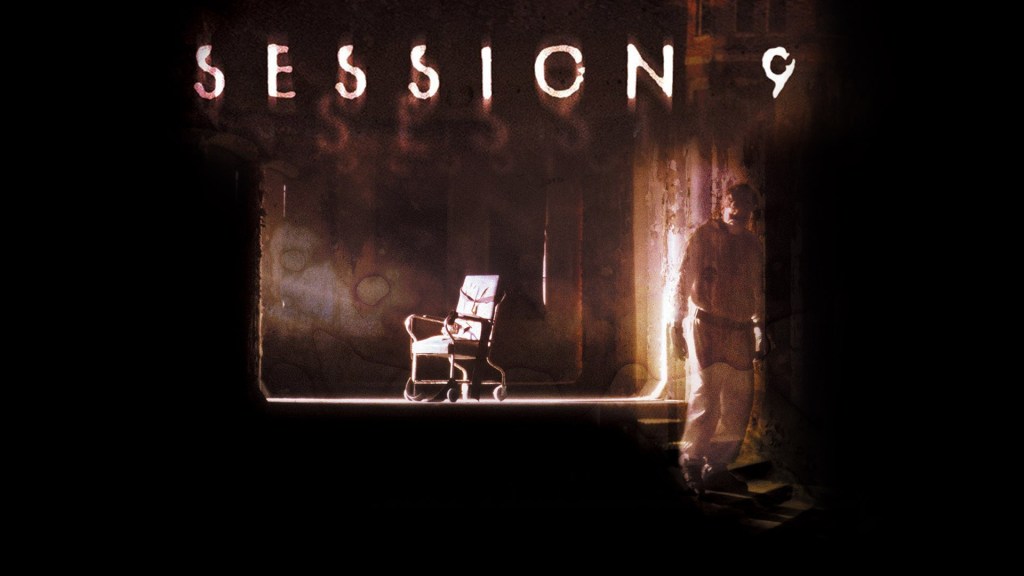
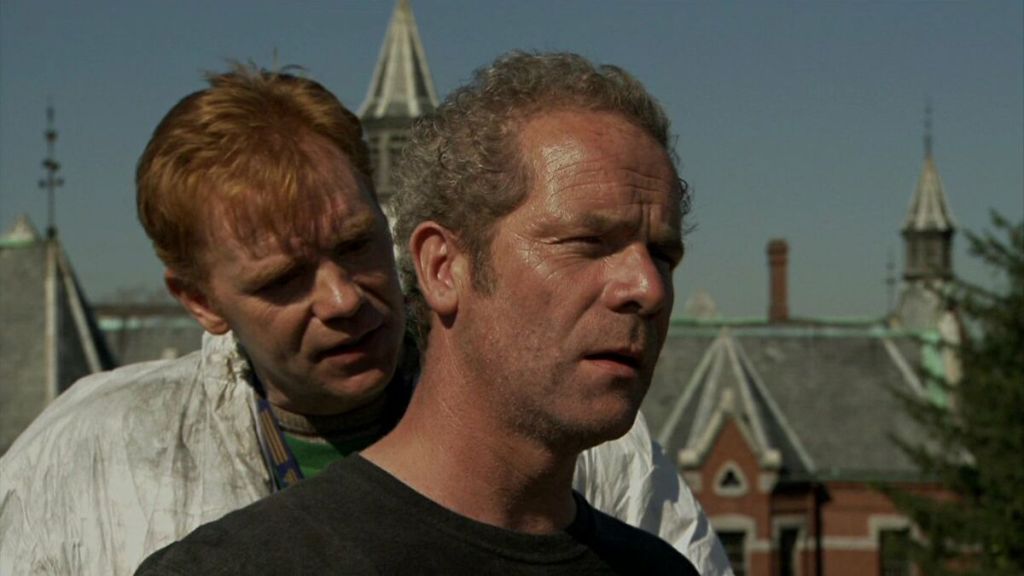
Brad reviews SESSION 9 (2001), starring David Caruso and Peter Mullan!


Gordon Fleming (Peter Mullan) the owner of a company that removes asbestos from old buildings, makes a bid for the work at the Danvers State Hospital in Massachusetts. In a desperate need for cash in his personal life, Gordon promises that his crew can complete the job in only one week, even though a job like this should normally take at least three weeks. His crew… Phil (David Caruso) is Gordon’s right hand man who tries to keep everyone else in line. This isn’t very easy these days considering that another member of the team is Hank (Josh Lucas), who’s currently “dating” (not the word Hank uses) Phil’s ex-girlfriend. The crew is rounded out by Mike (co-writer Stephen Gevedon), a law school dropout who seems to be way too smart to be doing this kind of work, and Jeff (Brendan Sexton III), Gordon’s nephew. As you might expect, once they begin the job, strange things start happening as the crew members find various items in the gigantic mental institution that once housed up to 2,400 people. Mike finds a box of tapes of nine therapy sessions detailing the case of Mary Hobbes, a patient with many personalities who may have murdered someone decades before. Meanwhile, Hank finds a stash of coins and other valuable items in one of the walls. A gambling addict, Hank goes back late that night when no one is around to collect his discovery. Things don’t go well and Hank doesn’t show up for work the next day. We’re led to believe that Hank has headed off to Florida for “casino school,” and this is where things start really getting weird as the pressure of the job and the strange events seem to be getting to the entire crew. When Jeff spots a very oddly acting Hank in the building a couple of days later, the sinister events at the Danvers State Hospital begin to completely unravel! 

Director Brad Anderson’s SESSION 9 is a creepy, slow burn that’s best described as a psychological horror film. It’s one of those movies where you can’t trust what you’re seeing on screen because the story is about the disturbed and damaged human mind. In my opinion, this is the most haunting kind of horror film because there are so many examples in the real world of mentally disturbed people committing horrific acts of violence. My wife has spent the last decade of her nursing career in the area of forensic psychology where she takes care of mentally ill individuals who have committed these types of horrible atrocities, often against the very people in their lives who take care of them. This is real world stuff. And the film’s setting, the actual Danvers State Hospital, also known as the Danvers Lunatic Asylum, in Danvers, Massachusetts, which operated from 1878 to 1992, adds a lot to the atmospheric feel of dread in the film. The Neo Gothic architecture of the facility, and the labyrinth of tunnels connecting the various buildings are a perfect setting for the creepy elements of Anderson’s story, and he takes full advantage of the location. The story and the setting set the stage for what feels like true terror, and I have to admit that SESSION 9 has stayed with me after my initial viewing. 

The cast of SESSION 9 is very effective. Though David Caruso receives top billing, the story really revolves around Gordon Fleming, portrayed by Peter Mullan. I primarily recognized Mullan from his interesting role as Jacob Snell in the excellent Netflix series OZARK, but he’s had quite a career as both an actor (TRAINSPOTTING, THE VANISHING) and director (THE MAGDALENE SISTERS). His quiet, internal performance is a solid anchor for the strange things going on around his crew. Caruso’s character is experiencing his own share of problems in his personal life, and the actor’s edgy intensity is a nice counterbalance to Mullan’s stillness. His life seems to be getting a little out of control and that dynamic works well for the moody paranoia of the film. Of the remaining performances, Josh Lucas seems to fair the best. His character isn’t really all that likable, but he does bring some humor to the role, and it’s ultimately the revelation of his character’s fate that begins to bring the story’s horrifying events to light. 

As I mentioned earlier, SESSION 9 is a slow burn of a film. Brad Anderson takes his sweet time setting the story up by introducing us to the dynamic of the main characters and placing them in the spectacular environment of the institution’s decaying buildings. It takes a bit for the doom and gloom to really start kicking in, so it’s possible that impatient or distracted viewers could lose interest as not much seems to be happening. I also wasn’t very surprised when the revelations of the story finally came to light. If you’re paying attention, the end moments of the movie aren’t as big of a “gotcha” as they could have been. But that’s all okay, because the brilliance of SESSION 9 is ultimately the mood it creates and the impending sense of dread we feel for the final discovery of what some of our characters may be capable of. In those aspects, SESSION 9 is a resounding success. 

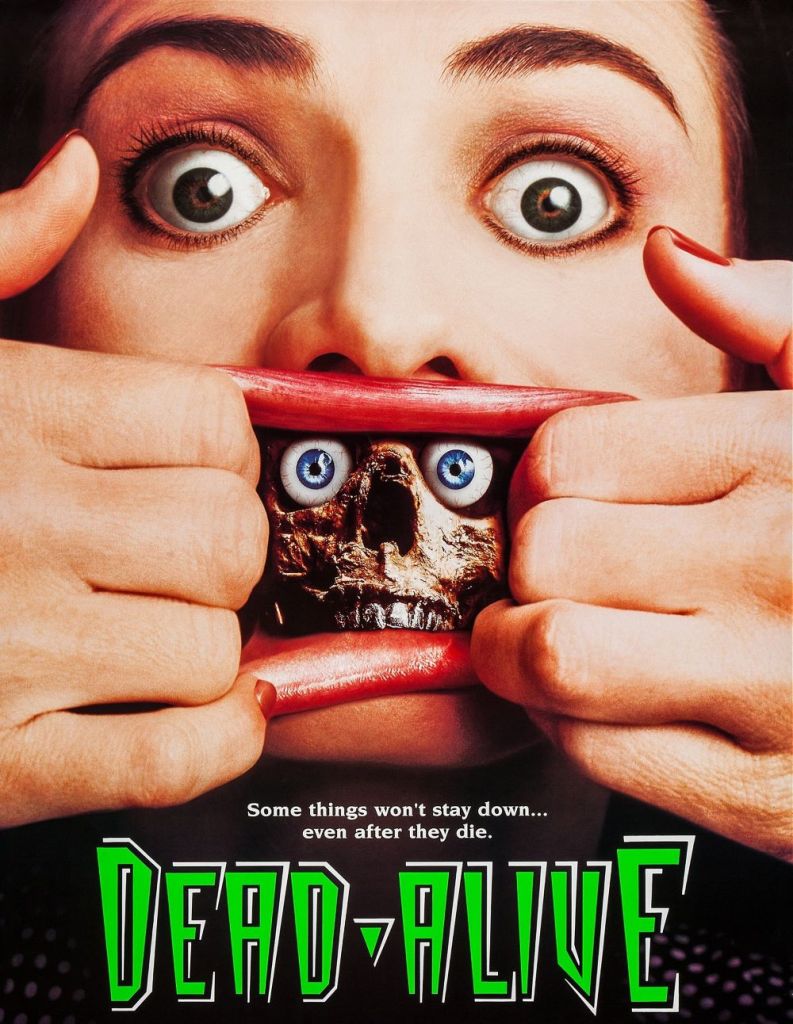
Horror Review: Dead Alive aka Brainded (dir. by Peter Jackson)


“I kick ass for the Lord!” — Father McGruder

Peter Jackson’s Dead Alive (or Braindead, if you’re fancy about it) is what happens when deranged genius meets a barrel of fake blood and zero self-restraint. It’s equal parts grand guignol and Saturday morning cartoon—one of the bloodiest and funniest films ever made. Long before Jackson became the cinematic architect of The Lord of the Rings, he was a scrappy splatter artist, weaponizing gore and absurdity with childlike glee. And while his first two features, Bad Taste and Meet the Feebles, showcased raw chaos and puppet debauchery, Dead Alive marks his evolution—still insane, but sharpened, confident, and shockingly heartfelt in its bizarre way.

The film opens on Skull Island, that mythic symbol of cinematic imperialism, where bumbling white explorers snatch a grotesque hybrid creature—the infamous Sumatran Rat-Monkey. When one of them is bitten, the native tribesmen panic, shrieking “Singaya! Singaya!” while pointing at the wound. It’s grotesquely hilarious—dark humor rooted in colonial parody. For a few fleeting moments, Jackson seems to flirt with serious themes: the toxicity of imperial arrogance, cultural desecration, and the viral consequences of exploitation. You could easily write a twenty-page graduate thesis connecting this opening to the cannibal panic of 20th-century western adventure cinema. But then the movie rolls into prosthetic carnage and butt jokes, and you realize—thankfully—that Dead Alive is no place for academic solemnity.

The story moves to Wellington, New Zealand, where Lionel Cosgrove (Timothy Balme) lives under the suffocating grip of his passive-aggressive mother, Vera. She’s the kind of matriarch who vacuum-seals her son’s adulthood. When Lionel starts falling for Paquita (Diana Peñalver), a kind-hearted shop girl whose grandmother insists destiny has chosen them, Vera’s jealousy leads her to sabotage the romance—and right into a bite from the cursed Rat-Monkey. That’s when everything turns gleefully revolting.

Vera’s infection transforms her into a dripping monument of decay, devouring neighbors and spewing black sludge at tea parties. Lionel, too timid to kill her, instead tries to sedate and hide the growing zombie horde in his basement. Naturally, this plan collapses with the speed of a B-movie funeral, leading to an escalating chain reaction of undead madness. By the one-hour mark, Jackson isn’t directing a film anymore—he’s conducting a symphony of splatter.

Part of what makes Dead Alive endure is just how expertly it moves between the grotesque and the hilarious. Every melted face and gory evisceration is framed like a punchline. Jackson’s camera zooms, tilts, and spins through crimson chaos with joyous purpose. The gore isn’t meant to horrify; it’s kinetic comedy, pure visual rhythm. By the time Lionel revs up his lawnmower for the film’s final massacre—quite possibly the most ambitious use of landscaping equipment in film history—Dead Alive has transcended genre. It’s no longer horror or comedy. It’s delirium art.

Of course, the cast of oddballs steals plenty of the show. Father McGruder, the kung-fu priest, delivers the film’s single most quoted line—“I kick ass for the Lord!”—before dropkicking zombies with ecclesiastical authority. The zombie baby, born from two reanimated corpses who just couldn’t keep their limbs off each other, is another masterstroke of twisted creativity. Lionel’s attempt to civilize the infant, leading to a playground brawl between man and monster-stroller, might be the most deranged slapstick sequence ever shot.

It’s the tactile nature of Dead Alive that makes it timeless. The production team drenched every set in homemade latex, goo, and fake blood—over 300 liters for the finale alone. No digital shortcuts, just pure craft and chaos. You can see Jackson’s imagination fermenting into the precision that would one day fuel his massive fantasy epics. Every scene here, beneath its slime and slapstick, demonstrates an intuitive cinematic intelligence.

If someone wanted to, they could absolutely load an academic essay with postcolonial readings, Freudian analyses, or references to Julia Kristeva’s theory of abjection—arguing that Vera embodies the grotesque maternal figure polluting the symbolic order. You could apply Deleuze and Guattari, Lacan, or even Foucault if you were persistent (and a little delusional). But Dead Alive doesn’t invite theory—it belly-laughs in the face of it. This isn’t a film to decode; it’s a film to experience, preferably with popcorn and zero pretension. Jackson knows exactly what he’s making and relishes every revolting frame of it.

More than thirty years later, Dead Alive remains the filthiest funhouse in horror history—an outrageous blend of low-budget energy, visual wit, and pure imagination. It might gesture briefly toward colonial rot and unchecked power, but ultimately, this movie isn’t about guilt or grandeur. It’s about having the best possible time making the worst possible mess.

For scholars, it’s a nightmare to analyze. For horror lovers, it’s cinematic nirvana. And somewhere in between all the entrails and laughter, you realize Peter Jackson’s greatest early lesson: sometimes, the most profound statement a film can make is “Relax—it’s just blood.”

Horror Scenes that I Love: Tor Johnson In The Unearthly


We honor the birthday of Tor Johnson with today’s scene of the day.

Even though Tor Johnson is playing a character named Lobo, today’s scene that I love isn’t from Ed Wood’s 1955 film, Bride of the Monster. Instead, it’s from 1957’s The Unearthly. In this film, Lobo is now John Carradine’s servant. (Lobo made quite a career out of working for mad scientists.) The Unearthly was directed by Boris Peftroff, a friend of Wood’s, so it’s not improbable that this film’s Lobo was meant to be the same Lobo as the one who appeared in Bride of the Monster and Night of the Ghouls.

Anyway, in this scene, Tor does his usual Lobo stuff while John Carradine plays the piano. “Time for go to bed,” Lobo says at one point, a much-mocked line but one that is delivered with a bit of gentleness by Tor Johnson. My point is that Tor did the best that he could and bless him for it.

October True Crime: Getting Gotti (dir by Roger Young)


In this 1994 made-in-Canada movie, Anthony Denison plays John Gotti.  We watch as he goes from being a street boss to Paul Castellano to assassinating Castellano so that he can take over the Gambino crime family.  Gotti thinks that he’s the king of New York and he’s convinced that no one will ever bring him down.  U.S. Attorney Diana Giacalone (Lorraine Bracco) is determined to prove him wrong.  She becomes the first of many prosecutors to try to get Gotti and Gotti reacts by having his attorney launch a series of outrageously misogynistic attacks against her.  Gotti doesn’t just want to defeat Diana.  He also wants to humiliate her.  Diane may have the evidence but Gotti’s got the money.  Who will get Gotti?

Now, I guess I could argue here that the horror aspect of this film comes from the crimes that Gotti commits.  And it is true that we see Gotti kill a number of people.  He’s a sadistic killer, the type who will shoot someone twenty more times than he needs to.  As the last of the truly flamboyant gangsters, Gotti would go on to become something of a pop cultural institution.  But one should not overlook the fact that, for all of his charisma and bravado, John Gotti was not a nice guy.  Of course, I should also point out that none of that charisma is really present in Anthony Denison’s performance as Gotti.  As played by Denison, John Gotti — the so-called Teflon Don whose greatest strength was his shamelessness — comes across as being a little boring.

Actually, the scariest thing about this film is Lorraine Bracco’s performance as Diana Giacalone.  Bracco does a lot of yelling as Giacalone.  Sometimes, it’s understandable.  Giacalone is portrayed as being someone who grew up on the same tough streets as Gotti and who resents people like Gotti and the Mafia giving a bad name to Italians in general.  The problem is that Bracco yells her lines even when there’s no reason to be yelling.  At one point, she discovers that someone screwed up her lunch order and she screams about it as if the world is ending.  Visiting her mother (Ellen Burstyn) for the holidays, Giacalone yells at her family.  When the verdict comes in, Giacalone yells some more.  The yelling is pretty much nonstop and, as a result, one starts to feel that the other U.S. attorneys might have a point when they say that Giacalone is a loose cannon.  The film tries to present her as being a strong, no-bullshit woman who is going up against an army of misogynists but there’s more to being strong than just yelling.  It would be such a big deal if the film had given her a personality beyond yelling but it doesn’t.  I blame the script more than I blame Lorraine Bracco, who can be a very good actress when cast in the right role.

Getting Gotti pretty much hits every Mafia cliche.  Whenever anyone drives around the old neighborhood, Italian string music plays.  There’s a moment where Giacalone yells that her goal is to make sure that people understand that the Mafia isn’t “Al Pacino looking soulful” in The Godfather.  I had to wonder if Giacalone had ever actually watched The Godfather.  Seriously, an Italian attacking The Godfather?  Who does she think she is, Joe Columbo?

Gotti remains the Gotti film to watch.