I, Zombie, yesterday’s film, was pretty dark. So, for today, let’s lighten things up with a horror film from 1966 that some people consider to be one of the worst films ever made.
I am, of course, talking about Manos: The Hands of Fate.
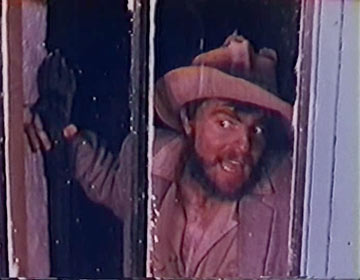
Manos deals with an angry middle-aged man named Michael (played by the film’s director-writer-producer, Harold P. Warren) who, after driving for an eternity through west Texas, ends up stopping off at a motel. At the motel, he meets an odd fellow named Torgo (John Reynolds, who sadly committed suicide immediately after filming Manos). Torgo works for a mysterious figure that he calls “The Master” and it quickly becomes obvious that the Master wants to add Michael’s wife and daughter to his harem. Most people would probably react to all of this by just getting in their car and driving somewhere else. However, Michael is kind of stubbon and stupid…
As I mentioned at the start of this review, Manos has a reputation for being one of the worst films ever made. This may be true but it’s also compulsively watchable. This is one of those films that is so extremely (and, often times, unintentionally) strange that you simply cannot look away.
One final word in defense of Manos. Manos was written, directed, and produced by a fertilizer salesman from my great home state of Texas. The cast was made up of community theater veterans. Next to nobody involved with Manos ever made another film. And yet, Manos will be remembered long after you’ve forgotten the title of the last film made by Michael Bay. You can keep your boring, well-made films because there will always be a place in my heart for Manos: The Hands of Fate.
(Add to that, the film’s title translates to Hands: The Hands of Fate and who can’t appreciate that?)
Last year, I was doing a search for dance scenes on YouTube and I came across a handful of scenes from a film called Lambada. The scenes all had an undeniably cheap look to them and featured a rather stiff dancer who was wearing one dangling earring. The scenes were so memorably bad that I promised myself that, if I ever got the chance, I would watch this Lambada.
Well, I got that chance last night when Lambada turned up on NUVOtv. I forced my BFF Evelyn to watch the movie with me because I thought I might want to use the movie for one of my What Evelyn and Lisa Watched Last Night reviews. However, as we watched Lambada, I realized that the only way to review this movie was to consider it as a guilty pleasure.
First released way back in 1990, Lambada tells the story of Mr. Laird (J. Eddie Peck), an idealistic math teacher in Beverly Hills by day and a sexy dancer at night. Did I mention that when Mr. Laird dances, he calls himself Blade? Because he so does!
However, Blade isn’t just dancing for fun or to deal with what appears to be a split personality. Instead, he uses dance skills to impress the poor kids at the clubs so that he can then lure them into a backroom where he helps them prepare to take the GED.
He’s a dancer with a conscience and who doesn’t love that, right?
However, eventually Mr. Laird is spotted dancing by Sandy (Melora Hardin, a decade and a half before playing Jan on The Office), one of his students from Beverly Hills. When he doesn’t respond to her crush, she reveals his secret and — for reasons that are never quite clear — this puts his job in jeopardy.
Why did Lambada turn out to be such a guilty pleasure?
Just consider the following:
1) Cast in the key role of “Blade” Laird, J. Eddie Peck looks good but gives a performance that almost epitomizes the concept of anti-charisma. When he’s teaching in Beverly Hills, he wears sexy glasses. When he’s dancing in the barrio, he loses the glasses and instead wears one dangling earring. When a female student in Beverly Hills hits on him, he awkwardly smiles. When he dances, he moves so stiffly that he resembles a mannequin on a treadmill. That’s about the extent of Peck’s performance.
2) Melora Hardin, on the other hand, is completely natural and likable in the role of Sandy but, even though this film was made 16 years before the premiere of the Office, Hardin has already picked up a lot of the techniques that she would use to make Jan Levinson-Gould such a memorable character. Every time that Sandy smiles nervously or looks annoyed by another character, it’s impossible not to be reminded of Jan struggling to manage Michael Scott. As Nathan Rabin pointed out in his review of this film over at the A.V. Club, Lambada really does feel like Jan Levinson: The Early Years.
3) If Lambada was made today, it would be called Twerking and, while watching, it was hard not to imagine Melora Hardin chasing J. Eddie Peck with a big foam finger.
4) An aggressively forgettable song called Set The Night On Fire is played about a hundred times over the course of the film. The song is so generic and forced, and everyone in the film has to pretend to be so in love with it, that it becomes oddly fascinating.
5) The club that Blade dances at has an upside down police car hanging from the ceiling. The club, itself, gives off a definite human trafficking vibe but that police car is pretty neat.
6) One of Mr. Laird’s Beverly Hills students is named Egghead. Naturally, he’s the smartest student and he’s obsessed with computers. Evelyn and I both found ourselves wondering if Egghead was just a nickname or if his parents actually named him that in order to force him to grow up to be intelligent. (Even Mr. Laird calls him Egghead, which — if that’s not the student’s name — seems a bit unprofessional for a teacher.) It may not sound like much but it provided us with hours of amusement.
7) There’s a scene where Egghead uses his computer to inspire an entire classroom to spontaneously start dancing. What makes this scene especially memorable is that the computer dances along with them.
8) Whenever Blade is teaching his GED class, the students respond to almost everything he says by cheering. If nothing else, I’m sure many teachers have fantasized about being as irrationally loved by their students as Blade.
9) Eventually, Blade’s GED students compete with the Beverly Hills students. No, it’s not a dance-off. It’s a math-off! That’s right — they’re competing to see who can correctly answer the most math questions. And, believe it or not, the future of Blade’s career depends on whether or not his GED students can win. Apparently, this is how the California educational system worked back in 1990.
10) Finally, the ultimate reason that Lambada is a guilty pleasure is because — regardless of how silly and ludicrous the film may seem to us today — it was actually produced and released into theaters. That means that, somewhere out there, there are people who actually paid money to see this movie. They may not admit it but they’re out there.
Sometimes a really bad film just does enough to push my buttons to actually make me like it. One such film was 2009’s scifi=thriller Pandorum.
The film was one of those that had some hype behind it prior to the film’s release. It had a nice marketing angle which included some very disturbing biomechanical imagery that harkened back to classic H.R. Giger artwork from both Alien and Dune. The film even had an interesting premise which was about a mental affliction caused by long exposure to space travel called “Pandorum”.
When the film finally came out to say that it bombed would be quite an understatement. While the ideas behind the film were interesting enough the overall execution of said ideas were haphazard at best and unimaginative at it’s worst. There’s nothing worst than a B-movie trying to stand out from the dregs and failing because it’s dull and boring. Yet, despite all that I’ve been fascinated by Pandorum ever since I’ve caught it on video.
German director Christian Alvart might be lacking some style in his direction of the film, but the cast itself manages to work their damnedest to make the film work. Ben Foster does his usual twitching performance where we don’t know if he’s about to go psycho on everyone around him or just curl up in the corner and start sobbing like a newborn. Dennis Quaid chews the scenery so much in every scene he’s in that his work in the film almost comes off as performance art.
Even the idea that people who were gentically-enhanced to adapt and evolve to their surroundings was a new one. The film even goes further by making the foundation of rapid evolution come from the ship itself. All the cannibalism involved just added that grindhouse touch to the proceedings.
The one thing that really brings me back to watching this film as one of my many guilty pleasure’s was this was the first film that introduced the world to Antje Traue. She’s better known as one of the few good things to come out of Man of Steel. Even in this first feature film for Antje Traue we already see examples of how much a badass she can be. It’s a shame that the film around her wasn’t better.
Pandorum never improves with each repeat viewing, but it doesn’t get worst either. It just straddles that fine line where one or two things changed for the better would’ve made it a good film. But for the life of me I have no idea why I like it and continue to watch it. Sometimes even bad films will push enough of the requisite buttons for people to like it and this film certainly pushed the right ones from me.
Last year’s Step Up Revolution is, in many ways, the epitome of guilty pleasure. On the one hand, it’s totally and complete ludicrous. And, then on the other hand — well, there is no other hand, to be honest. It’s a silly little film but the dancing is really good and how can you not love something that over-the-top? With it’s quick-cut editing, relentless beat, and hilarious attempts at being socially relevant, Step Up Revolution is the type of film that, in the future, our children will watch and laugh at even as we savor the nostalgia.
For my latest guilty pleasure, I want to take a look at Terror In The Family, a well-intentioned, out-of-control youth film from 1996.
Certain moments of Terror in the Family felt painfully familiar because, much like the film’s main character, Deena Marten (played by — yes, it’s true — Hilary Swank), I went through a period, when I was teenage, where I was seriously out-of-control. Much like Deena, I would sneak out of the house, I would hook up with guys who were obvious trouble, I had absolutely no impulse control, and I said and did a lot of hurtful and self-destructive things that I still would do anything to take back. I was 16 while, in the movie, Deena is portrayed as being 15. The main difference between me and Deena is that I was out-of-control because I was having an undiagnosed manic episode. Deena, however, is out-of-control because she comes from one of the most dysfunctional family in the history of dysfunctional families.
And that’s why, despite the fact that I can relate to the painful subject matter, Terror In The Family amuses me more than it disturbs me. Seriously, anything that can be wrong with a family is wrong with this family.
Consider this:
Father Todd Marten (Dan Lauria) spends all of his time down in the basement, making wooden bowls and then taking pictures of them. Usually, he avoids his family but when he’s finally forced to confront Deena, she ends up smashing his fingers with her bedroom door. “HOW CAN I WORK NOW!?” he bellows while holding up his bandaged hand.
Mother Cynthia Marten (Joanna Kerns) is an alcoholic who spends her spare time standing in front of a mirror and rehearsing being a disciplinarian. When Deena flees the house, Cynthia attempts to win her back by bringing her a huge, home-made pizza. “I made your favorite!” Cynthia drunkenly cries before accidentally dropping the pizza on the floor.
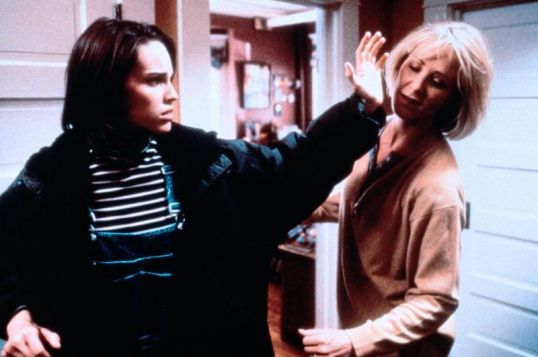
Grandmother Ivy (Nan Martin) is, without a doubt, one of the most evil and unpleasant characters that I have ever seen in a movie. When Cynthia tries to tell her about the difficulties of raising Deena, Ivy responds by literally punching her in the face.
Deena’s younger brother, Adam (Adam Hendershott), is a talented pianist who deals with his family by playing video games and literally sleeping with a bottle of vodka in his bed.
Finally, there’s Aunt Judith (Kathleen Wilhoite). Judith seems to be the only stable person in Deena’s family. That’s mostly because Judith left home when she was young and was apparently some sort of groupie for several years.
With this family, is it any wonder that Deena is spending all of her time with Garrett (Andy Kavovit), her 17 year-old boyfriend who, along with introducing her to drugs and sex, also speaks wistfully of killing his mother and her boyfriend? Garrett, not surprisingly, has a band and Deena soon finds herself staying out past curfew so she can perform with him at various seedy clubs. The film blames a lot of Deena’s bad behavior on Garrett but you know what? Back when I was 15, I would have been totally in love with Garrett too.
Seriously, Deena, you go girl!
Anyway, with all of this going on, can we really be shocked that Deena eventually ends up swinging a landline phone at her parents and demanding that they stay away?
Terror In The Family shows up on Lifetime occasionally and recently, for reasons that I don’t quite understand, it even turned up on Showtime, playing in between showings of Dexter and The Seduction of Misty Mundae. It’s worth watching because it really is the perfect marriage of good intentions, over-the-top melodrama, and intense cluelessness. For the most part, future Oscar winner Hilary Swank gives a good performance as Deena but the best parts of the films are the parts where she joins the rest of the cast in going totally and completely overboard.
The mix of melodrama and hindsight combine to make Terror In The Family into a true guilty pleasure.
Last night, before going on vacation, I watched the SyFy original movie, Ghost Shark.
Why Was I Watching It?
Every Saturday night, I watch and live tweet a SyFy movie with the Snarkalecs. Last night, we watched Ghost Shark. Seeing as Ghost Shark was going to be my last SyFy film to watch before going on vacation, I knew that both the film and the snarkiness would have to keep me satisfied for the next two weeks. Fortunately, both Ghost Shark and the Snarkalecs came through brilliantly!
What Was It About?
One of my huge problems with Sharknado is that, despite the title, there really wasn’t much tornado action. However, Ghost Shark lives up to its title. It’s called Ghost Shark and, by God, that’s what it’s about!
In short, a shark is killed by a bunch of rednecks who look like they’ve wandered over from an unaired episode of Duck Dynasty. However, the shark comes back and, as you might guess, it’s looking for vengeance. As a ghost, the shark has the ability to manifest itself out of any body of water and soon, it’s popping up in toilets, swimming pools, sinks, water slides, and an open fire hydrant. (As the film’s brilliant tagline put it — “If you get wet, you die.” Seriously, I would be so dead.) It’s up to Ava (Mackenzie Rosman) and the town drunk (Richard Moll) to figure out how to stop the Ghost Shark!
What Worked?
Even if I hadn’t known beforehand, I would have guessed that Griff Furst had directed Ghost Shark. Of all the directors who regularly direct films for the SyFy network, Furst is one of the best. Along with making good use of his trademark Louisiana locations, Furst also knows how to maintain the perfect balance of excitement and humor.
It should also be noted that Ghost Shark is one of the few films where you really can’t predict who is going to survive and who is going to end up as sharkbait. One reason why the ghost shark is an effective monster is because he will literally eat anyone, even characters who — in other films — would automatically be spared of any danger.
On a personal note, I have to say that the Snarkalecs were on fire last night. Kelly Thul, in particular, earned a spot in the hall of fame for commenting, about two characters who had just gotten the upper halves of their bodies chomped off by the ghost shark, “They’re waisted!”
What Did Not Work?
It all worked. Seriously, this was the best SyFy film since End of the World. And, in case you were curious, it’s a hundred times better than Sharknado.
“Oh my God!” Just Like Me Moments
At one point, one future victim said, “It’s too hot to be a virgin” and if I had a dollar for every time I’ve used those exact same words, I would be one rich redhead.
Also, I related to the scene where the sprinklers go off in the local museum and end up soaking every character there. Museums always get me wet too. What can I say? I love history.
The most recent entry in the Guilty Pleasure series had Lisa Marie waxing poetically about the idealistic teacher in the “jungle” film The Principal. I counter and follow this up with a similar-themed film called The Substitute that came and went very quickly in the theaters (I’m not even sure if it did or just went straight to video) in 1996.
The Substitute stars veteran actor Tom Berenger (you may remember him in such films as Platoon, Major League and Sniper) as a Vietnam vet mercenary who ends up substituting as the substitute teacher for his girlfriend’s high school class as she recovers from an attack that has left her unable to teach. The girlfriend was played by one Diane Venora who in the very same year was in another little film called Heat by Michael Mann. These two polar opposite films in terms of their “quality” just shows you that when it comes to acting, unless one was a recognizable name then any role is a good role it seems.
Getting back to the film, Berenger’s character is the titular substitute in one of Miami’s worst inner-city high schools where, as the film’s tagline proudly proclaims, the most dangerous things about it was the students. That is until Berenger’s character shows up to find out who attacked his girlfriend and bring down the wrath of God himself (or at least Berenger’s character and members of his old mercenary team).
The film isn’t what one would call very subtle. We clearly see either two types of teachers in this school. There’s Berenger and his girlfriend who care for the young teens (the former woth tough love and the latter going about it in a more liberal sense) and then there are those who have given up on the school and just cashing in on a paycheck. This goes to the extreme with the school’s principal (played by Ernie Hudson) who begins to suspect that the new substitute might be more than he appears.
It’s the passive-aggressive interaction between the two roles played by Berenger and Hudson that made for some of the more hilarious sequences in the film.
Oh, another thing the film also involves a dangerous high school gang that uses the school as if it’s their own little fiefdom and the local drug kingpin using it as a way station to move heroin into the Miami inner-city school system. Oh, did I happen to mention that Marc Anthony plays the leader of the high school gang, because he sure does.
The Substitute almost plays out like how a teacher fed up with the inattentiveness of his students and the stress of doing a thankless job imagines the perfect scenario to “clean-up” the high school. It’s not through coddling and talking things out with the students. It’s about using military tactics to take out the dangers of gangs and drug dealers and tough love on those who are still worth saving.
Some have called the film as blatantly racist while others have pointed out how it is just an extreme version of the longstanding storyline of the educated and civilized white man saving the “natives” from themselves. What this film has over other school films of similar themes is how it doesn’t try to sugarcoat and hide behind ideals when it comes to it’s story. Plus, it’s such a guilty pleasure to see a typical 80’s action flick dressed up to be a late 90’s film. They really don’t make films like this anymore.
I have a weakness for films about idealistic educators who try to teach and change lives in the inner city. You know which films I’m talking about. These are the films that always take place in a decaying high school and there’s usually at least one scene where the teacher is warned not to care too much about their hopeless students and then the teacher goes, “Someone has to care!”
Why do these films fascinate me so?
To a large extent, it’s because they take place in a world that is so extremely outside of my high school experience. I was recently doing a search on my school and I came across a video on YouTube that was made by some students from my alma mater:
As I watched this video, I realized that neither the students, the campus, nor the neighborhood had really changed in the 9 years since I graduated.
I also realized that, even though I didn’t realize it at the time, I went to one of the most suburban, white bread high schools in the DFW metroplex. At the time, of course, a lot of my classmates thought they were tough. They would make a big deal about blasting Jay-Z and 50 Cent while they were driving down to Starbucks during lunch. For the most part, though, we put the suburb in suburban.
That, I think, is why I’m fascinated by inner city high school films. It’s even better when those films are totally over-the-top and feature a hero who not only teaches but who kicks some ass as well.
Perhaps that’s why I recently enjoyed watching The Principal.
Originally released way back in 1987, The Principal is one of those films that seems to regularly show up on the lesser known television networks. A few weeks ago, I saw that it was going to be broadcast on Ion Television so I set the DVR to record it and I finally ended up watching it this weekend.
In The Principal, James Belushi plays Rick Lattimore. (You can tell that this movie was released quite some time ago because Belushi has a lot more hair and lot less chins than he does now.) Rick’s a teacher with an anger problem. When he sees his ex-wife out on a date with his divorce lawyer, Rick loses it and physically assaults the lawyer. The next morning, Rick is called into a meeting with the school board. He’s expecting to get fired. Instead, he’s promoted. Rick is now principal of Brandel High.
Brandel High, it turns out, is the most troubled high school ever! Drugs are sold and used openly in the hallways. Few students bother to attend class (but yet they still come to the school). The teachers spend most of their time hiding in either their classroom or the teacher’s lounge. The school’s head of security, Jake (Lou Gossett, Jr.), spends most of his time making sarcastic comments. When Rick pulls up on his motorcycle, the first thing he sees is a fight between rival drug dealers.
Rick responds to all of this by holding a school assembly. As every student at Brandel jeers him, Rick announces that he has only one policy: “NO MORE!” It’s at this point that the school drug lord Victor Duncan (played by Michael Wright) stands up and announces, “You talk too much!”
Things continue to build up from there as Rick divides his time between educating and getting beaten up by resentful students, Jake starts to actually care about his job again, and Victor wanders through the school hallways, dressed like he’s in one of the Underworld films and saying stuff like, “Try to reach me and I’ll just cut off your hand…”
The Principal is such an over-the-top, silly, yet heart-felt film that it’s impossible not to enjoy it in much the same way that you might enjoy eating junk food. As I watched this film, I found myself wondering what had happened to James Belushi in the years since it was originally released because, in The Principal, he’s actually likable. However, the film really belongs to Michael Wright. Seriously, as played by Wright, Victor Duncan is the most evil student in the history of high school cinema. When he tells Rick that he’s willing to cut off his outstretched hand, you believe him.
The Principal is a thoroughly predictable film that promotes a dubious educational policy of zero tolerance. However, it’s also a lot of fun.
In other words, it’s the epitome of a guilty pleasure.
So, I was recently talking to someone on twitter and he essentially said, “Nice blog but enough with Sharknado.” I have to say that I agreed with him. We do have a pretty nice blog here and Sharknado has been the overhyped, overrated film of 2013.
What’s distressing is that a lot of people think that Sharknado is the epitome of a good, silly SyFy film. By SyFy standards, Sharknado was nothing special. Certainly, it could in no way compare to previous SyFy films like 2-headed Shark Attack, End of the World and Flying Monkeys. The only thing that set Sharknado apart was the fact that it was watched by a bunch of celebs who proceeded to tweet some the lamest film commentary ever seen on twitter.
Myself, I’m much more looking forward to August 22nd of this year. That’s the day that Ghost Shark will premiere on SyFy. Not only was Ghost Shark directed by the great Griff Furst (director of such classic SyFy films as Arachnoquake and Swamp Shark) but, judging from the trailer below, Ghost Shark appears to deliver exactly what it promises: a shark that’s also ghost which eats a lot of fat people.






 Through the Shattered Lens