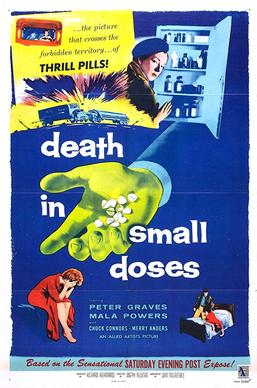
30 More Days of Noir #10: Death in Small Doses (dir by Joseph M. Newman)


Ah, speed.

I have to admit that I always find films about amphetamines to be fascinating because I take them for my ADD.  I’ve been taking Dexedrine since I was in middle school and it has always amused me how people who don’t have ADD seem to think that the meds will give you super powers.  For instance, every season of Big Brother, there’s people online who get outraged over certain houseguests taking Adderall.  “She had an unfair advantage!” someone will say, “Because she’s taking Adderall!”  What can I say?  People who don’t have ADD just don’t get it.  Yes, if you have ADD, the meds can help you focus but it’s not like they’re going to give you any sort of special power that’s not available to any other person.

(I will admit that there is a slight difference between me on my meds and me off my meds.  Actually, my family says that there’s a huge difference but I think they’re exaggerating.  It is true that I’m a lot more focused when I take my Dexedrine.  My mind wanders a bit less than usual and I’m also usually in better control of my frustrations.  When I take my meds, I can finish any project.  When I don’t take them, I can talk about finishing any project.)

Dexedrine focuses me but apparently, it does the opposite for those who don’t have ADD.  The 1957 film, Death in Small Doses, features a truck driver named Mink Reynolds who, despite not having ADD, pops too many capsules and ends up playing really loud music and trying to force a waitress to dance with him.  He also hallucinates seeing a car and then grabs a knife and tries to kill another truck driver.  To be honest, that seems a bit extreme to me.  In fact, I’d almost argue that Mink’s behavior would indicate that the filmmakers really didn’t know much about amphetamines.  Making things even stranger is that Mink is played by Chuck Connors, who was a remarkably inexpressive actor.  Watching Connors, with his stone face, trying to dance and jump around is an interesting experience.  Mink is supposed to be a jazz-crazed, speed-abusing hepcat but instead, he comes across like an animatronic mannequin.  You can almost hear the gears shifting whenever he has to move across the screen.

Mink’s fellow truck driver is Tom Kaylor (Peter Graves), a seemingly upright man who is usually seen wearing a tie and who looks like he would be more comfortable working behind a desk than driving a truck.  Of course, that’s because Tom is actually an FBI agent!  He’s working undercover, pretending to be a truck driver so that he can smash a ring of drug dealers!  Of course, the problem here is that everything about Peter Graves’s screen presence shouts out, “Narc!”  With his square jaw and his perfect haircut and his stiff but authoritative delivery of his dialogue, he seems like he was created in a lab that specifically set out to develop the most stereotypical FBI agent imaginable.  There’s not a single rough edge to him and it’s hard to buy that the other truck drivers wouldn’t see straight through him.

While Tom tries to bust the ring, he also finds time to possibly fall in love with two different women, both of whom seem as if they might know more than they’re letting on.  Amy (Merry Anders) is the waitress who has developed a drug habit of her own.  Val (Mala Powers) owns the boarding house when Tom and Mink live.  Can Tom trust either one of them?  And will Tom not only undercover the identity of the head of the drug ring but also survive long enough to bring the dealers to justice?

So, here’s the thing.  During its worst moments — i.e., whenever Chuck Connors is jumping all over the place and talking about how much he loves his friend “benny” — this is a campy and rather silly film that makes Reefer Madness look subtle by comparison.  However, during its best moments, this is a tough and entertaining noir that features good performances from Merry Anders and Mala Powers.  Both Anders and Powers manage to transcend the film’s sillier moments and they actually bring a charge of reality to the story.  And while director Joseph M. Newman may not have known much about drugs, he did know how to shoot a fight scene.  Making good use of its desolate locations (the truck drivers spend a lot of time driving through the desert) and setting many of the film’s best moments at night, Newman overcomes some of the script’s weaker moments.  In the end, it makes for a rather uneven but entertaining viewing experience.  Despite the film’s cluelessness about drugs and the miscasting of both Graves and Connors, this lesser-known noir is worth tracking down.
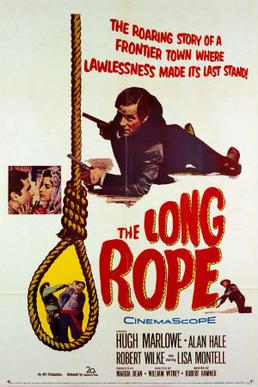
The Long Rope (1961, directed by William Whitney)


The time is the late 19th century and there’s been a murder in the territory of New Mexico.  Someone has gunned down Jim Matthews (Steve Welles) and store owner Manuel Alvarez (John Alonzo) has been arrested.  Everyone in town says that Jim was fooling around with Manuel’s beautiful wife, Alicia (Lisa Montell).  Manuel insists that he’s innocent but Jim was the brother of the town’s most powerful and richest land owner, Ben Matthews (Robert J. Wilke).  Ben is already having a gallows built so that Manuel can be hanged in the town square and it doesn’t look like there’s anything that Sheriff John Millard (Alan Hale, Jr. — yes, the Skipper) can do to stop him.

However, Federal Judge Jonas Stone (Hugh Marlowe) is determined to make sure that Manuel gets a fair trial.  When it becomes obvious that the Matthews family has no intention of letting that happen, Judge Stone launches his own investigation.  Believing Manuel to be innocent, Stone knows that he has to find the real killer before the gallows are built and Manuel is lynched by the mob.

A low-budget western with a 61-minute running time, The Long Rope is a surprisingly adult western, one that comes out strongly and directly against both lynching and the town’s racism.  With the Matthews family representing the brutal “old ways,” and Judge Stone representing a more enlightened and fair system of justice, it’s up to the town to decide who they will follow.  Hugh Marlowe brings a lot of gravitas to his role as the stern but compassionate Judge Stone while Lisa Montell makes a strong impression as Manuel’s rebellious wife.  Robert J. Wilke is an effective villain and even Alan Hale, Jr. gives a good performance once you stop thinking of him as being the Skipper.

One final note of interest: John A. Alonzo, who played Manuel in The Long Rope, went on to become an award-winning cinematographer.  Among Alonzo’s credits, as a cinematographer: Harold and Maude, Chinatown, The Bad News Bears, Black Sunday, Scarface, Norma Rae, and Close Encounters of Third Kind.

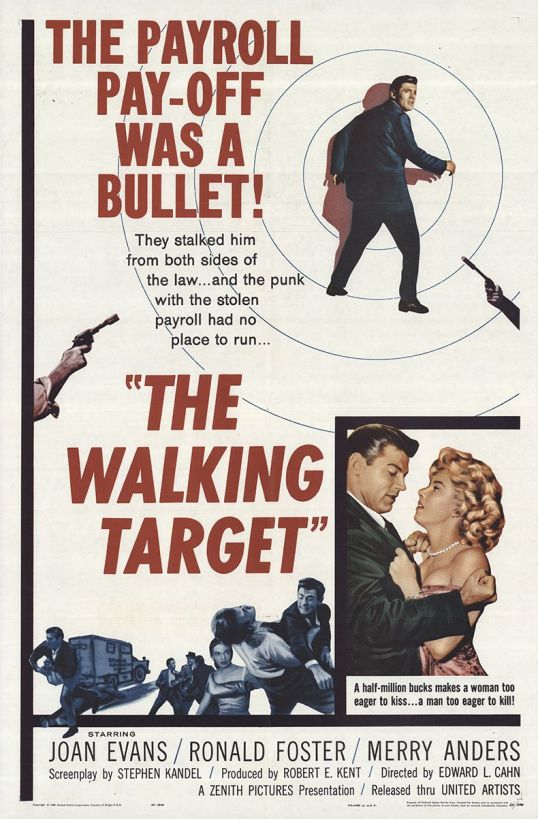
30 More Days of Noir #9: The Walking Target (dir by Edward L. Cahn)


In this 1960 noir, Nick Harbin (Ronald Foster) is a walking target!

That’s because he’s just been released from prison.  As the only survivor of a gang that pulled off a daring payroll robbery, Nick has done his time and he’s ready to get on with his life.  He even got himself an education while he was behind bars.  He’s decided to reform and no longer be the angry criminal that he once was.

But first, there’s a little matter of some money.

Only Nick knows where he buried the loot from the robbery.  Everyone wants it.  The press wants to know because it’ll make a great story.  A nosy detective wants to know because he’s convinced that Nick hasn’t changed his ways.  Susan (Merry Anders), who used to be involved with one of Nick’s criminal associates, wants to know because she’s only in it for the cash.  Susan’s current boyfriend, Dave (Robert Christopher) wants to know because …. well, again, it all comes down to greed.  Greed is also what’s motivating a local gangster to provide backing for Susan and Dave in their quest to find the money.  Dave is even willing to send Susan to seduce Nick.

However, all Nick wants to do is find the money and then split it with Gail (Joan Evans).  Gail is the widow of one of the robbers and Nick wants to do the right thing for her.  Of course, Nick is himself kind of in love with Gail.  Can Nick get the money, find love with Gail, and avoid slipping back into his criminal ways?  It won’t be easy.  Life is never easy when you’re….

THE WALKING TARGET!

Okay, that was a little bit melodramatic on my part but then again, it’s a melodramatic film.  Everyone is constantly plotting and double-crossing.  Appropriately, it all leads to a battle in the desert as modern-day outlaws prove themselves to be no more trustworthy than their vintage ancestors.

The Walking Target is a low-budget noir, one that clocks in at only 70 minutes and which, as a result, doesn’t waste much time when it comes to jumping into its story.  That’s one good thing about these B-movies.  They had neither the budget nor the time for red herrings.  As a result, you pretty much know what you’re going to get before the movies even begins.  The Walking Target features all of the usual tough dialogue and morally ambiguous characters that you would expect to see in a noir.  Merry Anders is an adequate femme fatale, though I do wish that Susan had been a smarter character.  (Nick sees through her way too easily.)  The film opens with the prison’s warden telling Nick that, even though he’s done his time, he’ll always be a no-good crook and that’s the perfect way for a noir to open.  Unfortunately, the film’s cinematography doesn’t really have the right noir look.  There aren’t enough shadows and the film often looks like it could just be an episode of an old TV show.  I guess that’d due to the budget but it really does keep the film from making the transition from being good to being great.

The Walking Target is a diverting-enough film.  I liked Ronald Foster’s uneasy performance as Nick and it was enjoyable to watch everyone plotting and scheming.  The Walking Target is currently available on Prime and I recommend it to anyone looking for a good, if lesser-known, B-noir.

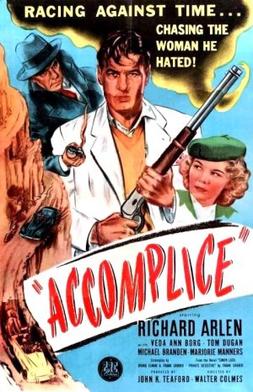
30 More Days of Noir #8: Accomplice (dir by Walter Colmes)


The 1946 film noir, Accomplice, tells the story of Simon Lash (Richard Arlen).

Now, I guess if you have a name like Simon Lash, you’re pretty much destined to become a private detective.  In this case, Lash is both a detective and an attorney.  I did some research — which is a fancy way of saying that I checked with Wikipedia — and what I discovered is that there was apparently quite a few stories written about Simon Lash.  He was a pulp hero created by Frank Gruber.  Gruber went on to write the screenplay for Accomplice, which was based on the novel Simon Lash, Private Investigator.  I don’t know if this was the only Simon Lash film or not.  If there were more Simon Lash films, let’s hope they found a more interesting actor than Richard Arlen to play him.

Yes, indeed, Richard Arlen makes for a rather dull hero in Accomplice.  Physically, he seems like he’s right for the role.  You look at Richard Arlen and you can imagine him beating someone up.  But, in this film at least, he has a boring screen presence that makes it difficult to really get invested in Simon as a character.  He doesn’t have the wounded cynicism of Humphrey Bogart or the killer eyes of Alan Ladd.  He’s just kind of there.

Simon Lash is hired by his ex-fiancée, Joyce (Veda Ann Borg), to track down here husband.  Joyce claims that her husband is president of a huge bank and that he’s suffering from amnesia.  Simon doesn’t quite trust Joyce and he worries that she’s actually using him to dig up dirt for a divorce.  Simon doesn’t work divorce cases.  Apparently, it’s a matter of honor for him.  Not surprisingly, it does turn out that Joyce hasn’t been totally honest with Simon.  Of course, it also turns out that Joyce’s husband has some secrets and tricks of his own.

Indeed, it’s a very complex story, which is something I appreciated.  I always love all the twists and turns of a typical California noir and this one had several.  It all eventually led to a shoot out at a castle in the desert and again, that’s exactly what you want a film like this to lead to.  Accomplice is only 66 minutes long and, as such, it never drags and the double and triple-crosses all come quickly.  That’s definitely a good thing.

Unfortunately, despite all of that, the film itself falls flat.  The main problem is one that I already pointed out.  Richard Arlen is just not a very compelling hero.  While Veda Ann Borg has the right look to play a femme fatale, she still has a strangely bland screen presence in this film.  It’s easy to imagine her trying to fool someone but it’s next to impossible to believe that she could actually do it.  She’s just a bit too boring for the role.  With different actors in the lead roles, Accomplice could have been a classic low-budget noir.  (Seriously, just imagine the film if it had reunited Detour’s Tom Neal and Anna Savage as Simon and Joyce.)  As it is, Accomplice is a bit of a disappointment.  The possibilities are more fun than the execution.

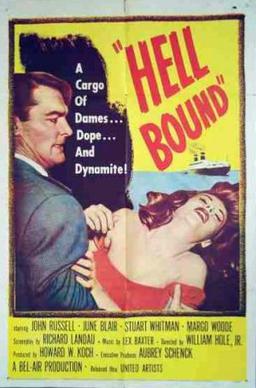
30 More Days of Noir #7: Hell Bound (dir by William J. Hole, Jr.)


Like so many film noirs, 1957’s Hell Bound opens with a narrator.  As we watch scenes of a group of thieves robbing a Naval ship of World War II narcotics, the narrator explains to us what each criminal is doing and how their plot will hopefully lead to them getting rich.  Again, this is something we’ve seen in a countless number of film noirs.  What makes Hell Bound unique is that the narration keeps going long after one would expect it to stop.  And the expected cops and federal agents are never introduced….

That’s because we’re watching a film within a film!  Jordan (John Russell) has made and produced the film himself, all to convince a gangster named Harry Quantro (Frank Fenton) to support his plan to …. well, to rob a Naval ship of narcotics.  Jordan promises that the real-life theft will go just as smoothly as the theft in the movie!  And, it must be said, Jordan’s movie was really well-made.  He hired actors and everything.  Harry agrees to give Jordan his backing on the condition that Jordan use Harry’s girlfriend, Paula (June Blair), in the operation.  That, of course, means that Jordan won’t be able to use his own girlfriend, Jan (Margo Woode).  That’s going to be awkward.

Anyway, Jordan starts to assemble his crew and they’re the typical film noir collection of misfits.  One of the more fun things about Hell Bound is that it’s full of odd and eccentric characters, the types who would you actually expect to find trying to rob the U.S. Navy of narcotics in the 1950s.  My favorite character was the blind drug dealer named Daddy (Dehl Berti).  He has the perfect attitude for someone who had the luxury of not having to see the damage caused by his professions.

Of course, there’s no such thing as a perfect plan.  Whenever you get a bunch of criminals together to pull off the perfect heist, there’s bound to be some betrayals and some paranoia.  We’ve all seen the ending of Goodfellas and we all know what the piano coda from Layla means.  Complicating matters is that a big part of the scheme requires Paula to fake being an ambulance nurse and that means that she’s going to have to work with an honest ambulance driver named Eddie Mason (Stuart Whitman).  Eddie is a good, working class guy who just wants to help people and make the world a better place.  How can Paula go through with her part of the plan when she’s got Eddie looking at his hands and saying that he wants to use them to be a healer!?

I really liked Hell Bound.  I wasn’t expecting much from it but it turned out to be a really effective and clever 50s film noir.  Clocking in at 70 minutes, it doesn’t have any time for excess padding or anything else.  As soon as the film-within-a-film comes to an end, it jumps right into the action and it doesn’t let up.  Add to that, you’ve got John Russell giving a tough and gritty performance as the wannabe criminal mastermind and then you’ve got Stuart Whitman managing to make his self-righteous character likable and June Blair doing a great job as the femme fatal.  Hell Bound is bit of an unsung classic, a tough and gritty film noir that packs a punch.


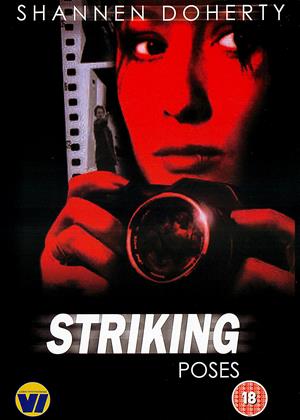
Cinemax Friday: Striking Poses (1999, directed by Gail Harvey)


Gage Sullivan (Shannen Doherty) is a freelance photographer who makes most of her money as a member of the paparazzi and who hates what her life has become.  When she realizes that she and her assistant, Casey (Tamara Gorski), are being stalked by someone whose trademark is leaving behind wads of chewed bubble gum (?), she calls in a security professional named Nick Angel (Joseph Griffin).  When it appears that not even Nick can protect her from the stalker, Gage turns to a former associate of Nick’s, a hitman named Gadger (Aidan Devne).

This direct-to-video film is pretty dumb,  Once Gage meets up with Gadger, the film goes off the rails as everyone reveals that they’re not who they say they are and multiple double crosses are revealed, each leaving behind plot holes so big that a convoy of trucks could probably roar through them without even having to slow down.  I don’t have much experience with professional con artists but it seems like the really successful ones would know better than to come up with a con that’s as pointlessly complicated as the one in this movie.  Even the fake gambling parlor in The Sting wasn’t as needlessly complex as what happens in Striking Poses.

Striking Poses is a let-down and, for an R-rated direct-to-video film, it’s also extremely tame.  I’m not really sure where that R rating comes from because there’s no nudity, very little violence, and I don’t think I even heard much profanity.  Maybe someone slipped the ratings board some money to avoid getting slapped with a dreaded PG.  This is a movie about a con that feels like a big con itself.

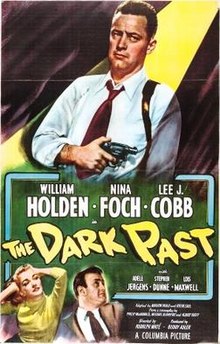
30 More Days of Noir #6: The Dark Past (dir by Rudolph Mate)


Now, this is an interesting little film noir!

This 1948 film stars William Holden, Lee J. Cobb, Nina Foch and Lois Maxwell.  William Holden is Al Walker, an escaped convict and a ruthless murderer.  Nina Foch is Betty, Walker’s devoted girlfriend and partner in crime.  Lee J. Cobb is Dr. Andrew Collins.  Lois Maxwell, years before she would be cast as Miss Moneypenny in the first Bond films, plays Ruth Collins, Andrew’s wife.  When Walker, Betty, and the gang break into the Collins home, they hold he doctor and his family hostage.

That may sound like a similar set-up to Desperate Hours and hundreds of other low-budget crime movies.  And, indeed, it is.  What sets The Dark Past apart from those other films is that Dr. Collins is a psychiatrist and his response is not to try to defeat or trick Walker but instead to understand him.  Even after Walker kills a friend of the family’s, Collins remains convinced that he can get to the heart of Walker’s anger and help the criminal start the process of reform.

When the nervous and violent Walker threatens the family, Collins calmly offers to teach him how to play chess.  When it looks like Collins might have a chance to escape, he instead stays in the house and continues to talk to Walker.  Eventually, he finds out about a recurring dream that Walker has been having, one that involves Walker standing in the rain under an umbrella that has a hole in it.  Collins links the dream to Walker’s traumatic childhood and he shows Walker why he feels the need to be violent and destructive.  But will it make a difference when the cops show up?

The Dark Past is an interesting relic.  Watching it today, it can seem a bit strange to see just how unquestioning the film is of the benefits of analysis and dream interpretation.  Nowadays, of course, we know that dream symbolism is often just random and that it’s impossible for a psychiatrist to “cure” a patient after only talking to them for an hour or two.  However, The Dark Past was made at a time when psychiatry was viewed as being the new science, the thing that that no one dared to question.  This was the time of The Snake Pit and Spellbound.  The Dark Past suggests that all any criminal needs is just a night spent talking to someone who had studied Jung and Freud.  Today, the film seems a bit naive but it’s still an interesting time capsule.

William Holden is great as Al Walker.  That, in itself, isn’t a surprise because William Holden was almost always great.  Still, Holden does an outstanding job of making Walker and his neurosis feel real and, like the best on-screen criminals, he brings a charge of real danger to his performance.  Lee J. Cobb has the less showy role but he also does great work with it.  It takes a truly great actor to make the act of listening compelling but Cobb manages to do it.

The Dark Past may not be as well-known as some film noirs but it’s an interesting and occasionally even compelling film.  Keep an eye out, eh?

30 More Days of Noir #5: The Criminal (dir by Joseph Losey)


From 1960, it’s British noir!

Johnny Bannion (Stanley Baker) is a career criminal, one who divides his time between long stretches in prison and short visits to the real world.  He’s handsome, he’s charming, he’s clever, and he’s totally trapped.  Baker moves through the film like a natural-born predator, waiting for the moment to strike.  When he’s in prison, he’s as defiant as a caged tiger.  When he’s out of prison, he’s always stalking the next prize.

Johnny has a hard time staying out of prison.  When we first meet him, he’s in prison and it quickly becomes clear that he’s quite a respected figure behind bars.  When he gets out, the first thing that he does is team up with his old associate, Mike Carter (Sam Wanamaker), and make plans to rob a racetrack.  Mike and Johnny have an interesting relationship.  On the one hand, Mike kept Johnny’s apartment for him while he was locked away and Johnny obviously has enough faith in Mike to work him.  On the other hand, neither man seems to truly trust the other.  That’s the world of criminals, I suppose.  Never trust anyone.

Of course, it quickly turns out that there’s actually a good reason to never trust anyone when you’re living a life of crime.  As soon as Johnny, Mike, and the gang pull of the racetrack robbery, Johnny’s betrayed.  Johnny ends up locked away once again, all thanks to Mike.  However, it turns out that Mike may have acted too soon because Johnny hid all the money before he was sent back to prison.  Now, Mike has to figure out a way to pressure Johnny into revealing where the money’s buried while Johnny has to try to survive in a world of ruthless prisoners and guards who are ineffectual at best and crooked at worst.  Mike’s not the only one who is interested in where Johnny put all that cash….

I have to admit that I’m probably a bit biased when it come to The Criminal because it’s a British crime film that I actually saw while in the UK.  It’s one thing to watch a tough British crime film from the safety of Texas.  It’s another thing to watch it at 2 in the morning while in a hotel room with a nice view of the Thames.  As opposed to the watered down British-American co-productions that we tend to get used to here in the United States, The Criminal was British through-and-through, from the tough working class accents to the harsh urban landscape to the stylish suits that were worn even inside the prison.

It’s a dense movie.  Though Stanley Baker is undoubtedly the star, director Joseph Losey is just as interested in the other people who come within Johnny’s orbit and, as a result, we get to know not just Mike but also the guards and the other prisoners.  Partrick Magee, who was a favorite of Kubrick’s, makes a strong impression as Barrows, the prison guard who may be a manipulative sadist or who may just be a man who is doing what he has to do to maintain some sort of order in the prison.  The film’s portrayal of Barrows is ambiguous but the same can be said for almost everyone in the movie.  In classic noir fashion, there are no traditional heroes.  Johnny’s bad but he’s a little bit less bad than the men who betrayed him and who are willing to go to extreme lengths to discover where Johnny hid that money.

Directed by Joseph Losey, The Criminal alternates between scenes of hard-edged reality and scenes that feel as if they could have been lifted from some sort of Boschian nightmare.  The scenes outside the prison are harshly realistic while the inside of the prison feels almost like some sort of surrealistic dreamscape where demons take human form.  The Criminal is an effective and violent British noir, one that will encourage you to keep your eyes on the shadows.

Porky’s Revenge (1985, directed by James Komack)


The senior class of Angel Beach High finally graduate in Porky’s Revenge, the last official Porky’s film.  It’s a good thing, too.  Most of the members of the Porky’s cast were already in their late 20s when they were cast in the first Porky’s.  By the time Porky’s Revenge was made, most of them looked more like they should be planning for their retirement than for college.

Director Bob Clark did not return for Porky’s Revenge and it really shows.  The third film doesn’t have any messages about tolerance or fighting bigotry.  Instead, it’s just a typical teen sex comedy with a subplot about Brian Schwartz (Scott Colomby) trying to help Coach Goodenough (Bill Hindman) pay back his gambling debt to Porky (Chuck Mitchell).  Otherwise, the gang plays basketball, tries to arrange an orgy with the cheerleaders, and even helps Ms. Balbircker (Ellen Parsons) find love.  I guess everyone forgot about Ms. Balbricker allying herself with the Klan during the previous film.

Porky’s Revenge doesn’t really have enough ambition to be terrible though.  It’s just bland.  Just as it doesn’t have the social conscience of the first two film, it’s also not as raunchy.  There’s considerably less nudity and the occasionally rough edges of the first two films have been removed.  That makes Porky’s Revenge less problematic but it also makes it less interesting.  The first two films may have been imperfect but they did capture the feel of high school.  This one doesn’t do that because the actors are too old and suddenly their characters are too nice.  If not for the title, you would think this was just another dumb comedy that played for a week at the drive-in as opposed to being the second sequel to the most commercially-successful Canadian film of the 80s.

I did laugh when the gang went to the ruins of Porky’s to make sure that it hadn’t been rebuilt, just to discover that Porky now owned his own steamboat.  I’m also glad that everyone finally graduated and gave the Porky’s saga a fitting close.

There was a direct-to-video sequel to Porky’s Revenge.  It came out in 2009 and was called Porky’s Pimpin’ Pee Wee.  I think I can live without watching it.

Porky’s II: The Next Day (1983, directed by Bob Clark)


The teens of Angel Beach, Florida are back!  They’re still trying to get laid, they’re still playing pranks on each other, and, this time, they’re …. FIGHTING THE KLAN!?

Porky’s II continues with the first Porky’s mix of raunchiness and social commentary.  While Pee Wee (Dan Monahan) tries to get back at his friends for spending the whole previous movie making fun of the size of his dick, the other members of the large ensemble cast thwart an attempt by the Klan to keep them from putting on a Shakespearean showcase.  The Klan is upset that a Seminole has been cast as Romeo so they burn a cross and do everything they can to sabotage the production.  Also trying to keep the show from going on is the hypocritical Rev. Bubba Flavel (Bill Wiley) and Mrs. Balbricker (Nancy Parsons), who both consider Shakespeare’s plays to be obscene.  When Wendy (Kaki Hunter) discovers that one of the county commissioners has been lying about supporting the play, she humiliates him in public by pretending to vomit in a fountain and accusing him of impregnating her.  It’s slightly funnier than it sounds but just slightly.

The first Porky’s took a stand against anti-Semitism while the second Porky’s takes a stand against censorship and the Klan.  That’s actually pretty cool when you consider that both of these films are usually just thought of as being dumb sex comedies.  Just like the first film, Porky’s II may be raunchy but it has a conscience.  That was due to director Bob Clark, who obviously meant for the Porky’s films to be about more than just T&A.

Unfortunately, Porky’s II is never as funny as the first Porky’s.  Too many of the jokes are recycled from the first film and the cast’s habit of laughing at their own “humorous” lines is even more grating the second time around.  Even the film’s most famous scene, where Wendy humiliates the duplicitous commissioner, goes on for too long and doesn’t have as much of a payoff as it should.  The best scenes in the film are the scenes that were lifted from Hamlet, Romero & Juliet, and A Midsummer Night’s Dream.  You wouldn’t expect the ensemble of Porky’s to feature that many Shakespearean actors but apparently it did.  Fans of A Christmas Story, which was also directed by Clark and which came out the same year as Porky’s II, will especially want to pay attention to the MacBeth sword fight scene just because the famous holiday leg lamp makes an appearance.

Porky’s II is nowhere near as good or memorable as the first Porky’s but its heart is in the right place.  While not as big of a success as the first Porky’s, it still did well enough to lead to Porky’s III, which I’ll review tomorrow.