In this western, Anthony Quinn plays Dave Robles, a Mexican gunslinger who rides into the town of Mesa, searching for an outlaw named Dan Ritchey (Barry Atwater). When Dave finds Ritchey, he discovers that Ritchey has been invited to Mesa by one of the town’s richest men. Dave doesn’t let that stop him from gunning Ritchey down in the street.
No one in town is upset that Ritchey’s dead. Instead, they’re impressed with how quick Dave is on the draw. When Dave runs another group of outlaws out of town, the townspeople decide to hire him as their new sheriff. Reluctantly, Dave agrees. At first, saloon keeper Ed Bannister (Peter Whitney) thinks that Dave will be easy to control but Dave surprises him by taking his new position seriously. Soon, Dave is having to fight off all sorts of bad guys. Meanwhile, Estella (Katy Jurado), the town’s nurse, goes from distrusting Dave to falling in love with him and begging him to set down his guns and join her in a peaceful life.
Man From Del Rio is a surprisingly good and intelligent B-western. Anthony Quinn gives a brooding performance as Dave, who is a far cry from the type of upright lawmen who typically appeared in the westerns of the period. As played by Quinn, Dave Robles is a brute who becomes the film’s default hero just because everyone else is even worse than he is. Dave may be an outlaw and a killer but he’s neither dishonest nor a sadist, which is what sets him apart from the other bad men who ride through Mesa. Dave only kills when he feels that he has to and he doesn’t do it for pleasure. Because he’s inarticulate and uncomfortable with the trappings of civilization, men like Bannister assume that Robles will be easy to control but he proves them wrong. Quinn’s outstanding performance sets the stage for the type of morally ambiguous western heroes who would become prominent in the late 60s and the 70s. He gets good support from Katy Jurado and, in the role of the town’s previous sheriff, Douglas Spencer.
Along with an interesting plot, Man From Del Rio also has all of the gunfights and tough talk that a western fan could hope for. Capped off by Anthony’s Quinn’s star turn, it’s a superb B-western.
Fifteen years into the future, a plague has wiped out almost everyone legally old enough to drink and it has instead left behind a post-apocalyptic hellscape dominated by teenagers. Tired of living in the boring desert, Lee (John Stockwell) hops on his motorcycle, puts on a skull mask, and drives to a nearby city. He hopes to join the Clippers, one of the two gangs that is fighting for control of the city. However, the Clippers aren’t as easy to join as Lee thought they would be. As well, an evil corporation (led by Robby Benson of all people) is manipulating the two gangs as a part of a plan to take over the city and also the world.
City Limits is one of those films that would probably be totally forgotten if it hadn’t been featured on an episode of Mystery Science Theater 3000. It’s a good episode but, unfortunately, it’s also led to City Limits getting a reputation for worse than it actually is.
City Limits is a dumb, low-budget movie that was made to capitalize on the success of films like Mad Max. The plot is impossible to follow, too many scenes are shot in the middle of the night, and Robby Benson is somehow even less intimidating as the villain as you would expect him to be. (All of Benson’s scenes take place in the same bare office and feature him sitting at a desk. It probably took a day at most for Benson to do all of his scenes.) Even with all that in mind, though, City Limits is a fun movie, especially if you can turn off your mind, just relax, and not worry about trying to make it all make sense. John Stockwell is a likably goofy hero and, Benson aside, the film has got a surprisingly good supporting cast, including Rae Dawn Chong, Kim Cattrall, Tony Plana, Darrell Larson, and even Kane Hodder in a blink-and-you’ll-miss-him type of role. James Earl Jones wears a big fur coat and blows people up. He also narrates the film, which automatically elevates everything that happens. Some of the action scenes are exciting. Fans of people shouting insults while riding motorcycles will find a lot to enjoy in City Limits. And, finally, there are a few genuinely funny moments. I loved that the gangs borrowed all of their plans for old comic books.
City Limits is stupid but entertaining, whether you’re watching it on your own or with Joel and the Bots.
Say whatever else you might want to say about 2020 as a cinematic year, at least it’s giving us five new films from Steve McQueen.
This British director is one of the most consistently interesting filmmakers working today and anytime we get new work for him, it’s a cause for celebration. His latest project is Small Axe, an anthology of five feature-length films that examines the real-life history of London’s West Indian community. In the UK, the film are premiering on the BBC while, here in the States, they’ll be premiering on Prime. Through mid-December, we’ll be getting a new Steve McQueen film every week.
The first of these films is Mangrove. The film opens in the late 60s, with activist Frank Crichlow (Shaun Parkes) opening a restaurant in London’s Notting Hill neighborhood. The restaurant is called The Mangrove and it quickly becomes a base for the community. It also becomes a target for the Metropolitan Police. PC Pulley (Sam Spruell) claims that the Frank has a history of tolerating petty crime and that the Mangrove is probably just a front for some nefarious operation. Of course, what quickly becomes obvious is that Pulley’s main problem with the Mangrove is that its owner is black and so are the majority of its customers. Pulley is an unrepentant racist, the type of man who sits in his patrol car and complains that the military hasn’t been called in to enforce the law in the neighborhood. (As obsessed as he is with the military, Pulley also says, with some pride, that he’s never actually served in the army.) When a new rookie shows up, Pulley informs him that his priority for the night is to arrest the first black person that he sees.
Every chance that he gets, Pulley raids the Mangrove. When Frank complains, he loses his liquor license. When the members of the community stage a peaceful protest (“Hands Off The Mangrove!” goes one chant), Frank and eight others are arrested and charged with inciting a riot and affray, charges that could lead to all of them spending several years in prison. (Affray is the legal term for “disturbing the peace.”) Among those arrested, along with Frank, are activist Darcus Howe (Malachi Kirby) and British Black Panther leader Altheia Jones-LeCointe (Letitita Wright). Both Darcus and Altheia insist on acting as their own counsel during the trial, giving them the chance to cross-examine the police and to also take their case directly to the jury.
Though Mangrove is a courtroom drama, the trial doesn’t being until almost an hour into the film’s running time. Wisely, McQueen instead spends the first sixty minutes of the film introducing us to the neighborhood surrounding the Mangrove and also allowing us to get to know the people who not only work there but also the ones who eat there. The film shows how, for a community of outsiders, the Mangrove became more than just a restaurant. It became a center for the entire neighborhood, a place where the members of the London’s West Indian community could safely gather. For someone like Pulley, the Mangrove was a symbol of everything that he couldn’t control and therefore, it had to be destroyed and its owners had to be humiliated. As well-handled as the courtroom scenes are, they would be considerably less effective if the film hadn’t shown us why it was felt that the Mangrove was something worth fighting for. When the Mangrove Nine go on trail, they’re not just nine people who have been unjustly accused. Instead, they represent an entire community that refuses to continue to bow down to their oppressors.
It’s an often effective film, one that is all the more powerful for being based on a true story. Much as he did with Shame, Steve McQueen makes effective use of the harsh and rather cold urban landscape that his characters inhabit. One needs only watch Frank walk down a dreary London street to understand why the Mangrove was so important to the community. As presented by McQueen, the Mangrove provides not only an escape from the harshness of the world but also a safe place to discuss how to make that world maybe a little bit less harsh for future generations. McQueen is brave enough to allow his camera to keep running, even beyond the point that most directors would have said “Cut.” McQueen shows us Frank yelling after being brutally pushed into a prison cell, as any director would. However, McQueen doesn’t cut away once Frank falls silent. Instead, his camera remains on Frank, making us feel his isolation and his feeling of hopelessness. It takes just a minute to go from the exhilaration of hearing Frank curse out his jailers to the horror of realizing that Frank is basically at their mercy.
For the most part, the actors make a strong impression, with the only false note coming from Rochenda Sandall, who plays Darcus’s partner and often seems to be performing in a different movie from everyone else. Malachi Kirby and Shaun Parkes have several strong moments as Darcus and Frank while Sam Spruell plays Pulley as being an all-too familiar monster. That said, the film is pretty much stolen by Letitia Wright, who brings both fury and wit to the role of Altheia. Whether she’s exposing the Crown’s medical examiner as a fraud or angrily reprimanding a defendant who is considering pleading guilty, Letitia Wright dominates every scene in which she appears.
Is Mangrove eligible for the Oscars? Under normal circumstances, it wouldn’t be. But, with the rule changes and the fact that Mangrove was not only selected to compete at Cannes (before Cannes was cancelled, of course) but that it also opened the BFI London Film Festival, I think a case can be made for considering Mangrove to be a feature film as opposed to being a television movie. This is a strange year so who knows? Personally, I think Mangrove deserves to be considered. If it’s not nominated for any Oscars, it’ll definitely be nominated for the Emmys. That’ll be determined in the future. For now, it can be viewed on Prime.
On August 2nd, 1876, the legendary western lawman “Wild Bill” Hickok was shot and killed while playing poker in Deadwood, South Dakota Territory. His murderer, who shot Hickok in the back, was Jack McCall. McCall was known for being a local drunk and it is believed he shot Hickok because he had lost money to him in a previous game. After shooting Hickok, McCall attempted to flee but ended up falling off of his horse. When McCall was put on trial for Hickock’s murder, he clamed that it was revenge for Hickok having murdered his brother in Kansas. Since no one knew much about McCall’s past, he was acquitted. (Modern historians believe that McCall grew up in Kentucky and never had a brother.)
Unfortunately, for McCall, it was later determined that the Deadwood courts didn’t have legal authority to try anyone and he was hauled into federal court. After first claiming that he had been too drunk to remember why he shot Hickok, McCall then claimed that he was actually wasn’t Jack McCall at all and that the wrong man had been arrested. The judge didn’t believe either one of McCall’s claims and Jack McCall was subsequently hanged on March 1st, 1877. It’s believed that he was 24 years old.
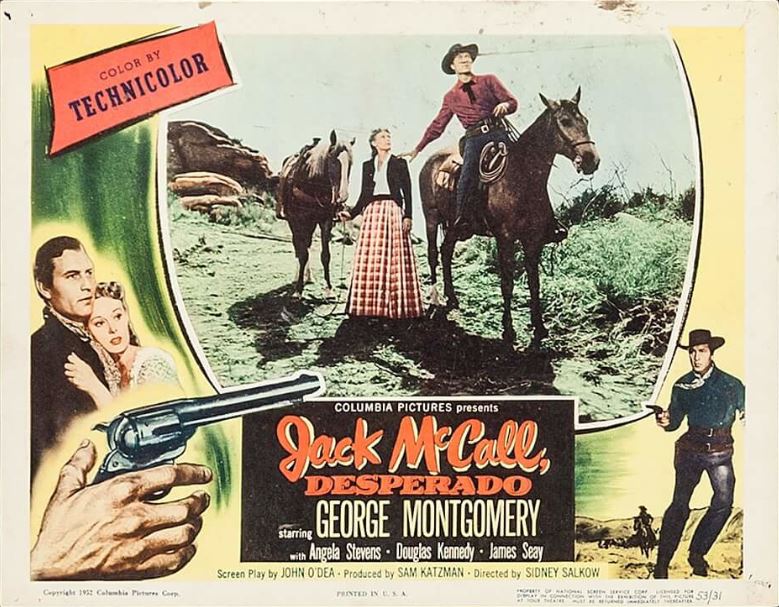
The life and murder of Wild Bill Hickok has been the subject of many books and films, the majority of which have portrayed Hickok in a heroic light while Jack McCall has typically been portrayed as being a low-life coward. Jack McCall, Desperado, however, takes the opposite approach. In this film, George Montgomery plays McCall as being an upstanding hero while Douglas Kennedy portrays Hickok as being a cruel and sociopathic murderer.
Jack McCall, Desperado comes up with a backstory for McCall and Hickok, one that I don’t think has ever been suggested by any of the many books written about Hickok’s life and death. The movie portrays McCall as being a Southerner who, during the Civil War, joined the Union Army. Because of his Southern heritage, he is distrusted by most of the other men in his unit. When a group of rebel spies trick McCall into revealing the location of the Union army’s headquarters, McCall is accused of treason and sentenced to death. McCall manages to escape but, upon returning to his family’s plantation, he discovers that both his mother and his father have been killed by Hickok and Jack’s cousin, Bat (James Seay). When McCall discovers that Wild Bill and Bat have headed up to the Deadwood, plotting to swindle the Native Americans out of a gold mine, and that they’re accompanied by a former Confederate who can clear Jack’s name, Jack purses them, intent on getting revenge for his family and justice for himself.
It’s a pretty standard western, one that is notable mostly for its portrayal of Wild Bill Hickok as being a bloodthirsty outlaw. While Hickok may not have been the hero that he was often made out to be (and let’s not even talk about the reality of Wyatt Earp), he probably wasn’t the mustache-twirling villain that he’s portrayed to be here. Still, Douglas Kennedy is an effectively dastardly villain and George Montgomery is an adequate hero. Even if it’s in no way based on fact, the Civil War subplot, with Jack supporting the Union cause despite his Southern heritage, is occasionally interesting. If you’re already a fan of B-westerns and not a stickler for historical accuracy, Jack McCall, Desperado is a decent enough way to pass the time.
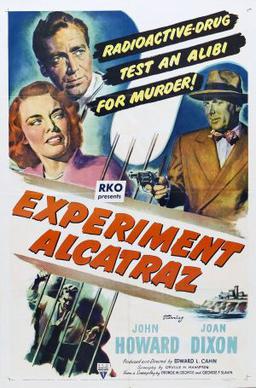
Dr. Ross Williams (John Howard) has a theory that injecting patients with a radioactive isotope can be used to treat a serious blood disease. However, he needs people on which to test his theory and, since it involves radiation, volunteers aren’t exactly lining up. Finally, five prisoners at Alcatraz agree to be used as test subjects in return for early parole. The prisoners are whisked off to a military where Williams and nurse Joan McKenna (Joan Dixon) oversee the experiment. Joan has her own reasons for hoping that Williams’s treatment is a success. Her own brother is currently dying of the disease.
Unfortunately, things go terribly wrong when one of the convicts, Barry Morgan (Robert Shayne), grabs a pair of scissors and stabs another prisoner to death. Morgan claims that he was driven mad by the treatment and, as a result, the experiments are canceled. Both Joan and Dr. Williams are convinced that Morgan had another reason for killing the prisoner. With Morgan and his cronies now free, Williams launches his own investigation into what happened.
Experiment Alcatraz starts out with an intriguing premise but then settles into being a typical B-crime film. Robert Shayne does a good job playing the viscous criminal but Morgan’s motives for committing the murder turn out to be fairly predictable and the story’s conclusion won’t take anyone by surprise. Howard and Dixon are competent leads but both are playing dull characters and too much of the film’s story depends on getting the audience to believe that a potentially revolutionary medical treatment would be tested in a thoroughly haphazard manner. Worst of all, despite the title, there’s very little Alcatraz to be found in Experiment Alcatraz. The prisoner leaves the prison early and never look back.
Experiment Alcatraz is one of the many films to be directed by the incredibly prolific and fast-working Edward L. Cahn. Between 1931 and 1962, Cahn is credited as having directed 127 movies. In 1961 alone, he directed 11 feature films! 1950 was actually a slow year for Cahn. Including Experiment Alcatraz, he only directed 5 films that year. As you can guess with that many movies, Cahn’s output was uneven. For every Experiment Alcatraz, there was an It! The Terror From Beyond Space. Despite a promising premise, Experiment Alcatraz is one of Cahn’s more forgettable films.
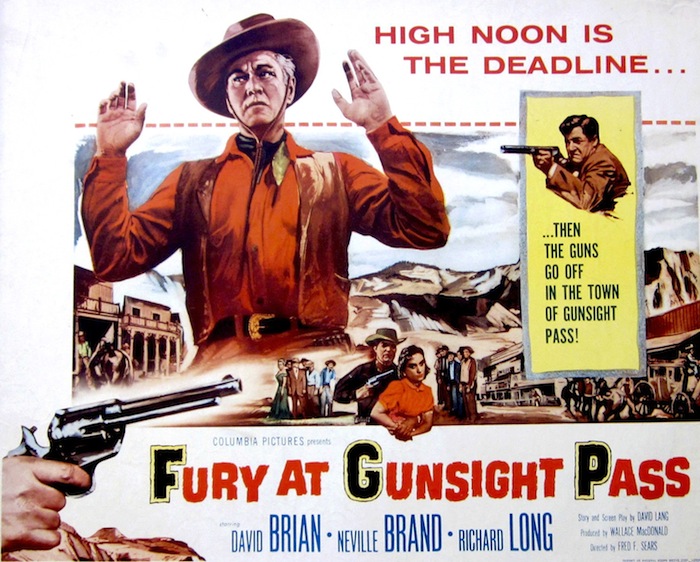
Old west outlaws Whitey Turner (David Brian) and Dirk Hogan (Neville Brand) are plotting on robbing the bank in the town of Gunsight Pass. They’ve even got an inside man to help them get away with the loot, local undertaker Peter Boggs (Percy Helton). Peter is eager to make some money and get away from his nagging wife (Katherine Warren). However, the robbery doesn’t go as planned. Whitey attempts to betray Dirk, there’s a huge shoot out, and several people are killed, including the bank president (Addison Richards). Whitey and his half of the gang are captured while Dirk barely escapes.
Because a satchel of money is missing, Dirk rescues Whitey from the posse and they return to the town of Gunfight Pass, determined to hold the entire town hostage until they get their money. While a huge dust storm blows through the town, the citizens of Gunsight Pass start to turn on each other, accusing one another of having stolen the money for themselves. The now dead bank president is accused of being a part of the robbery and it falls to his son (Richard Long) to try to not only clear his name but to also save the town from Dirk and Whitey.
Fury at Gunsight Pass is a nice discovery, an intelligent B-western that’s about more than just gunfights and money. Though David Brian and Neville Brand are both convincing as the two gang leaders, the movie is mostly about the citizens of the town and how quickly they all turn on each other. The citizens of this town make the ones from High Noon seem brave and supportive. All it takes is a little fear and greed for everyone to turn on each other. The film has such a cynical view of human nature that, in 1956, it probably couldn’t have gotten away with it if it had been anything other than a B-movie.
Fred F. Sears directed a lot of B-westerns, the majority of which were fairly undistinguished programmers. Fury At Gunsight Pass is an exception to that rule and probably the best film that Fred Sears ever directed. It’s a well-acted and well-directed movie that will take even the most experienced B-western fan by surprise.
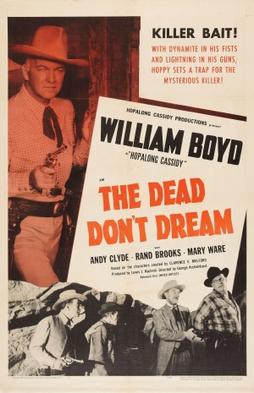
From 1935 to 1948, actor William Boyd played the role of upright, Sarsaparilla-drinking cowboy Hopalong Cassidy in over sixty films. Though most of these films were standard western programmers, they were still better produced than the average B-western and, despite having never been one in real life, Boyd was considered to be one of the most believable cowboys on the silver screen.
All good things, however, must come to an end and, by 1944, the Hopalong Cassidy films were no longer bringing in the audiences that they once did. After United Artists announced that they weren’t planning on producing any more Cassidy films, William Boyd bought the rights to character from producer Harry Sherman and then proceeded to produce and distribute Cassidy’s final film adventures himself. The Dead Don’t Dream was the 62nd Hopalong Cassidy and it was also one of the last. Only four more films would follow it.
Though The Dead Don’t Dream is set in the old west and features Hoppy and his two usual sidekicks, Lucky (Rand Brooks) and California (Andy Clyde), it’s hardly a standard western. Instead, it’s an Agatha Christie-style murder mystery, taking place in a western inn and even featuring William Boyd announcing, “The killer is in this room!” Hoppy, Lucky, and California are in town for Lucky’s wedding but, when Lucky’s future father-in-law turns up dead, the wedding turns into a murder investigation. Two other men disappear and are presumed to be dead and with everyone apparently dropping like flies, it’s up to Hoppy to solve the case, catch the killer, and prove that it’s neither him nor Lucky. The only clue is that all of the men spent a night in the same room.
The Dead Don’t Dream is diverting programmer. Though the low-budget means that there aren’t a lot of of suspects and the killer’s identity is pretty easy to figure out, Boyd does a good job playing detective and the method that was used to commit the murders is surprisingly inventive. There’s a lot more talking the shooting in The Dead Don’t Dream, which might disappoint some western fans. But personally, I enjoyed the film’s change-of-pace approach to the genre. It was interesting to see old west heroes solving mysteries instead of just shooting bad guys,
Though Strange Gamble, the final Hopalong Cassidy film, was released just a few months after The Dead Don’t Dream, Boyd would keep the character alive on both the radio and television. Boyd was considered to be the first western TV star and every western program that followed owed him an immeasurable debt. After finally retiring from acting in 1954, Boyd went on to make millions in real estate before eventually dying, at the age of 77, in 1972. For the rest of this life, he refused to do interviews or photographs, preferring the people always remember him as Hopalong Cassidy.
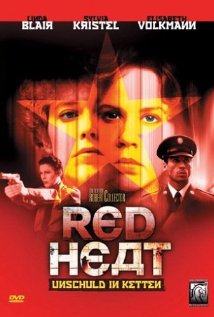
At the height of the cold war, college student Christine Carlson (Linda Blair, of course) travels to West Germany to marry her fiancée, Lt. Mike Grainger (William Ostrander). Mike has spent the last few years in West Berlin but, with his time in the army coming to an end, that means that he will be able to return to the United States with Christine. The only problem is that Mike doesn’t want to do that. Instead, Mike has decided to spend a few more years in the army and to put the marriage off for a while.
Christine is so upset that she goes for a walk to clear her head. Unfortunately, while walking around West Berlin, she witnesses a defector being abducted by the Stasi. For unclear reasons, the Stasi decided to kidnap Christine as well. Soon, Christine is in East Berlin, where she’s forced to falsely confess to being a CIA agent. Christine is sentenced to three years in prison and finally, after 20 minutes of build-up, Red Heat settles into being a typical Women In Prison film.
All of the usual WIP tropes are present. Sylvia Kristel plays Sofia, the lesbian gang leader who immediately targets Christine. The political prisoners (like Christine) are preyed upon by the common criminals, some of whom work with crooked guards to maintain order in the prison. There’s the usual collection of fights, shower scenes, and suicides, all mixed with scenes of Mike trying to get a group together to sneak across the border and rescue his fiancée. The only thing that really distinguished Red Heat from every other WIP film ever made is that it takes place in a communist-controlled prison so, in between fighting off Sofia and her crew, Christine has to watch propaganda films.
Linda Blair appeared in a lot of films like this and, by the time she made Red Heat, she was clearly getting bored with the genre. Both Blair and Kristel go through the motions and supply the obligatory nudity but neither one of them really seems to be that into the movie, with Sylvia Kristel especially appearing to be bored. Both Blair and Kristel were better in other films and, despite the uniqueness of the cold war angle, Red Heat is never as strange or as memorable as Blair’s best WIP film, Chained Heat. Red Heat is ultimately for Blair and Kristel completists only.
(In a perfect world, Red Heat would have been made in the 70s with Pam Grier in Blair’s role, Glynn Turman as Mike, Barbara Steele as Sofia, and Sid Haig as one of the guards. Now that would have been something to see!)
When we first meet Carolyn Elleson Grant (Marie Windsor), she refuses to give her husband, Harlow Grant (John Archer) a divorce, despite the fact that they’ve been separated for several years and Harlow now wants to marry Louise Nelson (Nancy Gates) and Carolyn is now involved with an art critic named Wayne Vincent (Patrick Knowles). Carolyn only married Harlow for his money and, while she has other rich lovers, she just enjoys making Harlow’s life as difficult as possible. It’s hard to blame her because Harlow is kind of whiny.
However, Carolyn has grown bored with Wayne Vincent and she’s now decided that she would rather get involved with Dick Sawyer (Richard Crane), who is rich and owns a boat. However, Dick is engaged to Carolyn’s personal assistant, Betty (Jill Jarmyn). Carolyn thinks it would be perfectly amusing to not only seduce Dick but to also destroy Betty’s happiness.
Why?
As one character put it, Carolyn is “a witch!”
(Someone then adds that Carolyn is a word that “rhymes” with witch. They don’t actually say the word because this film was made in 1955 but still….)
With Carolyn casually trying to destroy everyone’s lives and happiness, is it really a shock when some unseen person shows up at her art studio late at night and shoots her?
With Carolyn dead, it falls to Detectives Colton (Louis Jean Heydt) and Wells (John Gallaudet) to figure out the identity of the murder. They immediately suspect that it had to have been Harlow Grant. Not only does he have the motive and the opportunity but his name is Harlow Grant and I defy you to find anyone named Harlow Grant who hasn’t subsequently turned out to be involved in something shady. Harlow, however, insists that he’s innocent and the investigation is about to get a lot more complicated….
Well, okay, maybe not a lot more complicated. To be honest, it’s really not that difficult to figure out who the murderer actually is No Man’s Woman but that’s okay. The investigation itself only takes the last third of this 70-minute film. No Man’s Woman is a like a low-budget version of Gosford Park. The murder is less important than all of the drama surrounding it.
And make no mistake, there’s a lot of drama! This is a fun movie, specifically because Carolyn is such a wonderfully evil character and Marie Windsor has so much fun playing her. Carolyn doesn’t really have any deep motivation for why she does the terrible things that she does. She just does them because she can and she believes that she can get away with it. A good deal of the film’s entertainment comes from just seeing how bad Carolyn can be. In fact, you’re a bit disappointed when she’s murdered because Carolyn is the most enjoyable character in the movie. She’s someone who is literally willing to do and say anything and she makes an apologies for her actions. You wouldn’t necessarily want to work with her but she’s fun to watch.
The rest of the cast is adequate. John Archer and Nancy Gates are a bit on the dull side as the “good” characters but I liked the performances of the other suspects. Richard Crane and Jill Jarmyn, in particular, are memorable as Dick and Betty. I loved how going out on someone’s boat was apparently the height of decadence in 1955.
No Man’s Woman is an entertaining mix of noir and soap opera. Find it on Prime!
Yes, indeed. It would seem that during the 1940s and the 1950s, people were just dropping left and right. Mysterious murders were just a part of everyday life and you can be sure that every murder would bring with it an effort would be made to frame an innocent man. The 1947 British noir, The Mysterious Mr. Nicholson, opens with Peggy Dundas (Lesley Osmond) stumbling across a dead body. The body belongs to a man who was planning on changing his will and disinheriting his nephew. It seems like the nephew should be the obvious suspect, right?
Except …. the dead man has a letter pinned to his chest! And the letter is signed by VLS, a notorious cat burglar who, in the days before World War II, was famous for robbing the French and then sending the authorities taunting letters. So, obviously, VLS must be back and he must now be a murderer!
Except …. why would you kill a man and then leave behind a note letting everyone know that you did it? That makes no sense at all. Especially since VLS is actually a man named Mr. Nicholson (Anthony Hulme) and this mysterious Mr. Nicholson not only helped the British defeat the Germans but he also has a solid alibi for where he was on the night of the murder. Obviously, VLS is innocent!
Except …. Peggy says that she saw a man who looked exactly like Mr. Nicholson at the scene of the crime!
Could the Mysterious Mr. Nicholson have a look-alike? Yes, actually, he does. We learn this very early in the film so it doesn’t count as a spoiler. The murderer is man named Raeburn (also played by Anthony Hulme). Raeburn just happens to look exactly like Mr. Nicholson and he figured he would use that resemblance to his advantage by framing Nicholson for the crime!
So now, Nicholson has to not only prove his innocence but also track down the man who looks exactly like him!
That’s a lot of plot for a low-budget, 78 minute film. What’s odd is that, even with all of that scheming and the short running time, The Mysterious Mr. Nicholson still has some odd moments of blatant padding. In the middle of the film, all of the action comes to a halt so that we can watch a lengthy dog act. This is followed by a musical interlude. Why? Who knows? Neither adds much to the plot.
Anyway, I was actually kind of hoping that The Mysterious Mr. Nicholson would turn out to be one of those really fun, old movies that you just happen to stumble across on Prime or on TCM late at night. But it’s actually pretty boring. There’s only a handful of locations in the film, which gives the whole thing a stagey feel and, though short, the movie often seems to drag. Another huge problem is that Hulme plays Nicholson and Raeburn the exact same way, so it’s often difficult to keep track of which is which. I was hoping for at least some split photography so Hulme could act opposite himself but we don’t even get that. Instead, Nicholson and Raeburn are rarely on screen at the same time and, whenever they are, it’s obvious that a stand-in was used for the other man.
From a historical point of view, the film is interesting in that it was obviously made while London was still rebuilding from World War II. The few location shots reveal a city that’s in the process of being recreated. Nicholson is presented as being someone who was basically reformed as a result of fighting on the side of the good guys during World War II. As one Scotland Yard inspector explains it, Nicholson may have been a criminal before the war but, once the war started, he remembered that was British first and he did what had to be done to help defeat Germany. It’s a nice touch.
The historical aspect aside, The Mysterious Mr. Nicholson is pretty forgettable. When it comes to British noirs, I’ll take The Criminal.
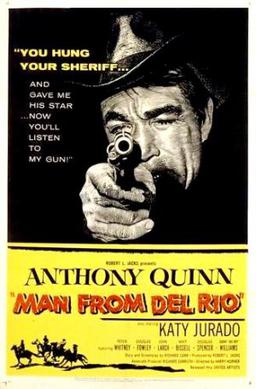 In this western, Anthony Quinn plays Dave Robles, a Mexican gunslinger who rides into the town of Mesa, searching for an outlaw named Dan Ritchey (Barry Atwater). When Dave finds Ritchey, he discovers that Ritchey has been invited to Mesa by one of the town’s richest men. Dave doesn’t let that stop him from gunning Ritchey down in the street.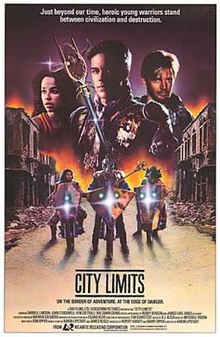



 Through the Shattered Lens