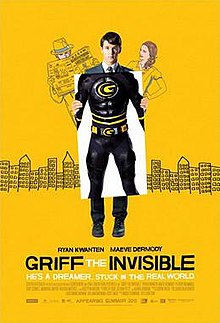
Griff the Invisible (2010, directed by Leon Ford)


Griff (Ryan Kwanten) is a socially awkward young office worker who keep a rubber suit hidden away in his apartment.  When he returns home from work, he puts on the suit and searches the night for crimes to stop and criminals to thwart.. Or at least he thinks that he’s fighting crime. The neighbors seem to be afraid of the man in the rubber suit and there are posters on every street corner, asking if anyone can identity the masked voyeur who has been spotted walking about the neighborhood at night.  The only one his neighbors who appreciates him is the stray cat that waits every morning for a tin of tuna.

Though he might fight crime at night, no one thinks much of Griff during the day. His co-worker, Tony (Toby Schmitz), constantly bullies him. His older brother, Tim (Patrick Brammall), resents that he had to move back home to keep an eye on him and he is constantly asking Griff if he is having another breakdown.  Only the owner of the local hardware store is polite to Griff and that’s just because Griff spends a lot of money in the store, buying what he needs to make what he thinks will be an invisibility suit.

When Tim brings his new girlfriend, Melody (Maeve Dermody), over to meet Griff, she discovers that she has more in common with Griff than with Tim. Griff wants to be invisible while Melody wants to learn how to walk through solid objects. Melody and Griff could be the prefect crime fighting team and also the perfect romantic couple, but only if their fantasy world is allowed to exist uninterrupted.  That may be difficult because both Griff and Melody are coming under more and more pressure to get it togther, conform, and start living in the real world with everyone else.

Griff the Invisible is a likable comedy-drama from Australia. At first, it seemed like the film was going to idealize Griff’s fantasy existence but it’s actually fair in its treatment of Tim and everyone who wants Griff to snap out of it and join them in the real life. Being Griff’s friend or relative can be demanding. At the same time, Griff and Melody’s fantasy world is inviting too. Who hasn’t imagined themselves as a super hero at some point?  Most importantly, the pairing of Ryan Kwanten and Maeve Dermody works well. By the end of the movie, you’re happy that they have their fantasy as long as they also have each other.

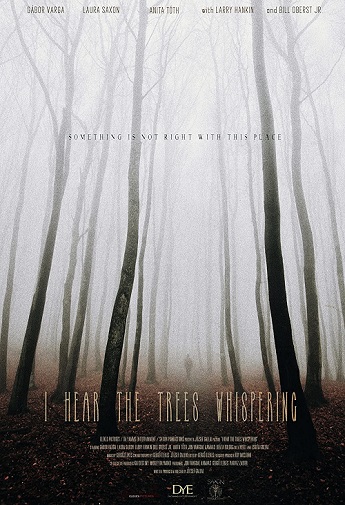
Film Review: I Hear The Trees Whispering (dir by Jozsef Gallai)


A man named Will (Gabor Varga) has a new job. He spends his days in the wilderness, living in a small cabin and essentially keeping an eye out for anyone who might need help or who might be doing something that they shouldn’t be doing. His only company is his supervisor, June (Laura Saxon). He never meets June. He just hears her voice as he spends his days exploring the forest. Her voice sounds familiar to him, like someone from his recent past,

Will is a man hiding from the traumas of that past. His wife died in a tragic accident. His daughter is currently being raised by her grandfather (Larry Hankin). Will has next to no contact with her. He says it’s better that way. June tells him that almost everyone who accepts a job in the forest is trying to avoid something or escape some sort of tragedy. The forest is where people go to disappear.

June also explains that strange things are hidden in the forest,. Will comes across creepy and deserted buildings. He finds a backpack and makes a shocking discovery when he searches it. Some nights, he thinks that he might see a figure in the distance trying to give him some sort of coded message.

The latest film from director Joszef Gallai, I Hear The Trees Whispering is full of atmosphere. The majority of the film is shot from Will’s point of view. Indeed, we never see Will’s face. Instead, we hear his voice and occasionally, we see his hands while he’s searching for something. It’s a technique that puts us directly into Will’s mind. Just as he’s lost in the wilderness, so are we. Just as he’s hearing strange noises and trying to see where they’re coming from, so are we. It’s a technique the allows the film to capture the forest in all of it ominous beauty. One can see why Will would want to escape to the forest while also understanding how the isolation could drive someone to the point of madness. However, there’s another reason why the majority of the film is shot from WIll’s point of view, one that I won’t spoil beyond to say that it all pays off in an unexpected but effective twist during the film’s third act.

With a 78-minute running time, I Hear The Trees Whispering moves at a deliberate pace, Once again, it’s a film that’s far more concerned with setting the proper atmosphere and developing the characters of Will and June than with tossing in any cheap jump scares. The audience’s fear and anxiety comes from the fact that it’s impossible to watch the film without imagining how you would react if you found yourself in the same situation. Would you have the courage to leave the cabin and see where the noises were coming from? I probably wouldn’t but Will doesn’t really have a choice. He’s as much a prisoner of fate as he is a prisoner of his tragic past. Just as Jack Torrance was always meant to be the caretaker of the Overlook Hotel, Will was always meant to search the forest in search of answers.

As I mentioned earlier, there’s a big twist in the third act, one that I guarantee will take you by surprise and which will force you to reconsider everything that you’ve previously seen. That’s what a good twist does!

I Hear The Trees Whispering is an effectively atmospheric thriller, one that will leave you thinking long after the end credits have rolled.

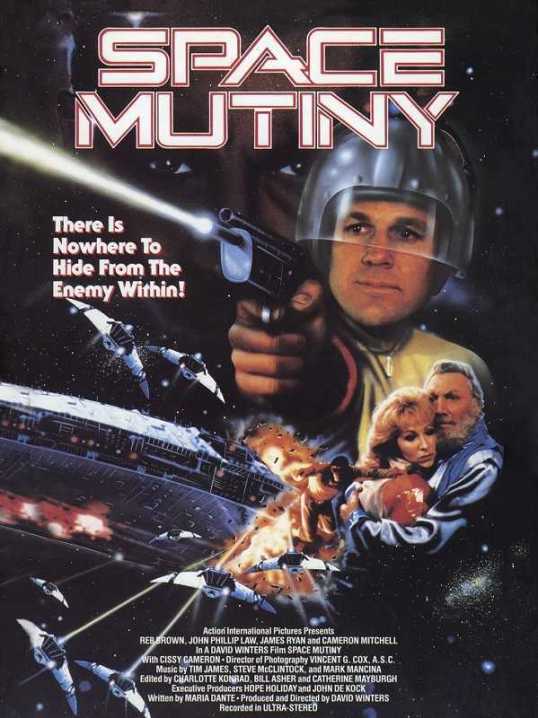
The TSL’s Grindhouse: Space Mutiny (dir by David Winters)


“Arggggh!”

— Dave Ryder (Reb Brown) in Space Mutinty (1988)

Space Mutiny, a sci-fi epic from 1988, is full of dialogue about all sorts of political and philosophical concerns but none of it is quite as memorable as the quote above.  Dave Ryder says, “Argggggh!” a lot over the course of Space Mutiny.  He’s the newly appointed head of security for the Southern Sun, a gigantic spaceship that has spent the last 260 years traveling from Earth to a new planet.  Being head of security is important because there are some people on the Southern Sun who are plotting a mutiny.  Dave Ryder decides that the most effective way to battle the mutineers is to yell loudly and frequetly.  “ARGGGGGH!’ Ryder yells whenever he’s being shot at.  “ARGGGGGGGH!” he screams when he finds himself on a very slow and gradual collision course with the head of the mutineers.

When Dave isn’t saying stuff like, “Argggggh!,” he’s saying stuff like, “Go!  Go!  Go!”  When the bad guys open fire on him and his men, it’s time for them to “Go!  Go!  Go!”  When the mutineers are being chased, Dave is quick to tell everyone to “Go!  Go!  Go!”  He’s like the physical fitness trainer from Hell.  He never actually yells “Feel the burn!” but you can be damn well sure that he’s thinking it.  In fact, there’s a point in the movie where “Feel the burn!” actually would have been a good line.  Dave and his girlfriend, Lea (Cissie Cameron), set a mutineer on fire.  It’s actually a bit of a sadistic scene and it doesn’t come across as being the big hero moment that it’s obviously meant to be.  But, then again, Dave isn’t yelling because he’s a nice guy.  He’s yelling because he’s played by Reb Brown.  Reb Brown yelled all the way through Strike Force Commando.  Why wouldn’t he do the same for Space Mutiny?

Of course, Dave isn’t the only person barking out orders on the Southern Sun.  Cameron Mitchell plays the ship’s captain, a wise old man who looks like Santa Claus.  John Phillip Law is Kalgon, the main mutineer.  He laughs a lot.  Cissie Cameron is the captain’s daughter.  She falls for Ryder, despite the fact that she appears to be old enough to be Ryder’s mother.  (In real life, Reb Brown and Cissie Cameron are married and Cissie is only a few years older than Reb.  In Space Mutiny, she’s stuck with an unflattering hair style and is made up to look like an aging cheerleading coach.)  There’s also a woman who works on the ship’s bridge.  She’s killed in one scene, just to mysteriously turn up alive in the scene that follows.  In space, no one can hear the script supervisor.  Finally, there’s a group of alien witches who board the ship and spend the entire movie dancing in front of a ball of electricity.  Since they don’t actually interact with any of the main characters, it’s obvious that they were added to pad out the film’s running time.

One of the more interesting things about Space Mutnity is that Kalgon actually has a point.  It does seem kind of stupid to spend several hundred years traveling to just one planet when there’s other planets nearby that the ship could just as easily reach.  Indeed, the mission of the Southern Sun never makes that much sense and the Captain seems to be delusional in his insistence that it does.  The Captain’s unending faith and his long-flowing beard makes him come across like a minor biblical prophet, the type who always had to ask a major prophet to interpret his visions for hm.  The Captain does not come across like someone who really knows what he’s doing.  I don’t care how much Ryder screams, Kalgon had a point!

Today, Space Mutiny is best known for being featured on an episode of Mystery Science Theater 3000 and for later being taken apart by the Rifftrax crew.  Space Mutiny, though, is such an extremely silly movie that you really don’t even need any professionals to help you snark your way through it.  The film offers up such a treasure trove of material then even the most humorless among your friends will be a comedic genius by the time it ends.  It’s a fun movie, made even more so by the fact that the filmmakers apparently meant for the film to be taken seriously.  There’s a lot of talk about important issues like freedom, duty, and faith.  In the end, what you’ll remember is the screaming.

End of a Gun (2016, directed by Keoni Waxman)


Decker (Steven Seagal) is a former DEA agent who now lives in France.  Lisa Durant (Jade Ewen) is a stripper who Decker saves from getting beat up one night.  Decker and Lisa become lovers and Lisa recruits Decker to help her steal two million dollars from a sadistic drug lord named Gage (Florin Piersic, Jr.).  Gage doesn’t like having his money stolen so he has his men kidnap Lisa.  Decker eventually gets around to trying to do something about it.

First question: Why is this movie set in France?  There’s nothing notably French about the story or any of the characters.  According to Wikipedia, End of a Gun was filmed in Romania, New Orleans, and Atlanta.  The movie does include stock footage of the Eiffel Tower and there’s a French flag in one scene.

Second question: who was this movie made for?  Will Seagal fans want to see their man Steve standing in a corner while his stunt double handles all of the action?  I know Seagal has claimed that he did all of his own stunts in End of a Gun but it’s hard not to notice that Decker’s face is never visible whenever he fights anyone.  Even though Seagal is not as heavy as he’s been in some of his direct-to-video films, he still seems out of breath for much of the film.  Seagal still whispers all of his lines.

Seagal is not in much of End of a Gun.  Most of the movie is about Gage looking for Decker and Lisa.  That works to the film’s advantage.  The more Seagal is in a film, the more difficult it gets not to focus on his deficiencies as an actor.  Steve showed up long enough to pick up his paycheck and probably sat in on the stripper casting call.  It’s all in a day’s work.

The Films of 2021: God’s Not Dead: We The People (dir by Vance Null)


Here’s the story so far:

In 2014, a film called God’s Not Dead was released.  Produced by PureFlix Entertainment, it was a big, messy, and often confusing movie about a college student who challenged the claim of an atheist professor that God never existed.  While the student was debating the professor, countless other characters were wandering around campus and having their own faith-related dramas.  The main theme of God’s Not Dead appeared to be that only bitterness could explain disbelief and that everyone on the planet secretly wants to be a Christian.  It was not a particularly good movie but it was a surprise hit at the box office.  After spending years being ridiculed in nearly every mainstream film ever released, hardcore evangelicals finally had a movie that ridiculed the other side.

In 2016, God’s Not Dead 2 came out.  God’s Not Dead 2 was so heavy-handed that it actually managed to make the original film appear balanced and fair.  As opposed to the previous film, God’s Not Dead 2 was overtly political, telling the story of a teacher who is put on trial for encouraging a student to pray.  Again, it wasn’t a very good film but it did have two things going for it: a sincere lead performance from Melissa Joan Hart and an amazingly over-the-top villainous turn from Ray Wise as the prosecutor.  Most prosecutors would be smart enough to just argue that the teacher’s actions violated the law and perhaps offer a deal so that they wouldn’t have to waste their time with a lengthy trial.  Instead, Wise’s prosecutor practically cackles that he’s going to prove to the jury that “God is dead.”  Not surprisingly, the jury responded with “That’s a little above our paygrade.”

After all of that, 2018’s God’s Not Dead: A Light In The Darkness was a surprisingly low-key affair.  Largely eschewing the overt political content of the previous installment, the third God’s Not Dead film returned the story to campus and followed the efforts of Rev. David Hill (played by David A.R. White, the franchise’s producer) to keep his church from being closed down.  Of all the films, the third God’s Not Dead probably comes the closest to being a conventional film.  It even admits that not all atheists are evil and acknowledges that there is a legitimate constitutional argument to be made for not having a church on campus.  Because it didn’t feature any villains as memorable Ray Wise, A Light In The Darkness is also probably the most boring of all the films.  It also underwhelmed at the box office, a sign that the novelty of seeing a Christian film in a theater had worn off for even the film’s target audience.

And that brings us to God’s Not Dead: We The People, which had a three-day exclusive theatrical engagement in October of 2021.  As you can probably guess from the title, the fourth God’s Not Dead returns to the political themes of the second film.  Congress is thinking about infringing on the rights of parents to homeschool their children.  Rev. Hill and a group of parents (one whom is played by Antonio Sabato, Jr.) head to Washington D.C. so that they can testify in front of a Congressional hearing that’s being chaired by a smug liberal played by legitimate actor William Forsythe.  Isaiah Washington appears as a congressman who supports homeschooling and who thinks the education system needs to be reformed.  (“He’s that Congressman from Texas!” one character exclaims.)  Judge Jeanine Pirro plays a judge who is originally against homeschooling but who changes her mind after her daughter argues with her because, in the world of God’s Not Dead, not a single atheist or skeptic has any sort of firmly held conviction that can’t be overturned by an argument that would be more appropriate for a community college Intro to Philosophy class.  The film ends with the reverend giving an impassioned speech while Forsythe glowers and Washington stares on in beatific appreciation.

As you can probably guess, God’s Not Dead: We The People is total and complete propaganda, full of strawman arguments and moralizing.  Speaking as someone who is not a fan of the government or its tendency to try to interfere in people’s lives, even I watched the film and thought, “Okay, this is just a little too heavy-handed for me.”  Director Vance Null takes a vaguely Oliver Stone-style approach to the film, editing in random shots of American flags and patriotic monuments while the film’s characters discuss how the founding fathers felt about religion.  To be honest, when it comes to how its presented, the film’s propaganda is not that different from the type of propaganda that regularly appears in more mainstream films.  The film’s flashy editing and one-sided view of the world isn’t that much different from Adam McKay’s post-Big Short filmography.  Ending the film with a passionate speech that leaves all of the main character’s opponents with nothing to say in response may be a cliché but it’s a cliché that Aaron Sorkin knows well.  All of the cameos from the characters who appeared in the previous film may feel a bit random but it’s not that much different from when Marvel used to sneak Robert Downey, Jr. into every film they made.  If nothing else, the people behind the God’s Not Dead franchise have learned the first rule of business: watch what the successful do and copy them.

All of that aside, God’s Not Dead: We The People is not a particularly interesting film.  The editing may be flashy but the pace is still slow and the final hour of the film is basically just people testifying in front of a congressional committee.  The film is less concerned with converting the skeptical and more about rallying the faithful to vote in 2022.  That’s always been my main problem with the propaganda films of both the left and the right.  It’s always less about making a case and more about vanquishing any shred of doubt from those who already largely agree with the film’s message.  Ideological purity tests do not make for enlightening or memorable entertainment.
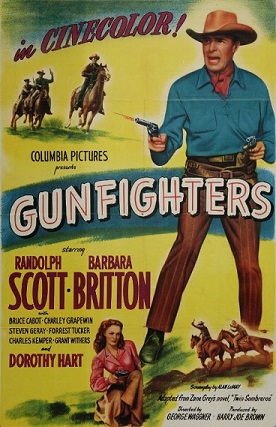
Gunfighters (1947, directed by George Waggner)


Brazos Kane (Randolph Scott) is a legendary gunfighter who has more notches on his gunbelt then he can count.  His reputation is so fearsome that he can’t even enter a town without having to worry about someone drawing a gun on him in an attempt to make a name for themselves.  When he’s forced to shoot his own best friend when the latter tries to outdraw him, Brazos says that he’s had enough.  He tosses aside his guns and he heads to the home of his friend, Bob Tyrell.  Brazos says he’s going to retire from gunfighting and just “ride the range.”

When Brazos reaches Bob’s cabin, he discovers that Bob has been murdered.  When Brazos rides to the nearby Banner ranch to report the crime, he’s arrested and accused of shooting Bob.  When it’s pointed out that Brazos doesn’t have a gun, corrupt Deputy Yount (Grant Withers) says that Brazos most have tossed it in the creek after he shot Bob.

With the help of Bob’s employer, a rancher named Inslip (Charley Grapewin), Brazos narrowly avoids getting hung.  Both Yount and the sheriff (Charles Kemper) encourage Brazos to leave town but Brazos isn’t going anywhere until he gets justice for Bob.  His investigation leads to him getting involved with two sisters (Dorothy Hart and Barbara Britton) and a young cowhand named Johnny (John Miles), who wants to become a famous gunslinger.  It also leads Bob into conflict with Bard Macky (Bruce Cabot) and Hen Orcutt (Forrest Tucker), who are both determined to run Brazos out of town.  Brazos finds himself tempted to go back on his word and pick up his guns yet again.

Based on a novel by Zane Grey, Gunfighters is a surprisingly mature and multi-layered western.  Brazos’s refusal to carry a gun and his genuine dislike of violence makes him a far more interesting protagonist than the typical B-western hero and Randolph Scott, one of the best of the cowboy actors, is appropriately world-weary in the role.  The villains are also written and played with an unexpected amount of depth, with Bruce Cabot the stand-out as Bard Macky.

Gunfighters is full of good scenes.  The opening sequence, featuring the pivotal gunfight between Brazos and his best friend, is excellently directed and captures how quickly violence can erupt in the old west.  Later, when Brazos first meets Johnny, the younger man is engaged in target practice and talking about how a man named Brazos Kane murdered Johnny’s best friend.  Johnny is practicing so he can kill Brazos himself.  Without revealing his identity, Kane gives Johnny a few pointers on how to draw and aim his gun.  It’s only after Johnny has perfected the quick draw that Kane laconically introduces himself and explains that he had nothing to do with Bob’s death.  Later, in a powerfully acted scene, Kane explains to Johnny just what exactly it means to be a famous gunfighter and to know that everyone you see is a potential threat.

Directed by George Waggner, Gunfighters is an intelligent and well-acted western and one of Radolph Scott’s best.

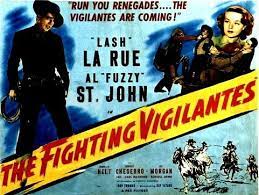
The Fighting Vigilantes (1947, directed by Ray Taylor)


A town in the old west has problem.  Any wagon that comes into town carrying food or cooking supplies is robbed by a group of bandits hired by Price Taylor (George Chesebro), who wants to make sure that he doesn’t have any competition when it comes to selling food at inflated prices to the townspeople.  Because of Taylor’s price gouging, the ranchers are now in danger of starving but the law refuses to do anything to help because they’ve all been paid off by Taylor as well.  Another group of masked people, known as The Fighting Vigilantes, are now robbing Taylor’s wagons.  Things are getting violent and someone is going to get hurt.

Fortunately, Cheyenne Davis (Lash LaRue) and his sidekick, Fuzzy Q. Jones (Al St. John), ride into town.  Everyone thinks that Cheyenne is an outlaw because he wears all black and he carries a whip.  What they don’t know is that Cheyenne and Fuzzy are actually undercover U.S. marshals.  It doesn’t take long for Cheyenne to fall for Abby (Jennifer Holt), the daughter of a local rancher who is involved with the Vigilantes.  When Abby’s father is arrested, Abby blames Cheyenne and says that Taylor will never be defeated.  Fuzzy says that this proves that it’s best to stay away from women.  Can Cheyenne Davis and his trust bullwhip prove them both wrong?

This was one of the many B-western programmers in which Lash LaRue played the role of Cheyenne Davis.  Lash was unique amongst B-western heroes, in that he always dressed in black and he used a whip instead of a gun.  Unfortunately, he wasn’t much of an actor and all of his films were low-budget, rush jobs but he did look pretty cool with a whip.  The Fighting Vigilantes is typical of Lash’s later films but it does deserve some credit for having its heroes go up against not just a gang of outlaws but instead an entirely corrupt town.  Taylor has taken over every institution in the town, leaving the people living under them no choice but to turn vigilante.  The villains are so evil that they even shoot people in the back.  It’s impossible not to enjoy Cheyenne demonstrating, via his whip, the foolishness of trying to draw a gun on Lash LaRue.

The movie ends as almost all of Lash LaRue’s adventures did, with everyone laughing as Cheyenne uses his bullwhip to nearly kill Fuzzy Jones before the two of them ride off to find more injustices that can be fixed with the crack of a whip.  As for the real-life Lash LaRue, his movies eventually went out-of-style and, like a lot of the B-western stars, he moved over to television.  He struggled with alcoholism and was arrested for vagrancy in 1966.  However, he eventually turned his life around and, along with appearing in a few low-budget movies in the 70s, he spent his remaining years ministering to alcoholics in Florida, showing that the real-life Lash LaRue could do just as much good in the real world as he did in the movies.

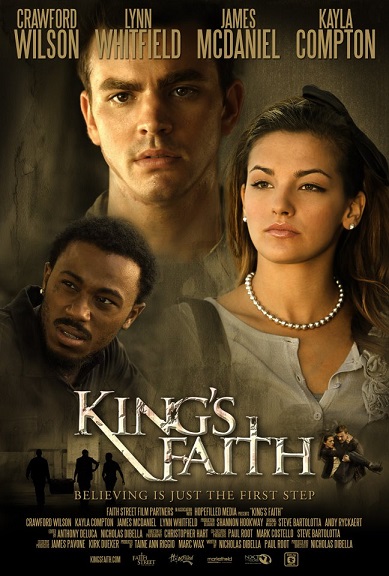
I Watched King’s Faith (2013, dir. by Nicholas DiBella)


Brendan King (Crawford Wilson) is eighteen and trying to change his life.  He’s just gotten out of juvie and is living with his eighteenth set of foster parents, Mike and Vanessa Stubbs (James McDaniel and Lynn Whitfield).  Brendan wants to leave his former gang life behind but it’s hard.  Vanessa doesn’t trust Brendan and neither does Mike’s best friend, Detective Dwyer (Christopher John Martin).

Brendan wants to help out his old neighborhood by buying the building where his best friend died and turning it into a rec center.  But after Brendan makes the news for saving the life of Natalie (Kayla Compton) after she crashes his car, the members of his former gang track Mike down.  They know that Mike knows the location of a hidden stash of drugs and they start trying to draw Mike back into his old life.

King’s Faith was made with the best intentions and it had a good message about forgiveness and second chances so I wanted to like it but Crawford Wilson, while easy on the eyes, was never believable as a former drug dealer and addict.  There was nothing tough about him and he seemed out of place whenever he was interacting with the members of his former gang.  Since I couldn’t believe that he was ever in a gang, there wasn’t any suspense about whether or not he would return to them.  Kayla Compton was more convincing as the troubled Natalie and her story was actually more interesting than Brendan’s.  The movie probably would have been better if it had been about her.

Riders of Destiny (1933, directed by Robert N. Bradbury)


John Wayne sings!

Well, not really.  Wayne does play a cowboy named Singin’ Sandy Saunders in this early, pre-code Western but his voice was dubbed by someone who didn’t sound anything like Wayne.  Wayne was only 25 when he starred in Riders of Destiny and this was six years before Stagecoach made him a star but he already had his famous way of speaking.

Riders of Destiny starts off with Singin’ Sandy riding through the west.  When he comes across a wounded sheriff and then witnesses a stagecoach being robbed by Ms. Fay Denton (Cecilia Parker), he knows that he’s reached the town of Destiny.  The town is under the control of a land developer named Kincaid (Forrest Taylor).  Kincaid and his henchmen have been extorting the local citizens and stealing money from Fay and her father (George “Gabby” Hayes).  After Singin’ Sandy reveals his skills with a gun, Kincaid offers him a position in his gang and if Sandy accepts, Kincaid will be unstoppable.  Before Sandy’s mysterious appearance, the townspeople wrote to Washington to help and Washington has agreed to send down one of their best agents.  Could that agent be traveling in disguise as a singing cowboy?

It’s always difficult for me to take a Singing Cowboy film seriously.  (That’s especially true after watching Tim Blake Nelson in The Ballad of Buster Scruggs.)  John Wayne is not an actor who was ever meant to be seen playing a guitar and singing a song, even if his voice was dubbed.  But Riders of Destiny is not that bad of a programmer.  If you can overlook the singing, the story is surprisingly mature and violent and Forrest Taylor is a good villain as the oily Kincaid.  (With Kincaid demanding protection money and gunning down anyone who refuses to play it, he has more in common with the type of gangsters who were appearing in Warner Bros. crime films than with the typical western bad guy.)  Cecilia Parker, who would eventually be best known for appearing in the wholesome Andy Hardy films, is sexy as Fay and, because this is a pre-code film, she gets away with robbing a stagecoach.  With a running time of barely an hour, the action has to move quickly and there’s no need for any padding.  Finally, even this early in his career, John Wayne was a perfect western hero, whether he was on his horse chasing the bad guys or walking down a dusty street, singing a song about how the “streets will run with blood” before drawing his guns.

Wayne would go on to play one more Singing Cowboy, in 1935’s The Lawless Range.  Again, his voice was dubbed.  He later said that he abandoned the Singing Cowboy genre because the children who saw the films would often approach him and ask him to sing one of the songs and they were always disappointed to learn that he couldn’t actually a sing a note.  Of course, in 1939, John Ford would select Wayne to play The Ringo Kid in Stagecoach and Wayne would never have to sing again.

Blast From The Past: The Outsider (dir by Arthur Wolf)


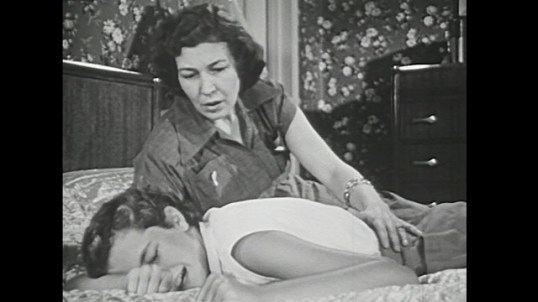
The year was 1951 and Susie Jane was struggling to fit in at school.  While everyone else was planning dances and hanging out at the malt shop, Susie was standing off to the side, quietly.  Why was Susie Jane such an outsider?  Was it the fault of her peers or was it her fault for being such a nonconformist?

This educational short, from Young American Films, puts most of the blame on Susie.  Yes, the film suggests, her classmates could have made more of an effort to include her.  But Susie also should have made more of an effort to fit in and she shouldn’t have been so quick to assume that everyone was against her.  Susie might think that Marcy is only calling the house to taunt her but Marcy is actually calling because she feels guilty and obligated.  

The short film may feel like one of the films that Herk Harvey made before directing Carnival of Souls but this film was actually directed by Arthur Wolf.  The narrator, I have to say, is a bit of a jerk and spends the entire film talking down to Susie.  Susie’s having a hard enough time without having to put up with all of that!  That said, the film also takes a very 1950s approach to the issue of fitting in.  Susie’s an outside because she’s shy.  No consider is paid to the idea that maybe Susie just isn’t interested in doing the same thins as everyone else.

From 1951, here is The Outsider.