Yesterday, I told my sister that I wanted to watch a good baseball movie.
“How about The Fan?” she said, “It’s on Starz.”
“Is The Fan really a baseball movie?” I asked.
“It’s got people with baseball bats in it.” she said.
The Fan does have people with baseball bats. Wesley Snipes is a baseball player who is getting paid a lot of money to swing a bat for the Giants but he’s in a slump because Benicio del Toro won’t let him wear his old number. Robert de Niro is a Giants fan who uses a baseball bat to beat to death his best friend after de Niro kidnaps Snipes’s son and demands that Snipes play better. Snipes has to win a game, even though it’s raining and he has terrible stats against the opposing pitcher. De Niro sneaks on the field as an umpire and makes bad calls on purpose, which proves everything that I’ve ever said about umpires.
The Fan wasn’t bad. I liked the baseball scenes and I also liked the scenes where de Niro would just start overreacting to anyone saying anything bad about the Giants because everyone knows a fan like that. (Where I live, most of them are Cowboys fans.) Whenever de Niro started to go crazy, Nine Inch Nails would play on the soundtrack, which was funny but also too obvious. There was a lot about the movie that didn’t make any sense. At the end of the movie, it’s raining so hard that there’s no way the game would have been allowed to continue but I guess once you accept that de Niro could sneak on the field dressed like an umpire, you have to accept that a baseball game would continue in the middle of a flash flood. But we all know fans like the one played by de Niro. At the start of the movie, I actually felt bad for him because it was so obvious that baseball was the only thing he had. He still had all of his pictures from Little League and he wanted his son to be as big a baseball fan as he was because that was the only way that he knows how to relate to other people. But then he started killing people and giving baseball fans everywhere a bad name.
Josh Hamilton once said that Dallas wasn’t a “real baseball town,” which hurt the feelings of fans like me who had supported him, through all of his struggles, when he was a member of the Rangers. Whenever Hamilton would return to Arlington to play against the Rangers, everyone in the stands would chant, “Baseball town,” whenever he stepped up to the plate. I still think it was rude for Hamilton to say what he said but he was right that Dallas doesn’t produce the type of baseball fans who will disguise themselves as umpires and take the field with a knife hidden in their cleats. Rangers fans aren’t “the crazy fans,” like the ones who Snipes says he can’t stand in The Fan. I hope that never changes but I also hope the Rangers get it together this upcoming season. Support the team without kidnapping or killing anyone, that’s the duty of every true fan. GO RANGERS!
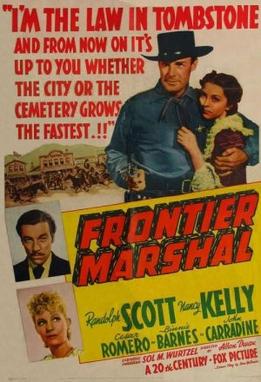
When Wyatt Earp (Randolph Scott) arrives in the town of Tombstone, he takes the law in his own hands by preventing a local outlaw named Indian Charlie (Charles Stevens) from destroying the saloon owned by Ben Carter (John Carradine). For his trouble, Earp is beaten up by Carter’s men. Earp, however, does get a job as the town’s new marshal.
After some initial weariness, Wyatt befriends an alcoholic dentist and gunfighter named Doc Holliday (Cesar Romero). While Earp keeps the peace in Tombstone, Doc is torn between two women, dancehall girl Jerry (Binnie Barnes) and his ex-girlfriend, Sarah (Nancy Kelly).
With Carter and his man planning on robbing a payroll train and also kidnapping frontier performer, Eddie Foy (played by the real Foy’s son, Eddie Foy, Jr.), it is only a matter of time before Earp takes on Carter at the legendary O.K. Corral.
Frontier Marshal was only the second sound film to be made about Wyatt Earp’s time in Tombstone and it was the first to use Earp’s name. (In the first film version of the story, also called Frontier Marshal, Earp’s name was changed to Michael Wyatt.) This was because Wyatt’s widow was offended by some of the material that was included in the biography that served as the basis for Frontier Marshal and threatened to sue anyone who wanted to make a movie out of it. In order to get her permission to make the film, 20th Century Fox agreed that no reference would be made to Wyatt’s marriage in the film. Mrs. Earp ended up suing anyways. 20th Century Fox settled.
As for the film, it’s in no way historically accurate and it pales in comparison to My Darling Clementine, Gunfight at the O.K. Corral, Tombstone, and the Star Trek episode where Kirk, Spock, and McCoy thought they were in the old west. It is, however, better than The Gunfighters episode of Dr. Who. Randolph Scott is convincing as an upright and law-abiding Wyatt Earp, quite a contrast to the real Wyatt. The movie though is stolen by Cesar Romero, who plays Doc Holliday as being pathologically self-destructive. Cesar Romero is not necessarily the first name that comes to mind when you think of a great western actor but he’s very convincing here. John Carradine is a perfect villain and keep an eye out for Lon Chaney, Jr. as one of his henchmen. Unfortunately, the final gunfight feels rushed and, for all the build up, it isn’t as exciting as it should be. Frontier Marshal will mostly be of interest to those curious to see how Doc Holliday, Wyatt Earp, Tombstone and the Gunfight at the O.K. Corral were portrayed in films before they became a sacrosanct part of the mythology of the Old West.
Frontier Marshal was later remade, as My Darling Clementine, by John Ford. Ward Bond, who played Morgan Earp in Ford’s film, plays the original town marshal in Frontier Marshal. Charles Stevens, who plays Indian Charlie in Frontier Marshal, was often falsely described by the Hollywood publicity mill as being the real-life grandson of Geronimo. He also appeared in My Darling Clementine, once again playing the role of Indian Charlie. It was one of the nearly 200 films he made before he died in 1964.
After his wife and most his family is murdered by a rival clan, ninja Cho Osaki (Sho Kosugi) leaves Japan for the United States. Not only is he leaving his home country but he’s also abandoning his ninja heritage. As he explains to his mother (Grace Oshita), he no longer has any use for the violent old ways. From now on, he just wants to sell dolls!
In America, Cho prospers and his mother continues to teach Cho’s young son, Kane (Kane Kosugi), how to defend himself. When Kane is confronted by a bunch of bullies while walking home from school, he kicks their asses while his grandmother watches approvingly. GO, KANE! Seriously, there’s nothing wrong with a movie that opens with a bunch of obnoxious 11 year-olds getting beaten up by a 9 year-old.
Cho has found success opening art galleries and selling dolls. He’s proven that he doesn’t need to be an elite assassin in order to be happy. However, Cho’s mother doesn’t trust Cho’s business partner, Braden (Arthur Roberts). She says that there’s something obviously evil about Braden but Cho doesn’t agree. Well, it turns out that mom’s right! Braden is evil. He’s using the dolls to smuggle heroin into the country! When the local mob boss (Mario Gallo) refuses to agree to Braden’s terms, Braden decides to wage war on the Mafia. It turns out that Braden is a ninja himself!
When members of the Mafia turning up dead in weird ways, the police bring in a local martial arts instructor named Dave (Keith Vitali). Confused by the murders, Dave decides to consult with a friend of his to determine whether or not a ninja could be responsible. That friend just happens to turn out to be Cho, who confirms that there is obviously a ninja in America but who also refuses to fight that ninja because Cho has abandoned the violence of the past and, as he explains it, he’s got a new art gallery opening soon. Of course, what Cho doesn’t know is that the ninja is his own business partner….
The 1983 film Revenge of the Ninja has an overly complicated plot but the story that it tells is relatively simple. Cho is done being a ninja. Then, his family and his girlfriend Cathy (Ashley Ferrare) end up getting caught in the middle of a turf war between Braden and the Mafia and Cho is forced to break his pledge to lead a life of non-violence. Revenge of the Ninja was produced by Cannon films. It was preceded by Enter the Ninja, which featured Kosugi as a villain who fought Franco Nero, and it was followed by Ninja III: The Domination, in which Kosugi played a ninja assassin whose spirit ended up possessing a young aerobics instructor. Of the three Cannon Ninja films, Revenge of the Ninja is the least interesting, as it doesn’t feature a star as charismatic as Franco Nero or a plot twist as wild as an aerobics instructor getting possessed. Revenge of the Ninja does, however, feature several exciting fight scenes and Sho Kosugi’s athletic prowess goes a long way to making up for the fact that he’s not a particularly expressive actor. Fans of low-budget but kinetic martial arts action should get a kick and a punch out of Revenge of the Ninja.
Finally, Revenge of the Ninja may not be the best ninja film ever made but it is a Cannon Film and therefore, it’s worth watching.
I know that I said yesterday that I was done with Eddie Dean westerns but I decided to watch one more, just because it was short and, based on the other Eddie Dean films I had seen, I assumed that it would be undemanding.
(I was right.)
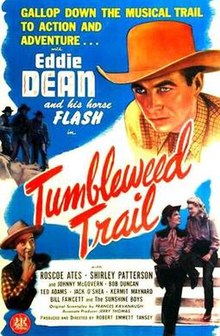
Tumbleweed Trail opens with Brad Barton (Bob Duncan) and his group of colorfully named henchmen (one is named Dead-Eye) ambushing and apparently killing a rancher named Bill Ryan (Kermit Ryan), who also happens to be Barton’s half-brother. Barton wants to take control of Ryan’s ranch and he’s even forged a will to to convince the land office to give it to him instead of Ryan’s children. If this plot sounds familiar, it’s because much of it was recycled for Black Hills.
What Barton did not count on was the arrival of singing cowboy Eddie Dean (played by real-life singing cowboy Eddie Dean) and his sideick, Soapy (Roscoe Ates). Eddie and Soapy get jobs working on Ryan’s ranch. Eddie finds time to sing a few songs and to fall for Bill’s daughter, Robin (Shirley Patterson). Everyone loves Eddie’s singing but he’s not make much progress when it comes to proving that Barton’s will is a fake. Just when it seems like not even Eddie and Soapy will be able to stop Barton, there’s a “surprise” ending that you’ll see coming from a mile away.
This one is uninspired, though some of my reaction could be due to having already seen Eddie Dean go through a similar plot in Black Hills. Eddie sings a lot but that’s about all he does in this routine poverty row western. Bob Duncan is a generic villain. Of the three Eddie Dean films that I’ve watched, TumbleweedTrail was the most forgettable. It’s for fans of the genre only.
Eddie’s horse in Tumbleweed Trail is played by Flash. Flash gets second billing, above Roscoe Ates.
This, I’m pretty sure, was my final Eddie Dean movie.
As we all know, this year’s Sundance Film Festival started tonight.
To me, Sundance has always signified the official start of a new cinematic year. Not only is it the first of the major festivals but it’s also when we first learn about the films that we’ll be looking forward to seeing all year. It seems like every year, there’s at least one successful (or nearly successful) Oscar campaign that gets it start at Sundance. Last year, for instance, Minari took Sundance by storm and it was able to ride that momentum all the way to a Best Picture nomination. Before that, nominees like Manchester By The Sea and Brooklyn got their starts at Sundance.
And, even if their films weren’t nominated for best picture, some of the most important filmmakers of the past few decades got their first exposure at Sundance. The Coen Brothers first won notice with Blood Simple. Years later, Quentin Tarantino took the festival by storm with Reservoir Dogs. Though an argument can be made that Sundance is now just as corporate as the Hollywood system to which it’s supposed to providing an alternative, one can’t deny the importance of the Festival.
For the next few days, I’m going to taking a look at a few films that made their initial splash at Sundance. Some of these films went on to become award winners and some did not. But they’re all worth your attention, one way or another.
Take for instance, Mass.
The first directorial effort of actor Fran Kranz (you may remember him as the clever and genre-savvy stoner from The Cabin In The Woods), Mass made its debut at least year’s Sundance Film Festival. It was one of the more critically acclaimed films of the festival and, in a perfect world, it would currently be an Oscar front runner. And who knows? There’s always a chance that Mass could pick up a nomination or two. Ann Dowd is apparently running a very energetic campaign for Best Supporting Actress and she’s said to be well-liked in the industry. It’s probably a bit too much to expect the film to be nominated for Best Picture, though it certainly deserves some consideration. It’s perhaps a bit too low-key for a year that’s full of bombast and big emotional moments. It’s a film that raises interesting questions but refuses to provide easy answers. In short, it’s the type of film that, ten years from now, people will watch it and say, “How did this not get nominated?” Even if it’s not a Sundance film that’s destined for the Oscars, it is a Sundance film that will be remembered for heralding the arrival of a vibrant new directorial talent.
Playing out in almost real time, Mass is a film about two couples having a very emotional conversation. Richard (Reed Birney) and Linda (Ann Dowd) are the parents of Hayden. Jay (Jason Isaacs) and Gail (Martha Plimpton) are the parents of Evan. Hayden and Evan went to the same high school. Years ago, Evan was killed in a school shooting. Hayden was the shooter. After killing ten students, Hayden killed himself.
The two couples are meeting in a room in the back of a church. It’s a part of therapy. They meet and they talk about their children and the events that led to the shooting. Jay and Gail demand answers. Richard and Linda can’t provide them. At first, Gail is angry and Jay is the one who tries to keep things civil but, as the conversation continues, it becomes obvious that Jay is in fact angrier than Gail. Even when Richard and Linda express obviously sincere remorse for what Hayden did, Jay cannot accept it because, in a way, he needs them to be evil or ignorant or both. Linda and Richard struggles to reconcile their love for their son with their hatred over what he did. Gail and Jay feel that their son was unfairly taken from them and they’re right. Richard and Linda feel that they’re being blamed for something they couldn’t control and they’re also right. There are no easy villains or heroes in this film. Instead, there are just four unique and interesting characters, all trying to understand something that makes no sense.
Almost everything we learn about the characters comes from listening to them speak. Almost the entire film takes place in that one room. By the end of the film, not a single character is who you originally believed them to be. Jay’s search for meaning has led to him becoming a political activist. He insists that there has to be some sort of identifiable reason to explain why his son is dead, even though he secretly realizes that there isn’t. Gail, who starts out as the angriest person in the room, reveals herself to be the most empathetic. At the start of the film, Jay accuses Richard of not having any emotions but, by the end, we see that Richard’s emotions are very real. Finally, Linda seems meek but quickly reveals herself to be perhaps the strongest and most honest person in the room.
It may sound a bit stagey, this film that takes place in one room and which is basically just four characters having a conversation. But director Fran Kranz does a wonderful job keeping the story moving and the conversation within the room never seems to drag. Indeed, the room itself is almost as fascinating as any of the people inside of it. At the start the film, we watch two church employees and social worker going out of their way to make the room as safe and non-confrontational as possible. However, their efforts have the opposite effect. The room is so friendly that it makes it impossible not to compare its pleasantness with the issues being discussed behind the room’s closed doors. The room itself tries so hard to avoid confrontation that it has the opposite effect.
In the end, the film suggests that there are no neat answers. Even though the two couples come to an understanding and even a sort of peace, there’s no guarantee that peace will last more than a day. Indeed, as soon as they leave the room, their initial awkwardness returns, a reminder that we can understand pain but we can’t necessarily vanquish it. It’s not a film about easy answers but there’s something liberating about the film’s willingness to acknowledge that life can be difficult but that life also goes on.
The film is a masterclass of good acting, with Dowd and Isaacs getting the biggest dramatic moments while Birney and Plimpton offer fantastic support. In a perfect Oscar world, all four of them would be nominated and so would the film itself. Unfortunately, one of the lessons of Mass is that there is no such thing as a perfect world.
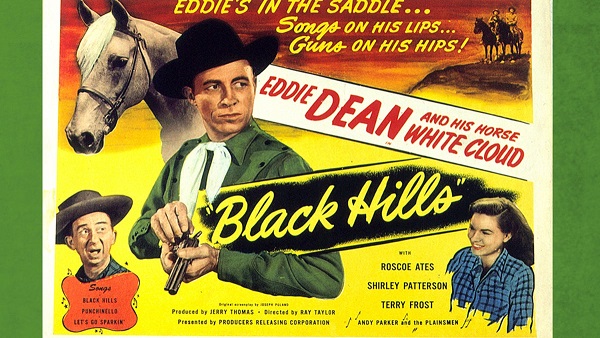
Times are hard and rancher John Hadley (Steve Clark) is running the risk of losing his ranch. When Hadley finds gold on his property, he think that all of his problems have been solved. He makes the mistake of revealing the existence of the gold to his friend, Terry Frost (Dan Kirby). Terry’s not much of a friend because he shoots and kills Hadley and then, working with a corrupt county clerk (William Fawcett), he tries to steal Hadley’s property away from the rancher’s children and rightful heirs.
Luckily, singing cowboy Eddie Dean (played by real-life singing cowboy Eddie Dean) rides up and, with the help of his comic relief sidekick (Roscoe Ates), helps to get things sorted out. Even with Terry trying to frame Eddie for a murder he didn’t commit, Eddie still finds time to sing a few songs.
This was Eddie Dean’s final feature film before he moved into television. Black Hills is better than Romance of the West, the Eddie Dean movie that I reviewed yesterday. The plot actually has a few interesting twists and, though it doesn’t appear that he was ever much of an actor, Eddie Dean appears to be more comfortable with his role here than he was in Romance of the West. Black Hills emphasizes that Eddie could throw a punch just as well as he could sing and veteran western actor Dan Kirby is a credible villain. It makes Black Hills into an entertaining if not exactly memorable western diversion.
One final note about Black Hills: Eddie’s horse, White Cloud, gets second billing in the credits.
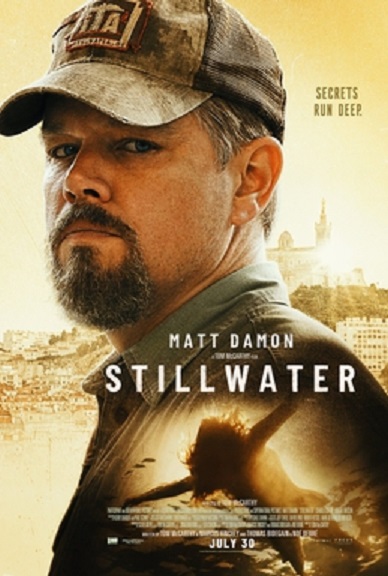
I finally watched Stillwater a few weeks ago. Stillwater, as you remember, was originally meant to come out in 2019 but the release date got moved to November of 2020, presumably so it could be an Oscar contender and also so it could come out just in time to provide some cinematic commentary on the presidential election. However, due to the COVID lockdowns, the release date got moved back to 2021. It was finally released on July 30th, 2021 and it was briefly the center of some controversy before everyone forgot that the movie existed.
Stillwater tells the story of Bill Baker (Matt Damon) and his daughter, Allison (Abigail Breslin). Bill is a plain-spoken construction worker from Oklahoma. He drives a pickup truck. He always wears a baseball cap. He speaks in the deep accent of the American midwest. He says grace before eating. He probably listens to country music and Kid Rock. Though he says at one point that he can’t vote because he has a criminal record, Bill would probably have voted for Trump if he had been allowed to vote (hence, the controversy when the film was finally released).
His daughter, Allison (Abigail Breslin), left Oklahoma so that she could attend school in France and, presumably, so she could get away from her father. Allison’s girlfriend, Lina, was murdered in France and Allison was convicted of the crime. Now, she’s sitting in prison while still protesting her innocence. Every few weeks, Bill boards a plane and flies to France. He gives Allison supplies, like an Oklahoma University sweatshirt. He also tries to convince the authorities to reopen her case. Allison swears that there is evidence that will exonerate her. When Bill, who doesn’t even speak French, realizes that he will never be able to convince the authorities to reopen the case, he decides to do some investigating on his own.
Bill moves to France. He lives with and eventually falls in love with an actress named Virginie (Camille Cottin). He becomes a surrogate father to Virginie’s young daughter. Virginie also serves as Bill’s translator as he searches for a witness who can prove that Allison is innocent. Virginie gets upset when Bill suspects that the murderer might have been a refugee from the Middle East. When one potential witness uses racial slurs, Virginie refuses to translate anything that he says. When she explains to Bill why she won’t talk to the man, Bill replies that he deals with people like that all the time …. back in the United States. When Virginie’s cultured friends meet Bill, they all dismiss him as being an ugly American and demand to know why he doesn’t like immigrants.
Yes, you guessed it. Stillwater isn’t just a murder mystery. It’s also meant to make a statement about America’s place in the world, with Bill standing in for the country during the age of Trump. Bill is the type of American that Europeans tend to hate and Bill’s efforts to prove his daughter’s innocence lead to him doing some things that have obvious parallels with the techniques used by CIA interrogators during the War on Terror. “How far would you go to protect your family? How far would you go to protect your country?” the film seems to be asking. It’s not an irrelevant question but the film approaches it in too heavy-handed of a manner to really be effective. Matt Damon might as well have spent the entire film shouting, “I’m an American!” like Dennis Hopper did in Apocalypse Now. That would have actually be kind of fun.
For someone who has given so many good performance in the past (and who was excellent in The Last Duel), Matt Damon gives a curiously detached performance as Bill. One gets the feeling that Damon was not particularly interested in emotionally connecting with the role of someone who has probably never seen a Matt Damon movie and who would certainly never vote for any of the candidates that Matt Damon has ever endorsed. (One can just imagine the scene if Will Hunting tried to convince Bill Baker to read anything by Howard Zinn.) Since Damon doesn’t seem to know how to suggest that Bill has any sort of inner life, he instead concentrates on trying to perfect Bill’s accent. And yet, even there, the film is inconsistent. It takes more to sound like your from Oklahoma than just lowering your voice and saying, “Yeah” a lot. Watching the film, I could help but think that Mark Wahlberg or even Ben Affleck would have been a bit better cast as Bill. Neither one of them sounds like they’re from Oklahoma, of course. But they do have the sort of blue collar attitude that Damon was lacking.
As for Abigail Breslin, she’s not really given much of a role to play. Every 15 minutes or so, she steps into a prison meeting room and berates her father for not getting her out of jail. Until that last few minutes of the film, that’s pretty much the extent of her role. Breslin is playing a character who is obviously meant to bring to mind Amanda Knox. The real-life Knox didn’t particularly appreciate this and, having watched the film, I have to say that Knox was more than justified in being offended. Even though the film is fictionalized, enough of the details of Allison’s case correspond to the details of Amanda Knox’s case that it’s impossible to watch the film without thinking of Knox. Beyond that, though, Allison is an inconsistently written character. The film’s final twist lacks power precisely because we really don’t know anything about Allison or what her relationship with her father was like before she was arrested.
As a director, Tom McCarthy uses the same flat visual style that made Spotlight one of the least interesting films to ever win best picture. Tonally, the film is all over the place. It starts out as a murder mystery before becoming a romance, and then suddenly, it takes a turn into Taken territory. It ends on an annoyingly ambiguous note, meant to leave the audience to wonder whether or not everything that Bill went though was actually worth it. If Bill and Allison felt like real characters, the ending may have worked but since they don’t, the ending just leaves you wondering whether it was worth spending over two hours to reach this point.
Anyway, if you want to see a better Damon performance, I suggest checking out Ridley Scott’s The Last Duel. If you want to see a better film for director Tom McCarthy, I suggest tracking down 2011’s Win Win, a charming film that feels authentic in a way that Stillwater never quite does.
Since today is David Lynch’s birthday, it only seems appropriate to share what may be the most obscure of David Lynch’s early short films.
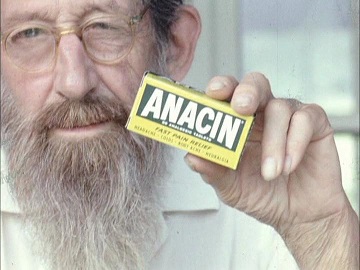
From 1967, Fictitious Anacin Commercial is a one-minute short film and a commercial for a real product. Jack Fisk, an early David Lynch collaborator who would later marry Sissy Spacek, plays a man in pain. God shows up, holding some aspirin. Suddenly, Jack Fisk is feeling a lot better. However, the audience is a little bit disturbed because God seems kind of menacing.
That’s my interpretation, anyways! David Lynch was 21 when he directed this film and it really is basically just a spoof of how commercials always act as if their product is the ultimate and only solution to whatever problem you’re having. One gets the feeling that, for the most part, Lynch and Fisk were just amusing themselves. And yet, because it is a Lynch film, there’s still a definitely unsettling vibe to it all. The man with Anacin almost seems like he could be an inhabitant of the Black Lodge.
Anyway, for your viewing pleasure, here is Fictitious Anacin Commercial!
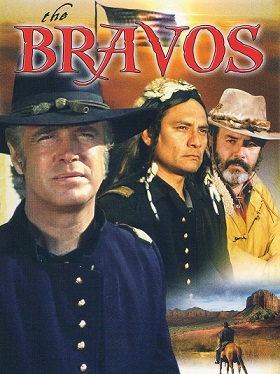
Major John David Harkness (George Peppard) is the commander of Fort Bravo, a small and ill-equipped frontier fort. Despite having only 77 soldiers and not many supplies, Harkness has managed to keep an uneasy peace between the local Indian tribes and the settlers who move through the area. The peace, however, is disturbed when an arrogant wagon master (Pernell Roberts) kills the son of the tribal chief.
That’s not all that Harkness has to worry about. A German outlaw (Bo Svenson) is hiding out at the camp. His head scout (L.Q. Jones) suspects that something is forcing the local tribes out of the area. Two settlers from Missouri (played by Barry Brown and Belinda Montgomery) are at the fort and trying to decide whether they should continue westward or return to Missouri. Finally, Harkness’s 12 year-old son, Peter (Vincent Van Patten), has been expelled from his New England boarding school and is being sent to Fort Bravo to live with his father. When Major Harkness refuses to turn the wagon master over to the Indians, they kidnap his son instead.
The Bravos was made for television and originally aired on ABC in 1972. It was apparently meant to serve as the pilot for a television series, one that would have followed the daily adventures of the Major, his son, and all of the men at Fort Bravo (who were played by television mainstays like Dana Elcar, Randolph Mantooth, and George Murdock.) For all intents and purposes, Pernell Roberts, Bo Svenson, Belinda Montgomery, and Barry Brown are all “special guest stars” and are meant to serve as examples of the type of television-friendly actors who would visit Fort Bravo on a weekly basis. That the pilot didn’t lead to a series isn’t surprising. TV westerns may have dominated the ratings in the 50s and the 60s but they quickly went out of fashion in the 70s as networks realized that they could make more money selling ad space for Norman Lear sitcoms and cop shows. In the 70s, the people that advertisers were wanting to reach were watching Archie Bunker and Starsky and Hutch, not George Peppard.
Because of its TV origins, The Bravos is a fairly bland western. It would be a few years before George Peppard would reinvent himself as a grizzled character actor and he’s sincere but fairly dull here. Pernell Roberts is more effective as the headstrong wagon master and perhaps The Bravos would have worked better if Roberts and Peppard had switched roles. In the end, the main reason to see the film is for the chance to see L.Q. Jones play a heroic role for once. A member of Sam Peckinpah’s stock company, Jones brings some authentic grit to his role as the fort’s only scout. Jones played a lot of villains but I always preferred him as one of the good guys.
The Bravos ends with a few major subplots unresolved. Maybe they would have been resolved during the show’s first season but it was not to be.
Adrian (Weston Cage Coppola) is an international criminal and terrorist, a man who isn’t going to let a little thing like being wanted by the FBI prevent him from getting what he wants. Adrian wants his brother to be freed from prison. He wants money. He wants a plane that he and his criminal associates can use to get out of the country. His plan is to take over a veteran’s hospital and hold the patients and the doctors hostage until he gets what he wants. Among the hostages is General Welch (Gerald Webb) of the Joint Chiefs of Staff.
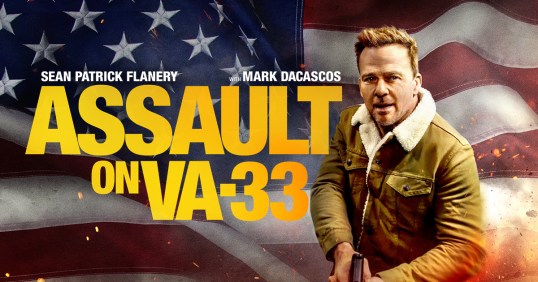
Also inside of VA-33 is Jason Hill (Sean Patrick Flannery). Jason is a decorated veteran who is struggling with PTSD and a bad leg. Jason’s wife, Jennifer (Gina Holden), is a doctor at the hospital and also one of the hostages. With his 14 year-old daughter waiting for him outside and the initially skeptical police chief Malone (Michael Jai White) providing as much support as he can, Jason must take out of the terrorists and liberate VA-33.
Assault on VA-33 is an entertaining action film. The film was directed by Christopher Ray, the son of Fred Olen Ray. From his father, Christopher Ray obviously picked up the ability to make an enjoyable film on a low budget. However, Ray also served, for seven years, in the U.S. Navy and there’s a deep respect for veterans that runs throughout Assault on VA-33, a respect that sets this film apart from many of the other Die Hard-inspired action films that have come out over the years. For me, the film’s key scene is not any of the many action sequences but instead it’s when Jason first attempts to call the police and finds himself being dismissed because the man on the other end, upon hearing that Jason is at the VA, just assumes that Jason is suffering from paranoid hallucinations. “Thank you for your service,” the voice at the other end of the line says somewhat condescendingly as Jason struggles to get the police to understand that this is all really happening. The consequences of war is a theme that runs through the entire film as both Jason and the General struggle to deal with the physical and mental scars with which they’ve been afflicted.
Sean Patrick Flannery is a good action hero, playing Jason not as being superhuman but instead as just being a tough but weary man who, due to his past injuries, doesn’t move quite as fast as he used to but who is still trying to do the right thing and protect innocent people, including his wife and his daughter. Adrian’s henchmen are all properly memorable and menacing. I especially liked Tim McKiernan as the terrorist who is left in charge of the front desk. Rob Van Dam has some good moments as the terrorist who has been assigned to wait outside in the van and who keeps reminding everyone that his name is Zero.
Assault on VA-33 is a fun and quickly paced action movie. Flannery is an effective hero and the villains are all properly evil. I would also suggest sticking around through the end credits, just so you can enjoy the film’s musical score, which is definitely a bit better than the music that we typically associate with indie action films. It’s an enjoyable movie and a good way to spend 88 minutes of your life.



 Through the Shattered Lens